Slashdot Mirror
Search
Search the archive with full-text matching across story titles, bodies,
and comments. Phrases are quoted; or, -word,
and parentheses behave as in a web search. Queries must be at least
3 characters.
Stories · 13,059
-
Solar Powered Plane Completes Cross-Country Flight
An anonymous reader writes "The Solar Impulse, a solar powered aircraft, landed at New York's John F. Kennedy International Airport completing its historic cross-country flight. From the article: 'The flight plan for the revolutionary plane, powered by some 11,000 solar cells on its oversized wings, had called for it to pass the Statue of Liberty before landing early Sunday at New York. But an unexpected tear discovered on the left wing of the aircraft Saturday afternoon forced officials to scuttle the fly-by and proceed directly to JFK for a landing three hours earlier than scheduled. Pilot Andre Borschberg trumpeted the milestone of a plane capable of flying during the day and night, powered by solar energy, crossing the U.S. without the use of fuel.'"
-
Patching Software on Another Planet
An anonymous reader writes "Sixteen years ago, the Mars Pathfinder lander touched down on Mars and began collecting about the atmosphere and geology of the Red Planet. Its original mission was planned to last somewhere between a week and a month, but it only took a few days for software problems to crop up. The engineers responsible for the system were forced to diagnose the problem and issue a patch for a device that was millions of miles away. From the article: 'The Pathfinder's applications were scheduled by the VxWorks RTOS. Since VxWorks provides pre-emptive priority scheduling of threads, tasks were executed as threads with priorities determined by their relative urgency. The meteorological data gathering task ran as an infrequent, low priority thread, and used the information bus synchronized with mutual exclusion locks (mutexes). Other higher priority threads took precedence when necessary, including a very high priority bus management task, which also accessed the bus with mutexes. Unfortunately in this case, a long-running communications task, having higher priority than the meteorological task, but lower than the bus management task, prevented it from running. Soon, a watchdog timer noticed that the bus management task had not been executed for some time, concluded that something had gone wrong, and ordered a total system reset.'"
-
Microsoft Integrating Xbox One Advertising With Kinect To Profile Users For Ads
MojoKid writes "When Microsoft reversed its Xbox One DRM policies a few weeks back, there was momentary hope that the company has listened to its customers and understood the features they were asking for. Granted, this was brief. However, with Mattrick gone, there was some hope that maybe the company would reintroduce plans like Family Sharing and put the console back on track. Apparently not. Microsoft's big new feature with Kinect? Advertising. Microsoft plans to use Kinect to make advertisements even more engaging than their current counterparts. In the future, Kinect may offer you a 'Choose Your Own Adventure' style narrative in which you speak commands or give orders to an ad as it's playing to change the final outcome. The other way Microsoft wants to use Kinect is to monitor what's going on in the living room to serve you group-appropriate content, rather than resorting to the plain old method of bombarding you with non-interactive advertising for things you don't care about. Microsoft will likely learn that telling gamers that the Xbox One is an ad-centric experience and attempting to spin it like a positive doesn't actually work."
-
LXDE Previews Port From Gtk+ 2 to Qt
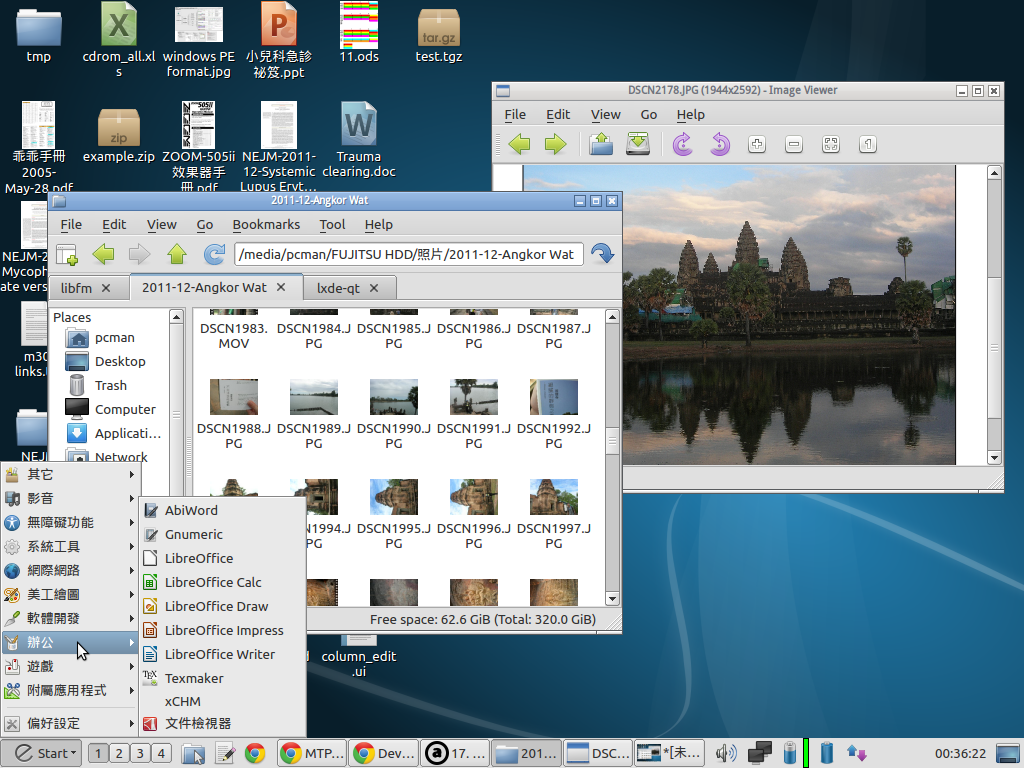
An anonymous reader writes "As the PCMan at the LXDE blog lets us know, the work on a port of LXDE to the Qt platform is showing promise. As the developers stand to face the deprecation of Gtk+ 2, migrating away from the popular toolkit will soon be necessary. The developers note that migration to Qt 'will cause mild elevation of memory usage compared to the old Gtk+ 2 version,' but clarify that a similar increase in resource usage is expected of a migration to Gtk+ 3. Yet, the port to Qt is ongoing, and clearly taking shape, as the screenshot shows. An official release might be a while, though. As an update to the post notes, the plan is to use the recently released Qt 5.1 in the future, which we might not see in distros for some time." They are also cooperating with the Razor Qt desktop. From the weblog post: "...We subscribed razor-qt google groups and discussed about possible cooperation earlier. Currently, the ported LXDE components are designed with Razor-Qt in mind. For example, PCManFM-Qt and LxImage-Qt will reads razor-qt config file when running in razor-qt session. We’ll try to keep the interchangeability between the two DEs. Further integration is also possible. Actually, I personally am running a mixed desktop with LXDE-Qt + Razor-Qt components on my laptop. Components from the both DE blends well."
-
Who Will Teach U.S. Kids To Code? Rupert Murdoch
theodp writes "For all of their handwaving at Code.org about U.S. kids not being taught Computer Science, tech execs from Microsoft, Google, and Facebook seem more focused lately on Plan B of their 'two-pronged' National Talent Strategy. So, who's going to teach your children CompSci? Enter friend-of-the-Gates-Foundation Rupert Murdoch. Murdoch's Amplify Education is launching an AP Computer Science MOOC this fall (Java will be covered), taught by an experienced AP CS high school teacher (video). An added option, called MOOC Local, will provide additional resources to schools with students in the CS MOOC. MOOC Local will eventually cost $200 per student, but is free for the first year."
-
NASA Mulling Joint Lunar Missions With Commercial Enterprises
MarkWhittington writes "According to a July 3, 2013 story in SpaceRef, NASA has issued a Request for Information concerning various commercial endeavors to create robotic lunar landers. NASA appears to be interested in assisting in those projects with a view of using the resulting vehicles for its own exploration plans. Officially, thanks to a mandate by President Obama, NASA is not planning its own crewed mission to the moon. However the space agency seems to be interested in supporting, in some way, a commercially run lunar base. Joint robotic lunar landings might be seen as the start of such an effort."
-
ARMs Race: Licensing vs. Manufacturing Models In the Mobile Era
MojoKid writes "The semiconductor market for mobile and hand-held devices has changed dramatically in the past six years and ARM has had to evolve along side it. ARM's IP focus allows it to dedicate all its resources to building a great design rather than committing to any single manufacturing process node, customer, or foundry. Architectural design and implementation is done very much in partnership with both foundries (TSMC, GlobalFoundries) and licensees like Samsung or Qualcomm. The difference between the way Intel goes to market and ARM's model is more nuanced than the simple ownership of manufacturing facilities. Owning its own fab means that Intel can tweak process technology to match the particulars of a given architecture (and vice-versa). It also gives the company far more flexibility when planning future nodes. If Intel feels that integrating Peanut Butter Silicon on Insulator (PB-SOI) is the best way to hit its performance and power consumption targets at 14nm, for example, it can make that happen internally. ARM, in contrast, is limited by the decisions of the foundry manufacturers it partners with."
-
Underground 'Wind Mines' Could Keep Datacenters Powered
Nerval's Lobster writes "Major IT vendors have been including custom-built wind- and solar-power farms in their datacenter construction plans. But while wind and solar power may be clean, they're often unreliable, especially by the standards of datacenters that need a way to keep operating through any unexpected surges or drops in power. How about saving the wind that generates the power? That might work, according to researchers at the federal Bonneville Power Administration (BPA), and U.S. Department of Energy's Pacific Northwest National Laboratory. A study published in February (PDF) outlined the potential benefit of pumping pressurized air into caverns deep underground as a way to store wind energy, then letting it out whenever demand spikes, or the wind drops, and the above-ground facilities need help spinning enough turbines to keep power levels steady. The technique, called Compressed Air Energy Storage (CAES) isn't new: existing CAES plants in Alabama and Huntorf, Germany (built in 1991 and 1978, respectively) store compressed air in underground salt caverns hollowed out by solution mining (pumping salt-saturated water out of concentrations of salt buried far underground and replacing it with fresh water). But implementing such a technique for datacenters might take a little work. The BPA and the Pacific Northwest National Laboratory have already identified, and are evaluating, sites in the Pacific Northwest that would be suitable for CAES underground reservoirs; the first, which could be located in Washington's Columbia Hills could—via existing CAES technology—store enough compressed air to generate a steady 207MW for 40 days of continuous usage, ultimately delivering 400 additional hours without adding any compressed air."
-
Opinion: Apple Should Have Gone With Intel Instead of TSMC
itwbennett writes "Apple is planning to have its ARM processors manufactured by TSMC — a move that blogger Andy Patrizio thinks is a colossal mistake. Not only is TSMC already over-extended and having trouble making deadlines. But Intel was clearly the better choice: 'Intel may be struggling in mobility with the Atom processors, but Intel does yields and manufacturing process migration better than anyone,' says Patrizio. 'While TSMC wrestles with 28nm and looking to 20nm, Intel is at 22nm now and moving to 14nm for next year. This is important; the smaller the fabrication design, the less power used.'"
-
Florida Keys Prepare For Sea Level Rise
An Associated Press report details how the Florida Keys are starting to prepare for seasonal flooding and rising water levels overall. "A tidal gauge operating since before the Civil War has documented a sea level rise of 9 inches in the last century, and officials expect that to double over the next 50 years." Flooding used to be a much rarer occurrence, but now many businesses are finding it necessary to have plans in place to deal with it. "The Keys and three South Florida counties agreed in 2010 to collaborate on a regional plan to adapt to climate change. The first action plan developed under that agreement was published in October and calls for revamped planning policies, more public transportation options, stopping seawater from flowing into freshwater supplies and managing the region's unique ecosystems so that they can adapt, too." The Keys are one of many places beginning to seriously evaluate their options for dealing with flooding after witnessing the damage caused by Hurricane Sandy.
-
Wikimedia Rolls Out Its WYSIWYG Visual Editor For Logged-in Wikipedia Users
An anonymous reader writes "The Wikimedia Foundation has finally enabled its long-awaited VisualEditor for all logged-in users on the English-language version of Wikipedia. The classic Wikitext source editor will remain available to edit both pages and page sections, and the organization stressed there are currently no plans to remove it. This is because VisualEditor doesn't yet support the broad range of functionality that Wikitext allows, and Wikimedia further notes it is aware some editors may prefer it. Nevertheless, the organization is hoping to the majority of editors will transition to VisualEditor, which is why it is slowly becoming the default." In other Wikipedia news, reader GerardM writes "Today the 'Universal Language Selector' premiered on the English Wikipedia. There is a ton of functionality in there and it has a lot of potential. The one thing that may prove to be a game changer for people with dyslexia is the inclusion of the OpenDyslexic font. Once people with dyslexia start to adopt this font, chances are that they can actually read/use Wikipedia. A lot of people are dyslexic; to quote the en.wp article on the subject: 'It is believed the prevalence of dyslexia is around 5-10 percent of a given population although there have been no studies to indicate an accurate percentage.'"
-
Why Apple and Samsung Still Get Along, Behind the Courtroom Battles
After suing each other for the last few years in various courts around the world, you'd think that if Apple and Samsung were human beings they would have walked away from their rocky relationship a while back. The Wall Street Journal explains (beside the larger fact that they're both huge companies with complex links, rather than a squabbling couple) why it's so hard for Apple to take up with another supplier. Things are starting to look different, though: "Apple's deal this month to start buying chips from TSMC is a milestone. Apple long wanted to build its own processors, and it bought a chip company in 2008 to begin designing the chips itself. But it continued to rely on Samsung to make them. ... TSMC plans to start mass-producing the chips early next year using advanced '20-nanometer' technology, which makes the chips potentially smaller and more energy-efficient."
-
AT&T Gets Patent To Monitor and Track File-Sharing Traffic
An anonymous reader writes "Internet provider AT&T has patented a new technology that allows the company to accurately track content being shared via BitTorrent and other P2P networks. The company explains that the technology can be utilized to detect pirated downloads and combat congestion on its network. Whether the company is already using the system to track infringing content, or has plans to do so, is unknown."
-
Scientists Work To Produce 'Star Trek' Deflector Shields
cold fjord writes "This might be useful. From CNN: 'Recent evidence from NASA's Curiosity rover mission to the Red Planet has revealed that astronauts on the round-trip would be exposed to high levels of radiation from cosmic rays and high-energy particles from the sun ... this would clearly be bad for your health — and it is proving difficult to find a solution. ... [S]hielding to completely block the radiation danger would have to be "meters thick" and too heavy to be used aboard a spacecraft. In contrast, ... science fiction fans have once again got used to the ease with which Captain Kirk gives the order for "shields up" and the crew of the Enterprise being protected instantly from the hostility of space. Perhaps though, a real Star Trek shield may no longer be science fiction — scientists at the UK's Rutherford Appleton Laboratory (RAL) certainly think so. They have been testing a lightweight system to protect astronauts and spacecraft components from harmful radiation and working with colleagues in America to design a concept spaceship called Discovery that could take astronauts to the Moon or Mars. "Star Trek has great ideas — they just don't have to build it," said Ruth Bamford, lead researcher for the deflector shield project at RAL. ... The RAL plan is to create an environment around the spacecraft that mimics the Earth's magnetic field and recreates the protection we enjoy on the ground — they call it a mini magnetosphere." Related: 'Deflector Shields' protect the Lunar Surface.'"
-
Google Developing Android Game Console
An anonymous reader writes "A report by the Wall Street Journal says Google is working on an Android-based gaming console in addition to the long-rumored smartwatch. 'The hardware plans are the latest sign of Google's determination to build on the success of Android, the software it launched in 2008 that powered 75% of all smartphones and 57% of tablets shipped globally in the first quarter, according to the research firm IDC. ... The people briefed on the matter said Google is reacting in part to expectations that rival Apple will launch a videogame console as part of its next Apple TV product release.' This development push comes as the company is wrapping up work on Android 4.3, and as the Kickstarted, Android-based Ouya console is finding success in retail markets. Google is also reportedly working on a revision to its Nexus Q media streaming device, which the company announced last year and quickly shelved after they realized it was a bit weird and not terribly useful."
-
Cute Japanese Robots To Be Launched Into Space
astroengine writes "This summer, the Japan Aerospace Exploration Agency (JAXA) plans to launch two amazingly cute yet advanced, white-helmeted robots into space. Then an astronaut aboard the International Space Station (ISS) will attempt to converse with one of them. Robot astronaut Kirobo and backup robot Mirata were created as part of the Kibo Robot Project, a collaboration among Robo Garage, Toyota, the University of Tokyo and the Japan Aerospace Exploration Agency JAXA. They aim to send the robots with the JAXA mission to the ISS on Aug. 4."
-
Canonical To Ship Mir Display Server In Ubuntu 13.10
An anonymous reader writes "Canonical has announced today that they intend to ship the Mir Display Server by default in Ubuntu 13.10, rather than Ubuntu 14.04 as originally planned. They moved ahead their Mir adoption since the code is materializing and they want Mir/XMir widely tested prior to the Ubuntu 14.04 Long-Term Support release. Mir in Ubuntu 13.10 will be using the XMir X11 compatibility layer to run the Unity 7 desktop and there will be fallback support for running an X.Org Server if the graphics drivers don't support Mir."
-
Netflix Ditches Silverlight With HTML5 Support In IE11
An anonymous reader writes "Netflix today announced that it has finally taken the first step towards ditching Silverlight for HTML5, largely thanks to Microsoft, no less. The company has been working closely with the Internet Explorer team to implement its proposed 'Premium Video Extensions' in IE11 on Windows 8.1, meaning if you install the operating system preview released today, you can watch Netflix content using HTML5 right now. Back in April, Netflix revealed its plans to use HTML5 video in any browser that implements its proposed 'Premium Video Extensions.' These extensions allow playback of premium video (read: with DRM protection) directly in the browser without the need to install plugins such as Silverlight or Flash."
-
Foxconn's Robot Workforce Now 20,000 Strong
itwbennett writes "Slashdot readers will recall Foxconn's plans to staff its factories with an army of 1 million robot workers to offset rising labor costs. Well, now we have an update on those plans. Speaking at the company's shareholder meeting on Wednesday, Foxconn CEO Terry Gou said that there are 20,000 robotic machines currently at work in Foxconn factories. Ultimately, these robots will replace human assembly workers and 'our [human] workers will then become technicians and engineers,' Gou said."
-
Obama Reveals Climate Change Plan
Today President Obama gave a speech outlining the administration's plan to take on climate change. (Video of the speech available on YouTube, and the White House published an infographic as well.) Most significantly, Obama's plan would have the EPA set limits on carbon pollution from all U.S. power plants, a goal already meeting resistance from Republicans. The plan also sets the goal of funding enough solar- and wind-based energy projects on public lands to power over 6 million homes by 2020. By 2030, it aims to use efficiency standards to reduce carbon pollution by 3 billion metric tons. Obama called for new efforts to deal with extreme weather like Hurricane Sandy. He also pointed out the difficulty in getting emerging industrial economies to be environmentally conscious. To that end, the plan calls for the end of U.S. support for financing coal power plants in foreign countries, unless those plants use carbon capture and sequestration technologies. The speech addressed the controversial Keystone XL pipeline, which would carry up to 800,000 gallons of oil per day from Canada into the U.S. Obama indicated that approval for the pipeline would be tied to emissions goals.