Slashdot Mirror
Search
Search the archive with full-text matching across story titles, bodies,
and comments. Phrases are quoted; or, -word,
and parentheses behave as in a web search. Queries must be at least
3 characters.
Stories · 13,059
-
Windows Mobile 7 Phone Release Delayed Again
jcoventry writes "Microsoft is delaying Windows Mobile 7, and it is thought new phones with the operating system are unlikely to reach the market before 2010. Microsoft partners who had expected to have a final release in their hands by early 2009 have been told that it won't be ready until the second half of 2009. Partners include companies like Verizon, Motorola and Samsung, all of which plan new phones that include the Mobile Windows 7 OS. Windows Mobile 7 is expected to have features like gesture recognition and speech input."
-
Penny Arcade Game Dev Talks Episode Two
jayintune points out an interview with Joel DeYoung of HotHead Games, the studio that developed the Penny Arcade video game. He describes some of the new additions coming in the sequel, how old characters and zones will be handled, and plans for the game's release. Additional details are available from DeYoung's comments during PAX, and Joystiq has some screenshots. "Maxing out your stats at the end of Episode One means that your party can be as high as Level 15 if you import your save game and character. Your character's look and all of your items are available to you as well, and if you want to improve upon your looks, you can always browse through the new customization options at the start of the game. About the only thing that won't carry forward is your weapons — we've automatically upgraded Tycho's tommy gun to a shotgun, Gabe's fists now have brass knuckles and your character has traded in your rake for a hoe. We're sticking with the garden tool theme!"
-
Microsoft's Mundie Sees a Future In Spatial Computing
An anonymous reader writes "Speaking at the MIT Emerging Technology Conference, Microsoft Chief Research and Strategy Officer Craig Mundie explained that he sees the industry evolving into 'spatial computing,' and he envisions a 3-D virtual world populated by virtual presences, using a combination of client and cloud services. 'In a few months, the compay plans to test a new virtual reception assistant in some of its campus buildings. The assistant, which takes the form of an avatar, helps schedule shuttle reservations to get people to various locations across the 10-million-square-foot Redmond, Wash., campus. The system includes array microphones and natural language processing by which the avatar listens to the subjects and then interacts with them in real time. The system has been programmed to differentiate people by their clothing. Someone in a suit, for instance, would more likely be a visitor and not a potential shuttle rider.'"
-
Review: Crysis Warhead
When Crysis was released last year, it immediately became known for two things; excellent gameplay and ridiculously high hardware requirements. With the recent release of Crysis Warhead, a standalone expansion to the original game, Crytek's plans were to maintain or improve the quality of gameplay while simultaneously streamlining it so a broader audience would have a chance to enjoy it. As it happens, they succeeded. Fans of the original game will feel right at home in Warhead, and it provides a good chance for new players who were curious but wary of Crysis's graphical requirements to give it a shot. Read on for my thoughts.
- Title: Crysis Warhead
- Developer: Crytek Budapest
- Publisher: Electronic Arts
- System: Windows
- Reviewer: Soulskill
- Score: 4/5
In the original Crysis, a team of American soldiers was dropped into combat on an island controlled by the North Korean Army. The game followed one of the soldiers, call sign "Nomad," as he made his way across the island to complete his objectives. In Warhead you control another member of the team, Michael "Psycho" Sykes, as he attempts to retrieve some cargo thought to be a nuclear warhead. While Psycho assisted Nomad throughout the first game, there is very little interaction with Nomad in this offering.
What differentiates Warhead from typical first-person shooters is the "Nano Muscle Suit," which provides limited protection and a number of enhanced abilities. You can only use one at a time, and you toggle the suit between the various enhancements through a very simple interface. It's similar to the interface used in Crysis, but slightly improved. The suit has an energy tank which runs dry quickly, but regenerates quickly as well. As a result, it's not feasible to just turn on all the goodies and annihilate everything in your path; each mode has an energy budget, which forces you to be creative, picking the right tool for the job. Armor mode will allow you to take extra hits, the damage coming out of your energy bar rather than your health bar. It drains quickly, though. It'll give you extra seconds to get to cover, but it won't let you take on a dozen guys. Strength mode will let you jump really high, throw things extra far, and land punches that would drop a buffalo. Speed mode makes you run a bit faster and gives you the ability to sprint incredibly fast for very short periods of time. Between Speed and Strength modes, you can get to a lot of interesting places. Dash up behind a building, jump to the roof, and smash your way through the ceiling to surprise the enemies inside. You also get Stealth mode, which is reminiscent of the Predator. You're camouflaged well, but not perfectly, so enemies who get close enough will still see you. Don't get caught running out of energy in the middle of sneaking through a battlefield. Through the same interface, you can add attachments to your weapon, such as a flashlight, a silencer, or different sights.
The different suit modes add a great deal of replayability to Warhead. If you want, you can literally sneak through the majority of the game, dropping out only to recharge your energy and fire your weapon. You can also just blitz your way though on Speed mode, dodging enemies and beelining from one obstacle to another for cover. Sometimes you do have to stop and shoot the roses, though. The modes combine in interesting ways. You can stealth from vantage point to vantage point, then use your Strength mode to steady your aim for sniping. You can dash past a group of enemy soldiers and get them to follow you to a group of aliens, then disappear. The two forces will lose you, see each other, and start shooting.
The AI in Warhead is definitely a step up. When you're spotted, enemy soldiers will converge on your position, calling over their friends to help. They'll flank you and use cover quite well to avoid your fire. They'll even duck behind a corner to reload. You can use stealth mode to get out of a lot of sticky situations, but even then, they'll continue to shoot at and around where you were last seen, knowing that if you're low on energy, you can't move very far without being revealed. I felt that the overall difficulty of the game was often hit-or-miss. Warhead was done in the (fairly common) style that strives for realistic aiming. In other words, holding down the trigger increases the spray radius, and headshots do more damage than shots to the center mass. It leads to fairly inconsistent encounters; sometimes you'll drop a group of three or four enemies without getting hit, and sometimes they'll absolutely demolish you. You'll also run into vehicles carrying more powerful guns that can pick you off from far away after a couple of lucky hits, and you may not have any recourse. It doesn't happen often enough that it's a major problem, but you'll almost certainly die a few frustrating deaths where you just didn't have time to cloak yourself or dive for cover. Occasionally, you'll run into opponents wearing their own version of your suit, and it can be annoying to (seemingly) pump 20 rounds into somebody and have them still kill you.
Vehicle use is a bit better, too. You get a couple new toys to ride around in, and they're easier to handle than in the original game. It's not perfect, but it's awfully entertaining once you have the hang of blazing down a road while taking out everything along the sides. The rides vary in maneuverability and firepower, but they're all useful for something. You can zoom around in an unarmed hovercraft, or putter along in a large truck. As with the normal combat, your durability usually depends on how lucky you are. Sometimes you'll feel invincible running over enemy soldiers while taking potshots at passing helicopters, and other times it seems like you have to find a new ride every hundred yards. There's nothing stopping you from taking out the gunner and driver of another vehicle and stealing it. I was a bit disappointed that you can't drop inside enemy-controlled tanks, though. It was hard enough to get on top of one. Make sure to keep an eye on your vehicle's damage meter; if they explode while you're inside, you die.
The story itself is simultaneously an upside and a downside of the game. Depending on your playstyle, you'll make it through Warhead in 5-7 hours. That said, the game is an expansion, and it's priced as such, so with the replayability and multiplayer options, the length isn't a gripe. Part of the reason the game clocks in where it does is that the pacing is excellent. The missions objectives are thrown at you quickly, and your military contacts are constantly checking in with new problems or to provide motivation. The game is designed to make you want to see what's over the next metaphorical hill, reward you for getting there with a battle or a visual "holy crap" moment, and then pointing you towards the next hill. The music contributes greatly to this with a driving, energetic, and dramatic score. In fact, it's some of the most appropriate music I've ever heard in a game. Another factor that mitigates the game's brevity is the options for replayability mentioned earlier. There's a great driving mission partway through that has you following a comrade through a hostile zone, taking a ton of heat from roadside stations and patrols. You can follow him and shoot your way to the objective on your first time through the game, and then ditch the vehicle and sneak safely through the next time. Or take the time to clear out all the enemy stations on your way. Crytek does a good job of offering you options without requiring that you take them, and pushing you toward your objectives without insisting on particular tactics.
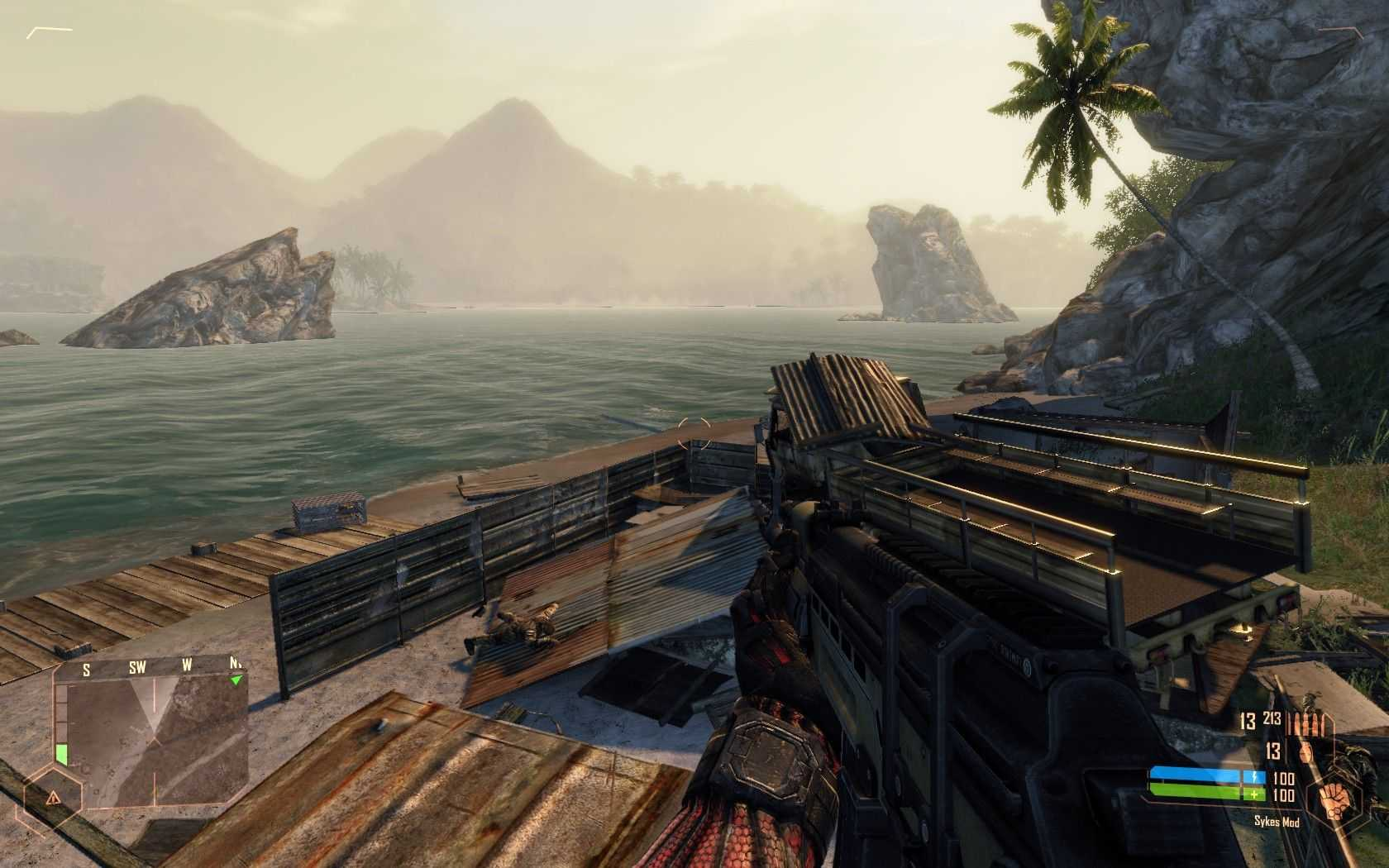
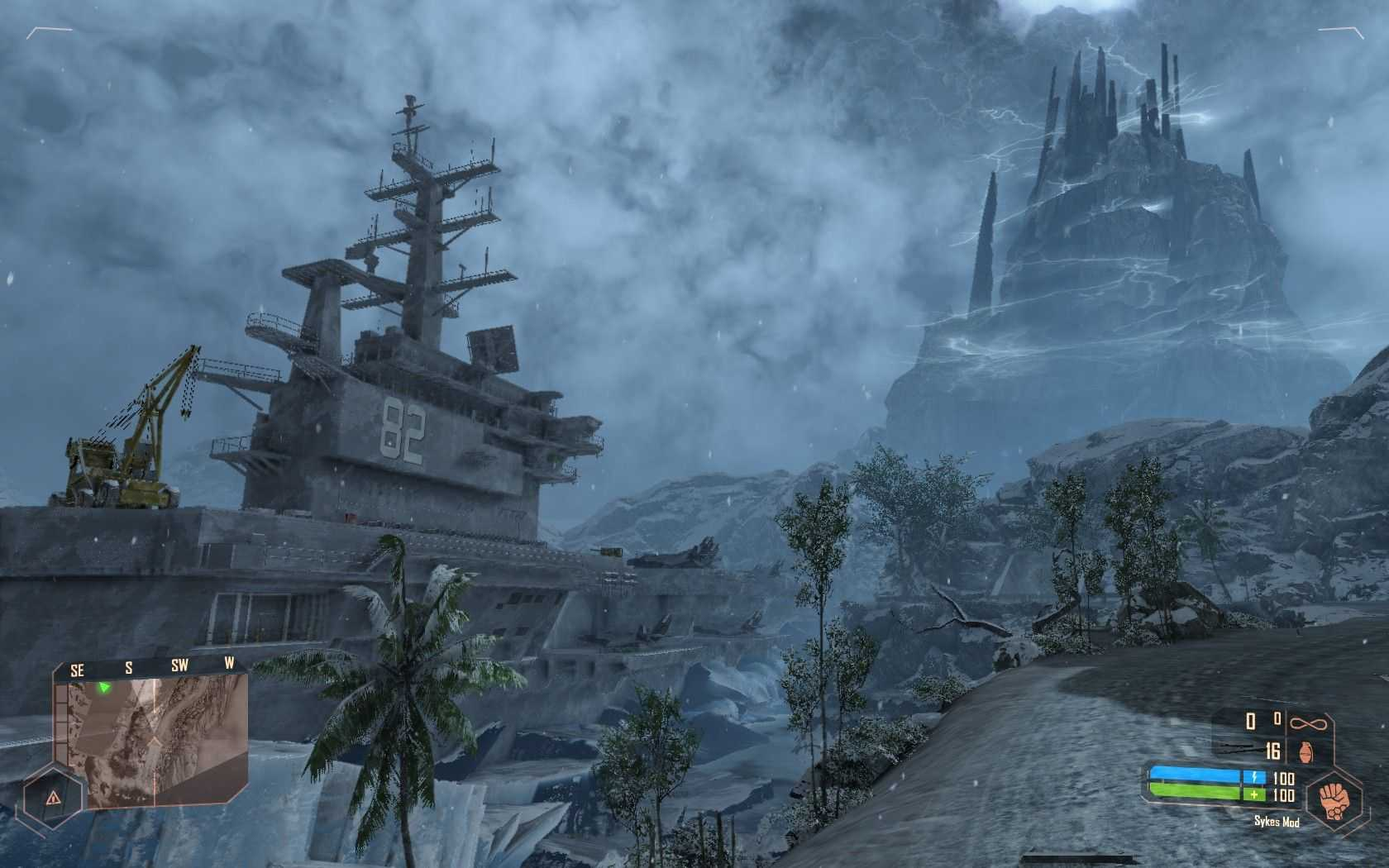
Warhead, much like Crysis, is a very visually impressive game. The artwork is stunning, but not obtrusive; it only served to deepen the immersion for me. I found myself rubbernecking when I made an enemy vehicle crash or knocked an alien out of the sky. When I had spare moments to collect my thoughts, I was torn between watching the scenery and keeping an eye out for the next Big Thing so I wouldn't miss it. Fortunately, Crytek has us covered; they consistently give you some warning or do something to draw your eye to the big, impressive sights. The graphic settings for Warhead are either intuitive or stupid, depending on whom you ask. The minor settings (for textures, shadows, etc.) have four options: Minimum, Mainstream, Gamer, and Enthusiast. The default is Mainstream, and that's what I used my first time through the game. On a middle-of-the-road PC, it was completely smooth. I bumped it up to Gamer and noticed a performance hit, but it was still playable. At Enthusiast, the game got very choppy in graphically intense sequences. It was borderline playable — I wouldn't use it for anything but exploring or showing somebody else the game. Sure looked good, though. TechSpot did a more in-depth analysis on the relation between hardware and framerate.
Warhead's multiplayer system, Crysis Wars, is basically a refined version of what was offered in the original Crysis. There are three different types of games: Instant Action (a basic free-for-all deathmatch), Team Instant Action (team deathmatch), and Power Struggle. The latter divides players between two teams and gives them a variety of buildings to capture and vehicles to unlock on their way to destroying the enemy's headquarters. The use of vehicles adds to the gameplay without dominating it. Given the option, I was happy to hop into a truck, but it was always to get somewhere so I could hop out again. I had trouble finding servers with enough people to make Power Struggle interesting, but if you get a lot of people involved, it could be quite fun. The other, more traditional game types are well-done, but a matter of personal preference. I tend to prefer Quake-style games rather than the ones more dedicated to realism. In Crysis Wars, encounters with enemies players are often over in seconds, with very little ability to break off an encounter that's not going well, or to overcome bad odds. I enjoyed the team version more, because having teammates is synonymous with having some target dummies scouting ahead to draw enemy fire. That said, having access to your suit puts a nice spin on an old concept. Players who make full use of them are incredibly dangerous. If that style of combat is your preference, you'll enjoy it. The maps are well crafted and provide many opportunities for unique interactions, and they make good use of all three dimensions.
Crytek is a great example of a developer who produced something good and then turned around and produced something better. That's the kind of progression I like to see in a company, but so rarely do. Warhead is an improvement on Crysis in almost every way. Fans of the original will be fans of the expansion, and the price tag is appropriate for the amount of content the game provides (even more so if the multiplayer community takes off). This time around, the hardware situation is much less of an issue. The streamlining of the graphics engine is evident, and technology has had some time to catch up as well. Be aware that Warhead ships with the same DRM as Spore, which we've discussed at length recently, so if that's a deal-breaker for you, give it a pass. The game itself, however, plays quite well, and its flaws are minor. I'm definitely looking forward to the next parts of the proposed Crysis trilogy.
-
Saudi Arabia Begins To Realize Supercomputer Ambitions
An anonymous reader writes "Saudi Arabia is building a supercomputer that could rank among the 10 most powerful systems in the world. And the country isn't stopping there. It has plans to turn this marquee system for the Middle East into a petascale system in two years, and, beyond that, an exascale system."
-
Exploring Europe's Shipwrecks, Virtually
An anonymous reader writes "Fancy youself as a bit of an archaeologist? This picture story shows images from a project aiming to digitally map out the shipwrecks around Europe's coasts. The plan is for people to eventually be able to take a virtual tour of the wrecks from their PC."
-
Man Attempts To Cross English Channel With Jet Wing
Back in May, we told you about Swiss pilot Yves Rossy and his personal jet powered wing. It seems Mr. Rossy will now try to cross the English Channel with his invention. The flight was planned for Sept. 25 but had to be canceled due to poor weather. Yves will leap from a plane more than 2,500 meters off the ground, fire up his jets and try to make the 35-kilometer flight from Calais in France to Dover in England. If all goes well, the flight will take about 12 minutes. I'd like to officially ask Mr. Rossy for a review model for Slashdot.
-
Windows 7 Trades Email and Photo Apps For Downloadable Ones
arcticstoat writes "Microsoft has said that it plans to remove a lot of the standard apps from Windows 7 in order to make the new OS 'cleaner.' Among the apps for the chop are Windows Mail, Windows Photo Gallery and Windows Movie Maker, which will no longer be included with the operating system as standard. Instead, equivalent versions of the apps will be available from Microsoft's Windows Live download service as optional free downloads, much like the new BETA versions of the apps that Windows Live offers today." Meanwhile, jammag writes that "tech pundit Mike Elgan posits that the rushed-to-market Windows 7 — due in 2010, now being beta released this October — may in fact merely be Vista with new packaging.
-
SpaceX Flight 4 Launch Postponed
Matt_dk noted that yesterday's launch plans for SpaceX have hit some turbulence. He says "SpaceX Flight 4 Launch has been postponed. The static fire took place on Saturday [20 Sep 2008, CA time], as expected, and no major issues came up. However, after a detailed analysis of data, we decided to replace a component in the 2nd stage engine LOX supply line. There is a good chance we would be ok flying as is, but we are being extremely cautious. This adds a few extra days to the schedule, so the updated launch window estimate is now Sept 28th through Oct 1st [CA time]."
-
Microsoft To Buy Back $40bn of Its Shares
phantomflanflinger writes "As you may have heard already, Microsoft have announced their intentions to buy back $40 billion in stock from their investors, in the biggest single buy-back plan in business history. The announcement has given Microsoft shares a small gain but they still stand significantly below their level in January — before Microsoft's unsolicited bid for Yahoo!. The announcement of the plan has also created new speculation about a now-or-never deal with Yahoo!."
-
T-Mobile May Offer Free Gmail Data Access On G1 Phone
An anonymous reader writes "AndroidAuthority.com is reporting that T-Mobile is considering putting free ad-supported Gmail access on its T-Mobile G1 smartphone — no data plan required. The G1 launches in New York tomorrow and is the first device to hit the market that uses the Linux-based Android OS that is backed by Google."
-
Comcast's Throttling Plan Has 'Disconnect User' Option
newtley writes "Comcast's new people, not protocols scheme may mean high speed for some, but by no means all. It's also created a draconian 'disconnect' option for use against anyone who fails to toe the Comcast line. But, says Robb Topolski, the Net protocol expert who originally uncovered Comcast's blatant efforts to control its customers, the plan does offer key take-aways, telling P2P users on Comcast how to do what they do without the risk of corporate interference."
-
EA Patches Spore, Eases DRM
EA has released the first patch for Spore, the purpose of which is to fix a number of bugs and tweak some gameplay settings to be more entertaining. Some of the visual effects were upgraded as well. They've also officially responded to the complaints about Spore's DRM, stating their intention to increase the number of allowed installations to five and to set up a system to "de-authorize" systems in order to reclaim the installation credit. They plan to allow multiple screen names per account, which was an issue for many families trying to play the game. This comes not long after EA made similar changes to the DRM of upcoming RTS Red Alert 3, and after Spore's DRM protest spread to in-game creature designs. Reader SoopahMan notes that users in EA's Spore tech support forum are reporting a number of new issues caused by the patch.
-
Peter Moore Talks About His Experiences In the Gaming Industry
Over the past several days, the Guardian has posted a five-part interview with Peter Moore, head of EA Sports. Moore was also the president of Sega, and a vice-president at Microsoft, so his experience at the top levels of the gaming industry is extensive. He describes how he came to be employed by Sega, the development of the Dreamcast, and its subsequent flop when confronted with the Playstation 2. He also discusses his involvement with the development of the Xbox franchise, how the integrated hard drive "killed" the original model, and he gives his account of how the Red Ring of Death fiasco affected the company. The series ends with a look at EA Sports' plans for the future, and how they're trying to create a new business model beyond the micro-payments popularized by iTunes, which Moore calls "a rip-off."
-
Germany Fired Up Over Clean Coal
MIT's Technology Review is reporting on the world's first coal-driven power plant designed to capture and store C02 emissions. "Vattenfall's small 30-megawatt plant burns the lignite in air from which nitrogen has been removed. Combustion in the resulting oxygen-rich atmosphere produces a waste stream of carbon dioxide and water vapor, three-quarters of which is recycled back into the boiler. By repeating this process, known as oxyfuel, it is possible to greatly concentrate the carbon dioxide. After particles and sulfur have been removed, and water vapor has been condensed out, the waste gas can be 98 percent carbon dioxide, according to Vattenfall. The separated carbon dioxide will be cooled down to -28 C and liquefied. Starting next year, the plan is to transport it by truck 150 miles northwest, to be injected 3,000 meters underground into a depleted inland gas field in Altmark. Ideally, in the future, the gas will be carried by pipeline to underground storage, says Vattenfall. "
-
Indian Moon Mission To Launch Next Month
Anil Kandangath writes with word that the Indian moon mission plans (mentioned earlier on Slashdot) are about to be put to the test. "While the spacecraft itself will not land on the Moon, it will act as an orbiter and land a rover on the surface. The spacecraft is being launched next month sometime between October 22 and October 26. The spacecraft payload includes 11 payloads (including one from NASA) and will perform remote sensing and studies of the lunar surface. The mission is estimated to cost Rs 386 crore (~ 84.3 million USD)." Update: 09/21 18:29 GMT by T : Thanks to reader Anil Gaddam for pointing out that this figure had been originally misstated as 7.7 million USD.
-
Mozilla Is Eyeing Your Phone
Slatterz writes "Mozilla is planning to develop a browser for mobile phones by 2010. Mitchell Baker, chairman of the Mozilla Foundation, has been laying out her plans for the organisation over the next two years. Baker also committed to expanding the role of Firefox and building on its market share, while developing new browser technology such as the Aurora project. Mozilla has already stated that it is working on a mobile version of Firefox, but has never set a timeframe for release."
-
IBM Leapfrogs Intel With 22nm Chips
Slatterz writes "Intel may be touting 45nm CPUs, but IBM says it can go much further with a strategy to produce future chips using a 22nm fabrication process. The company is adopting a technique called 'computational scaling' in order to manufacture circuits small enough to deliver more powerful and energy-efficient devices. Intel plans to introduce 32nm chips in 2009, but chipmakers have hit a problem in that current lithographic methods are not adequate for designs as small as 22nm owing to fundamental physical limitations. IBM claims to have solved this problem." Unfortunately the phrase "computational scaling" doesn't actually convey any information about how they've solved it.
-
Microsoft To Announce Jerry Seinfeld Ads Cancelled
An anonymous reader writes "Valleywag says the Jerry Seinfeld ads are over — In a phone call, Frank Shaw confirms that Microsoft is not going on with Seinfeld, and echoes his underlings' spin that the move was planned. There is the 'potential to do other things' with Seinfeld, which Shaw says is still 'possible.' He adds: 'People would have been happier if everyone loved the ads, but this was not unexpected.'"
-
Swiss Restaurant to Serve Dishes Containing Breast Milk
The owner of the Storchen restaurant, Hans Locher, plans on improving his menu with local specialties such as meat stew and various soups and sauces containing at least 75% breast milk. Mr Locher posted ads this week looking for women donors, who will receive just over three pounds for 14 ounces of their milk. Hans says, "We have all been raised on it. Why should we not include it into our diet? One can cook really delicious things with it. However, it always needs to be mixed with a bit of whipped cream, in order to keep the consistency." The grand unveiling of the new menu is sure to be a noisy occasion with every stray baby in the neighborhood crying and banging on the backdoor.