 Slashdot Mirror
A Close Encounter Of The Stellar Kind
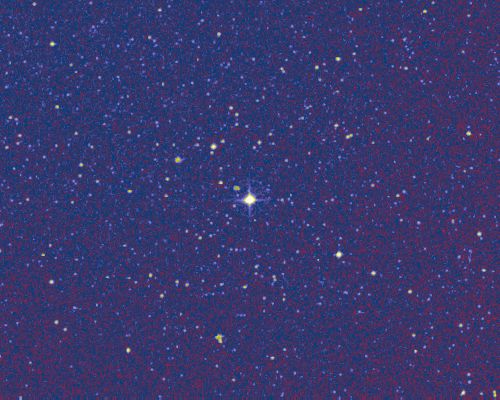
Beowulf_Boy writes "Acording to the APOD on July 7th, The star in this image known as Gliese (Gl) 710 (currently 63 lightyears away), will be only 1 Lightyear from Sol in 1.5 million years. Currently, it is much to faint to be seen by the naked eye, but, in 1,502,000 A.D. it will be at .6 magnitude, rivaling the current bright star of Antares. Although Gliese 710 will not apparently present any major dangers, it could possibly scatter debris out of the Oort cloud, cause many more comets and meteors than usual.
This future stellar encounter was discovered by researchers Joan Garcia-Sanchez and Robert Preston (JPL), and collaborators while studying stars in the solar neighborhood using data from the Hipparcos Astrometry Satellite."
What NASA says about Nemesis.
An excellent overview from IndiaWorld.
Why Nemesis isn't a wacked out theory, and might even be expected.
A fairly detailed account at space.com
We can see our clock ticking. Divine retribution seems to be a million years away But the animal smaller than dogs can take solace, as IIRC this might be Nemesis' last fly by, so they will inherit the earth for an indeterminate period of time.
--Jimmy has fancy plans; and pants to match.
Given the tales of near collision with an asteroid back in 1998, followed up a day later with a retraction, I wonder about the ability to accurately calculate something this far out in the future and that far away to start. The asteroid was only 30 years in the future, and they were off by quite a bit (30,000 miles then 600,000, a factor of 20). Not to be a doubting Thomas, but how can they predict intra-galactic positions over 1.5 million years in the future with any kind of accuracy? Maybe I should have kept auditing that astrophysics course in the summer of '83...