 Slashdot Mirror
A Close Encounter Of The Stellar Kind
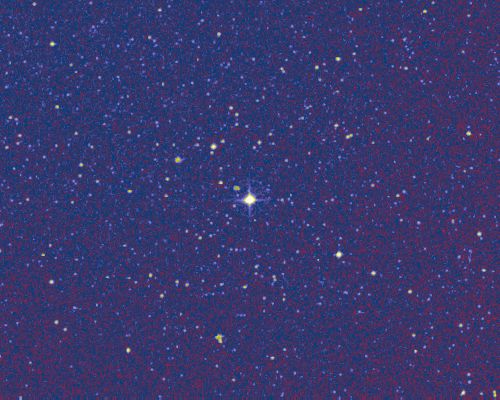
Beowulf_Boy writes "Acording to the APOD on July 7th, The star in this image known as Gliese (Gl) 710 (currently 63 lightyears away), will be only 1 Lightyear from Sol in 1.5 million years. Currently, it is much to faint to be seen by the naked eye, but, in 1,502,000 A.D. it will be at .6 magnitude, rivaling the current bright star of Antares. Although Gliese 710 will not apparently present any major dangers, it could possibly scatter debris out of the Oort cloud, cause many more comets and meteors than usual.
This future stellar encounter was discovered by researchers Joan Garcia-Sanchez and Robert Preston (JPL), and collaborators while studying stars in the solar neighborhood using data from the Hipparcos Astrometry Satellite."
We consider the possible influence of a star light years away more than a million years from now, but fail to track most of the near-earth objects, which would pose a much more immediate threat to life on Earth than any star! Do they just pick a large object at random and say, 'Okay, how could this affect Earth?' or what?
The purpose of this research was almost certainly not to find threats to Earth - it was to get a better map of dim stars in our area, which lets us check some of our models of star formation and celestial dynamics in our area of the galaxy.
It also provides another data point for planetary system models (by giving us a better idea of how frequent close stellar encounters are, which certainly affect sytem formation), and (if they're finding stars in addition to just measuring their courses) a better estimate for the amount of normal matter in the universe (there has been debate over how much of it is bound up in dim stars and sub-stellar objects like brown dwarfs).
What most likely happened here is someone noticed that this star in their survey would come close to earth, and said "hey, neat, free publicity for our project".
Most astronomy is pure research - there won't *be* an application for most of it.
On the other hand, it's much easier to track a steller object, which is basically unaffected by anything smaller than other stars, than an asteroid which is affected by everything else in the solar system.
Behold the start of a glorious day:
Divine Retribution is on its long way.
Through the deep void it never does stray:
Divine Retribution is on its long way.
It does not stray, but it tarries a bit --
Divine Retribution is a long way away --
And our Lord God shall throw a great fit
On Divine Retribution's late Day.
It takes its time, there is no big rush,
On this Divine Retribution's late way.
Penitents desperate, through the church doors do push,
In hopes Retribution to sway.
Yet in some dark, foul smelling quarter,
The Fiend of Heaven doth say,
"What is the fuss? What is the matter?
Divine Retribution's a million years away!
"And if this dread threat truly doth come,
As Divine Retribution well may,
Profit! Loss! Check ye the sum!
And Divine Retribution thus weigh!
"The punishment fits, and would deter --
Let Divine Retribution have its say --
And were I immortal, true, I would prefer
To avoid Retribution's dread way.
"But a million years is a long time ahead,
And I too have something to say:
Most, in a hundred year's time, will already be dead
And for Divine Retribution can't stay.
"And fear not some Divine resurrection:
Such is not Divine Retribution's Good way,
But sleep safe in sweet Death's good protection,
And let Divine Retribution have its day.
"For what sort of Divine Unknowable
Would make this Divine Retribution's way
Such to steal from the earth, as if with a shovel,
Just to punish on Divine Retribution's dark day?
"T'would needs be a Divine most Retributive
To send such Retribution this way,
And to such blasphemy is Nature prohibitive
And would make Divine Retribution thus stray."
~~~~~~
under-paid karma whore
personally, I think I'm gonna set up my lawn chair and cooler out back right now, don't wanna miss this! Oort cloud and everything, this should be quite a show...
So what time does it start?
Lack of eloquence does not denote lack of intelligence, though they often coincide.
And those are just a couple of the most glaring errors -- his short page is littered with them. There ain't no physics there.
---
---
Politics is about making compromises. Religion isn't. --Michael Horton
Sirius is the brightest star with an apparent magnitude of -1.46. Antares is about the 15th brightest star with an apparent magnitude of 0.96.
This sig intentionally left blank.
What NASA says about Nemesis.
An excellent overview from IndiaWorld.
Why Nemesis isn't a wacked out theory, and might even be expected.
A fairly detailed account at space.com
We can see our clock ticking. Divine retribution seems to be a million years away But the animal smaller than dogs can take solace, as IIRC this might be Nemesis' last fly by, so they will inherit the earth for an indeterminate period of time.
--Jimmy has fancy plans; and pants to match.
According to the links, the star is in an highly excentric elliptical orbit. A pretty good image can also be seen on the space.com link you give. This means, the orbit should be similar to long-period comets. Some graphs showing the orbit of the Hale-Bopp comet can be seen here.
There are also some scientist who think the claimed 30 million year periodicity is not real, but a result of impact crater data rounded to nearest round millions of years. You can get the artcile by entering the number 9701104 in the field here. The paper has been published in an international refereed astronomical journal, Astronomy and Astrophysics
My personal opinion is that Nemesis is propably not lurking out there, but I think it would be worthwhile to check it.
Divine retribution seems to be a million years away
I think that in one million year, out tech can stop the comets that this star might drop from the Oort cloud. Even with present tech, we get a good early warning. A 'killer comet' would probably be detected at least half a year before the possible impact. I'd be much more worried about the Near-Earth Asteroids - they may remain undetected until a few weeks before D-day.
Given the tales of near collision with an asteroid back in 1998, followed up a day later with a retraction, I wonder about the ability to accurately calculate something this far out in the future and that far away to start. The asteroid was only 30 years in the future, and they were off by quite a bit (30,000 miles then 600,000, a factor of 20). Not to be a doubting Thomas, but how can they predict intra-galactic positions over 1.5 million years in the future with any kind of accuracy? Maybe I should have kept auditing that astrophysics course in the summer of '83...
Scientists' prediction capabilities seem to be applied very erratically. We consider the possible influence of a star light years away more than a million years from now, but fail to track most of the near-earth objects, which would pose a much more immediate threat to life on Earth than any star! Do they just pick a large object at random and say, 'Okay, how could this affect Earth?' or what? It just seems like it would make more sense to organize our tracking, and study bigger threats first.
________
"And if the fool, or the pig, are of a different opinion...." -- J.S. Mill