 Slashdot Mirror
Fighting For Privacy With Art and Words
HomeSkillet writes contributes this link to an interesting NYT feature on the recent works of privacy activist, wearables pioneer and artist Steve Mann. Mann has been mentioned here a few times before, but in light of current moves to scan, monitor and track your every move by subtle and unsubtle means, it's never been more relevant. Can anyone suggest a non-registration source for this story?
check this link:s ical/25CYBO.html
http://archive.nytimes.com/2001/09/25/science/phy
Privacy is of the utmost importance. Its the freedom we need the most. The art highlighted in these article is a relevant and valuable expression of things that have come and are to come.
The article's spiked chair being useable by cardholders/citizens only and the other link to the wearable camera is an allusion to the underpinnings of fascism.
I get worried about the direction the US government is taking towards us. Half my company is foreigners, and good ones at that. The plausibility that they will become suspect or deported is minimal, but given some of the new legislation in the mill, it is possible to deport resident aliens if they contributed to an organization that terrorizes or makes threats. That could conceivably include Greenpeace.
Expatriate resident aliens are the best people, most of the time. They are not eligible for welfare, must take care of themselves, do no vote and pay taxes. I would fight to defend the rights of my friends at work.
The advent of the Orwellian era is near, I urge everyone to go to the EFF (www.eff.org) as soon as possible and write the senators and congressmen. And if you are from the EU or Canada or some other place, write them too. I'm still in shock about Skylarov not even getting a semblance of habeas corpus, and is being tried on laws that do not apply to him or what he did. And now the SSSCA and the Anti-Terrorism (Implement Fascism) bills by Adolph Ashcroft.
I am hurt by what happened September 11th. Black ops, special ops and "surgical" retaliation is a good thing. But suspending the rights of people who aren't even Arabic, and coining new criteria for "cyber-terrorism," proposing national ID cards and indiscriminately deporting people is NOT a smart thing to do. And developing legislation with such broad and far reaching wording is dangerous to everyone the world over.
The brain drain will begin, where mega corps of the US will have expatriates arrested for violating something inane. Soon, all the people will stop coming because they are afraid. And possible the greatest nation for development with the soundest fiscal policy will become and intellectual pariah.
Remember, stay moderate. Don't jump to conclusions about things, and make sure to check out the art in these articles, its an expression of what's to come.
- Z
Legalize the constitution. Think for yourself question authority.
I love his chair and the analogies it represents. It points out the idiocy of buying something that you can only use under certain circumstances.
For the SSSCA, maybe a book that you buy that is chained to a desk. Its your book, bought and paid for. But you can only read it at the desk. If you try to take the chain off you go to prison as a terrorist. Because we all know only terrorists would want to read a book anywhere but a desk.
These laws are madness, I can only pray that they are rejected by our leaders.
-- When a fool hears of the Tao, he will laugh out loud.
along with thad, steve is one of the best known wearables pioneers. one of my favorite examples to show to people new to wearables is steve's condomwoman sequence:
in particular, the before & after photos =)
I work in the Computer Vision and Robotics Research lab at UCSD. We have done research in many of the areas mentioned in the article, and are beginning some wearable computing starting with a PC-104 & i-glasses setup that another Grad student is working on. Wearables are cool stuff, we're already seeing phones, pagers, pdas, and watches unified.. next is more interfaces to the REAL world like he sums his article with.
/.'ers do already. But rather than blatantly rejecting any form of surveillance as I typically see on here and other forums, maybe appropriate questions should be asked about why/how/who has access to the data being taken. These are the issues at the heart of the problem.
But on to my main point. We've been operating for some time towards a concept we call Ubiquitous Vision, which means that basically we will eventually be able to look at any space (indoors/out), from any perspective and resolution using a distributed network of a variety of types of visual sensors, including mobile ones. The decreasing size and cost of these sensors makes this approach possible, and also is interesting from a user's perspective because of the freedom to choose the view of the scene.
We do get quite a few comments related to the potential impacts of such kinds of surveillance to people's everyday lives. Like he mentions in the article, as long as this kind of surveillance is possible for everyone - not just a select few (corporations, government, etc..) then there exists some kind of natural balancing mechanism. What's scary would be if only some specific organizations had access to the information and everyone else was prohibited from using it or doing their own surveillance.
However it seems essential to mention a point made before by people more intelligent than myself. It isn't the technology that is at fault for comprimising your privacy. It is the people who use it that need to be responsible, and the people who feel it is being used irresponsibly that should speak up, as many of you
I personally think soon we will begin to see high-profile social organizations responsible for regulating the use of surveillance and making policy to protect us. EFF comes to mind. With the increased media attention now, I think we are on a collision course with this issue on a national/global scale. More to come, and it's going to be a very interesting and complex debate.
Just my $.02
Brett
__ No registration required to read this message. They did it in the Matrix.
A Dutch collegue mentioned that in Holland all people are required to register with the authorities wen they move into a new area. Now, this is all very good when trying to cut down on benefits fruad and all that, but it didn't do the Jewish communities much good when the German forces marched in....
No, I'm not suggesting that this is liely to happen, but I think we should think about how much ionformation we want other people to have about us. Remember, the phrase "knowledge is power"? How much power do you want the next government to have over you?
Given the recent MORI opinion poll where an alarming number of (UK) people were not only pro ID cards, but also saw nothing wrong with having Religeon and DNA data (!!) on these cards, this is certainly a hot topic. And yes, an ID card is just the first step....
Tom
Oh arse
Does this kind of technology scare anyone else?
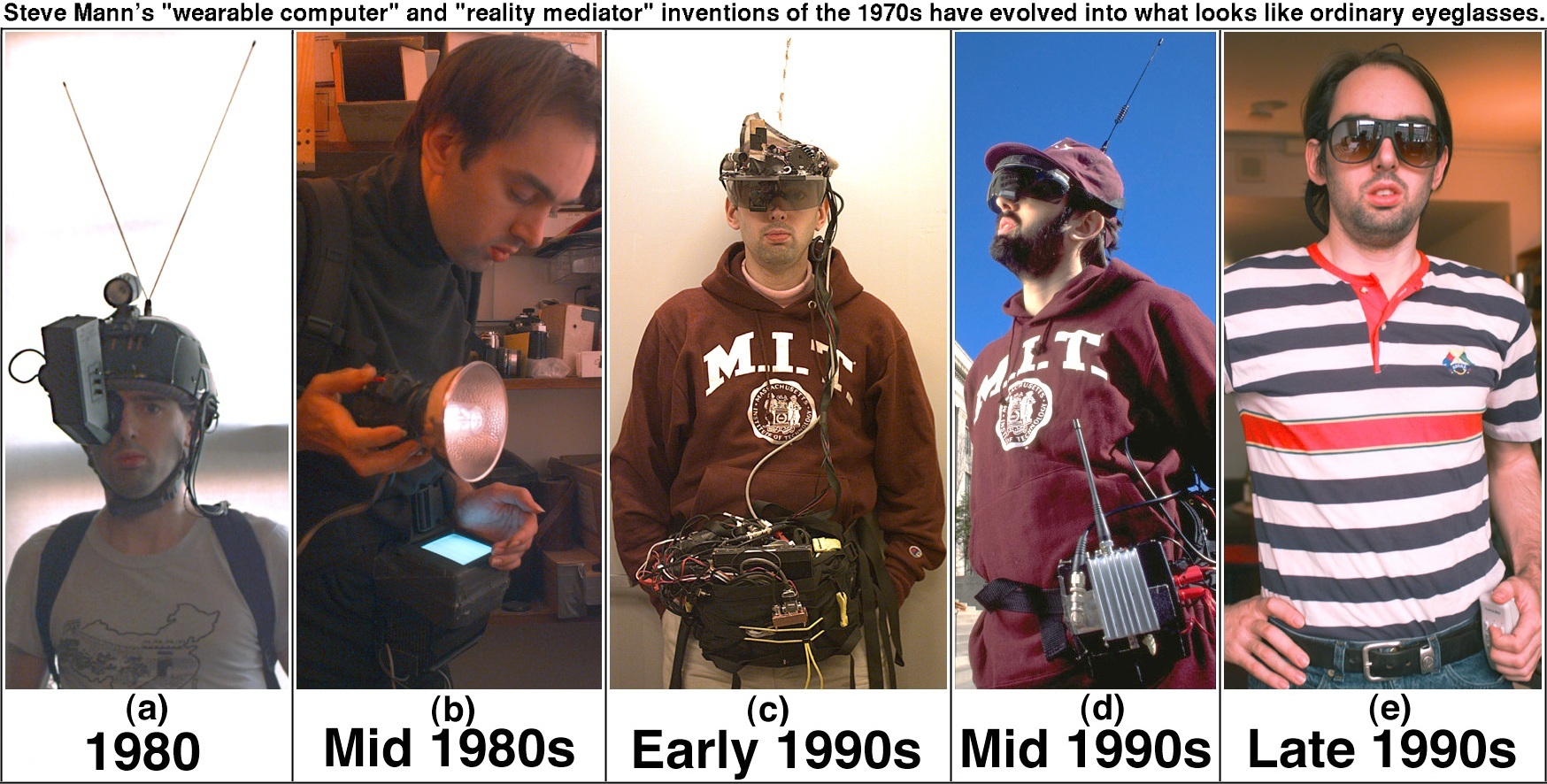
Having glasses that let others see through his eyes and can modify what he sees to provide information or block nuisances seems nice enough at first glance. I can imagine alot of neat uses for this tech and can even imagine it becoming somewhat common, if made portable and high quality enough. But what about ways this might be exploited in the future?
Once it's common, what's to stop a hacker or the government from breaking in to look through my eyes. Now, that's a scary thought. How about a worse one? Programmers and their backers designing these things to filter out aspects of the world because they are politically unpopular or show competitor's products? Or how about inserting ads into other parts of life? I wouldn't want to look at walls in my own house and be shown advertisements.
So long as the user is truly in control I suppose it's okay, but who knows what a greedy corporation might try to do with his tech.
In switzerland, this is also the case. When you change cantons (the subdivisions of switzerland) you have to notify the authorities. This means than moving from one city to the other implies a lot of annoying paperwork. Carrying you ID card is also mandatory.
Honnestly I don't feel that my privacy is so much threatened. The difference lies first in the policy of the state (here there are serious laws about privacy) and in what information is gathered, and how it could be used and the legal background (I have more obligations, but the are IMHO better laws to protect me).
A state needs to gather information, the problem is it should require some work. Face it, a lot can be learnt simply by watching what you do, but it requires a lot of resources (a guy trailing you). The problem is not what information can be found out (low tech surveillance can find a lot out), but how difficult it is - this is where the issue with technology lies. Having access to sensitive information a no cost is the problem.
- Where you live, the state needs to know this simply for taxing. I would be asthonished that a modern states has no idea where it's citizen live.
- Unique identifier, while it makes sense that the state assigns you one, this number should only be used by the state, and not other organisations.
- Your religion, ethnic group, etc... I don't see why the state should know this, nor any other organisation. This was one the first bad things with the Jews, I think there was some code to mark jews in official documents - bad.
- Who you are - this seems quite natural around here, also think that the information on the card is a problem only if the card is checked. This implies police-people, so it's work to collect acutal data. Having a security officer checking I am who I'm supposed to be while bording a aircraft makes sense.
I would be worried if there started to be bar-code scanner in certain places, say the entrances of restaurants, or subways. This would be very bad. For the moment, corporation seem to do much more intrusive stuff.
- Your DNA, this is linked to your medical record and should be treated as such, nobody except you doctor should have access to this.
Also remember that laws are very important. What is the penalty for breaching privacy? Most european countries have a much stricter approach than the US. And it's pointless to make a distinction betweeen corporation and state, once the info is gathered, it's to late. Strong corporation will have access to state information, and the state will be able to access corporate information.This isn't some grand conspiracy (if it were, it would be easy to do something about it). But look at it from the point of view of the people who get to make the rules. If they forbid picture taking, little happens. If they allow it, they are in trouble if something bad happens, or at least they risk exposing their organization to embarrassment if the pictures are used for something negative.
I think it's important to document our life in pictures for many reasons, and that's why it's important to keep cameras acceptable whereever we go. What can you do about it? Carry a camera, the unobtrusive snapshooting kind, and snap away. Don't dress up like an alien or be in-your-face or antagonistic--that only upsets people and raises valid concerns. But do use your camera: take pictures of your girlfriend picking out a new dress, pictures of your family waving good-bye at the airport, pictures of having lunch at the mall, pictures of furniture that you may want to buy (to show your family), etc.
Anyone else see the irony of a story on a privacy activist on a site that requires mandatory registration?
I didn't see anything in the article to suggest this thing was knocked up in two weeks. Do you really believe that prior to the 11th, there were no cameras or surveillance, and everything was dandy?
A quick look at the Austin Museum of Art site confirms that the exhibition was opened July 21st, and actually closed last week. If anything you can complain about the NYT running the story, but not the original exhibit.
"don't fall into the fallacy of believing that Perl can solve social problems. Maybe Perl 6 can, but that's a ways off"
I'm shocked that the deaths of so many innocent people mean so little to you fucking nerds.
Priorities?
We are not to be defeated. A proper amount of mourning has been observed. It has been fair and respectful and now proper respect is being paid to the living, to recovery and most importantly to damage control to prevent the situation from becoming worse. Within hours of the 9-11 events, politicians were proposing new law to restrict our freedoms. To turn a blind eye to those who would too far change our way of life for a reason of additional mourning would be an expression of misplaced priorities.
I do not speak for everyone though I invite the support of those who agree with me. The price of a few lives unwillingly taken does not outweigh the way of life earned by so many who fought and died willingly for the freedoms and the way of life we have taken for granted today. Yet somehow, people feel an acceptable exchange for the lives of the unwillingly taken would be equal to restriction upon our very lives and our very way of life. But I am unaffected directly by the tragedy of 9-11 so I would pose the question directly to any of the families or friends of those who died on that day.
It makes me wonder if we no longer value the lives already given in the name of the lifestyle we have been living until recently. So I think it's important to maintain a clear perspective on the events going on in all arenas and not allow yourself to wear the blinders of mourning for too long. The time for mourning is done. The alternative to this is to remain cowed under the fear of attack not only from foreign enemies but from those [lazy asses] who would legislate our freedoms away so that it would make their jobs more 'convenient' to execute; those who would sooner 'control' the world using a television remote control rather than actually WORK for a living and represent the interests of the people as their position was intended. I am all for protecting and securing the safety of all people everywhere. But I am not for doing so by way of restricting our rights and freedoms. I am for doing so by way of increased vigilance and a more agressive stance against those who would attack our freedoms and way of life. (The government should get off it's lazy asses and work on ways to secure our freedoms while at the same time securing our lives and our safety.)
Priorities indeed. If you don't think your rights and freedoms are worth protecting, then I invite you to voluntarily enslave yourself to me now. I could use a little help cleaning up around here anyway.
I'm shocked that the deaths of so many innocent people mean so little to you fucking nerds.
Priorities?
We are not to be defeated. A proper amount of mourning has been observed. It has been fair and respectful and now proper respect is being paid to the living, to recovery and most importantly to damage control to prevent the situation from becoming worse. Within hours of the 9-11 events, politicians were proposing new law to restrict our freedoms. To turn a blind eye to those who would too far change our way of life for a reason of additional mourning would be an expression of misplaced priorities.
I do not speak for everyone though I invite the support of those who agree with me. The price of a few lives unwillingly taken does not outweigh the way of life earned by so many who fought and died willingly for the freedoms and the way of life we have taken for granted today. Yet somehow, people feel an acceptable exchange for the lives of the unwillingly taken would be equal to restriction upon our very lives and our very way of life. But I am unaffected directly by the tragedy of 9-11 so I would pose the question directly to any of the families or friends of those who died on that day.
It makes me wonder if we no longer value the lives already given in the name of the lifestyle we have been living until recently. So I think it's important to maintain a clear perspective on the events going on in all arenas and no allow yourself to wear the blinders of mourning for too long. The time for mourning is done. The alternative to this is to remain cowed under the fear of attack not only from foreign enemies but from those [lazy asses] who would legislate our freedoms away so that it would make their jobs more 'convenient' to execute; those who would sooner 'control' the world using a television remote control rather than actually WORK for a living. I am all for protecting and securing the safety of all people everywhere. But I am not for doing so by way of restricting our rights and freedoms. I am for doing so by way of increased vigilance and a more agressive stance against those who would attack our freedoms and way of life. (The government should get off it's lazy asses and work on ways to secure our freedoms while at the same time securing our lives and our safety.)
Priorities indeed. If you don't think your rights and freedoms are worth protecting, then I invite you to voluntarily enslave yourself to me now. I could use a little help cleaning up around here anyway.
I figure that this will work like most other technology these days.
The camera-glasses and associated computer equipment will be expensive. Companies will offset these expenses just like in the early days of the internet...with ads. Don't expect to see that pretty waterfall while you're in the john, what you'll be seeing is an animated ad for condoms, maybe with sound..arranged by the company that got you the glasses for cheap!
And once the companies decide that ads are being ignored, they'll go to a pay-per-view model. Just make sure your subscription doesn't run out while you're driving.
And come to think of it, what a great platform for subliminal advertising! You can insist to no visual ads, but paragraph 85(s) of the licensing agreement will subject you to ads beamed directly to your brain!