 Slashdot Mirror
FSF Announces Corporate Patronage Program
Andy Tai writes "The Free Software Foundation has announced a 'Corporate Patronage Program' to allow companies to support the work of the FSF. The members already include IBM, HP, Ada Core Technologies and MySQL. Interested parties should contact Ravi Khanna."
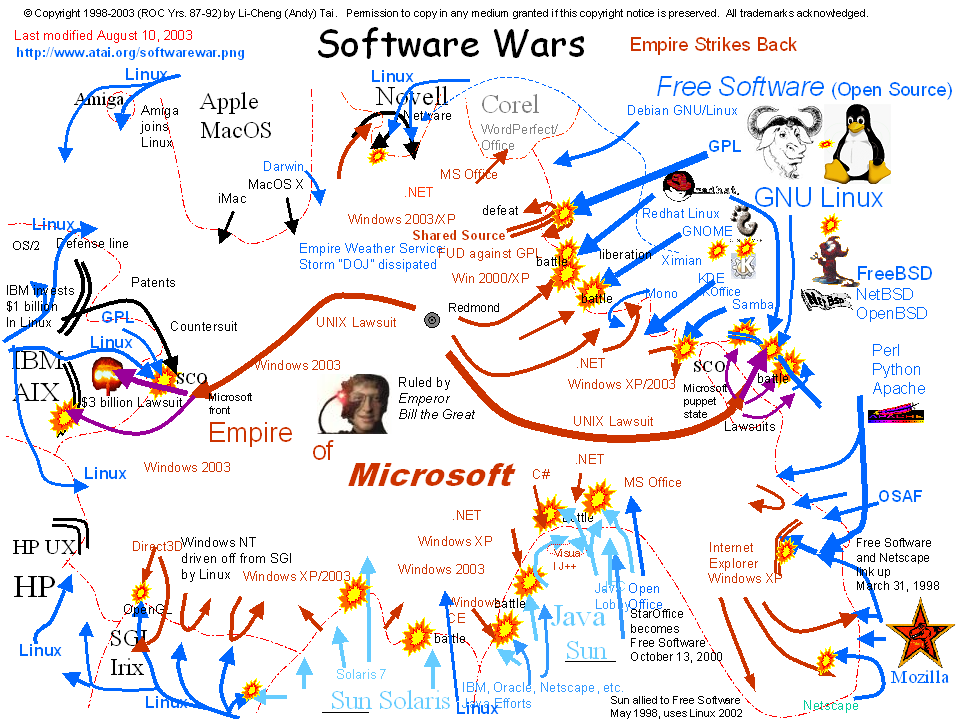
The FSF should at least offer to make the company's names on its Patron sponsor list linkable to the companys' websites. It is 2003 you know.
I hate having to go to Google to type in "OEone Corporation" to find out who the heck they are.
--LP
Time was when contributions to FSF funded programmers busy writing new free software. This appears to be far less the case, these days -- at a period of time when, 10 years ago, I would have predicted that FSF would now be doing more or less what RHAT does.
This is a delicate criticism, of course. It's not at all that where there money goes isn't important -- far from it.
But, hey, where's my "complete GNU system" (other than in arguments that various non-FSF distributions should be called GNU/Linux)?
-t
Doesn't this have Sally Struthers written all over it?
For example:
Today, I am visiting with GNU/Linux guru Richard M. Stallman. He needs a sponsor in order to be able to afford basic human necessities, like a razor and a haircut. Not to mention, in his part of the world, there is no running water. These GNU/Linux geeks are people too, and they are deserving of our compassion. For just pennies a day, you can make a difference.
GF.
Lots of petrified grits
Quick, someone tell Microsoft about this! I bet they'd love to sign on!
NO CARRIER
their only demand for the system is that you prepend GNU/ on your company name.
it had to be said.
This is a good thing. The FSF is getting corporations involved in free (libre) software. Goes to counteract all those nay-sayers who say "RMS and the FSF are communists!" No, they're not communists. Not even close. In fact, RMS and the FSF have repeatedly scolded licenses which are "like the GPL" but prevent corporations from using them on those terms.
social sciences can never use experience to verify their statemen
Patent happy IBM is supporting a group attempting to get rid of software patents. IBM is cruising for a corporate identity crisis. Who will win? IBM's Hackers and marketers or IBM's lawyers?
It's a GNU, you irrepressible rantallion.
Why the hell should the FSF throw out 15+ years of brand recognition on the say-so of someone called "Eric_Cartman_South_P?"
Now that you mention it, the bald eagle is ugly. And "bald" suggests old. We'd better change the national seal RIGHT NOW!
Comment removed based on user account deletion
The FSF has never taken a position against software patents, and has actually been rather restrained in its critism of them. For example, when the W3C tried to deal with the problem of incorporating patented technology into their standards, the FSF's only objection was that the patent license was too narrow.
:-)
Now, the League for Programming Freedom has a completely different take on the topic. Since it can be hard to tell its core members from those of the FSF, you're excused from the mistake this time
I have a little trouble grokking FSF's international structure.
On FOSDEM, FSF Europe was present, as well as RMS. While the FSFE was doing its own campaign, RMS was handing "FSF Associate Membership Sign-up" cards, with all the numbers in dollars on it and the address in Boston.
While Free Software is an international thing, I'd like to see some kind of representation back from where the funds came. For instance, spending high $$ on fighting American law structures is just so-and-so relevant to me, as long as the Netherlands/ Europe have their own situation.
I think that if the FSF would be willing to accept international donations in general, it should also take some time to explain how it benefits people outside of America (or how it doesn't, I don't care if it advertises well, but I'd like to get the picture), and how a donation to the American "chapter" affects the FSF Europe or another local chapter.
OTOH, if the FSF wants Europeans to become a member of the FSF Europe instead, to better support that organisation and local issues, they should also make that clear.
Just my 2 eurocents.
"We can confirm that Debian does *not* ship the version with the trojan horse. Our version predates it." [CA-2002-28]