 Slashdot Mirror
Gates: Microsoft IP Finds Its Way Into Free Software
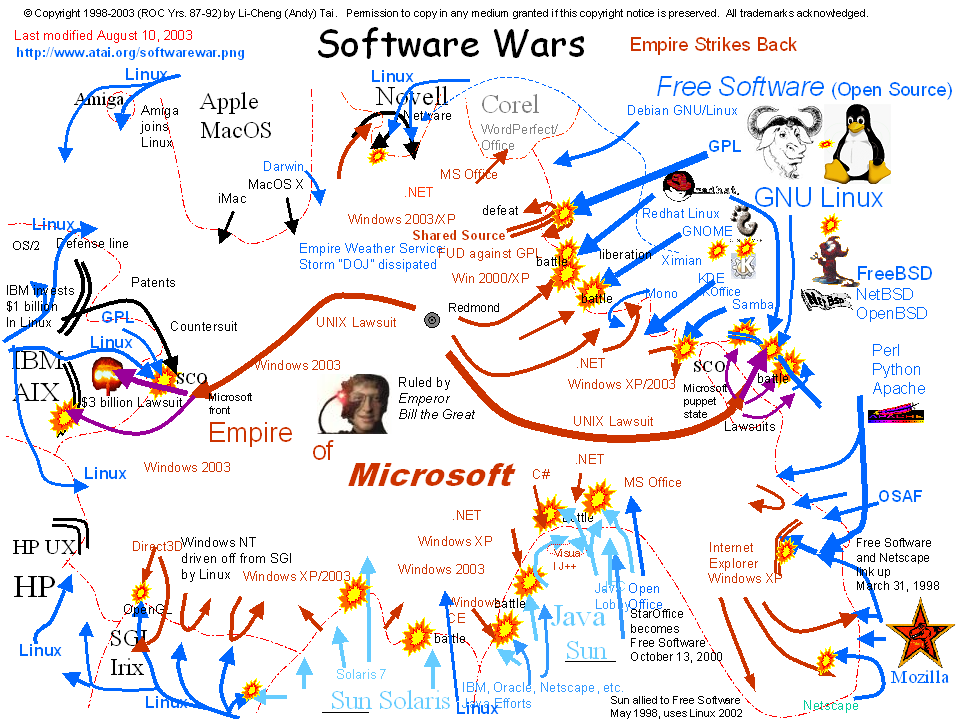
Andy Tai writes "While speaking to financial analysts and commenting on the SCO lawsuit, Bill Gates made the claim that Microsoft's IP is also included in Free/Open source software. Without being specific, he said "There's no question that in cloning activities, IP from many, many companies, including Microsoft, is being used in open-source software. When people clone things, that often becomes unavoidable." Considering Microsoft's claims of ownership over technologies like CIFS, does this mean Microsoft may also launch SCO-style attacks against Free Software/Open Source?"
This is plain stupid. Who do they think they are? Reverse engineering isn't illegal.
Cue 1000 posts about BSD netcode in Windows.
Although OSS does try to clone Windows "Look and Feel" (KDE themes etc..) and even Windows features in the form of WINE, the community is very pedantic on making sure they do not use Microsoft code or break any laws.
If developers of Open Sauce software disregard IP laws they are shooting themselves in the foot, because the whole paradigm of Free software relies on users sticking to the IP/Copyright laws and complying with the licence.
I believe this is the regular Microsoft FUD, trying to kick Linux when it is "down" .
There is no god
Wouldn't Apple then be able to claim that the Windows GUI is their IP, and then Xerox could claim that everyone's is theirs?
What about the guys who invented the Abacus? Shouldn't they get a cut too?
Sound waves should be free!
this is a perfect example on why you should use the GNU/GPL license instead of BSD or other open source models.
It means that big companies will find it more difficult to steal and bury.
* Carthago Delenda Est *
Besides, using the term "clone" is so vague as to be meaningless. There's a big difference between copying something directly and achieving the same results through reverse engineering.
Stop by my site where I write about ERP systems & more
Actually, this is exactly what Bill would say at this time. When Gartner says to hold off on Linux development, the business world pricks up its ears. When a few days later, Bill makes a casual statment that Microsoft code has been SCO'd, all of the sudden this is a trend. Linux has major IP problems, is what business will hear.
Bill won't probably ever give details about what IP he's talking about--he doesn't have to. The value of his statement is that it highlights MSFT's long shadow looming over OSS. Specific threats would be refutable--his statement is not.
Net effect? A wonderful chilling effect (in Bill's eyes) on open source development with no costs for MSFT.
I'm much funnier now that I'm a subscriber.
If any manager or businessman begins an assertion with "There's no question", "Clearly", or "It's obvious", that assertion is nothing of the sort. It's a wild-assed guess at best, and a lie at worst. They say these things to give their statement a false measure of authority, and because they can't stand not appearing to know everything all the time. These are the phrases that shift my BS meter into overdrive...
Well, there you have it.
MS recently paid SCO a liscense for UnixWare. Why? Well, I'm no Microsoft PR Troll, but if I were them, and planning on a new "Linux users are dirty lousy thieves" campaign, I'd do my best to let the little freaks at SCO be heard, even if everyone who has the slightest bit of knowledge in the subject knows SCO's full of it. Just long enough to be heard by most people, and get the community whispering in doubt in places. "SCO keeps shouting that Linux stole their IP, what if they're right?"
Because now MS can run "Us too!" ads and FUD Linux in interviews at will. It doesn't have to be true, or even slightly true, all they have to do is put the idea out there and the PHBs of the world, already a bit put off by the SCO mess, will buy it hook, line and sinker.
It's not like the various Open Source people (ESR, the FSF, etc) are given nearly as much press time in contrast to Gates.
How to fight this? Demand MS put up or shut up. Loudly. Whenever anyone is within earshot. Fight their FUD with honest, biting truth -- Linux is open source, we have nothing to hide, and is MS thinks we've stolen something, they're welcome to show some proof. Mention Kerebos, HTML 3.2, and whatever other instances of IP that MS has "Shifting Standardized" or "Embrace and Extended" into being a royal pain in the arse to use.
Of course, this is all assuming that Gates won't sneak some GPLed code into Windows now, and just claim that we stole it from him instead... Which is a decidedly more frightening prospect.
They can't beat us technology wise, they can't beat us pricing wise, but they can lie about us until everyone's too scared to use us.
Gates's main argument here is basically "if you make a clone of one of our programs, it becomes impossible to keep our code out of your program."
Yeah, I remember that time that I made that clone of IE, and then Gates himself showed up at my home, pointed a gun at my head, and forced me to copy and paste code right from IE into my browser. Right...
Last time I checked, it's not illegal for two programs to do the same thing, while having absolutely no code in common.
Let's think about this, anyway: how the hell does MS code get put into linux? MS's code is closed, we can't access it. I bet Linux gets a lot of kernel patches coming from billg@microsoft.com. On the other hand, Linux code is open, you can see all of it, if you want. It would be trivially easy for some coder at MS to see some linux code, and put it into windows without anybody noticing.
If there is any overlapping code in both linux and windows, it's far, FAR more likely that MS stole it from linux, not the other way around. It's also possible that they both came from BSD.
Sonce all their software is not only proprietary but also "closed-source" so nobody can see the source code, automatically nobody can copy or include their sources into other software.
Technically impossoble.
Unless of course you come with the same solution to the same problem and your code looks very much alike. But then I want to sue Gates for violating copyright of my software. Back in the times of Atari I wrote a screen blanker that looks similar to one of Windows blankers. I never released my code, just showed it to several friends, but no doubt one of them told Gates about it and he stole my program!
45 5F E1 04 22 CA 29 C4 93 3F 95 05 2B 79 2A B2
Under the present IP and patent laws, he's probably right - given MS holds zillions of patents, it would be very surprising if some Linux stuff didn't step on these patents.
However, I don't think he'd be silly enough to try to enforce these patents. Given IBM's love and support for Linux, and given that MS is almost certainly stepping on some of IBM's even larger set of patents, then he'd potentially be setting MS up for a world of hurt.
There's been a gentleman's agreement for years between IBM, MS and many others that sharing their patents via cross-licencing agreements is the only way to advance the industry as a whole. If MS tries to go against this agreement, IBM could give them a world of hurt (and get a lot of pain in return).
If there's "no question" that your IP is being used in open source software, tell us where. If you're not willing to put your money where your mouth is, the world should rightfully assume that your attacks are baseless and without merit.
I hope you continue on with this approach and name a specific distro or Open Source project so they can sue you for defamation.
He who refuses to do arithmetic is doomed to talk nonsense.
windows inet tools use BSD source, many use other open source libs [libpng, zlib, etc...] doesn't phase them. The fact that they rely on them for success...
The BSD TCP source is used by just about everyone, because when it was written it was the best. The 4.4 version is pretty much the reference product. And the Berkeley people had the wisdom to release it under the BSD license, which means that everyone else quickly adopted it and thus followed some sort of standard.
There is no hypocrisy involved. Microsoft's campaigns against open-source are misguided and misleading, but they have made it clear that they think a package like the BSD TCP stack should be released under a very liberal license. It would be a disaster if it had been released under the GPL- companies would have used their own inferior implementations, which would probably end up being somewhat incompatible or would break the standard. Although it's arguable whether Microsoft has played fast and loose with the protocol, I think we can agree that it's far better that they start out with the same implementation as everyone else rather than code their own...
As for libpng, same deal. The PNG team simply wanted to replace GIF with something that wouldn't get people sued, so they release libpng under a BSD-like license. If they hadn't, Microsoft simply wouldn't have supported PNG at all.
What Gates and people of his mindset continue to miss (or ignore) is the fact that 90% of software developers work on code that is never sold. They work for brokerages, shipping companies, hospitals. For code that is never meant to be sold, licensing is rarely an issue.
The GPL only threatens software companies whose primary source of revenue comes from shrink-wrapped proprietary applications.
MjM
I only mod up...
XKCD:Xeric Knowledge Comically Dispen
In any case, it is obvious to me that there are still a great many hurdles humanity must face before individuals actually have the freedom so many millions of people have died for in the last century alone. Or something... It is just painful to watch as large corporations push smaller companies and people around, all the while receiving the blessing of our "representatives." I don't know what else to do. Vote, write your representatives, protest. Anything we can legally do only marginally works, if that...
"Civilization is only skin deep"
Sticking feathers up your butt does not make you a chicken - Tyler Durden
I'm seeing a lot of people saying something to the effect of "put up or shut up". Are you sure you really want that? How would it affect your life if the Samba or Apache projects were shut down for patent infringement? I'm not saying this is likely, or even possible, but just think about it for a moment. MS could cause a LOT of problems without even having a valid legal leg to stand on. They certainly could convince a lot of companies to question adoption of open source. And it's not as if they are exactly convinced about it now...
SCO is the last gasps of a desparate company. Any legal action from Microsoft will be very calculated and a much bigger threat. Remember, $40 billion buys a lot of time from your friendly neighborhood legal team. That's pretty hard to fight, even if you are right.
If his goal is to destroy Linux, then he's going to delay showing us the source code as long as possible. If he showed us now, we would just change the code and move along. Same goes for SCO, but I'm not sure what SCO's true intentions are.
If they were honest in this, they would have released their own protocol implementations under a similar liberal licence. So, where is the library to handle word documents? Or the reference implementation for SMB? What about .NET?
Ciao
----
FB
". If it's created and it tramples the rights of others, then companies that have been trampled will have the right to come back and request damages from ANYONE that uses the software."
I'm sorry these rights are a recent fabrication - mostly by America - they did not exist when I entered the business 20 years ago in England.
Why should I recognise them now. I sure as hell didn't vote for them. Did you? I doubt it!
The stack could have been released under the LGPL and accomplished all the benefits you described.
In fact, this GPL FUD Microsoft loves to spread around like a nasty fart always fails to make mention of the fact that significant elements of Linux are in fact LGPLed and available to companies that wish to write commercial software for the OS. Witness the incoporation of khtml into Apple's Safari browser.
There are some very interesting and compelling technologies coming to linux in 2.6 that, in my opinion, obviously have certain competing OS companies running scared.
IP FUD was the expected strategy Microsoft would undertake; Take this statement from Mr Gates:
"One thing about the GPL is that you can't just license IBM Linux, or Red Hat Linux, The way the GPL works, if you license any Linux, you have to license all Linux."
This leaves an un-informed person the impression that they might have to make deals with everysingle Linux vendor/software writer out there. Total utterly dishonest bullshit and a blatant missrepresentation of the GPL.
Do not spread "09 F9 11 02 9D 74 E3 5B D8 41 56 C5 63 56 88 C0" over the internet, thank you.
What do you mean, OSS must die? Did Bill Gates say that anywhere? Oh, you're just arbritrarily deciding what Billy said.
Microsoft has a long history of allowing things like WINE to exist. People have been cloning their products for years into free and shareware versions. As a matter of fact, they are the least litigious company in that department that I can think of.
The only thing they did due was sue for use of the name Lindows, which in my opinion was understandable.
But, of course, Slashdot needed a controversial paint-Microsoft-as-bad article today. So the only thing this article did was take a quite logical quote by Gates--people who clone someone else's products are likely copying their IP in doing so (note that he didn't say anything about code, people)--and end with a question out of nowhere that there was no reason to bring up, and past history contradicts. Oh, and end with the obligatory SCO reference to ensure postage to the front page.
These kinds of articles are formulaic, as are their inevitable responses, as yours illustrates. People fall for it time and time again. "+5 Interesting!"
"Sufferin' succotash."
Thank you for the first comment in this thread that strikes to the heart of the matter.
All the people discussing "intellectual property" on this thread need to review the history of intellectual property, the original reason for its creation, and the social contract that it encompasses when analyzing the current situation in the the field of computer science (and frankly within the entertainment industry as well.)
Intellectual property does not exist to guarrantee the rights of a particular person or group to make a living in a certain way. Rather it is a grant of limited monopoly as an inducement for innovation. In fields were the monetary barrier to entry is small (computer science, music) or where the majority of innovation is government sponsered (biotech, genetics), intellectual property in its current form has ceased to serve its purpose and has instead become an anti-competive bludgeon that quashes innovation. The current system of intellectual property in the US is thus in severe need of reform but such reform is hampered by the business models that it currently protects (as reflected by several postings in this thread.)
Anyway THE GPL IS NOT AN EULA. How many times has it been stated here. All it is is a simple copyright notice. Yes this code is copyrighted do not copy it unless you show all the code thanks. Thats basically what the gpl is in simple terms. MS is so obsessed with EULA's because this is how they extort, oops I mean maximize profits.
He does not get the gpl at all. You are right about misinformation.
The only thing MS may be right in is linking to GPL code. This is a gray area. For example I was reading the Reiser comments in an earlier story yesterday and the BSD community will refuse any fS that is gpl. Why? Because they fear if you link to a gpl product then the kernel must turn gpl as well. Isn't the copyleft license specifically for situations like this? Perhaps more developers should use that.
http://saveie6.com/
Microsoft was convicted of software piracy in France in 2001. They were fined 3 million francs.
You can check out the details here. - Microsoft winds up on both ends of software piracy stick
I would think that the facts discovered during the anti-trust trial would make it painfully obvious to everyone that Microsoft is not overly concerned with things like ethics or laws. For them, it is an accounting decision. What are the chances we will get caught AND convicted, and what will it cost if we are convicted. Intentionally break our competitors' products, even if it hurts our own customers? Sounds like a good idea to me!
Although I happen to feel creators should have rights, I'd like to point out -- though everyone labels the anti-IP crowd as "communistic" -- it is things like "a right to make a living" that are actually closer to the Communist way of speaking.
But more relevantly,
This betrays a very fundamental (and possibly intentional) misunderstanding of intellectual proprty. As a matter of fact, no one is "selling ideas" -- or rather, no one is granted a state-fabricated artificial monopoly to sell them. You want to pay for an idea, go ahead. But the idea isn't protected by IP law. Only the expression of the idea is. That's the major thing messed up with patents on software algorithms and on business methods.
The Mongrel Dogs Who Teach
Wouldn't it be nice if we could get journalists to stop reporting stupid claims of "IP" theft?
It's like saying "They stole our karma".. it's a fictional thing that can't be proven.
Intellectual Property takes one of several specific forms, well defined by law. It's not a general thing.. like "Hey I had that idea, and you used it, so you stole my IP".
Copyright - Original works cannot be copied verbatim. This doens't protect ideas, just specific works. Example: You can't make copies of Windows and sell it without permission.
Patent - Must be registered. Gives absolute protection over the use of a mechanism. Example: firewire. Every firewire device pays Apple a royalty.
Secret (trade secret) - A method where nobody who knows your secret is given access to it except under strict contract. Not really a form of IP.. if someone figures it out and is not under contract, they are free to disclose it. The only value of this kind of so-called IP is if you can manage to keep it a secret. Example: Formula for Coca-cola.
All these companies running around saying "our IP has been taken" is just a bunch of stupid spin-doctoring, and the media should stop catering to it. If SCO has a valid case, they can take it up in court. The same goes for Microsoft, or anyone else.. but running around claiming "IP" theft without specific details is like saying "some people got some ideas from us". Well.. guess what MS.. you and every other software developer out there free or not, got ideas from someone else at some point and used them in their software. big deal.
The "start button" is almost an exact copy of the Apple menu. But let's not go into how Windows rips off Macs _again_, okay?
As for Samba, I think we're okay. I'm pretty sure reverse-engineering is protected for interoperability purposes even under DMCA.
...and how Microsoft is claiming we SCO'd them. I dont' believe that has been said. Gates refered to Microsoft IP, not code. Microsoft's IP can (and surely does) cover more than code (look and feel, networking techniques, crappy vague patents, etc.). I'd be worried more about that than I would be about MS trying to be sneaky and steal some GPL'd code and put it in Windows, or submitting Windows code to the kernel or something like that. Why pull a big elaborate scam when a violation of a vague patent will do just fine?
Monopoly at it's best. Instead of eliminating the competition through inproving your own products, simply bash and sue the others using what should probably be unlawfuly aquired IP ("Method for rasterization of a rectangle through means of an electronic device...OK *stamp*". Scary how much even that parody might be factual given the USPTO, even though I bet that one belongs to IBM
If there is any reason to be afraid, it's that. "FUD" could turn into "deep shit", if they really put their minds to it.
CAn'T CompreHend SARcaSm?
You are wrong on 1 point. Their is no cross-licensing. Their are only gentlemans agreements. They just dont sue each other. Mutual assured destruction.
It goes on it most inductries. Heck, I suspect most companies have no idea what their engineers have patented until its time to go to battle with someone.
Microsoft is a stagnating company. The share holders expect continued growth. They rule the desktop, but can't seem to break into any new markets. The server market is one they are fighting hard to win.
They know how to play dirty and leverage one monopoly to make a new one, so they keep making windows clients only work well with windows servers.
The open source people clone the server protocol and Bill gets steams. The funny thing is they can't really sue. If they sue, they have to make claims on the record in court and those claims would be great in the next anti-trust suit.
This accusation sounds rather ironic and hypocritical, considering that pretty much everything Microsoft has ever put out is a clone or a copy of something else.
That's how Microsoft has always done business: if you can't buy the innovators, clone their product and give your version away for free until the innovators goes out of business or is otherwise unable to compete.
-- This sig for rent.
Yeah, Slashdot should recognize that although Microsoft has a large (and growing) patent portfolio they've been pretty good about only using those patents for defensive purposes. Give credit where credit is due.
For as much as Microsoft's livelihood depends on IP, they've shown an amazing amount of restraint (IMHO) when it comes to clones of their products. (Not just borrowing elements, or arguably unintentional patent violations, which all companies do, but blatent end-to-end ripoffs like Evolution.)