 Slashdot Mirror
Gates: Microsoft IP Finds Its Way Into Free Software
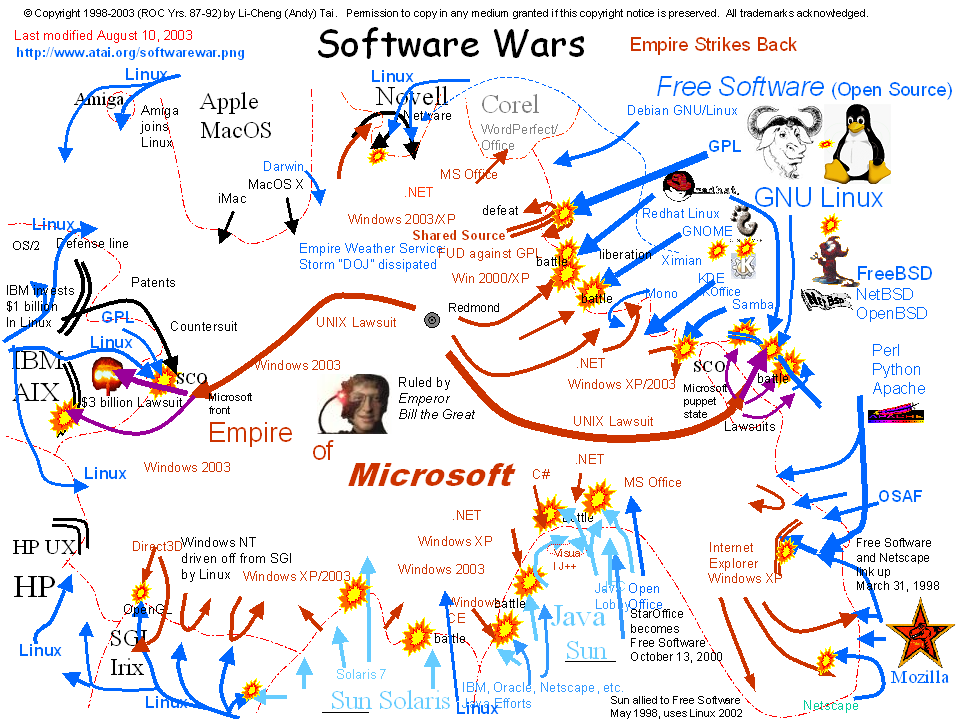
Andy Tai writes "While speaking to financial analysts and commenting on the SCO lawsuit, Bill Gates made the claim that Microsoft's IP is also included in Free/Open source software. Without being specific, he said "There's no question that in cloning activities, IP from many, many companies, including Microsoft, is being used in open-source software. When people clone things, that often becomes unavoidable." Considering Microsoft's claims of ownership over technologies like CIFS, does this mean Microsoft may also launch SCO-style attacks against Free Software/Open Source?"
This is plain stupid. Who do they think they are? Reverse engineering isn't illegal.
Cue 1000 posts about BSD netcode in Windows.
windows inet tools use BSD source, many use other open source libs [libpng, zlib, etc...] doesn't phase them. The fact that they rely on them for success...
But if someone copies a MSFT design element, omg, end of the world, OSS must die!
Hmm hypocrites!
Someday, I'll have a real sig.
Well, I guess this is the new FUD Wars. MS and its friends will be spreading this "Linux stole some copyrighted code/idea" propaganda to slow down adaptation of Linux. Strange that we didn't see it in a Halloween Document, this must be stuff they kept a tight secret about.
What time is it/will be over there? Check with my iPhone app!
Although OSS does try to clone Windows "Look and Feel" (KDE themes etc..) and even Windows features in the form of WINE, the community is very pedantic on making sure they do not use Microsoft code or break any laws.
If developers of Open Sauce software disregard IP laws they are shooting themselves in the foot, because the whole paradigm of Free software relies on users sticking to the IP/Copyright laws and complying with the licence.
I believe this is the regular Microsoft FUD, trying to kick Linux when it is "down" .
There is no god
Wouldn't Apple then be able to claim that the Windows GUI is their IP, and then Xerox could claim that everyone's is theirs?
What about the guys who invented the Abacus? Shouldn't they get a cut too?
Sound waves should be free!
There's no question that in cloning activities, IP from many, many open-source products, is being used in closed-source products. If people at SCO and Microsoft have access to source code, that kind of thing often becomes unavoidable.
I was wondering when the intellectual property attacks would come. It's really the only place open source is vulnerable. I'm really just surprised it took this long.
Any takers on a pool for how long before our good buddies at Microsoft start some legal action?
this is a perfect example on why you should use the GNU/GPL license instead of BSD or other open source models.
It means that big companies will find it more difficult to steal and bury.
* Carthago Delenda Est *
With the garbage that gets a software patent there is certainly IP from microsoft in Linux.
Then again, there's cetainly IP from microsoft in first year programming assignments, "Hello world" probably violates microsoft's IP by now.
Actually, this is exactly what Bill would say at this time. When Gartner says to hold off on Linux development, the business world pricks up its ears. When a few days later, Bill makes a casual statment that Microsoft code has been SCO'd, all of the sudden this is a trend. Linux has major IP problems, is what business will hear.
Bill won't probably ever give details about what IP he's talking about--he doesn't have to. The value of his statement is that it highlights MSFT's long shadow looming over OSS. Specific threats would be refutable--his statement is not.
Net effect? A wonderful chilling effect (in Bill's eyes) on open source development with no costs for MSFT.
I'm much funnier now that I'm a subscriber.
If any manager or businessman begins an assertion with "There's no question", "Clearly", or "It's obvious", that assertion is nothing of the sort. It's a wild-assed guess at best, and a lie at worst. They say these things to give their statement a false measure of authority, and because they can't stand not appearing to know everything all the time. These are the phrases that shift my BS meter into overdrive...
Well, there you have it.
MS recently paid SCO a liscense for UnixWare. Why? Well, I'm no Microsoft PR Troll, but if I were them, and planning on a new "Linux users are dirty lousy thieves" campaign, I'd do my best to let the little freaks at SCO be heard, even if everyone who has the slightest bit of knowledge in the subject knows SCO's full of it. Just long enough to be heard by most people, and get the community whispering in doubt in places. "SCO keeps shouting that Linux stole their IP, what if they're right?"
Because now MS can run "Us too!" ads and FUD Linux in interviews at will. It doesn't have to be true, or even slightly true, all they have to do is put the idea out there and the PHBs of the world, already a bit put off by the SCO mess, will buy it hook, line and sinker.
It's not like the various Open Source people (ESR, the FSF, etc) are given nearly as much press time in contrast to Gates.
How to fight this? Demand MS put up or shut up. Loudly. Whenever anyone is within earshot. Fight their FUD with honest, biting truth -- Linux is open source, we have nothing to hide, and is MS thinks we've stolen something, they're welcome to show some proof. Mention Kerebos, HTML 3.2, and whatever other instances of IP that MS has "Shifting Standardized" or "Embrace and Extended" into being a royal pain in the arse to use.
Of course, this is all assuming that Gates won't sneak some GPLed code into Windows now, and just claim that we stole it from him instead... Which is a decidedly more frightening prospect.
They can't beat us technology wise, they can't beat us pricing wise, but they can lie about us until everyone's too scared to use us.
If we look back at the early suits involving Microsoft and Apple, there may be indicators of how this might turn out. In that case Apple was suing Microsoft for duplicating the look and feel of their GUI but Apple didn't win. I don't know the details of what MS is claiming but does this qualify as a bonafied legal precident?
Gates's main argument here is basically "if you make a clone of one of our programs, it becomes impossible to keep our code out of your program."
Yeah, I remember that time that I made that clone of IE, and then Gates himself showed up at my home, pointed a gun at my head, and forced me to copy and paste code right from IE into my browser. Right...
Last time I checked, it's not illegal for two programs to do the same thing, while having absolutely no code in common.
Let's think about this, anyway: how the hell does MS code get put into linux? MS's code is closed, we can't access it. I bet Linux gets a lot of kernel patches coming from billg@microsoft.com. On the other hand, Linux code is open, you can see all of it, if you want. It would be trivially easy for some coder at MS to see some linux code, and put it into windows without anybody noticing.
If there is any overlapping code in both linux and windows, it's far, FAR more likely that MS stole it from linux, not the other way around. It's also possible that they both came from BSD.
Sonce all their software is not only proprietary but also "closed-source" so nobody can see the source code, automatically nobody can copy or include their sources into other software.
Technically impossoble.
Unless of course you come with the same solution to the same problem and your code looks very much alike. But then I want to sue Gates for violating copyright of my software. Back in the times of Atari I wrote a screen blanker that looks similar to one of Windows blankers. I never released my code, just showed it to several friends, but no doubt one of them told Gates about it and he stole my program!
45 5F E1 04 22 CA 29 C4 93 3F 95 05 2B 79 2A B2
If you can't beat them, sue them.
Microsoft is seeing the end. The end is near and they are starting to prepare for it by using the courts as a an offense instead of building a better product. The only defense (instead of building a better product) is to sue the product thats beating the shit out of you and tie them up legally.
This exact thing is happening to me. I created a product that is better than my one competitor out there. I sell it for a fraction of the cost and it's better technology (of course it's based on Open Source). I've taken 20 - 30 new customers from my one competitor in the last six 5 months. Not bad.
Well, what does the competitor do? They pull a credit report on my company, start making "wild claims" (read: FUD) about me and the company to their existing customers, even went as far as changing their product to make it hard for their existing customers to leave. Recently, I'm hearing that they are using lawyers now to find out information about me and my company... It's an ugly world.
What am I going to do? hahaha. Ignore eveything and keep going on. I won't stop. They'll have to show up with the Sheriff's to pull me out of my office. My belief, this is not about winning a court case, it's about "killing the little guy by legally strangling them."
The days of innovation and competition are over.
Under the present IP and patent laws, he's probably right - given MS holds zillions of patents, it would be very surprising if some Linux stuff didn't step on these patents.
However, I don't think he'd be silly enough to try to enforce these patents. Given IBM's love and support for Linux, and given that MS is almost certainly stepping on some of IBM's even larger set of patents, then he'd potentially be setting MS up for a world of hurt.
There's been a gentleman's agreement for years between IBM, MS and many others that sharing their patents via cross-licencing agreements is the only way to advance the industry as a whole. If MS tries to go against this agreement, IBM could give them a world of hurt (and get a lot of pain in return).
If there's "no question" that your IP is being used in open source software, tell us where. If you're not willing to put your money where your mouth is, the world should rightfully assume that your attacks are baseless and without merit.
I hope you continue on with this approach and name a specific distro or Open Source project so they can sue you for defamation.
He who refuses to do arithmetic is doomed to talk nonsense.
But it's not just the code! That's where you're missing the most critical part of his claim. When you patent softare concepts, you're patenting every array of copying that can happen, and that's the sad part of the matter. Open Source, though only out there for non profit means (until you arrive at Redhat, and the such), has to be aware that it can't trample the rights of big companies, even if it's being sucked dry of all of it's code at the same time.
We live in a capitalistic world, and frankly, an attack like this should be expected. It's a great idea to have people working on open source software for the fun of it, but it has to be original ideas. OSS is like the product of a company. If it's created and it tramples the rights of others, then companies that have been trampled will have the right to come back and request damages from ANYONE that uses the software.
It's a frightening world out there for Open Source Software, but it's a real world. We need not just look past these claims as "Micro$oft hogwash" or anything of the sort. SCO and Microsoft might be making VERY valid points, and it's something the OSS community MUST watch out for.
I love Open Source Software, but I also respect the rights of others, however evil they might be.
...when I saw XP first, was "Finally one of the guys at M$ saw Gnome and understood Windows UI was years behind current standards".
45 5F E1 04 22 CA 29 C4 93 3F 95 05 2B 79 2A B2
From the article:
"One thing about the GPL is that you can't just license IBM Linux, or Red Hat Linux," Gates said. "The way the GPL works, if you license any Linux, you have to license all Linux."
What a bunch of crap. This is disinformation at its best.
- Linux is a Unix kernel clone.
- There is no such thing as Red Hat Linux or IBM Linux. There are IBM or RH distributions that make use of the Linux kernel
- Wtf does "licensing any Linux" and "licensing all Linux" means ? I'm assuming Gates mean licensing any Linux-based distro, in which case you adhere to whatever licensing terms the distro is released under, licensing terms which in turn are compliant with the GPL (since Linux is included).
That blurb from Gates means rigorously nothing whatsoever. But most people aren't even aware of what the GPL is, and when they quickly read something like that, they decude "uuh, Linux is dangerous to my business" or something. That's just ridiculous.
As much as I hate RMS' rants, flamewars and stubbornness, I must admit we need him more than ever today.
"A door is what a dog is perpetually on the wrong side of" - Ogden Nash
What Gates and people of his mindset continue to miss (or ignore) is the fact that 90% of software developers work on code that is never sold. They work for brokerages, shipping companies, hospitals. For code that is never meant to be sold, licensing is rarely an issue.
The GPL only threatens software companies whose primary source of revenue comes from shrink-wrapped proprietary applications.
MjM
I only mod up...
XKCD:Xeric Knowledge Comically Dispen
Also, copyright covers the right to make derivative works. So if there's an icon or other UI element that was a tweaked Windows element then that's technically copyright infringement. It's awefully hard to prove though (given the Apple v. MSFT precedent.
In short, Gates is right but it doesn't mean they'll start firing lawsuits against open source...They didn't previously sue their other competitors unlike how Sun/Oracle lobbied and/or sued MSFT.
We see it in TimeLine suits, the shafting of SpyGlass Systems, Blue Mountain Greeting Cards et al, the clone wars beteen MS-DOS and DR-DOS, the emBorgment of STAC Systems to settle yet another suit, and so on ad nauseum. Heck the company started by dumpster-diving for printouts of other people's software, and probably also had a copy of the Dartmouth BASIC source in hand while they wrote their 4K ROM BASIC (which they had already sold as pre-existing; ie, their first product was vapourware, the start of a long tradition). This is the company that copied the Mac interface right down to details like throwing away variable-sized elevators in order to look more Mac-like (and got sued for that one too).
This is a severe case of the event horizon casting aspersions about the kettle's colour! "Chutzpah" isn't a substantial enough concept for this, it isn't even in the running!
Got time? Spend some of it coding or testing
What delightfull fud
The good mr. Gates completely fails to identify the nature of the IP. He completely fails to identify how the IP is protecteted. And, He completely fails to explain how it got away from microsoft.
Lets consider the possibilities
1. Source code copying
The usual suspect. As always its much more likely that microsoft stole from the open source world than the other way around. You can completely discount the historical incidents and still come to this conclusion. Its just to easy for Microsoft to take something thats publicly available and hide it in its code bloat. OSS developers, would have to somehow purloin Microsfts source and include it into existing projects. NOT LIKELY
2. Look and feel
Microsoft more or less destroyed this argument in their lawsuit with Apple. Apple still owns Xerox Parc and is releasing Darwin under GPL.
3. The ever popular patent system
This is where the pain can come from. Our patent system is seriously broken. Between business method patents, Patents for devices that never get built and the ever popular overly broad but legal patent, are microsofts best weapon against OSS. The sheer cost of prosecuting a lawsuit makes it an effective weapon. On the other hand the organizations developing OSS in general have no assets, they have allready released the code to the world, and theres nothing to stop them from reorganizing in saner parts of the world (PGP excellent example).
As usual this type of action makes me happy I am an NRA member and support the 2nd ammendment to the hilt. The reason smaller government is best is because it belongs to whoever is willing to buy it.
In any case, it is obvious to me that there are still a great many hurdles humanity must face before individuals actually have the freedom so many millions of people have died for in the last century alone. Or something... It is just painful to watch as large corporations push smaller companies and people around, all the while receiving the blessing of our "representatives." I don't know what else to do. Vote, write your representatives, protest. Anything we can legally do only marginally works, if that...
"Civilization is only skin deep"
Sticking feathers up your butt does not make you a chicken - Tyler Durden
If coca-cola brings out a new drink, i do a chemical analysis on it and duplicate it, then bring it out at half the price in a remarkably similar bottle, i'd get sued to death. I don't see why people think the software world should work differently.
Because free software cloning doesn't work that way. When someone write a clone of some Microsoft product, it is assumed that they don't disassemble the original and copy the code (the equivalent of your chemical analysis). The clone is a completely different piece of code with the same capabilities as the originals. Pepsi Cola similarly clean-room engineered their version of sugared water without analyzing the chemical composition of Coca Cola, and they're still around.
"A door is what a dog is perpetually on the wrong side of" - Ogden Nash
I'm seeing a lot of people saying something to the effect of "put up or shut up". Are you sure you really want that? How would it affect your life if the Samba or Apache projects were shut down for patent infringement? I'm not saying this is likely, or even possible, but just think about it for a moment. MS could cause a LOT of problems without even having a valid legal leg to stand on. They certainly could convince a lot of companies to question adoption of open source. And it's not as if they are exactly convinced about it now...
SCO is the last gasps of a desparate company. Any legal action from Microsoft will be very calculated and a much bigger threat. Remember, $40 billion buys a lot of time from your friendly neighborhood legal team. That's pretty hard to fight, even if you are right.
If his goal is to destroy Linux, then he's going to delay showing us the source code as long as possible. If he showed us now, we would just change the code and move along. Same goes for SCO, but I'm not sure what SCO's true intentions are.
We might not want to live in a world where the patent office "pushes innovation by ownership," but it's the reality of Capitalism. You can't turn off cash flow, or you essentially turn off innovation and invention.
Of course Open Source Software is the best example of my previous statement put to the test, but I can still hold to it, because even the best OSS people still have to go out and get jobs to make their OSS Lives work. I've seen examples of OSS projects failing all over the place becasue it costs money to even do OSS. The best place to look is the old Linux Router Project.
All I'm saying is, OSS is a very idealistic set of projects. Idealism is an awesome thing, but when it faces reality, it sometimes less than perfect.
Microsoft, and everyone else that has patent claims, has to be respected. It's part of the REALITY of our world today. If OSS software is unfairly stealing the work of Microsoft, then it's liable; I'm liable.
I realize everyone thinks SCO's actions are sleezy and MS is being oportunistic, but I really think this lawsuit is good for linux as a whole and me in particular. Why? The chicks. The current scenario is:
random girl: can I check my email?
me: sure...
girl: your desktop looks weird, I want to go home now. I'm confused...
but if linux does include stolen code it becomes dangerous:
different girl: mmmm, is that linux you're using?
me: why yes... it is (sly smile)
girl: you're so dangerous, take me now.... on the keyboard...
One can always dream :)
(And before you make wild geek accusations, yes I do have a girl friend and this was intended to be funny :)
Got time? Spend some of it coding or testing
Can they now close down the MS German office just like they did the SCO German office for making unsubstantiated claims?
I am not sure how smart this is for MS. I would think they would want to be distancing themselves from SCO at this point. SCO has obviously been manipulating the financial system by their outrageous and contradictory claims. If SCO is found guilty for pumping up its stock price by making claims about Linux IP, wouldn't MS then be in a difficult situation? Not even going into anti-trust issues . . .
Sdelat' Ameriku velikoy Snova!
I remember the days when Linux was a small esoteric system and most people simply did not know about its existence. Others who knew did not treat it seriously. For the first time I had installed Linux some time around 1993. People were laughing at me and asking why I am wasting my time on it. The reason I did it is that I was looking for a way out from MS crap and from overly expensive Unices from Sun, HP, etc. I wanted to have something that is Unix and that is always with me and I can use it on cheap hardware. It was pretty clear then that all non-MS OSes will be dead soon. Linux for me was a sort refuge from Microsoft repression and I hoped that it will remain an esoteric system for foreseeable future.
This is very regrettable that Linux has got so much attention these days especially from Microsoft. We know perfectly that Microsoft was able to muscle out any other competitor (IBM, Lotus, Borland, Netscape, DR DOS just to name few). Linux is unusual in that sense that it does not rely on the usual commercial cycle of investment-production-sales. But this does not mean that it is not prone to Microsoft tactics. Microsoft did not always use only economic means against its competitors. It was able to fend off antitrust lawsuit without much trouble. Sometimes the tactics was to hire competitors' execs or similar variation. It means that MS has something except for FUD to fight Linux with and there is no doubt that it will do, and it will win.
Using IP laws against Linux is indefensible tactics simply because Linux community is not able to afford to hire enough lawers to defend itself. Probably the only viable solution is to take Linux development and use out of the US and Europe. And this is where globalization plays a bad role: if IP laws are used then they are enforceable pretty much everywhere. Probably China is the most promising country because it has a rather independent policy and its government does invest into Linux.
There is much trouble ahead fro Linux, it had become a victim of its own popularity.
". If it's created and it tramples the rights of others, then companies that have been trampled will have the right to come back and request damages from ANYONE that uses the software."
I'm sorry these rights are a recent fabrication - mostly by America - they did not exist when I entered the business 20 years ago in England.
Why should I recognise them now. I sure as hell didn't vote for them. Did you? I doubt it!
He's not claiming reverse engineering.
What he's claiming is very interesting for people that aren't familiar with the nastiness of big business, though. Sort of an eye-opener for me a few years back, and tech folks should be aware of this if they're interested in IP.
See, you know how most Free Software folks complain bitterly about (at least some) software patents, saying that it makes things really hard to operate? They aren't lying. Engineers working at big companies ran into the same problem *years* ago. You simply cannot build things in a world with this many tech patents. It's impossible. You'd have to check through huge numbers of patents to do anything.
So big business came up with a solution. They just cross-license *everything*. One company is free to use all of another company's (or organizations...for example, MIT and Microsoft cross-license) patents. Most tech companies with decent IP portfolios do this with their competitors. For example, Seagate, Western Digital, Maxtor, etc, all cross license each others' patents.
This seems, at first, counterproductive. After all, isn't the point of patents to give you a short-term edge over competitors, to encourage new development? Nope. Patents in a situation like this still provide one big benefit to their owners -- they maintain oligopolies. If a new hard drive manufacturer comes along and wants to make hard drives, they can't. Seagate, WD, etc own masses of IP, enough to keep the new vendor from entering the market.
This is why patents are pretty frusterating in the world of big business. Go work at a corporate research lab...any patents you come up with don't do your company any good against their competitors. They just keep anyone else from entering the arena.
Now, Gates is troubled enough by Linux to pull the patent oligopoly card out of his sleeve, which normally doesn't get played. MS cross-licenses with *huge* numbers of organizations. They own massive amounts of IP. And yes, it's almost certain that they have rights to a large number of patents that Linux does not have rights to.
Hell, last time Slashdot ran a contest asking for silly patents (a ways back, maybe a year ago), I searched for "computer". First ten hits contained the just-granted patent on the table-lookup optimization for computing CRC-32s. Now, *everyone* does this...modem manufacturers, lots of hardware vendors. Not doing it is stupid. And maybe this patent would have gotten challenged if the owner went after, say, 3com with it. But instead, it's almost certainly in a large patent portfolio somewhere, waiting around for a day when its owner feels threatened by a newcomer to the industry. Then it can pull out its portfolio and start beating folks up.
This is not a trivially fixable feature of the patent system. Most US corporate research (probably foreign as well...I'm just not that familiar with non-US legalities) depends upon the oligopoly benefits provided by patents.
And just throwing out the patent system has other problems. I'm not sure that, say, RSA encryption would *ever* have been developed without a patent system to provide encouragement.
The best thing to do, I think, would be to cap tech patents at seven years, so that companies have to keep frantically coming up with new tech. Wastes more on lawyers -- it costs a couple of thousand per patent, and more patents would have to be produced to compensate -- but that at least alleviates some of the effect.
May we never see th
Thank you for the first comment in this thread that strikes to the heart of the matter.
All the people discussing "intellectual property" on this thread need to review the history of intellectual property, the original reason for its creation, and the social contract that it encompasses when analyzing the current situation in the the field of computer science (and frankly within the entertainment industry as well.)
Intellectual property does not exist to guarrantee the rights of a particular person or group to make a living in a certain way. Rather it is a grant of limited monopoly as an inducement for innovation. In fields were the monetary barrier to entry is small (computer science, music) or where the majority of innovation is government sponsered (biotech, genetics), intellectual property in its current form has ceased to serve its purpose and has instead become an anti-competive bludgeon that quashes innovation. The current system of intellectual property in the US is thus in severe need of reform but such reform is hampered by the business models that it currently protects (as reflected by several postings in this thread.)
It is fairly clear that IP law in the U.S. is out of control. We have companies who spend millions foisting their ideas off on society then complaining thet their ideas are treated as part of the cultural background. We have companies that think it is possible to own the commons. We have legislators and judges agreeing with them (possibly for pay in some cases).
The quickly developing morass is expensive to navigate and makes real innovation nearly impossible. It is rapidly expanding to cover every aspect of life and technology.
What will the U.S. do when the time comes for a cost/benefit analysis and the result is that it is cheaper to leave the U.S. entirely? There are a number of countries out there with a much saner IP situation (even if only by virtue of not really considering IP at all) that would really love to expand their economy and influence by becoming the home of technological innovation.
Up until now, their lack of infrastructure has removed them from consideration. There will come a point where the cost of dealing with stupid U.S. style IP law will exceed the cost of building your own infrastucture in these countries. The decision to move will be a simple matter of economics. After all, corporations do not have patriotism, they know only cost and benefit (read profit).
Looking at history, the U.S. benefitted greatly from being on the other side of that equasion in it's first two centuries. The opportunities presented by a country where one could have a good idea and develop it into a reality free of a million rules and regulations and laws favoring the entrenched dinosaurs were enough to cause innovators and businessmen all over the world to pull up roots and move to the 'the land of opportunity'.
The same legal and economic forces can just as easily drive innovation and business elsewhere.
Anyway THE GPL IS NOT AN EULA. How many times has it been stated here. All it is is a simple copyright notice. Yes this code is copyrighted do not copy it unless you show all the code thanks. Thats basically what the gpl is in simple terms. MS is so obsessed with EULA's because this is how they extort, oops I mean maximize profits.
He does not get the gpl at all. You are right about misinformation.
The only thing MS may be right in is linking to GPL code. This is a gray area. For example I was reading the Reiser comments in an earlier story yesterday and the BSD community will refuse any fS that is gpl. Why? Because they fear if you link to a gpl product then the kernel must turn gpl as well. Isn't the copyleft license specifically for situations like this? Perhaps more developers should use that.
http://saveie6.com/
All,
The term IP is confusing and I would urge that it not be used. It is confusing since it is often used to lump desparate laws of Copyright, Patent and Trademark as well as others together.
By using this term Mr. Gates is raising questions about all of these things lumped into that term, not just Patents or Trademarks.
The real question here is, can any company give us complete assurance that copyrighted or unlicensed material is not present in their software? Most companies DO NOT indemnify you for their infrigements (including MS even with their new license).
The answer to the above question is NO. Why? Because while Copyrights are easy to avoid infringement on in most cases, Patents are not. With Patents, it's like walking throught a mine field. There is no way of telling, short of doing an exhaustive search, if something is patented or not. In fact *MOST* patent attorneys will advise against doing such as search (really!!).
To learn more about patents and their evils in the software industry, please see the petition in my URL.
Thanks, GJC
Gregory Casamento
## Chief Maintainer for GNUstep
Microsoft was convicted of software piracy in France in 2001. They were fined 3 million francs.
You can check out the details here. - Microsoft winds up on both ends of software piracy stick
I would think that the facts discovered during the anti-trust trial would make it painfully obvious to everyone that Microsoft is not overly concerned with things like ethics or laws. For them, it is an accounting decision. What are the chances we will get caught AND convicted, and what will it cost if we are convicted. Intentionally break our competitors' products, even if it hurts our own customers? Sounds like a good idea to me!
It wasn't some guy suddenly deciding to patent software. The Supreme Court decided in Diamond v. Diehr that the USPTO's regulations at the time were unconstitutional. In case you don't follow the link, Diamond v. Diehr was about a method for vulcanizing rubber that used software connected to sensors to determine how best to heat the rubber.
So the USPTO (part of the executive branch of government) was prohibited (by the judicial branch) from following their current regulations. They got no help from Congress (the legislative branch) by creating new laws to help them guide new regulations. The USPTO can't unilaterally revert to their previous rules. Either someone needs to bring a new case to the Supreme Court to challenge the current USPTO regulations, or Congress needs to pass laws that will pass a judicial challenge.
"Under the GPL, all tweaks and applications developed for the operating system must be released to the community. That restriction does not hold true on commercial versions"
All applications must be released to the community? That's just plain untrue. Isn't there a way to let the people reading that article know that he's lying?
Although I happen to feel creators should have rights, I'd like to point out -- though everyone labels the anti-IP crowd as "communistic" -- it is things like "a right to make a living" that are actually closer to the Communist way of speaking.
But more relevantly,
This betrays a very fundamental (and possibly intentional) misunderstanding of intellectual proprty. As a matter of fact, no one is "selling ideas" -- or rather, no one is granted a state-fabricated artificial monopoly to sell them. You want to pay for an idea, go ahead. But the idea isn't protected by IP law. Only the expression of the idea is. That's the major thing messed up with patents on software algorithms and on business methods.
The Mongrel Dogs Who Teach
Wouldn't it be nice if we could get journalists to stop reporting stupid claims of "IP" theft?
It's like saying "They stole our karma".. it's a fictional thing that can't be proven.
Intellectual Property takes one of several specific forms, well defined by law. It's not a general thing.. like "Hey I had that idea, and you used it, so you stole my IP".
Copyright - Original works cannot be copied verbatim. This doens't protect ideas, just specific works. Example: You can't make copies of Windows and sell it without permission.
Patent - Must be registered. Gives absolute protection over the use of a mechanism. Example: firewire. Every firewire device pays Apple a royalty.
Secret (trade secret) - A method where nobody who knows your secret is given access to it except under strict contract. Not really a form of IP.. if someone figures it out and is not under contract, they are free to disclose it. The only value of this kind of so-called IP is if you can manage to keep it a secret. Example: Formula for Coca-cola.
All these companies running around saying "our IP has been taken" is just a bunch of stupid spin-doctoring, and the media should stop catering to it. If SCO has a valid case, they can take it up in court. The same goes for Microsoft, or anyone else.. but running around claiming "IP" theft without specific details is like saying "some people got some ideas from us". Well.. guess what MS.. you and every other software developer out there free or not, got ideas from someone else at some point and used them in their software. big deal.
You are close. It may be the property of MS, but applying the phrase 'intellectual' to the MS Windows UI stretches credibility to the breaking point. I wonder if there is any case law to challenge them on false use of intellect? Any lawyers out there know?
-Charlie
(Yes, for the sarcasm impared, this was meant as humor)
...and how Microsoft is claiming we SCO'd them. I dont' believe that has been said. Gates refered to Microsoft IP, not code. Microsoft's IP can (and surely does) cover more than code (look and feel, networking techniques, crappy vague patents, etc.). I'd be worried more about that than I would be about MS trying to be sneaky and steal some GPL'd code and put it in Windows, or submitting Windows code to the kernel or something like that. Why pull a big elaborate scam when a violation of a vague patent will do just fine?
Monopoly at it's best. Instead of eliminating the competition through inproving your own products, simply bash and sue the others using what should probably be unlawfuly aquired IP ("Method for rasterization of a rectangle through means of an electronic device...OK *stamp*". Scary how much even that parody might be factual given the USPTO, even though I bet that one belongs to IBM
If there is any reason to be afraid, it's that. "FUD" could turn into "deep shit", if they really put their minds to it.
CAn'T CompreHend SARcaSm?
This accusation sounds rather ironic and hypocritical, considering that pretty much everything Microsoft has ever put out is a clone or a copy of something else.
That's how Microsoft has always done business: if you can't buy the innovators, clone their product and give your version away for free until the innovators goes out of business or is otherwise unable to compete.
-- This sig for rent.
Okay, that is finally it. I have been holding onto this idea for too long. In a way, I am surprised that I have not seen or read anything like this idea, but here it goes:
What about Open Source/Free Software code having been used by Micro$oft?
Given what is known about Micro$oft, it is reasonable to suspect that Micro$oft has used Open Source/Free Software code to enhance its software.
What do you we know about Micro$oft? We know:
Given all this, it seems more than reasonably likely that Micro$oft has unlawfully appropriated Open Source/Free Software code into its operating system and tools.
This brings me to the question:
If they did use GPL'd code, is the Micro$oft now required to Open Source all of the code that depends on the appropriated code? In this case, Micro$oft might finally be able to acurately claim that Open Source/Free Software is "viral".Can the Open Source/Free Software community receive a billion dollars from Micro$oft, as SCO is asking from IBM? (A billion dollars would go a long way for the EFF :)
Micro$oft may be using its closed source approach to conceal illegal activities. It seems it is time for the Open Source/Free Software community to ask Micro$oft to demonstrate that their code is free of taint before they can continue to accuse Open Source/Free Software programmers of "stealing" code.
Is this a case of the pot calling the kettle black? Or worse, the pot calling the white porcelain cup black?
All data is speech. All speech is Free.
The (Free)BSD license must be changed. It's no secret that ms is using code from BSD in their 2000/XP code base. While the ability to do so shouldn't change, the BSD team should do what it can to prevent sco/ms type actions.
One of the sco leeches has already stated that they will be looking at BSD next.
The BSD code should be changed, where they revoke license rights if the company using any BSD code either instigates, or supports another company instigating, sco type tactics. They can lay out a roadmap of sorts, where prior to any lawsuit, prior to any contacts by any attorneys, the company's (who adopted the BSD code) engineers will show all code in question to BSD, or to any affected entity, and will be given ample opportunity to replace the code, suggest a mutually agreeable alternative, delete the code, or take some other action that the parties can agree upon. And if they do take the case to court, the complaining party must agree to refund attorney's fees if they lose all, or even part of their case.
Refunding attorney's fees even if they only lose part of their case is important because it makes sure the complaining company's case is damn solid, which in turn will give the affected company/entity more motivation to come to an agreement with the complaining company.
It's up to BSD to do this. Not the linux kernel maintainers. It is the BSD code which can be (and is) adopted by proprietary companies for use in their own code. And they are permitted to not reveal the source code. That's why ms is using BSD code, and why they are getting their OS's to some semblence of stable (they have many miles, and years to go).
So what say you BSD?