 Slashdot Mirror
Gates: Microsoft IP Finds Its Way Into Free Software
Andy Tai writes "While speaking to financial analysts and commenting on the SCO lawsuit, Bill Gates made the claim that Microsoft's IP is also included in Free/Open source software. Without being specific, he said "There's no question that in cloning activities, IP from many, many companies, including Microsoft, is being used in open-source software. When people clone things, that often becomes unavoidable." Considering Microsoft's claims of ownership over technologies like CIFS, does this mean Microsoft may also launch SCO-style attacks against Free Software/Open Source?"
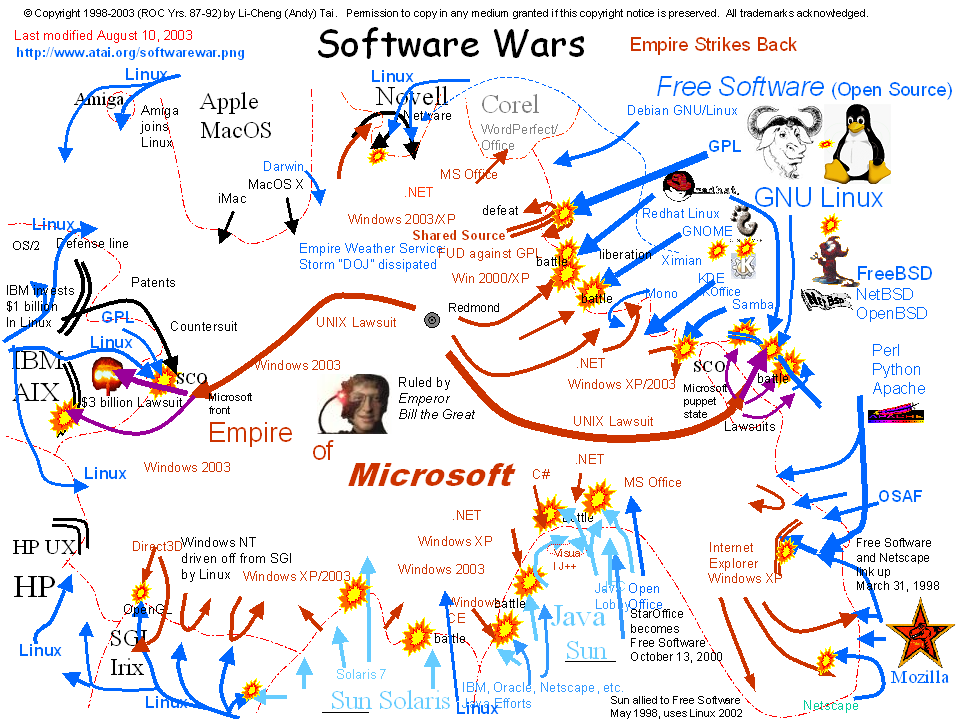
Although OSS does try to clone Windows "Look and Feel" (KDE themes etc..) and even Windows features in the form of WINE, the community is very pedantic on making sure they do not use Microsoft code or break any laws.
If developers of Open Sauce software disregard IP laws they are shooting themselves in the foot, because the whole paradigm of Free software relies on users sticking to the IP/Copyright laws and complying with the licence.
I believe this is the regular Microsoft FUD, trying to kick Linux when it is "down" .
There is no god
Wouldn't Apple then be able to claim that the Windows GUI is their IP, and then Xerox could claim that everyone's is theirs?
What about the guys who invented the Abacus? Shouldn't they get a cut too?
Sound waves should be free!
this is a perfect example on why you should use the GNU/GPL license instead of BSD or other open source models.
It means that big companies will find it more difficult to steal and bury.
* Carthago Delenda Est *
Besides, using the term "clone" is so vague as to be meaningless. There's a big difference between copying something directly and achieving the same results through reverse engineering.
Stop by my site where I write about ERP systems & more
With the garbage that gets a software patent there is certainly IP from microsoft in Linux.
Then again, there's cetainly IP from microsoft in first year programming assignments, "Hello world" probably violates microsoft's IP by now.
Actually, this is exactly what Bill would say at this time. When Gartner says to hold off on Linux development, the business world pricks up its ears. When a few days later, Bill makes a casual statment that Microsoft code has been SCO'd, all of the sudden this is a trend. Linux has major IP problems, is what business will hear.
Bill won't probably ever give details about what IP he's talking about--he doesn't have to. The value of his statement is that it highlights MSFT's long shadow looming over OSS. Specific threats would be refutable--his statement is not.
Net effect? A wonderful chilling effect (in Bill's eyes) on open source development with no costs for MSFT.
I'm much funnier now that I'm a subscriber.
If any manager or businessman begins an assertion with "There's no question", "Clearly", or "It's obvious", that assertion is nothing of the sort. It's a wild-assed guess at best, and a lie at worst. They say these things to give their statement a false measure of authority, and because they can't stand not appearing to know everything all the time. These are the phrases that shift my BS meter into overdrive...
Well, there you have it.
MS recently paid SCO a liscense for UnixWare. Why? Well, I'm no Microsoft PR Troll, but if I were them, and planning on a new "Linux users are dirty lousy thieves" campaign, I'd do my best to let the little freaks at SCO be heard, even if everyone who has the slightest bit of knowledge in the subject knows SCO's full of it. Just long enough to be heard by most people, and get the community whispering in doubt in places. "SCO keeps shouting that Linux stole their IP, what if they're right?"
Because now MS can run "Us too!" ads and FUD Linux in interviews at will. It doesn't have to be true, or even slightly true, all they have to do is put the idea out there and the PHBs of the world, already a bit put off by the SCO mess, will buy it hook, line and sinker.
It's not like the various Open Source people (ESR, the FSF, etc) are given nearly as much press time in contrast to Gates.
How to fight this? Demand MS put up or shut up. Loudly. Whenever anyone is within earshot. Fight their FUD with honest, biting truth -- Linux is open source, we have nothing to hide, and is MS thinks we've stolen something, they're welcome to show some proof. Mention Kerebos, HTML 3.2, and whatever other instances of IP that MS has "Shifting Standardized" or "Embrace and Extended" into being a royal pain in the arse to use.
Of course, this is all assuming that Gates won't sneak some GPLed code into Windows now, and just claim that we stole it from him instead... Which is a decidedly more frightening prospect.
They can't beat us technology wise, they can't beat us pricing wise, but they can lie about us until everyone's too scared to use us.
If we look back at the early suits involving Microsoft and Apple, there may be indicators of how this might turn out. In that case Apple was suing Microsoft for duplicating the look and feel of their GUI but Apple didn't win. I don't know the details of what MS is claiming but does this qualify as a bonafied legal precident?
Hay, if they clime open source stole some of their IP, then they'll just have to open up their source codes so we can see if they've stolen any GPL'ed code from OSS.
-----
One is born into aristocracy, but mediocrity can only be achieved through hard work.
BSD code is in there, in full compliance with the license.
Microsoft actaully does use GPL code as well in some of their unix interopability software. Again, believe it or not, they actually comply with the license.
With the pressure on Microsoft, I don't think they would risk getting caught stealing code. If such an accusation came up and had even the slightest whiff of legitimacy, I'd expect to see several MS developers fired immediately and MS offering a large settlement deal.
If you can't beat them, sue them.
Microsoft is seeing the end. The end is near and they are starting to prepare for it by using the courts as a an offense instead of building a better product. The only defense (instead of building a better product) is to sue the product thats beating the shit out of you and tie them up legally.
This exact thing is happening to me. I created a product that is better than my one competitor out there. I sell it for a fraction of the cost and it's better technology (of course it's based on Open Source). I've taken 20 - 30 new customers from my one competitor in the last six 5 months. Not bad.
Well, what does the competitor do? They pull a credit report on my company, start making "wild claims" (read: FUD) about me and the company to their existing customers, even went as far as changing their product to make it hard for their existing customers to leave. Recently, I'm hearing that they are using lawyers now to find out information about me and my company... It's an ugly world.
What am I going to do? hahaha. Ignore eveything and keep going on. I won't stop. They'll have to show up with the Sheriff's to pull me out of my office. My belief, this is not about winning a court case, it's about "killing the little guy by legally strangling them."
The days of innovation and competition are over.
But it's not just the code! That's where you're missing the most critical part of his claim. When you patent softare concepts, you're patenting every array of copying that can happen, and that's the sad part of the matter. Open Source, though only out there for non profit means (until you arrive at Redhat, and the such), has to be aware that it can't trample the rights of big companies, even if it's being sucked dry of all of it's code at the same time.
We live in a capitalistic world, and frankly, an attack like this should be expected. It's a great idea to have people working on open source software for the fun of it, but it has to be original ideas. OSS is like the product of a company. If it's created and it tramples the rights of others, then companies that have been trampled will have the right to come back and request damages from ANYONE that uses the software.
It's a frightening world out there for Open Source Software, but it's a real world. We need not just look past these claims as "Micro$oft hogwash" or anything of the sort. SCO and Microsoft might be making VERY valid points, and it's something the OSS community MUST watch out for.
I love Open Source Software, but I also respect the rights of others, however evil they might be.
...when I saw XP first, was "Finally one of the guys at M$ saw Gnome and understood Windows UI was years behind current standards".
45 5F E1 04 22 CA 29 C4 93 3F 95 05 2B 79 2A B2
windows inet tools use BSD source, many use other open source libs [libpng, zlib, etc...] doesn't phase them. The fact that they rely on them for success...
The BSD TCP source is used by just about everyone, because when it was written it was the best. The 4.4 version is pretty much the reference product. And the Berkeley people had the wisdom to release it under the BSD license, which means that everyone else quickly adopted it and thus followed some sort of standard.
There is no hypocrisy involved. Microsoft's campaigns against open-source are misguided and misleading, but they have made it clear that they think a package like the BSD TCP stack should be released under a very liberal license. It would be a disaster if it had been released under the GPL- companies would have used their own inferior implementations, which would probably end up being somewhat incompatible or would break the standard. Although it's arguable whether Microsoft has played fast and loose with the protocol, I think we can agree that it's far better that they start out with the same implementation as everyone else rather than code their own...
As for libpng, same deal. The PNG team simply wanted to replace GIF with something that wouldn't get people sued, so they release libpng under a BSD-like license. If they hadn't, Microsoft simply wouldn't have supported PNG at all.
Actually... if you check out halloween 7, you will see that this was foreshadowed. Indeed, the brush up with SCO has every sign of being just an opening skirmish in a long battle. Note Eric Raymond's comment in the intro to Halloween 7 - "The risk that Microsoft will go on a patent-lawsuit rampage, designed more to scare potential open-source users than to actually shut down developers, is substantial. The language about "concrete actions" in relation to IPR has the same ominous feel that the talk of "de-commoditizing protocols" did in Halloween I and II." This is partly based on the following comment within the Halloween doc: "Linux patent violations/risk of being sued" struck a chord with US and Swedish respondents. Seventy-four percent (74%) of Americans and 82% of Swedes stated that the risk of being sued over Linux patent violations made them feel less favorable towards Linux. This was the only message that had a strong impact with any audience."
From the article:
"One thing about the GPL is that you can't just license IBM Linux, or Red Hat Linux," Gates said. "The way the GPL works, if you license any Linux, you have to license all Linux."
What a bunch of crap. This is disinformation at its best.
- Linux is a Unix kernel clone.
- There is no such thing as Red Hat Linux or IBM Linux. There are IBM or RH distributions that make use of the Linux kernel
- Wtf does "licensing any Linux" and "licensing all Linux" means ? I'm assuming Gates mean licensing any Linux-based distro, in which case you adhere to whatever licensing terms the distro is released under, licensing terms which in turn are compliant with the GPL (since Linux is included).
That blurb from Gates means rigorously nothing whatsoever. But most people aren't even aware of what the GPL is, and when they quickly read something like that, they decude "uuh, Linux is dangerous to my business" or something. That's just ridiculous.
As much as I hate RMS' rants, flamewars and stubbornness, I must admit we need him more than ever today.
"A door is what a dog is perpetually on the wrong side of" - Ogden Nash
What Gates and people of his mindset continue to miss (or ignore) is the fact that 90% of software developers work on code that is never sold. They work for brokerages, shipping companies, hospitals. For code that is never meant to be sold, licensing is rarely an issue.
The GPL only threatens software companies whose primary source of revenue comes from shrink-wrapped proprietary applications.
MjM
I only mod up...
XKCD:Xeric Knowledge Comically Dispen
We see it in TimeLine suits, the shafting of SpyGlass Systems, Blue Mountain Greeting Cards et al, the clone wars beteen MS-DOS and DR-DOS, the emBorgment of STAC Systems to settle yet another suit, and so on ad nauseum. Heck the company started by dumpster-diving for printouts of other people's software, and probably also had a copy of the Dartmouth BASIC source in hand while they wrote their 4K ROM BASIC (which they had already sold as pre-existing; ie, their first product was vapourware, the start of a long tradition). This is the company that copied the Mac interface right down to details like throwing away variable-sized elevators in order to look more Mac-like (and got sued for that one too).
This is a severe case of the event horizon casting aspersions about the kettle's colour! "Chutzpah" isn't a substantial enough concept for this, it isn't even in the running!
Got time? Spend some of it coding or testing
I suspect that the IP they're referring to isn't just source code. Off the top of my head, for example, check out this fvwm95 screenshot. I'm sure MS considers the Windows UI as its intellectual property, and though IANAL I suspect they may be right.
I realize everyone thinks SCO's actions are sleezy and MS is being oportunistic, but I really think this lawsuit is good for linux as a whole and me in particular. Why? The chicks. The current scenario is:
random girl: can I check my email?
me: sure...
girl: your desktop looks weird, I want to go home now. I'm confused...
but if linux does include stolen code it becomes dangerous:
different girl: mmmm, is that linux you're using?
me: why yes... it is (sly smile)
girl: you're so dangerous, take me now.... on the keyboard...
One can always dream :)
(And before you make wild geek accusations, yes I do have a girl friend and this was intended to be funny :)
Got time? Spend some of it coding or testing
I'd spend the rest of my life puzzled as to how something Microsoft patented could have ended up in Apache without it automatically being prior art either in Apache or httpd.
One line blog. I hear that they're called Twitters now.
Can they now close down the MS German office just like they did the SCO German office for making unsubstantiated claims?
I am not sure how smart this is for MS. I would think they would want to be distancing themselves from SCO at this point. SCO has obviously been manipulating the financial system by their outrageous and contradictory claims. If SCO is found guilty for pumping up its stock price by making claims about Linux IP, wouldn't MS then be in a difficult situation? Not even going into anti-trust issues . . .
Sdelat' Ameriku velikoy Snova!
". If it's created and it tramples the rights of others, then companies that have been trampled will have the right to come back and request damages from ANYONE that uses the software."
I'm sorry these rights are a recent fabrication - mostly by America - they did not exist when I entered the business 20 years ago in England.
Why should I recognise them now. I sure as hell didn't vote for them. Did you? I doubt it!
He's not claiming reverse engineering.
What he's claiming is very interesting for people that aren't familiar with the nastiness of big business, though. Sort of an eye-opener for me a few years back, and tech folks should be aware of this if they're interested in IP.
See, you know how most Free Software folks complain bitterly about (at least some) software patents, saying that it makes things really hard to operate? They aren't lying. Engineers working at big companies ran into the same problem *years* ago. You simply cannot build things in a world with this many tech patents. It's impossible. You'd have to check through huge numbers of patents to do anything.
So big business came up with a solution. They just cross-license *everything*. One company is free to use all of another company's (or organizations...for example, MIT and Microsoft cross-license) patents. Most tech companies with decent IP portfolios do this with their competitors. For example, Seagate, Western Digital, Maxtor, etc, all cross license each others' patents.
This seems, at first, counterproductive. After all, isn't the point of patents to give you a short-term edge over competitors, to encourage new development? Nope. Patents in a situation like this still provide one big benefit to their owners -- they maintain oligopolies. If a new hard drive manufacturer comes along and wants to make hard drives, they can't. Seagate, WD, etc own masses of IP, enough to keep the new vendor from entering the market.
This is why patents are pretty frusterating in the world of big business. Go work at a corporate research lab...any patents you come up with don't do your company any good against their competitors. They just keep anyone else from entering the arena.
Now, Gates is troubled enough by Linux to pull the patent oligopoly card out of his sleeve, which normally doesn't get played. MS cross-licenses with *huge* numbers of organizations. They own massive amounts of IP. And yes, it's almost certain that they have rights to a large number of patents that Linux does not have rights to.
Hell, last time Slashdot ran a contest asking for silly patents (a ways back, maybe a year ago), I searched for "computer". First ten hits contained the just-granted patent on the table-lookup optimization for computing CRC-32s. Now, *everyone* does this...modem manufacturers, lots of hardware vendors. Not doing it is stupid. And maybe this patent would have gotten challenged if the owner went after, say, 3com with it. But instead, it's almost certainly in a large patent portfolio somewhere, waiting around for a day when its owner feels threatened by a newcomer to the industry. Then it can pull out its portfolio and start beating folks up.
This is not a trivially fixable feature of the patent system. Most US corporate research (probably foreign as well...I'm just not that familiar with non-US legalities) depends upon the oligopoly benefits provided by patents.
And just throwing out the patent system has other problems. I'm not sure that, say, RSA encryption would *ever* have been developed without a patent system to provide encouragement.
The best thing to do, I think, would be to cap tech patents at seven years, so that companies have to keep frantically coming up with new tech. Wastes more on lawyers -- it costs a couple of thousand per patent, and more patents would have to be produced to compensate -- but that at least alleviates some of the effect.
May we never see th
Anyway THE GPL IS NOT AN EULA. How many times has it been stated here. All it is is a simple copyright notice. Yes this code is copyrighted do not copy it unless you show all the code thanks. Thats basically what the gpl is in simple terms. MS is so obsessed with EULA's because this is how they extort, oops I mean maximize profits.
He does not get the gpl at all. You are right about misinformation.
The only thing MS may be right in is linking to GPL code. This is a gray area. For example I was reading the Reiser comments in an earlier story yesterday and the BSD community will refuse any fS that is gpl. Why? Because they fear if you link to a gpl product then the kernel must turn gpl as well. Isn't the copyleft license specifically for situations like this? Perhaps more developers should use that.
http://saveie6.com/
Microsoft was convicted of software piracy in France in 2001. They were fined 3 million francs.
You can check out the details here. - Microsoft winds up on both ends of software piracy stick
I would think that the facts discovered during the anti-trust trial would make it painfully obvious to everyone that Microsoft is not overly concerned with things like ethics or laws. For them, it is an accounting decision. What are the chances we will get caught AND convicted, and what will it cost if we are convicted. Intentionally break our competitors' products, even if it hurts our own customers? Sounds like a good idea to me!
Microsoft is a stagnating company. The share holders expect continued growth. They rule the desktop, but can't seem to break into any new markets. The server market is one they are fighting hard to win.
They know how to play dirty and leverage one monopoly to make a new one, so they keep making windows clients only work well with windows servers.
The open source people clone the server protocol and Bill gets steams. The funny thing is they can't really sue. If they sue, they have to make claims on the record in court and those claims would be great in the next anti-trust suit.