 Slashdot Mirror
Surviving Slashdotting with a Small Server
S.BartFarst writes "Our little departmental server has been slashdotted twice in the last year and survived! Implementation of a two-headed redundant hardware scheme using linux virtual server and backup and failover capabilities enhanced by the linux high-availability tools has produced a nifty low-cost solution. Gotta love those little white boxes!
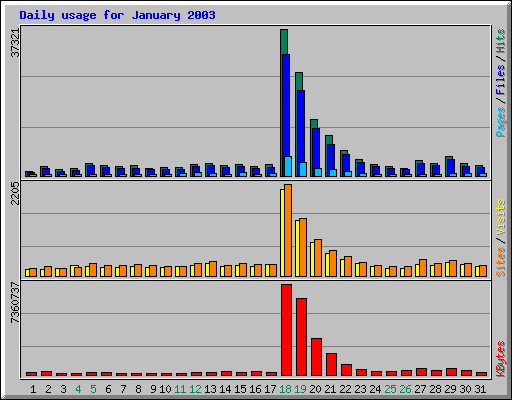
(also having a university-supplied BIG PIPE doesn't hurt). More interesting is the documentation of the apparent exponentially decaying attention span of slashdotters. Anybody else observed similar phenomena?"
Notice this comment was posted on a slow Sunday afternoon (EST). Very clever, because they know that /.'ers can't resist a challenge like that. Feel sorry for them on Monday morning though...
well there you go... having a massive amount of bandwidth will allow you to survive a slashdotting. In most cases of slashdotting, I dont think the server was the bottleneck... its no problem for a server to dish out static pages... its the bandwidth, especially for serving pictures or videos....
Or is it where the article is at any given time? Top of front page gives lots of hits. As it drifts down, the hits slow as fewer read; to the sidebar, fewer but still substantial hits; then off to the specialty pages such as Science or Games, then only a few will read.
Of course, the only test would be to repost the article and see if there's the same number of hits... Nah, slashdot would never go for duplicate stories.
Interesting how it peaks, drops off slowly then rises again a little before dropping off again. Maybe some 'behind the curve' slashdot readers?
Its incredible, this person has actually proven that LOAD BALANCING MULTIPLE SERVERS INCREASES YOUR LOAD CAPACITY! This is incredible news! Wow, I am sure glad it made it as an article, stunning.
Every medium to large website out there will be pleased to know that what they have been doing for the last 8 years is actually VALID, thanks guys!
I think the only reason this made it to the front page is the slashdot self-reference.
I'll bet if you chart the data hour-by-hour, you'll see a sudden dropoff at the very moment the story scrolls off.
You didn't get Slashdotted if the server was still operating normally. You just had some people from Slashdot visit.
May we never see th
Our little departmental server has been slashdotted twice in the last year and survived!
:-)
Oh, come on. Even my little old G3 iMac is capable of handling quite a load from Slashdot and this site is serving up graphics intensive stuff. What you need to prevent a good Slashdotting is bandwidth that universities provide. T3 backbone connections are a wonderful thing.
Go ahead click all you want.
Visit Jonesblog and say hello.
From the Article:
Each machine has its own independent 100 Mbit connection to the Gigabit SMU internet service,
I really didn't see 'cheap dual-channel switch' in there anywhere . . I DID see independent 100 Mbit connection though.
Your hair look like poop, Bob! - Wanker.
Er... no. Logarithms increase.
Exponential decay is of the form:
y = e^-a x
Where a is positive. It's exponential in that a fixed increase in x multiplies y by a fixed number; it's just that this number is less than one.
I think that's part of it. But I bet most of the effect goes to Karma whoring. Notice the second minor blip later on in their data.
When the article is new, the rush is on for insightful comments that deal with commenting on elements of the referenced links. (Might as well, there aren't any comments beyond ascii pictures, and troll expiditionary forces.) They have their responses, which then triggers the volley of RTFA's, and now there are a number of posts, people don't have to RTFA so much and the thread contains so much information anyway. But certain conversations develop, some tangential, but others still tightly following the information referenced in the links, and may even provide deeper links, which cause people to go back and reference the original works which provoked the server beating.
So one might look at there data and then form the yet to be tested hypothesis that the second blip is accurately representative of the slashdotters who are genuinly interested in any random subject at hand, and the difference between that and the peak could be correlated to the number of whores.
But that one isn't me, because A) Sunday B) I forgot to take my adderall.
Most slashdottings come from limited bandwidth or php/perl/asp/mysql/ etc being unable to handle it. Most dynamic content could be static content. (Most slashdot pages are static caches).
The ideal situation would be if you got a warning from slashdot and then then made some mirrors of the pages on distributer mirror.
Mouse powered Chips, Open source Processors and Lego
On the stats link provided for a January slashdotting, the most bandwidth used in a day was a little under 7.4 GB. Assume that it was posted on /. at noon, so there were 12 hours to spread the big hit over: about 617 MB/hr. That's a little over 10 MB/Min, or 170 KB/sec. Even if we assume that the initial hit was double that, I can easily stream a 1000 KB/sec Divx movie over my 100 Mbps switched home LAN. The limiting factors here are the servers, routers and bandwidth to the Internet, not the local network connecting the servers.
That's it. I'm no longer part of Team Sanity.
Why is it surprising that it follows an exponential dropoff? The only interesting questions are the coefficients of exponential dropoff, not that it's exponential--I'd sit upright and take notice if it was a linear decrease.
Anything which follows a steady fractional diminishment will have a curve of y = ke**-ax, where k and a are constants. You see this basic equasion pop up all the time in physics, economics, statistics... etc. Why should server slashdotting be any different?
You're getting modded down for a number of reasons:
1. You're posting AC. Try logging in, ok?
2. Your code redirects the user to goatse.cx. Other variations you have posted redirect to tubgirl.com. This shows that you're not really concerned about slashdotting (why the variation in code? you mean this isn't the *actual* code you use? why am I not surprised?). You just want the juvenile thrill of trolling.
3. If you honestly want to prevent a slashdotting, how about redirecting to a google cache of your page?
If you're really serious, login and post your contribution without being so trollish. How do you expect to be serious when you say "Slashdot users are BANNED, now go look at an erupting asshole!" ?
I remember the days when I would treasure any new content and what I read or saw had more of an impact on me. Now information is just catalogued in my head and I feel this strange need to gather more all the time.
...and don't even get me started on modern day movie trailers. There are so many cutscenes in trailers now that I literally have to close my eyes in the theatre to avoid having an epileptic seizure.
I think the attention span problem is more widespread than just us slash-heads. People are now being inundated with constant 'quick clips' and cut scenes for every television show and commercial
How can our brains avoid being desensitized with so much information being thrown at us all the time?
- Simon
Remember also that even though it's a fact that a huge amount of Slashdot users are interested in articles like this, still I'd imagine that a "normal" article with actual information attracts more readers, and therefore causes more traffic and server load. I could be wrong too, but I doubt it. ;)
They survived this before, just saying that judging their performance now by this article may not be correct. Subject does matter.
True, especially since the Kazaa-happy college kids aren't due back for two more weeks.
The problem with that is by giving a heavy disadvantage to the newest user on the system will likely make that new user feel unwelcome. That leads to abandonded newbie accounts, which is a bad thing for business. If you have no replacement customers coming in for the ones who leave, you'll have a decaying site and there won't be any /. effect anymore, nor will there be a /.
Beware of side effects when you try to implement simple solutions like that...
Bill Stewart
New Fast-Compression-only CPR http://preview.tinyurl.com/dy575ks
> After that, your cheap ide disk might have a hard time
You do realise, don't you, that a cheap IDE disk can handle
more throughput than a T3 line or a 10/100 switch? Refer to
the speed chart below.
Although, if you don't have adequate cooling, making it do so
continually for a few hours could have a detrimental impact on
its lifespan. But a university department server is probably
in an air-conditioned building, which makes adequate cooling
fairly easy, because ambient temperature stays low no matter
how much heat you blow out the back of the box. So you slap
a cooler on the HD and add one case fan and you're set, yes?
Speed Chart:
CPU, RAM, HD, Ethernet/T3, T1, Dialup, Keyboard
Each step is _at least_ an order of magnitude slower than the
previous step on the chart. Thus, if your bottleneck is the
T3 line, even the cheapest IDE hard drive can easily keep up.
Removable drives are well slower than the HD, but I don't know
how they compare to the networking technologies. Residential
broadband is generally not better than T1 and often is closer
to dialup. (Dialup at "56k" gets real speeds up to 45kbps; T1
is about 1500kbps, so 128 or even 256kbps is closer to dialup
than it is to T1. 512kbps is (geometrically) closer to the T1,
however, and so can be classified as true broadband.)
Cut that out, or I will ship you to Norilsk in a box.
1. Not enough bandwidth
2. Poorly configured web server
3. 300k images & 20MB mpeg/avi downloads (see #1)
4. Not enough RAM (1GB is generally enough)
I host about 50 domains for friends on my webserver (an Athlon 1.2Ghz w/ 1GB RAM) and have survived a simultaneous Slashdot and Fark link.
--Brent
Anti SCO T-Shirt