 Slashdot Mirror
Halley's Comet Imaged As Transneptunian Object
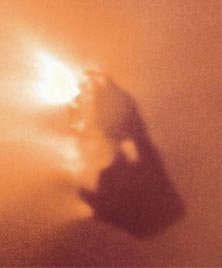
An anonymous reader writes "The European Space Observatory has imaged Halley's Comet at the farthest point (past Neptune) in which such a 10-kilometer diameter iceball has ever been observed. To image a comet as a raven-black object, without its bright dust tail (coma), is equivalent to seeing a lump of coal at the distance between the Earth's poles and to do so in the evening twilight. The last gasp seen from Halley's Comet was 1991, when a gigantic explosion happened, providing it with an expanding, extensive cloud of dust for several months. It is not known whether this event was caused by a collision with an unknown piece of rock or by internal processes (a last 'sigh' on the way out). Halley has an orbital period just over 76 years and will return in 2062."

Reading this made me think of the comet rendevous in 2061. I doubt that I'll live to see something like that actualy accomplished.
What we need is another space race, some incentive to get there. My guess is that the next space race will be for resources, metals, chemicals, etc.
stuff
... in seeing a comet without its dust tail??
The spot was discovered by Robert Hooke in 1664. The spot is HUGE (large enough to hold to Earths) and back in the 15'th centurty it was much brighter.
Really? You have some idea of of how the GRS appeared 200 years before Hooke (in the mid seventeenth century) inferred the rotational period of Jupiter? The earliest definitive observations of the GRS, btw, are those of Heinrich Schwabe (1831)
Now it's 5% imagination, 5% data, and 90% computation.
"Learning is not compulsory... neither is survival."
--Dr.W.Edwards Deming
I'd put money on it in fact being impossible to view a lump of coal at that distance. In fact, I propose someone do a lump of coal viewing test. These people can get away with all sorts of silly analogies to make themselves seem impressive and nobody calls their bluff.
Doesn't it make you feel good to know that our freedoms are protected by politicans, lawyers and journalists.