 Slashdot Mirror
Halley's Comet Imaged As Transneptunian Object
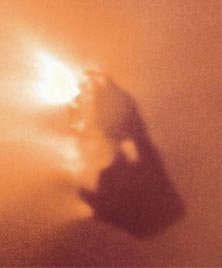
An anonymous reader writes "The European Space Observatory has imaged Halley's Comet at the farthest point (past Neptune) in which such a 10-kilometer diameter iceball has ever been observed. To image a comet as a raven-black object, without its bright dust tail (coma), is equivalent to seeing a lump of coal at the distance between the Earth's poles and to do so in the evening twilight. The last gasp seen from Halley's Comet was 1991, when a gigantic explosion happened, providing it with an expanding, extensive cloud of dust for several months. It is not known whether this event was caused by a collision with an unknown piece of rock or by internal processes (a last 'sigh' on the way out). Halley has an orbital period just over 76 years and will return in 2062."

The spot was discovered by Robert Hooke in 1664. The spot is HUGE (large enough to hold to Earths) and back in the 15'th centurty it was much brighter. The red spot in the southern hemisphere has been there for about 400 years and is starting for fade.
That should be European Southern Observatory (www.eso.org).
-- "Sponges grow in the ocean. I wonder how much deeper the ocean would be if that didn't happen."
Wll, at least sometime around the Battle of Hastings. It appeared near Easter, 1066 and Harold was warned it was a BAD OMEN. Hastings was in September or October, 1066. The Bayeux Tapestry (yes, I've seen it) records the events and the comet appears well before the battle above Harold's minions warning him.
So shove your Cool Fact urban legend. Not even the Middle Ages records support your ignorant claim.
Considering the fact that Aricebo is a radio telescope, i don't think you'll get much of a view. (well, aside from the fact that the telescope itself is quite a view...)
True. Halley's Comet is ideal for this kind of observation because it has one of the most accurately known orbits of all comets of this kind of orbital period.
But you shouldn't see this as just a comet finding exercise (though it does prove the capabilities of the VLT rather well).
By analysing the image further it will be possible to determine whether there is any activity at this distance, or a residual dust cloud. Depending on what filters they used for the observation, they might be able to compare the "colour" of the nucleus with that observed by the spacecraft back in 1986 and look for changes. This might indicate a change in surface conditions at large distances form the sun.
-- "Sponges grow in the ocean. I wonder how much deeper the ocean would be if that didn't happen."
Hmmm, I read that as a 'gigantic explosion' involving Halley's Comet, however it seems to involve Comet 57P/du Toit-Neujmin-Delporte according to one of the linked articles. Did I miss something?
Even if the event was caused by internal processes, trajectory changes are still possible due to Newton's 3rd law of motion. A last 'sigh' may not generate as much momentum as a collision, but it should still have enough impulse to make determination of the exact nature of the event non-trivial.
Should we be worried about the solar system replenishing its comets? I don't think running out of comets should concern us Earth dwellers that much. In fact, it would be best to have as few of them as possible unless we want to go the way of the dinosours. Our technology gives us an edge over our Cretaceous-dwelling friends, but the resources needed for a comet defense force seem outrageous when you consider all the problems on Earth that need money, political will, and man power. Besides, Bruce Willis & gang are better suited for...well, almost anything else. damn! that movie sucked!
Stay sentient. Don't drink bad milk.
The link that is described as referring to an event involving Halley's Comet is talking about a different comet. I should poke around for events actually involving Halley's, but I'll just settle for saying that I don't recall hearing anything unusual as it wandered away, and I'm actually rather skeptical we could see so much of it at that time (though the latest imaging is an impressive accomplishment).
Freedom = (Meaningful - Coerced) Choice != (Speech | Beer^2), and sad sock puppets' bad mods avail them naught.
I'm sorry I did not flame this comment with the vehemence it deserves. I'm a blood-loyal American of bavarian descent, but respect and study other cultures. The Bayeux Tapestry records the events quite well, or at least better than any other extant records. Harold and his Anglo-Saxon advisors saw the comet around Easter, 1066, well before the battles that shaped the future of England began. Prior to that, he had been washed ashore on the Norman coast and pledged allegiance to William of Normandy in return for safe passage home. The comet was seen as an EVIL OMEN. As far as 1066 fighting went, the Anglo-Saxons first fought Norseman in what is now northeastern England and sustained serious losses. They were then defeated at Hastings after a brutal fight. The Norman cavalry won the day, and some it may have been the stirrup (pictured in the Tapestry) that won the day. And no, it is not certain that Harold was killed by an arrow in the eye. There is no definitive evidence of how Harold died. The comet -- as depicted in the Tapestry -- is not a major event. It is significant in that it appeared before the battles that consumed the entire year, culminating in the Norman Conquest. View the evidence and get a clue.
In other news: Aricebo is a radio telescope.
"Learning is not compulsory... neither is survival."
--Dr.W.Edwards Deming