 Slashdot Mirror
Halley's Comet Imaged As Transneptunian Object
An anonymous reader writes "The European Space Observatory has imaged Halley's Comet at the farthest point (past Neptune) in which such a 10-kilometer diameter iceball has ever been observed. To image a comet as a raven-black object, without its bright dust tail (coma), is equivalent to seeing a lump of coal at the distance between the Earth's poles and to do so in the evening twilight. The last gasp seen from Halley's Comet was 1991, when a gigantic explosion happened, providing it with an expanding, extensive cloud of dust for several months. It is not known whether this event was caused by a collision with an unknown piece of rock or by internal processes (a last 'sigh' on the way out). Halley has an orbital period just over 76 years and will return in 2062."

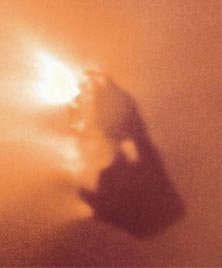
It is not known whether this event was caused by a collision with an unknown piece of rock or by internal processes (a last 'sigh' on the way out).
If they were able to image it, it seems they knew where it was, by mapping where it was going. If it had collided with something, it's trajectory would have changed.
So does this give us new insight as to how comets die? And if they die, how are they still comets? How does the solar system replenish its comet supply?
Everything seemed to be going so nice
'till the end of all beings punched right through the ice
Almost 1000 years ago, Halley's Comet was overhead during the Battle of Hastings in the year 1066. That long ago, the comet was said to have virtually filled the sky it was so bright. It must have been perceived as a powerful omen.
They can pick out such a small dark object at that distance. Makes me hope that maybe one day the Star Trek scenes where Picard asks Data for range to object and then has it on screen in living colour at 50 million Kilometres may one day become a reality.
Do not try to read the dupe, thats impossible. Instead, only try to realize the truth
What truth?
There is no dupe
It's a remarkable achievement, and shows what can be done with Earth-based telescopes, but it seems to be more proof of concept than practical.
Panurge has posted for the last time. Thanks for the positive moderations.
Hmmm, we didn't have "human curiosity" before we "evolved through [the] ages".
e s curiosity."
We had "ape curiosity", or as some scientists call it, "wow-that-ground-sure-looks-better-than-these-tre
codegolf.com - smaller *is* better.
That sounds about right for me as well. I remember that Hardees was selling these mini telescope things to use to see it in the night sky. I lived in North Dakota at the time and the clear nights (I seem to recall seeing it in the winter) were perfect for viewing. Being 17 miles from the nearest city's lights also helped. It was actually quite awesome and I believe I still have the telescope in a box somewhere... though I doubt it, or for that matter Hardees, will survive to 2062.
:)
I wish I could accurately describe the telescope... it was a hinged box with two sides that expanded into three flaps each, and on the two flat sides (top and bottom, if you will) it had plastic lenses. A rubber band was inside the thing connected to some of the three flaps (without obscuring the view-path) to make it contract into its box-like shape. You then squeezed it together to expand it in order to focus on the comet. You could squeeze it completely flat, in which shape it looked much like an asterisk (in the old Apple ][ or TI-99/4A character set sense.)
It worked great for viewing Halley's Comet, as well as the girl who lived across the street from me. Ahhhh, how I remember the sweet, pubescent, acne-riddled, youthful love
Did you have a look at Mars last week? I did, but only through this tiny collapsable telescope a friend gave me. It was very difficult to find Mars in the first place as fully extending the telescope focuses it at somewhere past infinity so the deal was:
a) try and find something in the distance to focus on (not easy at nighttime - luckily the sillhouette of the trees against the bright yellow London night sky sufficed)
b) try for ages to get the damn thing pointing in the right direction
c) Try not to look too suspicious as you're doing it - standing in the street at night looking around with a telescope pointed at a 30degree angle looks rather pervy to the casual observer...
In the end, I got a look at Mars, it looked like this:
.
except it was pink.
In other words, It was big enough to just about tell it was circular in shape, but that was about it. I wished I'd had my Dad's telescope with me, it wasn't the greatest thing on earth, but it had 60x magnification, rather than the 15x - odd that my little telescope has...
here's a stoopid question:
How long is halley's comet going to last? If its a little 10km diameter object thats not only melting on each pass, but breaking up as well, how many times can it survive its lap of the sun?
Inquiring Minds want to Know!