 Slashdot Mirror
Robotics + Car = Hallucigenia
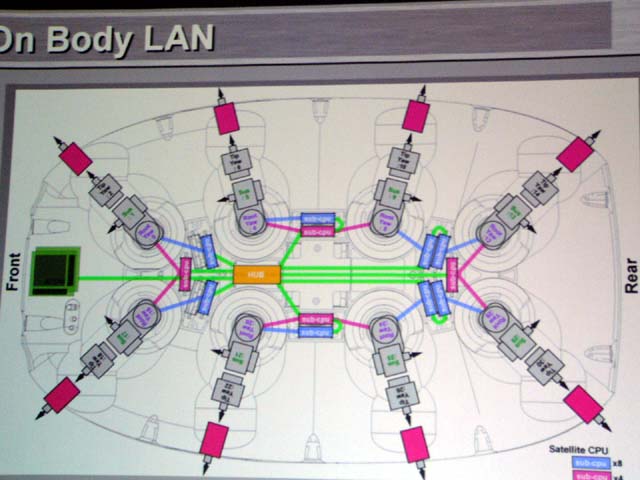
News for nerds writes "I4U has news about a new transportation concept, called The Hallucigenia 01, which is a working 1/5 scale vehicle prototype, designed by Japanese design firm Leading Edge Design. PC Watch (Japanese) has photos and movies. Its 8 wheels are independent robotic arms controlled by their own satellite CPUs, interconnected to the main CPU by an internal LAN."
GM also came up with the "skateboard" design, the only difference that i see is this one has more wheels, more gdgets, and better control; which may be good for suspension and stability, but it makes me wonder as to the economy of producing a full scale unit, due to cost, complexity, maintenance and later on replacement (as if replacing 4 tires wasnt expensive enough). Not to say that this vehicle doesent have a bright future, heck, im guessing this will make one helluva city car. They did borrow one good thing from GM though, for if this car gets mass produced the owners or factory, will be able to change "skins" (IE top part of the car) intermittently.
Live for the present, learn from the past, and dream of the future!
From looking at the pictures, it seems that the wheels can rotate perpendicular to the length of the vehicle. Should make parallel parking a breeze.
Hallucigenia is a fossil. Very old, early Cambrian, I believe. And very weird, hence the name. Check the logo.
I don't know wheter this model can or not, and the wheels are toys in this model, but the think should be able to turn the wheels flat and use them as rubber feet and WALK over obstacles. I like the idea. Complicated gizmo, though.
``L'imagination au povoir.''
In my
previous post on the new industrial revolution I discussed how the impact of
robotics and cad design would result in more variety seen on the road.
This post will focus on the technological impact these will have on car features
and safety.
1 wheel is good, 2 wheels are better, 4 are better still. When you
start to go into 8 wheel designs you start to run into problems with friction
(due to bad wheel alignment). This isn't noticeable on vehicles carrying
large mass (such as semi trucks) because the momentum of the mass keeps the
vehicle going in a straight line, but on small less than 2 ton vehicles one
wheel out of alignment would be very noticeable. Although technology
exists to re-align your tires on the fly exists, current auto makers have yet to
implement that type of self repair into their vehicles. Instead they rely
on good old physics and mechanical engineering to figure out how best to tune
the suspension for maximum performance.
With robotics and sensors implemented mechanical suspension systems will be
obsolete. Cars like this one will make adjustments on the fly to suite current
road conditions, instead of the specialized approach used by automakers today.
If you want to go really fast, you buy a car with a big engine, low to the
ground. If you expect to be driving on rough terrain you buy a 4wd vehicle
with adequate ride clearance. Shouldn't transportation be able to adapt to
it's environment?
The main reason automakers take this specialized approach is so they can
break the car market into different segments. Instead of creating a cheap, one
size fits all vehicle we get many choices that are basically the same ideas all
rehashed in one form or another so they can appeal to a wider audience. Jim bob
likes his ford f150, soccer mom likes her GMC suburban, Gary geek loves his
prius hybrid. For the most part though, all these cars still have the same
wheels, drive train, suspension as the other does. How can one justify
that as truly different?
Because of our new industrial revolution and the rising computation power of
electronics, we'll start seeing things like self driving cars as standard
equipment. This will in turn drive down the prices of material logistics
for manufacturing plants as they will no longer have to rely on teamsters unions
to deliver materials or finished products to market. With robotic factories and
robotic delivery bringing the labor cost down to near zero, hopefully we will
see the prices of these new vehicles drop in line with that of the manufacturing
costs. An added benefit to the consumer will be the inclusion of these new high
tech features as standard option packages.
Right now is a transition time to this new industrial revolution. I
know in the long run my children will benefit from both the choice and low price
of these internationally produced goods. As more of the world produces a
product, their need for this product increases as well, whether it be cars, IT
services, computers, or what not. Demand creates necessity, which turns into
invention.
We won't see much of the old technology on the road in 20 years. By then the
57 Chevy will be 66 years old, old enough to collect social security if it still
exists. I think the car of the future wont look anything like the car of
the present because of all the variety that will exist.
Please take your racist stereotypes elsewhere. I was talking about historical business practices, not racial characteristics.