 Slashdot Mirror
GNOME/KDE Integration Gets A Few Boosts
Balinares writes "Great bunch of news on the Linux desktop unification front. After the unification of GTK and Qt themes that Slashdot already reported on, it is OpenOffice's turn to get the unified look treatment (screenshot 1, screenshot 2, screenshot 3).
In related news, the recently released QtGTK library allows to merge the Qt event loop with that of GTK. In other words, this means you can now easily use KDE's DCOP, IOslaves, and, last but not least, file dialogs, from inside your GTK apps. (Screenshot of this feature used in XMMS2: 1 2). It comes with a tutorial that explains the basics.
Finally, the new fuse_kio tool now makes it possible to use KDE's IOslaves directly at the filesystem level, from any Linux app. 2004 is really beginning well for all those of us who use Linux as their primary desktop!"
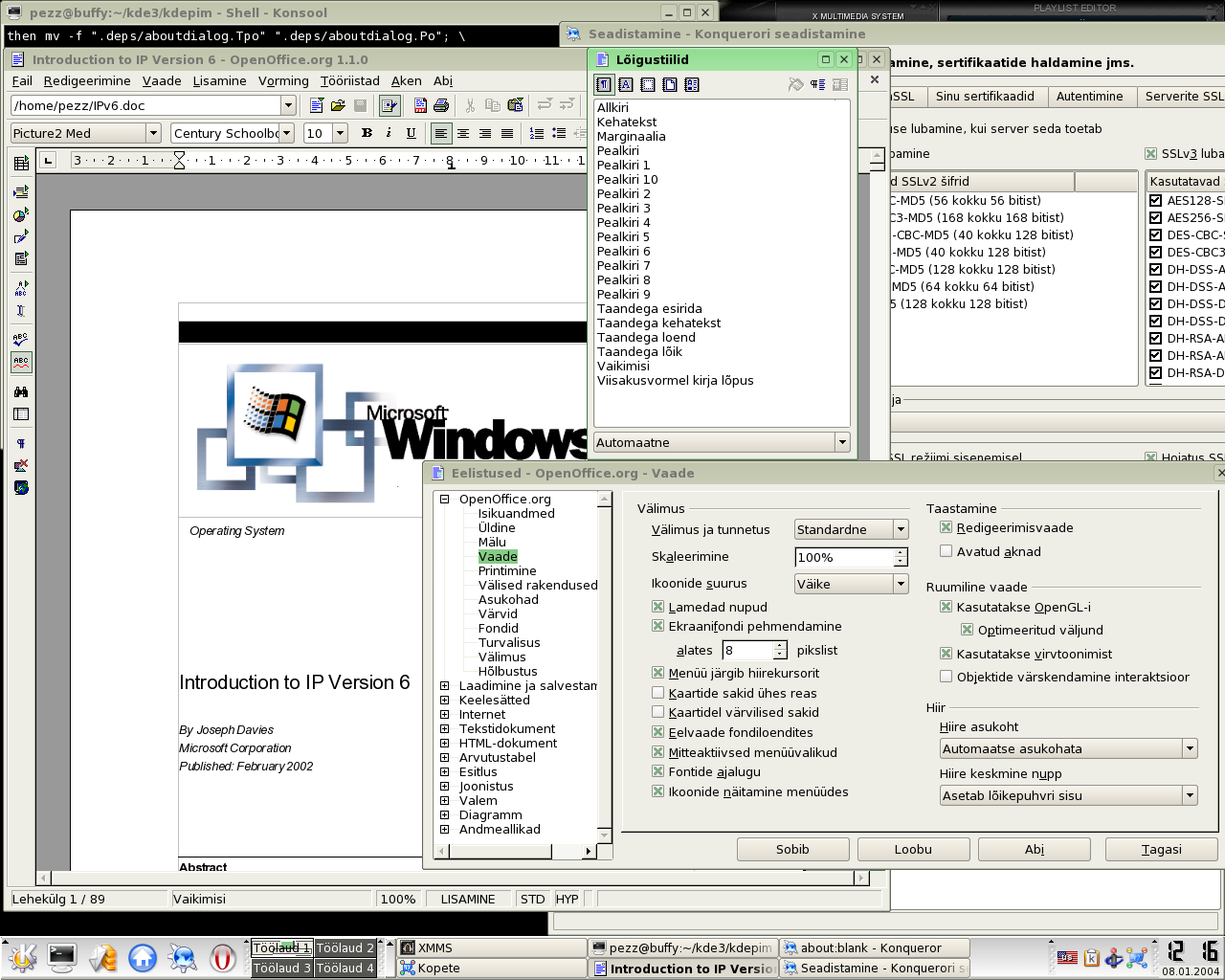
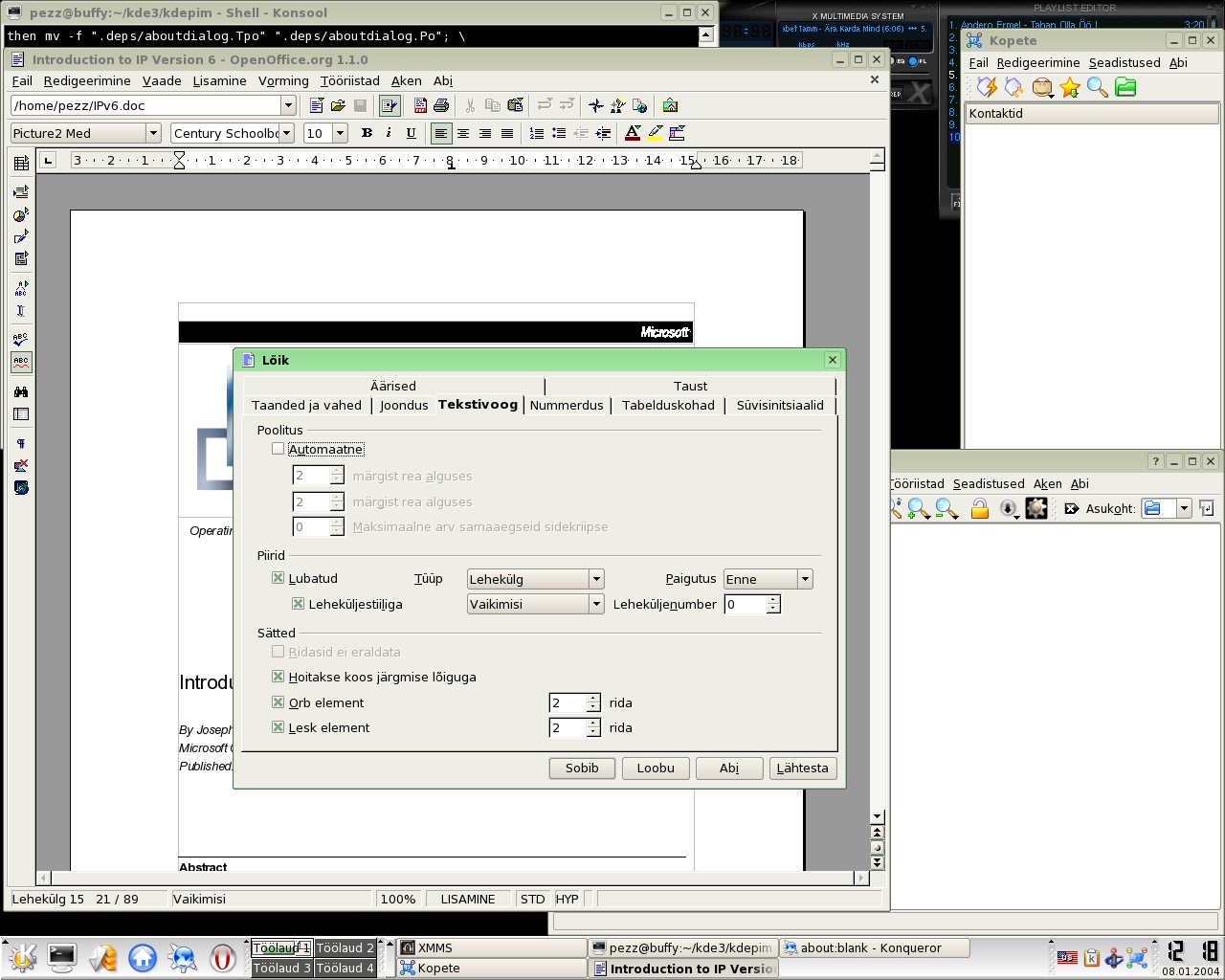


I can't wait for this to happen, I'm tired of there being so many desktops in linux. You can argue all you want about "it offers better choices for people." But the truth is, people don't want to choose, they want you to choose for them. Once they learn your system, then they can go in and tweak it for themselves.....I've always seen this as a drawback for Desktop Linux, some programs work in one window maker, others work in another. It's too hard for the average user.
This is not wanted, because XMMS has always been the bastion of UI consistency. Also, while I am telling the truth, Mozilla makes any desktop look professional with its native menus and widgets. While I am still telling the truth, I am not always looking for functional replacements for Mozilla and XMMS that don't scream UGLY and awkward every time you see them.
~Darl
This is exactly what should be happening I think. We've seen some pretty good strides as far as interopability goes between KDE and GNOME. This brings us the unified desktop without having to sacrifice either one of these projects. It's good that KDE and GNOME can both go their own directions while still increasing interoperability.
This should satisfy the people who just want a consistent look on the desktop and then people who want choice.
It's projects like these that show how much more productive Open Source is.
Proprietary companies may try to run other company's formats, but probably wouldn't be willing to say "oh here's how we do it, let's make it easier for people and merge the two for greater compatibility." Open Source companies can't (and I'd like to think wouldn't if they could) restrict compatibility for their own benefit.
For example: Microsoft comes out with special new features like "plug n' play" or some new way to install programs "faster" and "more easily," but RedHat releases an open source program, RPM, and allows anyone who will to use it.
Hooray for Open Source!
Esoteric reference.
I don't see it that way. I use about 95% KDE applications on my desktop, and about 5% GTK/GNOME applications. The GTK/GNOME applications always bug me because of things like the file selector (which, for example, can't load files using the KDE IOSlaves).
Given that I find this kind of thing useful, and that I use 95% KDE applications, I can't agree that it's a sign of GNOME's success. It's just dragging the GTK/GNOME applications along where the original developers have failed to take them.
That argument's been done to death. The basic points:
Oh well. To quote someone here (Sorry I don't remember your name)
"Why are we so worried about the fact that publishers of closed source proprietary software who are used to paying for software development tools are going to have to continue that exact same practice in the OSS wordl?"
On the topic at hand, all I can say is sweet. Gimp, Evolution, Beep etc all fitting in KDE and where possible even getting to use the excellant KDE fileselector.
If you wanna get rich, you know that payback is a bitch
Now the wide variety of commercial applications for Linux et al can play nice with KDE!.
That remains true. Commercial applications written in other developement platforms will work inside KDE (they will behave differently, though). Oh, wait... doesn't KDE require a license for commercial applications... oh, never mind...they can't play nice together.
Well, now that integration is possible, instead of coding in QT you can write Gnome/GTK commercial applications and run them inside KDE, with the looks and behavior of KDE. As far as I can tell, you are not violating any license by doing this.
I really like that idea. I'm a C coder rather than a C++ coder, so coding in GTK feels more natural to me. But... I prefer KDE over Gnome for my desktop (*), and I'd like the programs I create to have the behavior of KDE. So I was in a point of desperation trying to decide whether to use C-based GTK or C++ KDE/Qt.
Now, I can happily code in C/GTK, knowing that my apps will look great in both Gnome and KDE!
(*) No trolling or flamebait intended. If you prefer Gnome and say KDE sucks, that's fine by me, it's a free world.
GTK apps using KDE file dialogs
GTK apps using the QT event loop and DCOP, etc.
All Linux apps able to use KIO Slaves
How come no KDE apps want to use the GLib event loop or the GTK file dialogs or Gnome VFS I wonder? (*wink wink*)
I would guess that it is considered a troll because Qt does allow you to keep your source closed.
Okay, step by step:
1. You can't normally link proprietary software to QT without paying licensing fees, agreed? No criticism here, no condemnation, just those are the rules, agreed?
2. GTK normally does allow you to link with proprietary software without requiring licensing fees, agreed?
3. The system this article is about apparently allows you to use some QT functionality with your GTK apps.
So the question if I understood it correctly was, can you legally use this system in conjunction with a proprietary GTK-using app? If I understand correctly this would be the user making this choice not the developer, but maybe I've misunderstood how this system works.
That question seems to me to be a valid and reasonable one. I don't think you have answered or even addressed it, but either way it does not appear to be a troll.
While I appreciate the humor, all this has a reasonable explanation. This integration work in question is being done by KDE people, as part of a recent initiative to do something about KDE's reputation for only doing their own stuff, seemingly "starting over" (their own office suite, their own browser etc) where GNOME is adapting to existing technology. Basically, KDE is starting to show that it, too, can adapt existing technology.
This work is NOT being done by people who simply want more integration, but by people who want a more consistent KDE desktop. If the GNOME people want to integrate KDE apps so that they'll feel more like GNOME apps, they're free to do so.
"Oppression and harassment is a small price to pay to live in the land of the free." -- Montgomery Burns.
"Not true. It was sometimes,"
It still is. We're talkling about people writing applications. Trolltech has a large list of customers, which includes many major companies. More importantly, not a single company has come forth and said they used GNOME for licensing reasons. Sun's choice of GNOME had much more to do with the fact that:
a) Since GNOME 2.x was a total rewrite, they got to play a huge role in shaping it. Much of the HIG and the usability and accessibility work on GNOME was thanks to Sun.
b) KDE wouldn't compile with Forte C++ (Sun's C++ compiler), which meant that no KDE apps would be developed with Forte C++, and Sun's engineers were much more comfortable with C.
c) Sun's engineers were much more comfortable with existing standard technologies like CORBA, as opposed to KDE's new ones like DCOP. CORBA turned out to be more or less a failure on GNOME, but Sun didn't know that at the time.
"Sun-Gnome, IBM-Gnome(at least based on assumption that Suse and RH are it's distros), RH-Gnome, Novell-Gnome, Suse the major KDE player - Gnome"
Whoa. Neither SuSE nor Novell have comitted to GNOME. And neither has IBM. Its just Sun and RedHat. IBM is a mix of GNOME and KDE (because of RH and SuSE). And to this day, most of the major Linux desktop rollouts that have actually happend (the China rollout hasn't, yet) have been KDE.
"KDE is loosing ground in this field. Not gaining."
This is probably true. But its *very* early in the game, and it is these sorts of initiatives that could stem the tide.
"Phoenix and Thunderbird - GTK"
Neither are GTK+ apps. They use GDK to handle drawing and do fonts. They don't use any GTK+ dialogs, widgets, or any GNOME technologies.
"OpenOffice.org - Now native GTK planned for next release"
No, a GUI-independent framework is planned for next release.
"KDE release, well project is open but no one want's to do it"
I have yet to see any indication that "no one want's to do it." Hell, KDE's already ahead on this front. There is already a release that adopts OpenOffice to the native KDE theme. That's one step, anyway, ahead of OpenOffice's GTK+ support.
"Evolution - I can't remember any serious KDE mail client sorry (please no kmail)"
Kontact? KMail is a very seriousl mail client, and you provide no evidence to the contrary.
"Gimp - not Gnome but GTK it is"
This is probably the standard one. However, 2.0 has the GUI and core seperated, and a Kimp would not be out of the question.
"xmms - GTK"
XMMS is a GTK-1 app! It looks and feels nothing like a GNOME app! And KDE has many excellent media players, notably JuK and AmaroK.
"Time to smell the future, distro maybe but commercial apps are poping up"
And so far, very few of them have been based on either GTK+ *or* Qt. Most are Motif ports. And of the commercial apps that do use a modern toolkit, most of them have chosen Qt.
"btw. all this **look** hacks KDE producess, GTK look, OpenOffice look, KDE dialogs in GTK are just dust in your eyes."
Well, apparently dust works. Because GNOME has managed to convience a whole bunch of people that Mozilla and OpenOffice are GNOME apps! KDE should have done these hacks a long time ago. And note, Windows is entirely based on such **look** hacks, to make the many Windows toolkits look cohesive. Its a crappy solution, technically, but the market doesn't seem to care.
A deep unwavering belief is a sure sign you're missing something...
Its not a sign of GNOME's success, but an indication that GNOME has some great apps that KDE doesn't. Its actually an indication of GNOME's weaknesses as a platform. If GNOME was really comparable to KDE, the GNOME application base would have pulled them over long ago. But the sheer technical advantages of KDE make it worth it to build projects like these, to access GNOME's apps from within KDE.
A deep unwavering belief is a sure sign you're missing something...
So, why are more apps written using GTK/Gnome? I don't know. FWIW I feel the KDE framework is better too, but ultimately they are both pretty good. In particular GTK stands on its own more than Qt does on the Linux desktop - for apps that wish to remain desktop neutral it seems a more natural choice (and to be honest GTK vs Qt is a pretty even match, you can argue about the corner cases all day but I'd say they're just as good as each other).
Whenever I read the KDE API docs I can't help thinking what a shame it is - if the original developers had cared more about licensing we'd probably only have one desktop, and everybody would use these great frameworks. There'd be no problems with desktop neutrality, no need to slowly reinvent everything in order to make it desktop neutral and so on.
A lesson learned hard, and one I hope future developers will respect..... those who don't take community concerns over platforms seriously can seriously damage things.
> 2004 is really beginning well for all those of
> us who use Linux as their primary desktop!"
Yes. Because GNOME and KDE only run on Linux, don't they?
Please, a little credit to the folk who right proper, portable code, and to those who port it.