 Slashdot Mirror
3D Display, No Glasses Required
Shibatch writes "Hitachi, Ltd has developed a 3D display called Transpost which can be viewed from
any direction without wearing special glasses. 3D movies can be seen as floating in
the display. Also, 3D movies captured at other places can be shown on the display
in realtime. The principle of the device is that 2D images of an object taken from
24 different directions are projected to a special rotating screen. They also
developed a camera which can capture images from 24 directions simultaneously." The pictures are interesting, but ... translations, anyone?
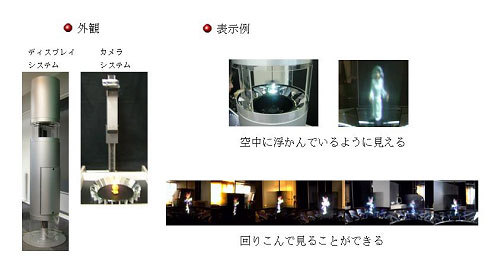
Just about readable, but a few untranslated gaps:
--
Developing the stereoscopic vision display technology which can see from with 360 degree anywhere
- Photograph taken on the spot image in real time appreciation possibly -
Hitachi, Ltd. (President execution part: Manor mountain Etuhiko, below: Hitachi), this each time, turning from with 360 degree anywhere, it developed the new model stereoscopic vision display technology which can look at image. With this technology, as for the viewer like wearing and hologram image of the special glasses, it is possible to enjoy the kind of stereoscopic vision which just floats in the sky without processing specially. In addition, jointly using the private photographing system, stereoscopic vision of photograph taken on the spot discrimination/reference also it is possible in real time to praise. Through network, if photograph taken on the spot image is sent, the presentation of the completely new shape that is actualized stereoscopic vision is appreciated simultaneously at the place where it is far. Application in wide field is expected as the new information offer system where this technology used image.
[untranslated] *1)Is known widely. But, with holography, because the process which draws up the interference fringes (hologram) in order to play back stereoscopic vision is necessary, it is not possible to indicate photograph taken on the spot image in real time.
It becomes possible to actualize the scene that, in the actual world if in real time, as stereoscopic vision it becomes possible to indicate for example, in order to appear in the world of the SF movie, stereoscopic vision of the person and the object is projected photograph taken on the spot image in the sky. In addition, it just drew up in Japan even in the foreign country simultaneously appreciating mock-up (prototype), such that the presentation is done it can actualize the form of new business to argument and the customer of the commodity design.
[untranslated]
(1) indication of the stereoscopic vision with simple mechanism
As for basic principle, projecting the image of the subject which is projected from plural directions, simultaneously to the rotary screen which administers uniqueness processing, it is something which indicates three-dimensional image. With trial manufacture display "Transpost", it projects to the mirror of the top board with the liquid crystal projector which first installs image of the subject which is projected from 24 directions, in the pedestal. It is the mechanism that the image which is reflected with the mirror of the top board is projected by 24 mirrors which are arranged around the rotary screen, furthermore, reflects with this mirror and is projected to the rotary screen.
(2) indicating stereoscopic vision of photograph taken on the spot in real time
[untranslated]
As for the stereoscopic vision display technology which this time was developed, both the still picture and animated picture indication of full color is possible from [untranslated] to photograph taken on the spot image. Until recently it is expected to the field of business and entertainment, as a stereoscopic vision expression of the [untranslated] times which are not and a display of information transmission, that it is utilized widely.
Help me! I'm turning into a grapefruit!
It seems to me like a system such as this would be rather inappropriate for watching movies. For one thing, making a device any much larger than a normal-sized tube TV would start to get really impractical, as the spinny elements would start to generate a lot of noise (and you WOULD NOT want to be there if a large, high-speed spinning element broke off of its axis and started ricocheting about the room...).
Also, unlike conventional holograms, you would not be able to "touch" the image. Reach out to touch these images, and the rotate-o-thingy will lop your hand off.
I shudder to think of the safety (and power consumption, and noise) issues that would be involved in making a movie-screen-sized version of one of these...
Something like this is probably more useful for scientific and military visualization. I know it's corny, but think of the Star Wars-like 3D display in South Park, in the scene where Bill Gates gets shot by the army guy. Something like that display machine...
Honey, I shrunk the Cygwin
This won't be big until its actually useful for something other than technical visualisation. But it's still cool...
I really wonder how these images you can see in the tube are created.
I could imagine it's a kind of fog where the image is projected by the help of lasers or other strong light sources.
I don't think this technique is very helpful because it requires really bulky "Displays", returning a relatively small picture.
If this does ever want to become generally accepted, the viewing appliances have to shrink and return bigger pictures, perhaps by sacrificing quality over price and bigger pictures.
-huha
You may be moderating this as funny but that is the most serious/insightful comment you will see here.
If you think about it, it is going to be really hard to show scenery ie mountain landscapes on this screen - you can only show objects standing in a void - the demo piccies here show a man standing in the middle of nowhere. Think about Star Wars and Princess Leia standing in the middle of nowhere in R2's projection - there are no walls around her...
So if you think about it, the only real use for this are artificial landscapes like Air Traffic Control displays, and people.
Porn is _the_ killer app for this one.
The number of angles is dependant on the number of projectors since that is all that changes when you see something different. Your simply looking into a different projector.
unzip; strip; touch; finger; mount; fsck; more; yes; unmount; sleep
If 3D ever become mainstream for computing environments, my big question is how we'll navigate it. You can't exactly move your mouse up and down through the table as it tends to leave big holes. Maybe an orientation-based thing a la Twiddler 1, or a POV button for vertical movement and rotation. It's something I haven't seen addressed at all, and if we want to get support for 3D computing then I think we need to start with some interesting ideas on how we'll use it.
I'm sure cam-whores would love it. They could be the first group to use it commercially as well.
FIVIt's not like people commonly claim that straining your ears, trying to hear a very very soft noise is damaging to your hearing. Or that trying to taste something that's present in very very low concentration will damage your sense of taste
Now, staring at something very brigth, or hearing a very loud noise can indeed be damaging, but that's sorta in the oposite direction, overload if you like.
Still, people persist in this "trying to see in poor ligth will kill your eyes" thing. I've honestly got no idea where that comes from.
Either your images have to be very simple, or you need extremely powerful hardware, or the resolution sucks, or you're going to have to accept low frame rates.
Well, duh! 24x3d images, given that we can do one image now, Moores law would say that the tech should be mainstream in about 7 years. Not that I think Moore's law is correct, but the point is, of course it's computational expensive, if it weren't it wouldn't be innovative. Eventually, processing power will catch up.
Schrodinger's cat is either dead or really pissed off...
Reality maybe?
Okay, maybe some people misunderstand how the eye works, and use the analogy to apply to things that won't actally damage your eyes. However, your eyes most certainly can be damaged by some activities...
It was recently discovered that the muscles in your ears will atrophy if they are in a completely noiseless environment (but normal, quiet, background noise prevents it) so eyes aren't the only sense that can be damaged due to extra-low conditions.
Your eyes are different entirely. The real problem is that your eyes focus, and different envirnments will influence your eyes to focus differently... For example, if you wear a pair of perscription glasses designed for someone else, your eyes will gradually try to adjust their focus to accomodate. Wear those glasses for several weeks, and when you finally take them off, your eyes won't be able to focus normally again.
Another issue is moisture. When trying to focus on things like a computer screen, you will subconsciously begin to blink less. If you don't blink often enough, this will both cause pain to you, and can cause scratches on your eye's lense, which will damage your vision.
So, yes, there are a number of things that you can do that will damage your eyesight..
Slashdot gets worse every day... Pipedot: News for nerds, without the corporate slant
Check out this other interesting or should I say bizarre stuff.
http://hhil.hitachi.co.jp/products.html