 Slashdot Mirror
3D Display, No Glasses Required
Shibatch writes "Hitachi, Ltd has developed a 3D display called Transpost which can be viewed from
any direction without wearing special glasses. 3D movies can be seen as floating in
the display. Also, 3D movies captured at other places can be shown on the display
in realtime. The principle of the device is that 2D images of an object taken from
24 different directions are projected to a special rotating screen. They also
developed a camera which can capture images from 24 directions simultaneously." The pictures are interesting, but ... translations, anyone?
http://www.worldlingo.com/products_services/worldl ingo_translator.html
Of course not perfect translation, but should able to give some draft idea what it is talking about.
http://hhil.hitachi.co.jp/products/transpost.htm
This isn't true 3D, it's stereoscopic. It uses a clever method to project stereo pairs, sort of like those rotating cylinder animated holograms they used to make (watch the end sequence of the film Logans Run if you've never seen one).
Looks like two wholly different technologies to me. This article looks like StarWars-style holographic projection, while the article you link to is about LCD displays that has two different pictures depending on your viewing angle (that is, two different pictures for each eye, when it works).
Used Babelfish and then paraphrased it so it wasn't as engrish:
:/
But from what I can read, I can tell you this:
The stereoscopic video display that can been seen from all 360 degrees is in development. Video can be displayed on the fly. - Hitachi, Ltd.
This time, Hitachi has developed a new stereoscopic video display that allows viewers to view it from all 360 degrees. With this technology, viewers can see a 3D picture as if the viewer was using special glasses. It is possible to enjoy this stereoscopic image which just floats in the air without special processing. In addition, using a special video recording system, it is possible to display the images in real-time. Through the network, the photograph is sent (along with positional vector details), and the image is displayed. Various applications in the field are expected as the new technology matures.
Only bothered to do the first paragraph, as what babelfish produces is really really bad engrish
# It's called 'Transpost'
# It uses LCDs and mirrors
It'll be much better if a native speaker translates for us.
Founder of Mirror Moon - Tsukihime Game Trans
Transpost product homepage (Japanese w/ pictures) at Hitachi Human Interaction Lab.
Other products from this laboratory include Waterscape (English).
The first [untranslated] tag refer to "hologram". And the bottom bit just explains what holograms are and what the Hitachi Human Interaction Labs are.
Founder of Mirror Moon - Tsukihime Game Trans
They then go on to explain a little more about the technology. They take video feed from 24 different angles and then feed that into their projection system which I think is a number of projectors inside a single machine. They then project it upwards onto some sort of rotating screen/plate.
They then talk some more about how it's automatic and works in realtime over a network.
Lastly they just talk about how a color projector like this is possible and what some of the uses might be (business, entertainment). Then at the bottom, they define the terms "holography" and "hitachi human iteraction lab".
http://www.computerworld.com/hardwaretopics/hardwa re/story/0,10801,69675,00.html
It's hard for thee to kick against the pricks.
It looks more like the system from Actuality Systems. I am guessing it works by spinning a 180 degree screw shaped structure really quickly, and getting the timing right so you can project onto any point in space...
Actually, the Hitachi one seems to be spinning a flat plane, rather than a screw... The screw based method is described here
If construction was anything like programming, an incorrectly fitted lock would bring down the entire building...
All the cameras involved would need to synchronize their frames ala time-based correctors we used to use for video editing, else you'd probably get some disconcerting flicker as you moved around it...
"Waste not one watt!" - CZ
Many people are dubious about 3D screens. This is understandable as there have been doezens of them and none has "made the grade"
The reason for this is simple: stereopsis is, while whiz-bang, is not "interesting". After the initial gee-whiz the grim reality of the lack of value added benefits for the cost always come into play.
Today the tag "3D" has a fuzzy meaning, but it is usually interpreted to mean mere stereopsis: artificial illusion created by presenting each eye a differing perspective of am in image.
The reason stereopsis fails is that it only provides a fractional increase in information, where as "holographic" (a misnomer) provides a full dimensions worth of information.
To explain it simplest: stereoptic images have one depth of focus, whereas a "holographic" image has thousands of "planes" of focus. A holographic image allows you to focus your eyes at different depths whereas a mere stereoscopic image keeps your eyes focused at one depth.
When it comes down to it, its about information density; fake stereroptic effects add no information. So we can conclude that "3D" technology won't ever become mainstream until true depth "holographic" imaging is available.
Bottom line: this screen is not worth its cost. Give us depth of field.
You probably mean Sega Time Travellert ter=T&game_ id=10124
http://www.klov.com/game_detail.php?le
which according to the klov entry uses a parabolic mirror to display a hologram image
I remember this game too, and yes it looked very cool
Learn about pinball machines on www.flippers.be
It was a sega game.. called .. *gasp* "Hologram Time Traveller"
Linkage: Digital Leisure
http://www.lemminginvestor.com/DDDpresentation.htm l
For those wondering how this system works here is the actual article:
Viewers gaze at a live three-dimensional image produced with groundbreaking technology unveiled by electronics giant Hitachi Ltd. on Tuesday. Hitachi's device is the first in the world that can record and instantly display three-dimensional images from 360 degrees.
Up until now two steps were required: special filming using lasers and the intermediate process of physically recording the image, meaning that the image could not be seen at the same time as filming.
The circular viewing device stands about 2 meters high and is 40 centimeters in diameter. The image of the person being filmed is portrayed onto a high-speed spinning screen from angled mirrors.
When viewed from the side, the person's face can be seen and their back is visible when viewing the object from the opposite direction.
The person or object being filmed is surrounded by 24 mirrors and recorded with a camera. This recorded image is instantly transmitted to a projector in the viewing device. (Mainichi Shimbun, Japan, Feb. 24, 2004)
To see the picture, which is larger than the ones on the Hitachi site, go to Mainichi Daily News and in the lower right corner of the current picturce click 'More'. When the pop-up occurs click 'Next' to see the single picture and the text I just posted.
I hope this helps.
Hitachi Co. Ltd. (CEO: Etsuhiko Shouyama) has developed a novel 3D image display technology, which allows a 360 degrees view from any direction. The technology allows a viewer to enjoy a 3D image that appears to be floating in the middle of the air. With the proprietary camera system, one can take and view a captured real-time 3D image. The taken image can be sent over a network and played in distant places simultaneously --- this makes a totally new presentation style possible. The technology is expected to be use as a new image-based information system in various fields.
Holography has been a well-known method for playing floating 3D images to date. However, playing a 3D image requires preparation of an interference pattern (hologram), and this make real-time playing of a captured 3D image impossible.
Real-time playing of a captured 3D image will bring, for example, projection of 3D images of a person or an object in the air, which has appeared in SF movies, to the real world. As a new style in oversea business, discussion of a product design or a presentation to a customer can be made based on the image of a sample freshly made here in Japan.
The Hitachi Human Interaction Laboratory in the Hitachi Fundamental Research Center has developed the 3D image display technology that allows one to view a real-time 3D image floating in the air from any direction. This comes with a demonstration system, cylindrical 3D image display "Transport." The developed display technology has the following features.
(1) 3D image display by a simple mechanism
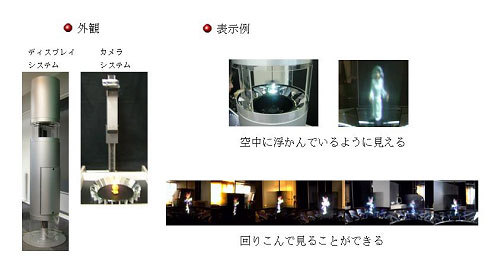
The system is based on simultaneous projection of the images of a subject taken from multiple direction onto a proprietary prepared rotating screen. In the experimental display "Transport," the images of the subject taken from 24 different directions are projected to (a) mirror(s) at the top by (a) LCD projector(s) set in the base. The projected images are reflected by the mirror(s) to 24 mirrors placed around the rotating screen, and further directed on to the screen.
(2) Real-time display of captured 3D image
The Lab developed a proprietary camera system that automatically produces images of a subject from 24 different angles. Directly sending the images captured by the camera system to the LCD projector displays the captured 3D image in real time. The captured image can be sent to a distant place by connecting the camera system to "Transport."
The developed 3D image display technology can handle both still and animated images with full colors and from computer-generated graphics to real image captures. The technology may find various applications in business and entertainment as a unconventional display system for 3D image presentation and information distribution in the ubiquitous era.
(Notes about *1) holography and *2) Hitachi Human Interaction Lab)
Left: Overviews of the display system (left) and the camera system(right)
Right: (top) "It appears to be floating in the air."
(bottom) "One can move around and see."
This Hitachi display is not new technology and it has some problems, principally:
On the upside:
It would be most useful for applications such as air traffic control, etc.
It competes with the other autostereoscopic displays (the LCD shutter glasses will never break out of their nerd/medical/scientific-imaging market for social and multi-tasking reasons), of which there are only really 2 consumer-market viable architectures:
The other displays linked to in the comments, and various others not linked, are all variations on the parallax barrier approach. Again, not new. They have the benefits of:
They have the big downsides of:
The limited viewing angle practically requires most parallax barrier systems to use active head tracking systems, where the display identifies where your eyes are and retargets the imaging accordingly. This exposes the practical usefulness of the 3D image to a further potential degradation if the headtracking system is not spot on.
Sharp and Dresden both use parallax barrier. Dresden's is beautifully bright but its headtracking can unfortunately jump the image around very badly for some people -- speaking from experience, it is beyond unusable if you're one of the unlucky ones, the image is jumping inches in random directions on random sub-second intervals.
Another major disadvantage is the extreme difficulty of presenting a 2D image via parallax barrier systems, thereby sharply restricting its desktop market. If you want to write or read something, such as a spreadsheet or some code or a word document, you're out of luck -- you need another monitor.
The other approach has been developed by a single company comprising now 2 people (holographic artists) about 10-12 years ago. The Display:
It does look similar to Actuality's system. But it seems to have much lower resolution. Take a look at the video someone posted in this message.
:-)
It's really really smeary, almost to the point that the subject is unrecognizable.
From the spec sheet you can see Actuality's display does 198 slices of the volume compared to Hitachi's 24, and each slice is 768x768 resolution, compared to whatever Hitachi does. Just guessing, but assuming they Hitachi splits one projector frame up into 24 subframes (which it looks like they do because the schematics seem to indicate fixed optics), and generously assuming no wasted pixels, that comes to something like 213x256 resoultion per view, assuming they start with a 1280x1024 projector. So the frame resoulution is also a good bit lower than Actuality's.
Also looking at the vid of the Hitachi, and how smeary the images are, it almost makes me think they are projecting ALL 24 images ALL the time rather than blanking all but the two projecting most perpendicular to the screen. Or maybe it's smeary because they're using the same image for 15 degree chunks (360/24), compared to Actuality's 1.8 degrees (360/198). Or it could just be an artifact introduced by the video camera.
The other big difference is you can actually buy a display from Actuality today -- if you have $39,995.
I think that only projects a 2D image into 3D space. It looks like they are basically doing the trick of projecting on a thin laminar stream of fog. Although they don't call it fog, they call it "transformed air" because that sounds a lot cooler and more mysterious.
It does look pretty neat. But it's not 3D imagery.
There's a few (very short) enlish news blurbs:
Ananova
Akiba live, which ananova mentions and links to.
It is an irrefutable fact that pornography sells -- more to the point, there will always be people who are willing to pay for it.
What happens then with new technology is that those who pay for porn end up subsidizing the rest of us -- as they pay top dollar for the latest tech, leading to further advances in those technologies which ultimately cause a reduction in price enough that these latest and greatest technologies start getting widely used in the mainstream.
The technology is always actually available to the general public, but is usually priced out of that market (at least in terms of what it would take to be considered a mainstream technology) -- and the only ones that will pay for it initially are the ones that use it for pornography.
I've had occasion to observe this specific phenomenon in the past, and although it's always impossible to predict which technologies become successful, it pretty much always follows that unless some government has allocated virtually unlimited funds in that direction (which doesn't happen too often), new technologies don't in general become successful without being subsidized first by people who are willing to pay for porn. Weird, huh?
File under 'M' for 'Manic ranting'
Human-generated translation (mine)
360-degree viewable volumetric display developed
Enabling appreciation of real subjects in real time
The Japanese Product Development Team (Pro tempore executive ATSUYAMA Etsuhiko, below "Hitachi") has recently developed a new volumetric display technology that allows viewing of images from 360 degrees. Using this technology, without using specialized lenses or holograms, a viewer can enjoy images as if floating in space. Furthermore, combined with specialized visualization systems, these images may be viewed in real-time. If the images are transmitted across a network, this allows a completely new style of presentation, with volumetric objects displayed at a remote location. This technology, as a new projection-based information transmission system, is poised for use in a broad range of applications.
Among past techniques for projecting a volumetric object in space, holography is widely known. However, in holography, a specialized process is required to record the image, making realtime display impossible.
If it were to become possible to display actual objects in real time, then the transmission of messages delivered by physical images of people and objects would become possible, as in the world of SF movies. Furthermore, it would become possible to change the face of business, enabling Japanese-developed mockups to be viewed synchronously overseas for review or presentation to clients.
Now, Hitachi's Foundational Technologies Research Group's Hitachi Human Interaction Laboratory has developed a volumetric display technology allowing viewers to see realtime volumetric objects from all 360 degrees. Also, as a testbed, a cylindrical volumetric display unit called "Transpost" has been developed. In this case, the developed display technology has the following salient features.
(1) Volumetric Image Display Using Simple Mechanisms
The fundamental principle is that of displaying multiple shots of the object on a rotating screen, and thus displaying a volumetric object. In the testbed display "Transpost," images shot from twenty-four angles are projected onto the ceiling mirror using an LCD projector. The images reflected off of the mirror are projected onto twenty-four mirrors surrounding the rotating screen, and from there are projected onto the screen itself.
(2) Realtime Display of the Volumetric Image
A camera system was developed which automatically generates the twenty-four views of the object. If we transmit the views produced by this system, it is possible to change the viewed object in real time. Furthermore, connecting the system to the "Transpost" using a network, it is possible to send the images over long distances.
The volumetric display developed in this instance is capable of reproducing everything from computer graphics to recorded images, from still images to movies in full color. In an unprecedented era of ubiquitous computing, we anticipate its use in a wide range of fields, including information distribution, business and entertainment.
Sigmentation fault - core dumped
I guess those guys must be Jesse Eichenlaub and Arnie Lagergren from DTI. Their displays have been discussed before.