 Slashdot Mirror
The Nintendo Keynote In Depth
President Iwata began the talk by announcing that he has some conflict within himself in his role as president. He's only a President on his Business Card, he said. In his mind, he's a Game Designer. And in his heart, he's just a gamer. He began programming games on his pocket calculator, with no games, and became attached to Nintendo by being a part of the small Hal design company. Hal, he stated, came from the computer in 2001 a space Odyssey because the name sounded cool. The company created the Kirby and Earthdawn titles, and as time went on he found himself working full time for Nintendo.
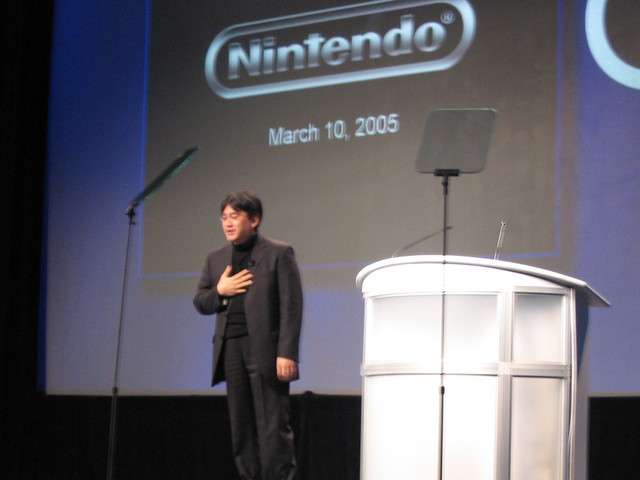
He's been making games, then, for almost two decades, and he discussed some of the things that have changed and some of the things that have stayed the same in the business since then. Overall, he saw most of the changes be to size. Bigger budgets, bigger complexity, bigger attention from worldwide media. On the other hand, there are fewer risks, fewer visions, and fewer ways of thinking about players and games.

To respond to this, Nintendo has committed itself to not abandoning the core gamers. Metroid Prime will be out later this year, and the demo shipped with the DS system. Geist is going to be a new and interesting version of a shooter, Zelda appeals to hard-core gamers and regular gamers alike, and Resident Evil 4 is a GC exclusive.
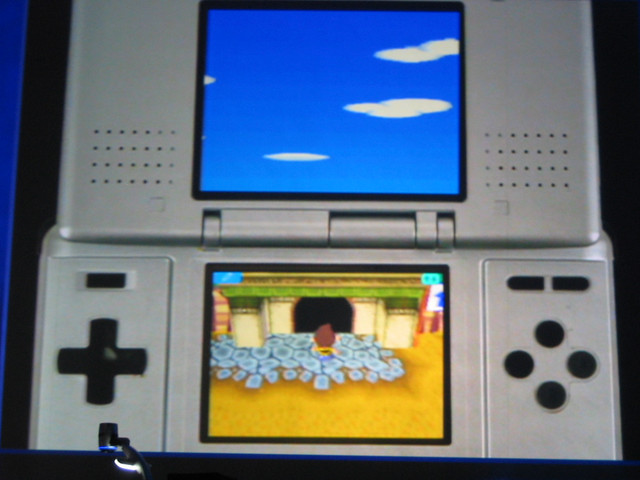
On the other hand, Nintendo is really trying to push out of the current player base and into the market beyond. The DS is their flagship for this effort, and they've currently sold 4 Million units (with the European launch of the system today). Mario Kart DS is an upcoming title for the system, will bridge the gap for both new and old gamers, and is going to utilize wireless play to let up to 8 people play together. Beyond that, though, they really want to give players more than just what they already know they want.
To that end, DS Wifi will be rolling out by the end of the year. The goal of the system is to allow gamers to play together over large distances, simply and seamlessly. Most importantly, the service is going to be completely free of charge. This service will hook people who have never used wifi services before into a new arena of technology, and their new style of games will reach out to people who don't really want to play "games". Nintendogs has already received a lot of press, and is one of these tools to reach out to the non-gamer. If you'd like a look at a portion of the Nintendogs presentation, you can view that here. They didn't reveal anything terribly new, but did show off the microphone capability of the game. The person demoing Nintendogs would whistle, and the dog would come running. By issuing voice commands that he'd pre-selected the virtual critter would perform for him. Even more interesting was the non-game they showed off entitled ElectroPlankton. The music/sound experiment utilizes the microphone as well, and you can see three portions of the game here, here, and here.
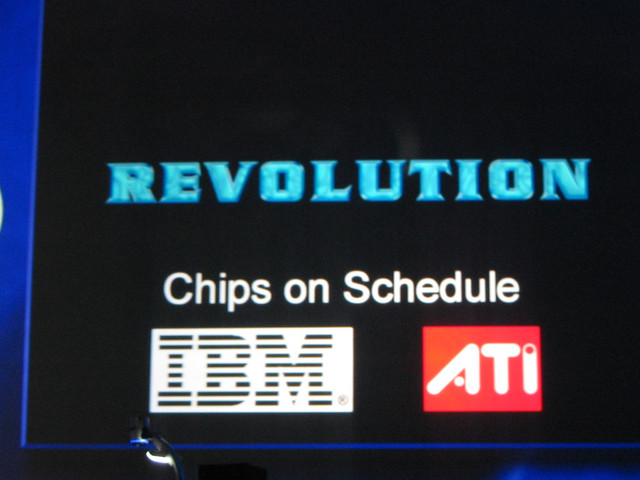
The Revolution was only mentioned, but they did give out some new and interesting information. It will be completely backwards compatible with the Gamecube, ensuring that the most popular of the current stable of games will be available into the future. As with the DS, it will also be wifi enabled for mysterious purposes that they didn't really go into. Their chips and technology are completely on track, and more will be revealed at E3.
Overall President Iwata was a very arresting speaker. He had excellent delivery, his message was one of change and a new look at gameplay, and he was promising more of what we already know to be good gaming experiences. As they were two of the largest events at the conference, comparing the Nintendo and Microsoft speeches is a must. In general, the "yay Nintendo" aspect was just as much of a commercial endeavor as existed in the Microsoft keynote. Iwata was taking the opportunity to promote his company's vision of the future, and that naturally trends towards the products and services fo the company he represents.

At the same time, though, I felt a lot more hopeful listening to President Iwata than I did listening to Allard. The "HD Future" isn't much to get excited about. A Gamer's card and higher resolution isn't something that really leaps beyond the norm of what we have today. Incremental changes are needed, of course, but keynotes are meant to fire the blood. Iwata did that more effectively through the invoking of something that everyone in the room had in common: "The Heart of a Gamer". Nintendogs and Electroplankton may not be the way to make this industry sell its first 20 million unit title, but like the analogy that Iwata used in speech, they're definitely not of this gaming world. And exploration is something that I think is on far too few peoples minds in the gaming industry today.
Ever since Sega bowed out of the handheld market, Nintendo hasn't had any real competition. For many many many years, the Gameboy was the only game in town (from Nintendo to N64). Sony's competition will make things interesting.
If Nintendo's wifi access works, I think it will, in short, make maintain Nintendo's dominance. One of the reasons for X-box popularity is the live system, and no one's really tried anything similar for handheld. Additionally, Nintendo has some really fun multiplayer games (Mario Party, Mariokart, Metroid Prime 2, and Smash Bros) that go beyond the stereotypical FPS. If these are ported to the new handheld system AND the wifi works, I think it's going to be hard to find a company to beat Nintendo's appetizing combination of great games and easy multiplayer.
-- Political fascism requires a Fuhrer.
At the same time, though, I felt a lot more hopeful listening to President Iwata than I did listening to Allard.
:)
This is the way it always is at industry trade shows. Nintendo always has the fun press conference, MS always has that "nerdy kid trying desperately hard to be cool" feel, and Sony is always just a complete snooze-fest of dry facts and figures.
I've been to about ten of these industry events over the years and the pattern is always the same, but in the end it means nothing in the marketplace. The press always seems excited about Nintendo after a big speech or press event, because they have some extremely engaging speakers - Iwata's one, Miyamoto's another. Neither MS nor Sony have anybody like this. Nintendo also generally ignores the business side of things in press events and either just talks about video games or has someone up there demonstrating them (usually Miyamoto, who will be cracking self-deprecating jokes about how bad he is at playing games all the while).
I've gotten caught up in it myself; I came out of my last E3 (a couple years ago, I guess) thinking Nintendo would just be unstoppable. The energy in the room at the Nintendo press conference was just so palpable; there were several standing ovations, there was constant applause and laughter, there was a feeling like big things were happening, like Nintendo really "got it". By contrast, MS was just a bunch of flashing lights and sirens wailing away at you to PLEASE BE EXCITED about their games, and Sony was basically just a big 2 hour PowerPoint presentation. Nintendo always comes off as the only company that actually cares about creating good games.
If only Nintendo could really turn that energy into something the marketplace wants to buy. They know PR, but they've lost touch with what consumers actually want. I'm hearing a lot of the same predictable stuff about this keynote speech - namely, that those who were there are really excited about Nintendo again - but objectively speaking, and as someone who was not there this time, I don't see anything that Iwata said that's all that revolutionary or even unexpected. It seems like people are getting caught up in the Nintendo mystique again (it's easy to do when you're there), but the reality of what was actually said doesn't really jibe with the hype that it's getting.
Maybe the solution is for Nintendo to just do constant roving press conferences around the world, and invite the public in to see them
You really do get a different feeling listening to these guys in person than you do reading about them afterwards. There is a major disconnect between public perception of this company and how they see themselves (and how they talk and act in person). I think more people would buy into their philosophy if they could see and hear it explained first-hand. But then again, I'm never really sure if there actually is anything to that philosophy, or if it's just the cult of personality that makes you think there is when you see it live.
I've got to admit, that Zelda trailer makes me drool. It's been a few years since I've had to get a napkin after watching a preview of a game, and I almost regret selling my Gamecube last year. Almost, though, I'm not discounting Nintendo's penchant for dropping the ball. Nintendo could really do some very amazing things if they keep stuff like that up and cut back on the remaking and rehashing.
I have to take issue with your claim of Nindendo "remaking and rehashing". While it is true that certain franchises appear throughout every system, Nintendo makes it a point ti offer a unique new spin on gameplay. Back to the original NES days, Mario went through numerous sequels but each stood out on its own as something truly unique. Mario Sunshine included the water cannon for example. The same holds true for Zelda. WInd Waker was a drastic shift in many ways from the previous N64 games, while keeping the integrity of the franchise. Beyond the "old" franchises, Nintendo is creating new franchises all the times such as Mario Party, Super Smash Brothers, Animal Crossing, etc. There is, I admit, a certain amount of rehashing in the porting of old games to the handheld systems, but I think this is legitimate. These systems require a different sort of game because of the play and go aspect of a handheld. A complex and in depth Zelda works less on a handheld than it does on a console... I would love to see more original games as well in this regard, I am chomping at the bit for a new 2d Mario Brothers game.
You won't find them on these sites, but BoingBoing had some choice words from Greg Costikiyan (game design pundit and one of the primary guys behind the old Paranoia pen-and-paper RPG) on Iwata's speech. The upshot of his remarks were, basically, sure you're original, but only because the practices of big companies, like Nintendo, made it difficult for other people to take those kinds of risks, by making all their games blockbusters and thus making it difficult for small studios to compete.
At first I thought he had lost it. Thinking about it some more, however, and I can say that actually he's pretty close to the money.
Nintendo has a support website for their developers. While the juicy info is locked off behind site registration (NOT FREE) and such, there is information on what your company can do to gain Nintendo developer status, and what you can do, as an individual developer, to become a licensee. Guess what? They're only looking for established developers.
Let's dissect this for a moment though. In order to program for their system on your own, you must already be an established developer. You can't just tinker, and if you come up with something great, go from there.
I've done some looking into the GBA specs lately, on homebrew sites and such. Here's the secret: the Gameboy Advance is super easy to develop for! You don't even need an official dev kit. Give me a few weeks over the summer and I could easily come up with a working demo of one of my "closet" designs, even though I am not what you would call an "established" developer. (In point of fact, I'm an English grad student.)
But here's my point. It's precisely outsider developers, such as what I'd like to be, who would be most likely to come up with the most inventive and unusual games. And it's established developers who are most likely to give you Guy Game XVIII. Nintendo is not alone in this either -- licensing fees are big bucks, and so are dev kits.
Nintendo is the company, currently existing, that comes up, on the average, with the most innovative games in the industry. I don't think this is arguable. But it all comes from in-house with them. Sony is the only company that has an official path by which a hobbyist can get his own code running on their console -- and it ain't cheap either. Of course Microsoft has tools by which you can develop for Windows, but it's not as easy to pick up on DirectX programming, it seems to me, as it would be to cook something up for the GBA.
Anyway, just a bit of frustrated ranting. You may now resume with your ordinary, everyday existence.
Mario Sunshine included the water cannon for example.
And Madden 2005 included the "Hit Stick". Just sayin'.