Slashdot Mirror


Google Violates Miro's Copyright?

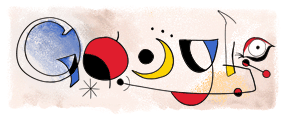
Anonymous Coward writes "In a homage to Joan Miro on his birthday, Google changed its logo as to spell out the word "Google" in Miro's style. Google has a history of changing its logo in order to commemorate events and holidays of particular significance. In this case, the homage was not well received by the Miro family or the Artists Rights Society which represents them, as reported by the Mercury News. According to Theodore Feder, president of the ARS, "There are underlying copyrights to the works of Miro, and they are putting it up without having the rights". The ARS demanded that Google removed the logo, and Google complied, though not without adding that it did not believe it was in violation of copyright. The ARS has raised similar complaints regarding Google's tribute to Salvador Dali in 2002. "It's a distortion of the original works and in that respect it violates the moral rights of the artist," Feder said." It seems to me that the art world has a glorious history of incorporating prior art into modern creations. It's amusing to me that ARS doesn't understand that.
9 of 651 comments (clear)

  1. Moral Rights by TubeSteak · · Score: 5, Informative
    "It's a distortion of the original works and in that respect it violates the moral rights of the artist,"
    That struck me as a very European viewpoint. However, I went to google and found out that the U.S.A. has similar thoughts (and laws) on the matter.

    I can't vouch for this particular article, but similar information shows up on other sites. http://www.carolinaarts.com/902fenno.html
    Many European countries have long recognized artists' personal or "moral" rights in their works of art. Among these rights are the rights of "integrity" (the right to prevent distortion or mutilation of an author's work) and "attribution" (the right of the author to be recognized as the author). These "moral" rights (termed "droit moral" in Europe) spring from a belief that an artist in the process of creation injects his or her spirit into the work. Moral rights are intended to protect the honor and reputation of the artist.

    In 1990, Congress enacted the "Visual Artists' Rights Act" (the "Act") to provide protection for artists' moral rights in selected categories of works of art in the United States. The Act is limited in scope, protecting only works of "visual art" that are created on or after June 1, 1991. [Insert what is and isn't protected]

    Subject to "fair use" rights and other limitations, the Act provides the author of a work of visual art the right to:

    • Prevent any intentional distortion, mutilation, or other modification of that work which would be prejudicial to his or her honor or reputation;
    • Prevent any intentional or grossly negligent destruction of a work of recognized stature;
    • Claim authorship of the work;
    • Prevent the use of his or her name as the author of any work of visual art that (s)he did not create; and
    • Prevent the use of his or her name as the author of the work of visual art in the event of a distortion, mutilation, or other modification of the work that would be prejudicial to his or her honor or reputation.
    ...
    Since moral rights are intended to protect the honor and reputation of the artist, the Act only protects the rights for the lifetime of the artist. ...
    --
    [Fuck Beta]
    o0t!
  2. They don't understand copyrights by Matt+Perry · · Score: 3, Informative
    According to Theodore Feder, president of the ARS, "There are underlying copyrights to the works of Miro, and they are putting it up without having the rights"
    He's thinking of patents. Copyrights only cover a specific creation of a work. If Google's work was created entirely by them then there's no legal issue here, no matter what ARS thinks. Feder needs to talk to a lawyer before making public statements like that. It only makes him look woefully ignorant of the law (and greedy at the same time).
    --
    Slashdot: Failed Car Analogies. Amateur Lawyering. Anecdote Battles.
  3. Re:spotlight by east+coast · · Score: 4, Informative

    Joan is a he not a she.

    But I agree. How much value, both monetary and artistically, did Miro's work lose over this? None is my guess, frankly. While I do support the right to the works of Miro by the current copyright owners I can't see how a simple logo can distort the value of the original works. Although I will say it did make the point as I knew immediately that it was meant to represent Miro when I had seen it on Google originally.

    --
    Dedicated Cthulhu Cultist since 4523 BC.
  4. ARS is for ARSloch by iggymanz · · Score: 4, Informative

    Joan Miro himself borrowed and altered some things from other surrealists. Everyone write to president Dr. Theodore Feder at

    Artists Rights Society
    536 Broadway, 5th Floor
    (at Spring St.)
    New York, NY 10012
    Tel: 212-420-9160
    Fax: 212-420-9286

    or drop him a line at tfeder AT arsny DOT com

  5. Re:This is what I think about ARS by Alystair · · Score: 5, Informative

    You know it's personal when they submit an email address in the content of a slashdot article ;)

  6. Re:Estate of Miro vs. Google by mrchaotica · · Score: 4, Informative
    I thought it was wonderful to see the Miro pic on Google; it made me smile.
    First of all, it wasn't a "Miro pic." It was a Google pic done in a Miro-esque style, which is why the ARS has no legitimate claim to begin with.
    HOWEVER: there is a little wrinkle (note: IANAL). A right that is not defended can be argued to have lapsed. Thus, if the agency and the estate of Miro hadn't at least rattled their sabres and expressed annoyance ... then some future, less-benevolent Miro-ripoff would be able to point to the earlier inaction as precedent.
    I'm not a lawyer either, but from what I understand, that reasoning applies to trademarks but not copyrights or patents.
    And, Google (which is chock full-o-lawyers at the exec levels now) surely needs to create new form letters asking for non-commercial permission to exhibit content.
    Google doesn't have to ask permission for a damn thing, because it was their own content that they were exhibiting!
    --

    "[Regarding the 'cloud,'] ownership was what made America different than Russia." -- Woz

  7. Re:This is what I think about ARS by Schraegstrichpunkt · · Score: 3, Informative

    Parody isn't a legal exception to copyright in all jurisdictions (e.g. Canada), sadly.

  8. Weird Al vs Coolio by John+Straffin · · Score: 3, Informative

    From http://www.al-oholicsanonymous.com/faq/#coolio:

    9. What's the beef with Coolio?

    Added: 8/12/03

    The story goes like this. Al wanted to do a parody of Coolio's 'Gangstas Paradise' called "Amish Paradise". He tells his record label to get permission. They do. Al records and releases the song. Coolio then hears the song and says he never gave permission for it and wasn't happy about it. Al figures there was a communications breakdown somewhere and sends Coolio a public and sincere apology for the mixup saying he wouldn't have done the song if there was no permission. Coolio doesn't respond. This all took place back in the day of 1996, and by now, it's old boring news.

    --
    My contempt for the behavior and beliefs of the two major political parties cannot be adequately expressed in 120 chara
  9. Re:Wish Groucho Marx could type up the response by Piquan · · Score: 3, Informative

    And the REAL story (or at least, more real than the one those letters spell) can be found here.

    While Marx's letter makes it sound like Warner Brothers was upset about the use of the word "Casablanca", that's not really how it happened. That's just what Groucho wanted the public to THINK happened.