 Slashdot Mirror
Final Fantasy XII Review
The Final Fantasy series is almost twenty years old. When Square developed the first title in the series, the game's name was meant to coincide with designer Hironobu Sakaguchi's retirement. Instead, the game's popularity set the stage for a series that has now reached twelve 'main' titles and more than half a dozen offshoots. Almost everything about the series has changed over the years, except for popularity and a generally high level of quality. Final Fantasy XII has changed almost everything from the series norm, except the quality. The result is a game that very well may be considered the best Japanese RPG in years. It's a smarter, more adult, and absolutely beautiful title; the perfect balm for anyone not taken with The Elder Scrolls IV: Oblivion . Read on for my impressions of the newest and most ambitious chapter of the Fantasy that's never quite Final.
With a game as lengthy as Final Fantasy XII, a decent story would quickly become boring if you had to slog through the gameplay. In my estimation, though, the originality breathed into the tried-and-true combat system has transformed this series. Taking the best elements of the older turn-based battles and the auto-attacking tendencies of Final Fantasy XI, FFXII offers a welcome new approach to RPG combat. For starters, there are no 'random' attacks in FFXII. Monsters wander around dungeons in all their beautiful graphical glory, and whether to engage an enemy or flee is up to you. It's a welcome change, forgoing the frustration of random encounters dogging your steps on an overworld map.
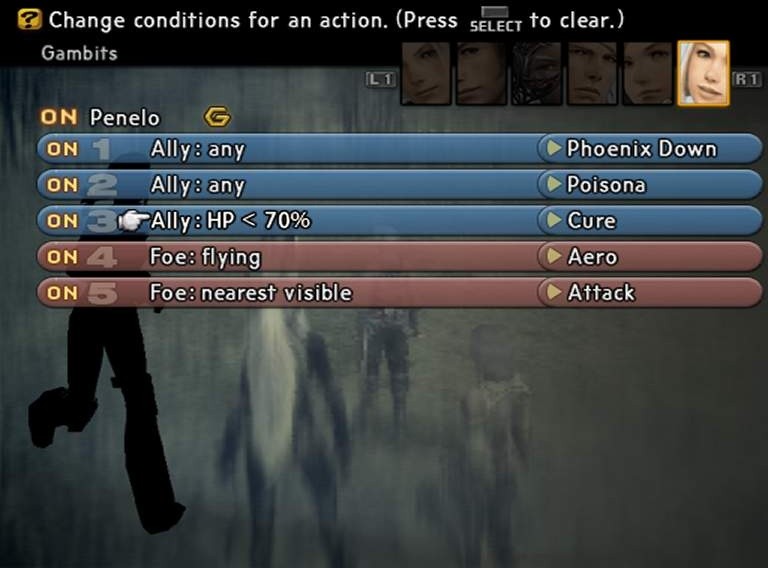
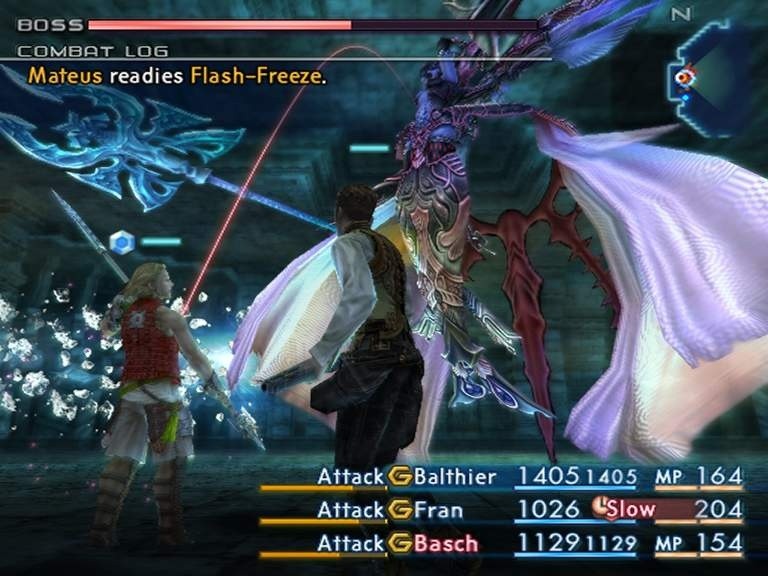
The real innovation here, though, lies in the 'Gambit system'. Each character has a certain number of Gambit slots. Each Gambit slot can be loaded with a specific command, with an extremely simple programming-like syntax allowing for some surprisingly complicated maneuvers. When loaded up, these Gambits dictate the actions of the characters within the game world. A Gambit could say 'If an Ally's HP is less than 80%, cast cure on them.' As you progress through the game, more esoteric criteria become available. Some allow you to target enemies based on their weaknesses, while others look for allies with detrimental conditions. This combat system can be overridden at any time with the simple push of a button, allowing the precision of a turn-based approach and the speed of the Gambits. Taken as a whole, Gambits allow the player to leave more of the 'nitty gritty' to the rules you've laid out. You don't have to make sure every character is healed up after a battle; they'll take care of that themselves. This frees you up to stay appraised of the whole battlefield, and in general means more fun per moment for the player. If this sounds like things are 'too easy', it should be pointed out that Gambits should either be heavily tweaked or turned off before boss battles. These non-stereotypical fights almost require a return to the series' turn-based roots, so that each character can execute the most efficient set of instructions possible. Gambits allow a wonderful blend of control and gameplay, and definitely aid in making the title the powerhouse that it is.
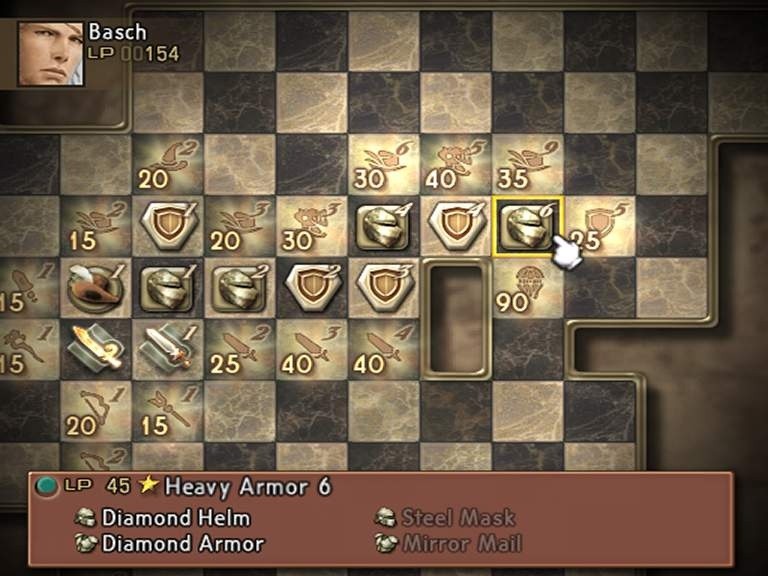
Other gameplay elements should be familiar to Final Fantasy players, but have received some additional tweaking. Each character can have their abilities focused by gaining new abilities and permissions on 'the license board'. License board points are obtained by defeating monsters, similar to but separate from the traditional experience points. While gaining levels does make a character stronger, it's the application of license points that makes them more versatile. A character focused on casting spells, for example, fills in the spellcasting part of the board with their points. There are board areas for weapons of varying types, armor, spells, simple stat buffs, and unique abilities called 'Technicks'. These last are non-magical moves that can produce a variety of quirky effects. One throws money at enemies to cause damage, while another damages opponents randomly based on what time of the day it is. These abilities, spells, and equipment are trained on the license board, but are unusable until actually purchased. While gil (the game's currency) is obtainable 'straight' from monsters, the most common way of paying the bills is by selling loot. Loot drops from monsters, and exists for no other purpose than to be sold for money. Entertainingly, you can increase your chances of gaining loot by 'Chaining'. Slaying several monsters in a row, all of which are of the same creature type, will allow you to start a loot chain. The more creatures you kill in a row of the same type, the better and more copious amounts of loot you'll receive. I've gotten chains up over 150 creatures, and by engaging in this entertaining activity it becomes easy to get the money you'll so desperately need.
Graphically, Final Fantasy XII may be one of the finest titles ever to grace the PS2. There are, of course, some jaggies and obvious pixilations. Despite that, the unique art style utilized to show off the world of Ivalice is absolutely breathtaking to behold. Character designs are iconic and memorable, while very distinct architectural styles makes it easy to understand where you are and differentiate from where you've been. They don't pull out the stops with well-imagined location concepts either, moving you from rotting tomb to scorching desert to a city floating on an island in the sky. Weather effects change locations you've been to previously, adding additional layers of complexity to an already quite dense graphical palette. Musically, the game stands shoulder-to-shoulder with the works of Nobuo Uematsu, the traditional composer for the series. Despite not being done by the master, Sakimoto's work has the same haunting weight and presence we've come to expect.
Given that the PS2's successor launched commercially in the U.S. today, it's fitting that the last-gen Sony system would see titles such as this be published on the way out the door. Along with titles like Okami and Bully, FFXII is the last gasp of a true winner in the world of videogames. The PS2 won the last generation exactly because of games like this. At the end of the day, it's not marketing or hype that makes a game great; it's solid gameplay, an engaging story, and an attractive presentation. Final Fantasy XII proves that you don't have to be 'next-gen' to be a truly great game. I only hope that the lessons learned in these late-generation titles transfer into the games of the next generation. It's always frustrating relearning things again.
The game elements of Final Fantasy XII, laid out separately, sound solid but fairly routine. Gambits are new, to be sure, but it's all pretty standard stuff. The key here is that it doesn't play like the standard stuff. Moving through the actual game in Japanese RPGs has gotten to be a real chore over the years. Unlike the freedom valued by American games in the same genre, the boxed-in storylines and gameplay have gotten mostly fairly stale. Even exceptionally good examples of the genre suffer from a a case of the been-there done-thats. All this makes Final Fantasy XII that much more enjoyable in aggregate. By stepping outside of series norms, the game's creators have had the chance to reintroduce us to the very gameplay and storytelling concepts which made the Final Fantasy series a powerhouse in the first place. I highly recommend this title to any fan of Japanese-style roleplaying games. If you've been put off by the stodgy nature of the genre in the past, I would even go so far as to say this may be the title that allows you to finally enjoy these games. Final Fantasy XII is a triumph for the series, and I sincerely hope marks the direction future games will be heading.
- Title: Final Fantasy XII
- Publisher/Developer: Square / Enix
- System: PS2
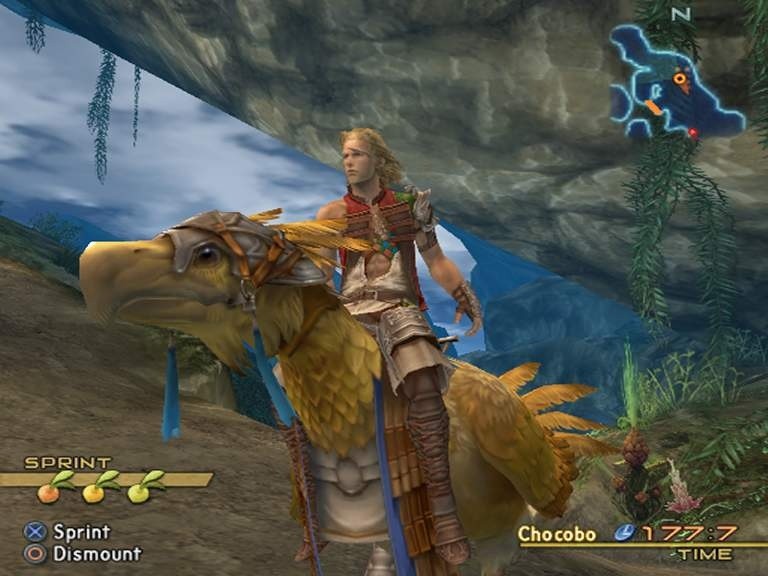
With a game as lengthy as Final Fantasy XII, a decent story would quickly become boring if you had to slog through the gameplay. In my estimation, though, the originality breathed into the tried-and-true combat system has transformed this series. Taking the best elements of the older turn-based battles and the auto-attacking tendencies of Final Fantasy XI, FFXII offers a welcome new approach to RPG combat. For starters, there are no 'random' attacks in FFXII. Monsters wander around dungeons in all their beautiful graphical glory, and whether to engage an enemy or flee is up to you. It's a welcome change, forgoing the frustration of random encounters dogging your steps on an overworld map.
The real innovation here, though, lies in the 'Gambit system'. Each character has a certain number of Gambit slots. Each Gambit slot can be loaded with a specific command, with an extremely simple programming-like syntax allowing for some surprisingly complicated maneuvers. When loaded up, these Gambits dictate the actions of the characters within the game world. A Gambit could say 'If an Ally's HP is less than 80%, cast cure on them.' As you progress through the game, more esoteric criteria become available. Some allow you to target enemies based on their weaknesses, while others look for allies with detrimental conditions. This combat system can be overridden at any time with the simple push of a button, allowing the precision of a turn-based approach and the speed of the Gambits. Taken as a whole, Gambits allow the player to leave more of the 'nitty gritty' to the rules you've laid out. You don't have to make sure every character is healed up after a battle; they'll take care of that themselves. This frees you up to stay appraised of the whole battlefield, and in general means more fun per moment for the player. If this sounds like things are 'too easy', it should be pointed out that Gambits should either be heavily tweaked or turned off before boss battles. These non-stereotypical fights almost require a return to the series' turn-based roots, so that each character can execute the most efficient set of instructions possible. Gambits allow a wonderful blend of control and gameplay, and definitely aid in making the title the powerhouse that it is.
Other gameplay elements should be familiar to Final Fantasy players, but have received some additional tweaking. Each character can have their abilities focused by gaining new abilities and permissions on 'the license board'. License board points are obtained by defeating monsters, similar to but separate from the traditional experience points. While gaining levels does make a character stronger, it's the application of license points that makes them more versatile. A character focused on casting spells, for example, fills in the spellcasting part of the board with their points. There are board areas for weapons of varying types, armor, spells, simple stat buffs, and unique abilities called 'Technicks'. These last are non-magical moves that can produce a variety of quirky effects. One throws money at enemies to cause damage, while another damages opponents randomly based on what time of the day it is. These abilities, spells, and equipment are trained on the license board, but are unusable until actually purchased. While gil (the game's currency) is obtainable 'straight' from monsters, the most common way of paying the bills is by selling loot. Loot drops from monsters, and exists for no other purpose than to be sold for money. Entertainingly, you can increase your chances of gaining loot by 'Chaining'. Slaying several monsters in a row, all of which are of the same creature type, will allow you to start a loot chain. The more creatures you kill in a row of the same type, the better and more copious amounts of loot you'll receive. I've gotten chains up over 150 creatures, and by engaging in this entertaining activity it becomes easy to get the money you'll so desperately need.
Graphically, Final Fantasy XII may be one of the finest titles ever to grace the PS2. There are, of course, some jaggies and obvious pixilations. Despite that, the unique art style utilized to show off the world of Ivalice is absolutely breathtaking to behold. Character designs are iconic and memorable, while very distinct architectural styles makes it easy to understand where you are and differentiate from where you've been. They don't pull out the stops with well-imagined location concepts either, moving you from rotting tomb to scorching desert to a city floating on an island in the sky. Weather effects change locations you've been to previously, adding additional layers of complexity to an already quite dense graphical palette. Musically, the game stands shoulder-to-shoulder with the works of Nobuo Uematsu, the traditional composer for the series. Despite not being done by the master, Sakimoto's work has the same haunting weight and presence we've come to expect.
Given that the PS2's successor launched commercially in the U.S. today, it's fitting that the last-gen Sony system would see titles such as this be published on the way out the door. Along with titles like Okami and Bully, FFXII is the last gasp of a true winner in the world of videogames. The PS2 won the last generation exactly because of games like this. At the end of the day, it's not marketing or hype that makes a game great; it's solid gameplay, an engaging story, and an attractive presentation. Final Fantasy XII proves that you don't have to be 'next-gen' to be a truly great game. I only hope that the lessons learned in these late-generation titles transfer into the games of the next generation. It's always frustrating relearning things again.
The game elements of Final Fantasy XII, laid out separately, sound solid but fairly routine. Gambits are new, to be sure, but it's all pretty standard stuff. The key here is that it doesn't play like the standard stuff. Moving through the actual game in Japanese RPGs has gotten to be a real chore over the years. Unlike the freedom valued by American games in the same genre, the boxed-in storylines and gameplay have gotten mostly fairly stale. Even exceptionally good examples of the genre suffer from a a case of the been-there done-thats. All this makes Final Fantasy XII that much more enjoyable in aggregate. By stepping outside of series norms, the game's creators have had the chance to reintroduce us to the very gameplay and storytelling concepts which made the Final Fantasy series a powerhouse in the first place. I highly recommend this title to any fan of Japanese-style roleplaying games. If you've been put off by the stodgy nature of the genre in the past, I would even go so far as to say this may be the title that allows you to finally enjoy these games. Final Fantasy XII is a triumph for the series, and I sincerely hope marks the direction future games will be heading.
Each character can have their abilities focused by gaining new abilities and permissions on 'the license board'. License board points are obtained by defeating monsters, similar to but separate from the traditional experience points. So now we have Licenses and Permissions instead of our own experience points? What is this? Final Fantasy Vista?
-Now I may be an idiot, but there is one thing I am not sir, and that, sir, is an idiot.
A 17 year old street-kid, who (as the game begins) is training himself on rats, quickly progresses to the wanton slaughter of the undead, not to mention elite Imperial guardsmen (in whichever order common sense would indicate with regards to their difficulty).
Many of the FF titles I've played have centered around remarkably young characters...who are capable of causing death and destruction. In some cases, they do so using rather improbable weapons (by which I do not mean sci-fi things like gunblades...I refer to things like blitzballs in FFX).
While I applaud the improvement of the plot in this FF over some of the previous iterations, I still find some of the things that are just taken for granted to be highly unlikely, such as the foregone conclusion that someone with extensive experience as a pirate (or as a soldier) would join with a young urchin, regardless of how many times their paths cross.
Further, I have never understood why the experience level of ones comrades does not accurately represent their life. If my character has lived on the street all his life, and someone who has been a professional soldier joins my party, he starts at the same level as I do (excepting that I can steal...since I'm a pickpocket).
I say all this not to be overly critical. I understand that some things must simply be accepted for the sake of the gameplay mechanics. However, with a little more attention to the detail in the story, I think that the game could go from something that is already very good to something superb.
Take it to the limit, everybody to the limit, come on, everybody fhqwhgads.
Because we all know that maturity and adulthood are all about sex, drugs and $MUSIC_GENRE.
Conservatism: (n.) love of the existing evils. Liberalism: (n.) desire to substitute new evils for the existing ones.
I thought it just meant to read more in general. I read the teaser... then I saw "read more", so I picked up a random book and started reading. "Moby Dick" sucks, just to let you know!