 Slashdot Mirror
1-Click Rejection Rejected
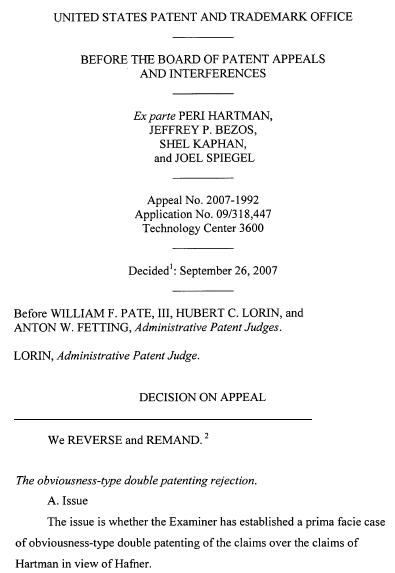
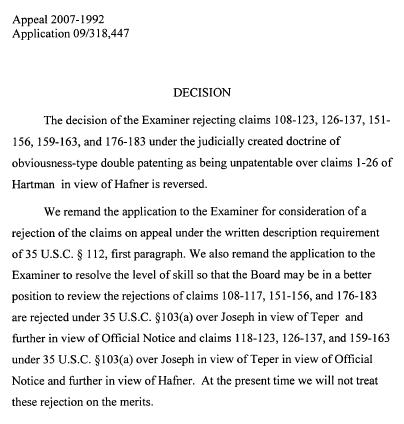
theodp writes "On Wednesday, a three-judge USPTO panel convened at Amazon's request rejected a USPTO Examiner's rejection of Amazon CEO Jeff Bezos's 1-Click patent, ruling that it wasn't obvious to them what the Examiner found obvious. The application has been remanded to the Examiner with instructions to make the obviousness more obvious."
The level of obviousness they need to show on appeal to reject the patent application is well below the level an applicant need to show to get it granted. The gap between the two is even greater now:
http://www.news.com/Supreme-Court-loosens-patent-obviousness-test/2100-1014_3-6180220.html
The court just wants to show it's done it's job. In this case the patent office has an extra problem in that it previously granted the patent, so undermined it's own right to reject on the grounds of obviousness. But that just means they have to explain why they're rejecting it now (as opposed to accepting it before), it doesn't mean they don't win by default.
But it would have been really helpful to have a story on the original decision linked, such as to the Slashdot post, or, perhaps, even a direct link to the original rejection?
The cesspool just got a check and balance.
Obvious does NOT mean easy and vice versa.
Obvious does NOT mean what you think it does.
Obvious in patent law is a specific term with a specific statutory interpretation. Here is a simple interpretation...
Pretend to be an unimaginative man skilled in the art, look at the cited prior art, look at the patent application, consider the difference. In considering the difference you have to have a motivation to add that difference to the prior art. Sometimes the prior art may teach or fairly suggest alternative approaches. Say for example the application is for a composite thingumagig and one prior art document is for a metal thingumagig which says "other materials may be used" and a second prior art document that says "composites can be used for lots of things". You can then consider combining these two pieces of prior art into an obviousness argument. But what if the first document said "we tried other materials, metals are best no other material will do". Where is the motivation then?
It might come down to the skilled man and this is an important point from the ruling. The judge has asked the examiner to "resolve the level of skill". This means that they are not sure who the skilled man is in this case. The skilled man is a construct and may be an amalgam of different people not just a single person. Is it a computer scientist? a shop keeper? a website designer? an accountant? Remember they have to be unimaginative, they will only do what they know. Also you have to place this man at a time before the application was filed. You must not use hindsight. Thinking that something was obvious after the fact is easy!
It isn't as straight forward as you think.
I suggest using the following pseudo-code:
// THIS IS THE OBVIOUS PART - a simple IF!
// This applies for both normal checkout and 1-click-buy
// This is for non-1-click buy // NOTE: These are pseudo-functions, the actual implementation may differ according to the programming language used (PHP, java, ASP.NET, C#).
function button_click() {
add_item_to_shopping_cart();
if(one_click_enabled) {
checkout_and_buy();
} else {
continue_showing_items();
}
}
function checkout_and_buy() {
process_financial_transaction_to_buy_items_in_shopping_cart();
empty_shopping_cart();
show_thankyou_screen_and_continue_showing_items();
}
function button_checkout() {
show_checkout_screen_and_wait_for_confirmation();
}
there ya go.
Non-obviousness is a legal requirement for a patent. The Examiner is required to make his determination based on a reasoned finding of fact and conclusions of law. If the Examiner failed to make his reasoning clear that the legal requirement of non-obviousness has not been met, then his determination is legally deficient. This doesn't mean that the Board doesn't see the obviousness; it means at the minimum that the Examiner did not adequately do his job in defending his determination in writing as required.
I'm not denying that, what I'm trying to say is that "I could have thought of that eventually" is not a cogent legal argument.
I quite often accidentally click things by my finger slipping on the mouse and pressing the button. I've also clicked 2 things on a page in the browser, and it'll send both requests (if you click slow enough) but only show you 1 or the other page. Some show you the first, some the second. If you accidentally click the 'buy' button, then click another link, it's possible to have bought the product and never know it.
I'm sure you'll get an email and all that, but how often do most people check their email? I doubt they're as anal about it as I am.
The MP3 'buy' button offered no such cancellation page and actually immediately started the download of the MP3. There was no chance to back out. As I said, there's an option in place now to help that, though.
"If you make people think they're thinking, they'll love you; But if you really make them think, they'll hate you." - DM
(My emphasis added above.)
One thing I've learned in lengthy 'discussions' (... and by 'discussions', I really mean 'arguments') with a group of law grads is that legal definitions of words are a very limited subset of the real world definition. Many words mean exactly one specific thing. No matter how much nuance or implication you can attach to a word in the English language, these things do not apply in Legal English. I can't tell you how many times I simply sat there, agape, as these people were explaining to me that simple words do not have the same meanings that I have attributed to them for my entire life.
The trick is, these magic keywords are sprinkled throughout the text without any indication... so unless you know beforehand that the word "obvious" doesn't really mean "obvious", but rather "something which would be put together in exactly the same way by someone of average skill in the art with the same components at their disposal." (Note: That definition is from memory, rather than a factually accurate quote. It may be off but I cba to look it up.)
Not necessarily any old web developer, given a database of user information, would create a 1-click purchase system (thankfully!) and therefore it's arguably not obvious, in Legal English. Whether or not you agree, that's the logic. It may be internalized, bizarro-world, insane troll logic with little to no bearing on the real world but there is some sort of consistency to it, however twisted.
Perhaps you meant this URL instead?
http://www.artlum.com/dilbert.gif
- Give a man a fire and he's warm for a day, but set him on fire and he's warm for the rest of his life.