Slashdot Mirror


1-Click Rejection Rejected

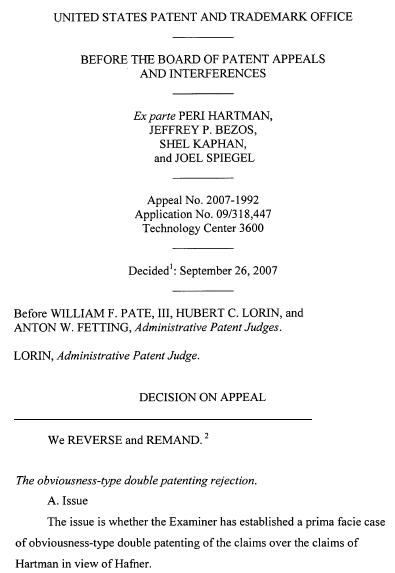
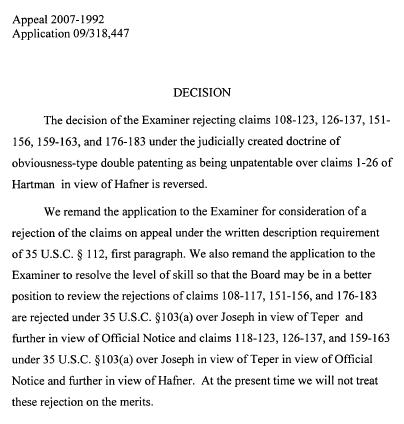
theodp writes "On Wednesday, a three-judge USPTO panel convened at Amazon's request rejected a USPTO Examiner's rejection of Amazon CEO Jeff Bezos's 1-Click patent, ruling that it wasn't obvious to them what the Examiner found obvious. The application has been remanded to the Examiner with instructions to make the obviousness more obvious."
49 of 201 comments (clear)

  1. But... by Aladrin · · Score: 4, Funny

    But, but... It's so OBVIOUS!

    Seriously, though... If there's even a single person that can't see what's obvious about this in the patent office, there needs to be firings until there isn't. This is pretty much the definition of obvious. Heck, if the person even had access to the internet, they'd have fallen across rants about its obviousness every other month.

    --
    "If you make people think they're thinking, they'll love you; But if you really make them think, they'll hate you." - DM
    1. Re:But... by pimpimpim · · Score: 4, Insightful
      Apparently the Examiner saw it, but the people higher up (let me guess, older?) are apparently easily flabbergasted by Amazon's techspeak. I'm no patent lawyer, but I can imagine one can rewrite "using account data saved from the user" in a complex enough way to make it sound like innovation.

      And as far as I've heard it's a crap 'invention' anyway, one wrong click and you just spent money on something you didn't really want. I'd rather review my account data and address every time.

      --
      molmod.com - computing tips from a molecular modeling
    2. Re:But... by delong · · Score: 4, Informative

      Non-obviousness is a legal requirement for a patent. The Examiner is required to make his determination based on a reasoned finding of fact and conclusions of law. If the Examiner failed to make his reasoning clear that the legal requirement of non-obviousness has not been met, then his determination is legally deficient. This doesn't mean that the Board doesn't see the obviousness; it means at the minimum that the Examiner did not adequately do his job in defending his determination in writing as required.

    3. Re:But... by Anonymous Coward · · Score: 5, Funny

      You could probably patent breathing if you'd word it something like:

      Method of obtaining oxygen while at the same time getting rid of carbon dioxide in intra-body transportation liquids by periodically increasing and decreasing the interior volume of a intra-body cavity connected with the outside air supply through a flexible biological tube, where the walls of the intra-body cavity are connected with the inter-body transport liquid system through semipermeable membranes which allow diffusion of oxygen and carbon dioxide between the transportation liquid and the air.

      Funny thing is, the captcha is "breath" :-)

    4. Re:But... by ehrichweiss · · Score: 2, Interesting

      And as far as I've heard it's a crap 'invention' anyway, one wrong click and you just spent money on something you didn't really want. I'd rather review my account data and address every time.

      I'd never thought of it that way but you're right. I already want to review everything(is the seller charging me $15 to ship an item that costs 40 cents to mail?) so why I'd want to accidentally buy something without a chance to say 'no' is beyond my reasoning powers.

      --
      0x09F911029D74E35BD84156C5635688C0
    5. Re:But... by Anonymous+Brave+Guy · · Score: 5, Insightful

      But, but... It's so OBVIOUS!

      The problem with the whole area of tech patents evaluated by non-techie people is the classic teacher's dilemma: for those who understand, no explanation is necessary, while for those who do not understand, no explanation is possible.

      Almost by definition, something is obvious if it is apparent without further explanation. However, like the many tests of "reasonableness" in law, obviousness is in the eye of the beholder and depends on context. Defining an accurate, repeatable, qualitative test that determines whether something is or is not obvious in general is impossible.

      However, one realistic and credible test is whether other people in the field in question could sensibly be expected to "invent" the same thing in the same circumstances without much thought. I would argue that claiming a typical web developer wouldn't think of the idea to have a single click in a specific place perform an action is pretty insulting to the intelligence of web developers, not least because hyperlinks have been following this principle since before Amazon was a twinkle in Jeff Bezos's eye. Similarly, the idea of remembering user data to minimise repetitive data entry has been around in database world since many years before the web existed. This is drifting into prior art rather than obviousness, perhaps, but I suspect that's the best way to attack this particular lunacy. After all, you can't credibly argue that other people wouldn't think of the same thing in the same circumstances if many of them already did.

      --
      If you disagree, post your argument. (-1, Overrated) isn't your personal censorship tool for views you don't like.
    6. Re:But... by Aladrin · · Score: 5, Interesting

      Far from elegant, '1 click' is dangerous and insane. As a developer, I would -never- consider implementing such a crazy thing. The 'are you sure' dialog is more of an invention than '1 click'. '1 click' is the opposite of invention, it's lack of one. It's leaving out a step. You know, the secure one that prevents the customer from accidentally ordering the $1000 fuzzybear their daughter was looking at by accidentally clicking on the button, then clicking elsewhere and loading the second page so they don't even know they've ordered it.

      I'm of 2 minds about this patent. It's so obvious that if it remains, the patent system is irretrievably broken. But as long as it remains, nobody else can implement this horrid system.

      When the Amazon MP3 thing showed up on /. yesterday, buying MP3s defaulted to 1-click. I bought one about 3 steps earlier than I expected. (Luckily, I had intended to follow through with it.) Less than an hour later, they had added a 'check here to always confirm before purchase' checkbox. They had obviously snagged quite a few 'accidental' sales that people didn't expect to make, and got tons of complaints.

      This patent is so obvious that every programmer goes through a stage where they learn about the confirmation dialog because they've already implemented this and need to fix it!

      --
      "If you make people think they're thinking, they'll love you; But if you really make them think, they'll hate you." - DM
    7. Re:But... by yerM)M · · Score: 2, Insightful
      I agree, but in this case there is no teacher's dilemma. If you can explain the concept in a sentence, it is obvious:

      We'll keep your credit card on file.

      This is the essence of 1-click. Now, I'm not saying that just saying it makes it possible, but, come-on, if you said this to any web-designer from 1988 on, they could have implemented it (perhaps not securely, but, whatever.)

    8. Re:But... by Aladrin · · Score: 2, Informative

      I quite often accidentally click things by my finger slipping on the mouse and pressing the button. I've also clicked 2 things on a page in the browser, and it'll send both requests (if you click slow enough) but only show you 1 or the other page. Some show you the first, some the second. If you accidentally click the 'buy' button, then click another link, it's possible to have bought the product and never know it.

      I'm sure you'll get an email and all that, but how often do most people check their email? I doubt they're as anal about it as I am.

      The MP3 'buy' button offered no such cancellation page and actually immediately started the download of the MP3. There was no chance to back out. As I said, there's an option in place now to help that, though.

      --
      "If you make people think they're thinking, they'll love you; But if you really make them think, they'll hate you." - DM
    9. Re:But... by BadMrMojo · · Score: 3, Informative

      Almost by definition, something is obvious if it is apparent without further explanation. However, like the many tests of "reasonableness" in law, obviousness is in the eye of the beholder and depends on context. Defining an accurate, repeatable, qualitative test that determines whether something is or is not obvious in general is impossible.


      (My emphasis added above.)

      One thing I've learned in lengthy 'discussions' (... and by 'discussions', I really mean 'arguments') with a group of law grads is that legal definitions of words are a very limited subset of the real world definition. Many words mean exactly one specific thing. No matter how much nuance or implication you can attach to a word in the English language, these things do not apply in Legal English. I can't tell you how many times I simply sat there, agape, as these people were explaining to me that simple words do not have the same meanings that I have attributed to them for my entire life.

      The trick is, these magic keywords are sprinkled throughout the text without any indication... so unless you know beforehand that the word "obvious" doesn't really mean "obvious", but rather "something which would be put together in exactly the same way by someone of average skill in the art with the same components at their disposal." (Note: That definition is from memory, rather than a factually accurate quote. It may be off but I cba to look it up.)

      Not necessarily any old web developer, given a database of user information, would create a 1-click purchase system (thankfully!) and therefore it's arguably not obvious, in Legal English. Whether or not you agree, that's the logic. It may be internalized, bizarro-world, insane troll logic with little to no bearing on the real world but there is some sort of consistency to it, however twisted.
    10. Re:But... by bkr1_2k · · Score: 2, Insightful

      Or you could say that lawyers make language specific and attempt to make it less ambiguous. It's all a matter of perspective, really.

      I'm not a fan of legal abuses or lawyers who try to weedle a situation trying to get the bad guy off on some technicality of how something was worded, but let's face it, sometimes that's exactly what's needed. Sometimes it's the bad guys who are getting hung by the same technicalities of language. Consider the RIAA's attempts to prosecute people for "offering up" songs for download, which technically isn't doing anything wrong. Without being specific about what "offering up" means, we'd have no real way to defend against the RIAA, right?

      Everything can be used for "good" or "bad" deeds, but what is "good" and what is "bad" are strictly a matter of perspective.

      --
      "Growing old is inevitable; growing up is optional."
    11. Re:But... by mavenguy · · Score: 5, Interesting

      This very probably the case, as reading the board's full decision shows. However, after browsing over the long and contorted prosecution of this application, and considering the huge number of claims to consider it's clear that there was not enough time to do a proper job to meet the level of discussion and discourse required by the Board.

      I have no idea if the examiner was given extra time to work on this application, but this is unlikely, or, if given, would hardly be enough to cover the work required. PTO management is fanatical about meeting production goals and meeting dates to crank out responses. Assuming that the business methods get among the most time to work on an application would mean a Primary Examiner would be expected to average getting out the equivalent of one full prosecution in about 40 hours that counts everything from when the examiner first sees the application until it sent off as an abandonment, allowance, or an appeal. the applicant here filed a Request for Continued Examination, so the examiner got another "balanced disposal", meaning that he had about 80 hours to get this out. Of course, the time is accounted on each application, but extra time spent on one application must come at the expense of working on other applications.

      Give the spotlight that this application has been under I bet management will come down hard on the examiner, probably charging him/her with an "Action Taking" clear error, if not others. They will scold employees for not doing a sufficieent job, but will will continue to hold them to production standards. Therein lies the main reason the quality of work from the PTO is often very poor.

      -Ex Examiner

  2. Firehose antics... by SnoopJeDi · · Score: 3, Insightful

    Sure, it's something that relevant to Slashdot, but posting a link directly to the documents leaves somebody without much experience reading patent-speak (like myself) almost in the dark.

    Maybe this was a bad call coming straight from the firehose?

    1. Re:Firehose antics... by Anonymous Coward · · Score: 5, Funny

      But a direct link means you only have to use 1-click to get to the documents.

    2. Re:Firehose antics... by Intron · · Score: 4, Funny

      "If a "provisional" nonstatutory obviousness-type double patenting (ODP) rejection is the only rejection remaining in the earlier filed of the two pending applications, while the later-filed application is rejectable on other grounds, the examiner should withdraw that rejection and permit the earlier-filed application to issue as a patent without a terminal disclaimer."

      Clear now?

      --
      Intron: the portion of DNA which expresses nothing useful.
    3. Re:Firehose antics... by Gr8Apes · · Score: 3, Informative

      But it would have been really helpful to have a story on the original decision linked, such as to the Slashdot post, or, perhaps, even a direct link to the original rejection?

      --
      The cesspool just got a check and balance.
    4. Re:Firehose antics... by mystran · · Score: 2, Interesting

      And now somebody probably should say: You must be new here.

      Rationale: one is not supposed to RTFA on /.

      That said, I personally kinda like legalese, patent-speak, and other dialects of formalese. They appear to be kinda like somewhere between natural and formal languages. The rules seem too strict for a truly natural language, yet not strict enough to be parsed with a formalized grammar. Most of the potential ambiguity is removed (or reduced), yet the expressive power doesn't seem to be artificially limited. If one could somehow take such a language just a couple of steps towards formalization to allow mechanical parsing and then replace the rather heavy-weight syntactical forms with something more digestible, maybe that would be an interesting basis for a semi-programming language for human-computer interaction. I mean, seriously.

      --
      Software should be free as in speech, but if we also get some free beer, all the better.
  3. Obviousness by geoffrobinson · · Score: 5, Funny

    It isn't obvious to me why they couldn't find obvious what the examiner found non-obvious.

    Obviously?

    --
    Except for ending slavery, the Nazis, communism, & securing American independence, war has never solved anything.
    1. Re:Obviousness by nuzak · · Score: 3, Funny

      PTO: Well, I reject your rejected rejection rejection and no tagbacks!

      Pwned! Should have seen that one coming, obviously.

      --
      Done with slashdot, done with nerds, getting a life.
  4. This post, which is first by PresidentEnder · · Score: 4, Funny

    The post which is first comes before the other posts. That is, it is the first post, if read in chronological order. Its firstness is determined by the earliness of its posting.

    But no matter how hard I try, I still can't make this as confusing as the summary.

    --
    I used to carry a bottle of whiskey for snake bite. And two snakes. -Nefarious Wheel
    1. Re:This post, which is first by HoosierPeschke · · Score: 3, Funny

      But you can make it as obviously wrong as the rejected rejection of the obviously obvious...

      --
      Mr. Universe: "They can't stop the signal, Mal. They can never stop the signal."
  5. You're joking...right? by condition-label-red · · Score: 5, Funny

    There has GOT to be a Monty Python joke in there somewhere....

    --
    Lorem ipsum dolor sit amet, consectetuer adipiscing elit.
    1. Re:You're joking...right? by danpsmith · · Score: 4, Funny

      Sir Lancelot stops to keep from marching into a giant hole.

      Sir Lancelot: Halt here!

      Servants stop.

      Servant: Why'd we stop sire?

      Sir Lancelot: Well isn't it obvious?

      Servant: Isn't what obvious?

      Sir Lancelot: Why we stopped, isn't it obvious?

      Servant: That's what I was asking.

      Sir Lancelot: There's a giant hole there.

      Servant: Ahh, I see, great job stopping there. Fine job indeed. I shall tell tales of your decisiveness and cunning.

      Sir Lancelot: Decisiveness and cunning? But it was obvious!

      Servant: What was obvious?

      Sir Lancelot: Stopping in front of the hole there of course.

      Servant: Well, that might have been obvious to someone such as you, your excellence. But I'd hardly call that obvious.

      Sir Lancelot: But it's a hole!

      Servant: Yes... Yes it is...

      Sir Lancelot: And it's quite deep.

      Servant: Yes sir, quite deep indeed.

      Sir Lancelot: And falling down it would've indeed injured us.

      Servant: Perhaps so, your excellence, perhaps so.

      Sir Lancelot: So it was obvious to stop then!

      Servant: To someone with your skills and decisiveness perhaps.

      Sir Lancelot: Are you saying you wouldn't have stopped then?

      Servant: Perhaps not.

      Sir Lancelot: But you would of fallen.

      Servant: Probably yes, your majesty.

      Sir Lancelot: Did you see the hole?

      Servant: Yes, yes I did, it was a quite impressive hole.

      Sir Lancelot: But you would've still gone?

      Servant: Perhaps.

      Sir Lancelot: But WHY?!? IT WAS OBVIOUS THEN!

      Servant: No offense, but maybe to you it was obvious, your excellence. But to me it was less so.

      King Arthur strides up with servants.

      King Arthur: HALT HERE!

      Servants and Arthur halt.

      King Arthur: Why have you stopped here Lancelot?

      Sir Lancelot: Well, isn't it obvious?

      Servant: Here he goes again, twas what we were just discussing.

      King Arthur: AHA the hole, but wait, why did we stop? There's a bridge over there.

      --
      Judges and senates have been bought for gold; Esteem and love were never to be sold.
  6. Even More Trouble by organgtool · · Score: 4, Funny

    Bezos was reported to be so mad about this ruling that he began throwing chairs and now he's getting legal threats from some CEO in Redmond who claims to have a patent on chair launching.

    1. Re:Even More Trouble by aweiland · · Score: 5, Funny

      Actually there is prior art on chair launching. Seems a fellow named Bob Knight did it first.

    2. Re:Even More Trouble by deniable · · Score: 4, Funny

      Bill should step down and make Steve chairman just for the joke value.

    3. Re:Even More Trouble by FredDC · · Score: 2, Funny

      Yea, but since when does prior art matter when giving out patents?

      --
      09 f9 11 02 9d 74 e3 5b d8 41 56 c5 63
    4. Re:Even More Trouble by ravenshrike · · Score: 2, Funny

      Maybe with folding chairs, but Ballmer pioneered in the field when he launched office furniture. Definitely worthy of a patent under the current USPTO.

  7. 1 click rejection? by Anonymous Coward · · Score: 4, Funny

    Sounds like me in high school...

  8. 1-Click Rejection by biocute · · Score: 2, Funny

    At first I thought someone tried to patent this " 1-Click Rejection" feature, and Slashdot would have to be paying $0.20 for every submission they easily rejected with one click.

  9. We need a hero to save the day. by Cutriss · · Score: 4, Funny

    Where's Captain Obvious when you need him the most?!

    --
    "Mod, mod, mod...and another troll bites the dust."
  10. Catch-22 by Pantero+Blanco · · Score: 3, Insightful

    How do you explain what makes something obvious when it's obvious?

    It's incredibly easy, if not trivial, to design a site so that someone can save a set of data (name, address, CC info) and resubmit it along with another set of data (the order) in one click. There are first and second-year CS and CIS projects that are more complicated than that. Securing the site wouldn't be nearly as simple, but that's not the part that's covered by the patent.

  11. Obviousness. by Ihlosi · · Score: 3, Insightful

    As always, there are some who will find somthing obvious only after they've had their heads repeatedly banged against it.

  12. Half-click shopping ... by MacTO · · Score: 5, Funny

    It is time to patent a brilliant new system that will help e-commerce vendors rake in billions of dollars: half-click shopping. Rather than waiting for the MOUSE_UP event after a MOUSE_DOWN event, we will use the MOUSE_DOWN event itself to close the transaction. This will ensure that all of those customers who initiate a click in a moment of shopping excitement will not be able to prematurely terminate a transaction by dragging their mouse pointer off of the link element before releasing the mouse button. Just imagine all of the extra transactions that will initiate! Next up, Zero-click shopping by using MOUSE_OVERs.

    1. Re:Half-click shopping ... by Overzeetop · · Score: 2, Insightful

      Wouldn't this make for prior art? Or at least give credence to any future obviousness claim.

      --
      Is it just my observation, or are there way too many stupid people in the world?
    2. Re:Half-click shopping ... by IronChef · · Score: 2, Funny

      You are correct. Shopping that seems to defy the Arrow of Time is the future of ecommerce. Marketing is calling it "Lightspeed Shopping" for now. Reasonably priced licenses are available now, contact me for details.

      When a new potential revenue stream is instantiated (ie, born) the retailer references the birth record and local demographics. Based on the instance's socioeconomic class and other factors, a queue of products is created and stored in a database. The instance will then receive products and bills without intervention for the remainder of their lives. (Geolocation data from the instance's mobile phone can be used to update the product stream in near real time. You have probably already seen some fascinating articles about this in the standard publications, eg J Retail Sci.)

      Advanced collaborative filtering will be used to ensure that the product stream is highly relevant to the instance's lifestyle. Obviously, this method is patented. The specific database techniques used to store the predicted product stream has also yielded an unreasonably broad patent, which we are very excited about.

      Eventually, the legislature may wish to allow our revenue streams to opt out of the program, so we all need to get ready to spend some time in court to protect the business model.

  13. So show basis already by Anonymous Coward · · Score: 2, Informative

    The level of obviousness they need to show on appeal to reject the patent application is well below the level an applicant need to show to get it granted. The gap between the two is even greater now:

    http://www.news.com/Supreme-Court-loosens-patent-obviousness-test/2100-1014_3-6180220.html

    The court just wants to show it's done it's job. In this case the patent office has an extra problem in that it previously granted the patent, so undermined it's own right to reject on the grounds of obviousness. But that just means they have to explain why they're rejecting it now (as opposed to accepting it before), it doesn't mean they don't win by default.

  14. Catch-22 by RyanFenton · · Score: 4, Funny


    "Why isn't this obvious?!" Yossarian asked

    "The obviousness is just to obvious, that's why." said Captain Black

    "That... that's just stupid. If it's so obvious, you should just call it obvious and reject it." said Yossarian

    "Oh, sure. But if we did that, what would be the end result? Everyone would spend all their time trying to force themselves to think of non-obvious things." said Captain Black

    "What?! Isnt't that the point of this whole patenting system?!" asked Yossarian

    "NO! That's exactly my point - have you ever seen a good invention, I mean a really good invention? What makes you say it's a good invention - I'll tell you, it's because it makes so much sense for the situation its in! The really good inventions are only the ones that are SO obvious you never thought of them before. So, therefore, we decided it's really best that if an invention seems TOO obvious, it obviously must be something we have to encourage, and therefore has to be accepted BECAUSE it was too obvious." said Captain Black

    -

    Ryan Fenton

  15. Gah! by Thaelon · · Score: 3, Insightful

    Why can't they reject it on the grounds that software shouldn't be patentable?

    Patents were never intended to protect ideas but rather an idea + method of accomplishing it. The purpose being that it wouldn't stifle innovation because other people could come up with other - perhaps improved - methods to accomplish the same thing. Thus innovation continues forward, but the particular device that the original designer came up with is protected, not the goal he set out to accomplish. It's akin to patenting an octagonal wheel. Someone else is free to come along and patent a circle based wheel. But with software patents, even if you do it better, you can be sued for it. Thus obvious stifling of innovation. Sure you could do it on your own time, but you have to wait, what, 50 years before you can make money from it?

    --

    Question everything

  16. Comment removed by account_deleted · · Score: 3, Interesting

    Comment removed based on user account deletion

  17. Captain Obvious to the rescue! (serious) by Spy+der+Mann · · Score: 2, Informative

    I suggest using the following pseudo-code:


    function button_click() {
        add_item_to_shopping_cart();
        if(one_click_enabled) { // THIS IS THE OBVIOUS PART - a simple IF!
              checkout_and_buy();
        } else {
            continue_showing_items();
        }
    }

    function checkout_and_buy() { // This applies for both normal checkout and 1-click-buy
        process_financial_transaction_to_buy_items_in_shopping_cart();
        empty_shopping_cart();
        show_thankyou_screen_and_continue_showing_items();
    }

    function button_checkout() { // This is for non-1-click buy
        show_checkout_screen_and_wait_for_confirmation();
    } // NOTE: These are pseudo-functions, the actual implementation may differ according to the programming language used (PHP, java, ASP.NET, C#).


    there ya go.

  18. An Obligatory, just for you by hellfire · · Score: 4, Funny

    Sir Lancelot: We were in the nick of time. You were obvious.
    Sir Galahad: I don't think I was.
    Sir Lancelot: Yes, you were. You were very obvious
    Sir Galahad: Look, let me go back in there and be obvious
    Sir Lancelot: No, it's too obvious
    Sir Galahad: Look, it's my duty as a knight to be as obvious as I can.
    Sir Lancelot: No, we've got to find the Holy Patent. Come on.
    Sir Galahad: Oh, let me have just a little bit obviousness?
    Sir Lancelot: No. It's unhealthy.
    Sir Galahad: I bet you're Jeff Bezos.
    Sir Lancelot: Am not.

    --

    "All great wisdom is contained in .signature files"

  19. The problem with "Obvious" by mlwmohawk · · Score: 2, Insightful

    The problem is "Obvious" to whom?

    There are a number of things that are perfectly obvious to me that may not be obvious to someone else. One of the things I think is lacking is the notion, actually used in patent law, "obvious to someone skilled in the art." But what "art?" Software engineering is not one art. Like it or not, it is splitting into a number of (sometimes and sometimes not) overlapping fields.

    Web, GUI, networking, search, OS, embedded, etc. these are all specializations and what is obvious to an OS guy may be completely incomprehensible to a web guy. An OS guy who only sees mouse clicks as merely system interrupts may not think 1-click is obvious, hell he probably doesn't even like mice.

    The 1-click patent is totally obvious and trivial to anyone doing any sort of GUI and/or web programming.

  20. Not treated on the merits by Jimb0v · · Score: 2, Insightful

    This appeal decision did not even address obviousness. Obvious type double patenting essentially means another application has the same claims as this patent. The appeal board recommended a rejection under 112. That means they think the claim is indefinite. They explicitly said they didn't treat the obviousness rejection on the merits. Stop bashing software patents. Stop bashing the patent system, when you have no clue what you are talking about.

  21. Perhaps by Poromenos1 · · Score: 2, Interesting

    Maybe it's useless for this particular implementation, but what if someone creates a site that allows you to buy items/services (such as songs) for a fixed fee (say $1) with one click while you're browsing? That'll be useful, but in comes this patent and that site can't use their system any more.

    --
    Send email from the afterlife! Write your e-will at Dead Man's Switch.
    1. Re:Perhaps by Firehed · · Score: 2, Interesting

      Well I have to say that it pairs quite nicely with Amazon's new MP3 store. Or if you have Amazon Prime (since 2-day shipping is free on Prime items). At least with the MP3s, you can have it show a confirmation after the one-click purchase making it two-click - I'd assume it's the same for tangible goods as well.

      But yeah, it's obvious if I've ever seen it. In fact, doesn't iTunes use it? Surely a patent this stupid would apply to web apps just as much as it applies to websites.

      --
      How are sites slashdotted when nobody reads TFAs?
  22. Re:Obvious to WHOM? by joto · · Score: 2, Insightful

    From my experience, this is a huge win for Amazon. Many, many patents look "obvious" in restrospect.

    I don't get this argument. If it looks obvious in retrospect, it's still obvious. Patents exist because it's good for society to have a system where individuals or companies that choose to spend money on expensive research, have a way of profiting from it. If your research wasn't expensive, and your "invention" was the result of a single aha-moment, then society does not benefit from you getting a patent.

    And that's the way obviousness should be interpreted. There's no way someone else wouldn't have "invented" ("discovered" is perhaps a better word) one-click shopping, if Amazon didn't. Perhaps Amazon was first, but it's still obvious.

  23. Re:Explanation... by Otto · · Score: 2, Informative

    Perhaps you meant this URL instead?
    http://www.artlum.com/dilbert.gif

    --
    - Give a man a fire and he's warm for a day, but set him on fire and he's warm for the rest of his life.
  24. Re:Parent violated patent! by digitig · · Score: 4, Funny

    I P.S.
    Your link leads to nowhere.

    That's what you think. In fact, you've just ordered a 36 volume encyclopaedia, and the first instalment of $199.99 will be debited from your credit card next month.

    That's what comes of not reviewing your order.

    --
    Quidnam Latine loqui modo coepi?