 Slashdot Mirror
Amazon Sneaks One-Click Past the Patent System
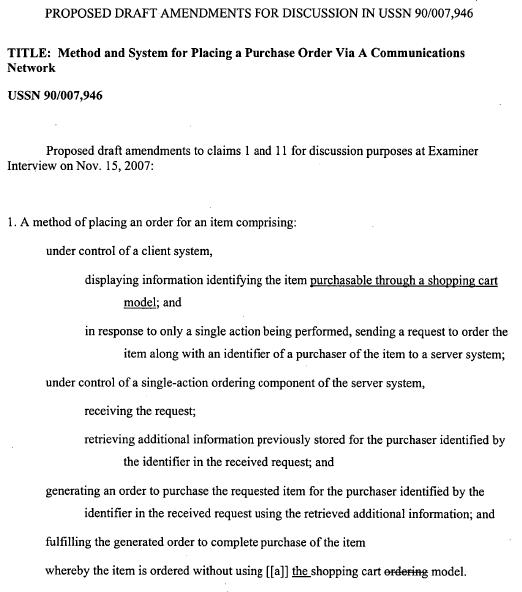
theodp writes "By changing the word 'a' to 'the' and adding the phrase 'purchasable through a shopping cart model,' lawyers for Amazon.com have apparently managed to reinstate two of CEO Jeff Bezos' 1-Click Patent claims that were rejected a month earlier. 'Patent Owner's Rep was informed that the proposed addition to the claims appear to place the claims in condition of patentability,' writes the USPTO in its Ex Parte Reexamination Interview Summary of the 11-15 conference call that was held with five representatives of the USPTO and patent reformer Amazon."

What about obvious to the expert part ?
No, absolutely not. The previously rejected patent is not a different patent from the one that is apparently now being allowed...actually, I think it is just specific claims that were rejected and now modified versions of those claims are being allowed. In any case, none of the prior iterations of the patent can server as disabiling prior art for the final version of the patent. Even if there were previous patents from Amazon that had parts of the invention, this one could have been filed as a continuation of the earlier patents to avoid prior art issues. With the latest changes and allowance by the USPTO, this one looks good, meets the requirements and is very likely to stand.
More at CNN.
Where is the abuse of the system here? Amazon is playing by all the rules set forth by Congress and the Patent Office. If prior art is found that reads on their claim, they amend the claim by adding more limitations (making it more specific) so that the claim overcomes the art rejection. The new limitations generally come from the dependent claims and must have adequate written description in the original patent application.
The /. posting is very misleading. First, the claim was amended with a further limitation "purchasable through a shopping cart model," to an already lengthy claim. The change of "a" to a "the" cleans up the antecedent basis problem (i.e., which shopping cart model is the last line referring to, the same one of line 3, or a different one). Second, this claim is still not in condition for allowance! The patent examiner looked at the new limitation and agreed that it probably overcomes the art currently rejecting the claim. He still gets to closely re-read the art of reference and conduct additional search before he can determine whether the claim is allowable.
And finally, I want everyone to look at the claim, not the title of the patent, and then, without impermissible hindsight, get to work finding prior art to read on the claim. Just saying that a single click of the mouse is obvious makes you look dumb. That's your homework for this week, now get to work!
The addition of "a shopping cart model" in the first clause of the claim necessitated the change of "a" to "the" in the last clause to make sure it had the correct "antecedent basis."
In claim drafting, you must first introduce a word or concept with "a" or "an" and then you refer back to it with "the" or "said." If you do not the claim will not be allowed.
The change from "a" to "the" did not magically change the claim from being invalid to allowable.
-- James
"One Click" shopping is an e-commerce technique, which allows a customer to purchase products via the Internet without repeatedly entering personal information such as name and address. At the time it was introduced it eased the frustration of on-line shopping.
The problem is, the whole reason cookies were created was precisely to enable on-line shopping:
http://www.ietf.org/rfc/rfc2109.txt
So soon after the RFC was *announced* Amazon requested a patent for doing what the RFC was specifically designed for. If you ignore the sleeziness of the action, it would be virtually impossible to find prior art since no implementation was possible before the standard was approved. And even if an early implementations of cookies existed, since Amazon was one of the few e-commerce site out there at the time, there would be virtually no chance of finding another prior art implementation.
Now you could go to the real-world analogy of going to a friendly store and pointing at a bunch of things and saying "Charge it", but since it's done by "a computer" it magically turns into a completely different thing.