Slashdot Mirror


Amazon Sneaks One-Click Past the Patent System

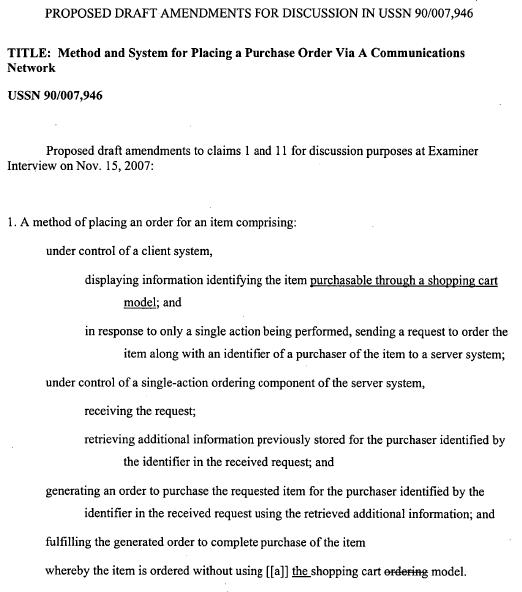
theodp writes "By changing the word 'a' to 'the' and adding the phrase 'purchasable through a shopping cart model,' lawyers for Amazon.com have apparently managed to reinstate two of CEO Jeff Bezos' 1-Click Patent claims that were rejected a month earlier. 'Patent Owner's Rep was informed that the proposed addition to the claims appear to place the claims in condition of patentability,' writes the USPTO in its Ex Parte Reexamination Interview Summary of the 11-15 conference call that was held with five representatives of the USPTO and patent reformer Amazon."
17 of 104 comments (clear)

  1. Re:I hate to ask by Tod+DeBie · · Score: 2, Insightful

    Without convincing prior art to show, it is highly unlikely that the USPTO would grant another review.

  2. Broken System by Rainbird98 · · Score: 4, Insightful

    The present system of patents is totally broken. It appears to exist for the promotion of lawsuits and legal fees rather than achieving true innovation.

    1. Re:Broken System by Anonymous Coward · · Score: 1, Insightful

      shhhh don't tell everyone

    2. Re:Broken System by jibjibjib · · Score: 2, Insightful

      That's like saying that DRM encourages innovation by causing people to create cracks for it, or that computer viruses encourage innovation in antivirus programs. While both of these statements are true, they don't necessarily mean that innovation is a good thing. In general, I don't think there's a net benefit to society from a company pointlessly having to come up with a new way of doing something that we already know how to do. What the patent system does is create obstacles to progress, and then say it must be good because it's making us pointlessly innovate to work around these obstacles.

  3. Re::facepalms: by calebt3 · · Score: 2, Insightful

    Will the last sane person in government... No such thing, as government is where asylums send all patients too loony for them to handle.
  4. Will Slashdot Ever Get It? by Anonymous Coward · · Score: 2, Insightful

    This comment is probably just a waste of virtual breath, but I'll give it a try anyway:
    Here on Slashdot, it looks like everybody enjoys conflating the issues of 1) whether we should have software patents at all and 2) whether the subject matter of this patent is obvious or not. It may be way too late for any meaningful discussion of this patent here on Slashdot, but keeping those two things separate would help out there.

    So I'd like to make an argument here, and see if I actually get any constructive responses: I really don't think that it was obvious or anticipated by any prior or *at the time that it was filed.* It was filed on September 12, 1997. How many people on here remember the state of internet commerce back in 1997? This idea was pretty innovative at that time. (Now that it's been used for 10 years, it's pretty obvious.)

    I'd also like to point out (and see if I get any constructive responses) that this patent isn't that broad, and not worth of the fear-mongering it has induced over the years. Here's the first claim of the patent (I added the numbers):

    1. A method of placing an order for an item comprising:
    1)under control of a client system,
    2) displaying information identifying the item; and
    3) in response to only a single action being performed, sending a request to order the item along with an identifier of a purchaser of the item to a server system;
    4) under control of a single-action ordering component of the server system,
    5) receiving the request;
    6) retrieving additional information previously stored for the purchaser identified by the identifier in the received request; and
    7) generating an order to purchase the requested item for the purchaser identified by the identifier in the received request using the retrieved additional information; and
    8) fulfilling the generated order to complete purchase of the item
    9) whereby the item is ordered without using a shopping cart ordering model.

    If your e-commerce site leaves out any one of those 9 clauses, you're not infringing. For example, if you're using a shopping cart ordering model, you're not infringing (look at part 9 there, you have to have a shopping cart ordering model to be within its bounds).

    Anyway, Happy Thanksgiving!

    1. Re:Will Slashdot Ever Get It? by Stormx2 · · Score: 3, Insightful

      The listing of nine items just makes it seem more complicated than it is. Infact this is a bunch simpler than the shopping cart model. It just eliminates the shopping cart altogether and procedes straight to checkout. How is this particularly innovative? The shopping cart system came along and was considered innovative, now taking it away is innovative? Get a grip.

    2. Re:Will Slashdot Ever Get It? by cfulmer · · Score: 4, Insightful

      Of course, if you have a shopping-cart ordering model, then it's not a one-click buy.

      Let's break that down with some specifics:

      1. A method of placing an order for an item comprising;
      1) a web browser
      2) a web page about an item
      3) where pushing "buy now" causes the web browser to send a "buy this item now" message to a web server
      4) a web server
      5) receives te request
      6) looks up the purchaser's credit card number
      7) creates an order for that purchaser in the order processing system which ...
      8) Processes the order
      9) all without a shopping cart

      I suggest that the only potentially novel thing here is #3. And, I suggest that #3 is obvious -- the only reason that nobody was doing it before hand was that nobody had previously considered the problem of reducing the number of clicks it takes to get somebody to buy something.

    3. Re:Will Slashdot Ever Get It? by nothings · · Score: 3, Insightful
      5 Insightful? WTF.

      One-click was always trivially obvious to anyone and everyone who'd had anything to do with anything even remotely like thinking about the problem.

      Received wisdom was that one-click was a bad idea, because (a) people would misclick and buy something they didn't want, and (b) people would be scared off from the site they were scared of misclicking. But this was received wisdom; everybody before Amazon thought one-click was a bad idea--but that means everyone knew about one click already.

      Maybe Amazon gets points for figuring out how to make it work pyschologically for people (if they even have--I have one-click disabled), but that's not the part that's being patented, and is surely not the part that people are talking about being obvious. Of course the ideal of clicking once was obvious--that's how the vast majority of actions on the computer worked, e.g. following hyperlinks! Or submitting a form! How could the action 'buy' not be obvious as one click as well? How could you possibly think that? And the implementation is trivial (the site just needs to know who you are, which it does if you're you logged in, whether with cookies or just earlier in the session and you have a session ID in the url).

      There's a GUI rule of thumb that everything should be undoable, and anything you can't make undoable should have a confirmation dialog? That's the exact same principle that underlies both the common wisdom against 1-click (require confirmation) and Amazon's specific solution (allow undoing the order).

      If you think this wasn't obvious, you can choke on a turkey.

    4. Re:Will Slashdot Ever Get It? by DamnStupidElf · · Score: 4, Insightful

      So I'd like to make an argument here, and see if I actually get any constructive responses: I really don't think that it was obvious or anticipated by any prior or *at the time that it was filed.* It was filed on September 12, 1997. How many people on here remember the state of internet commerce back in 1997? This idea was pretty innovative at that time. (Now that it's been used for 10 years, it's pretty obvious.)

      Vending machines are one click shopping models. Put your money in, then click the button for the item you want. Amazon includes the "putting your money in" step when you sign up for an account; there's no reason you couldn't put $1,000 in a vending machine and come back whenever you wanted something and get a "one click" shopping experience. Patenting an existing business model just by doing it on the Internet is silly, otherwise every single type of financial transaction (or any other action really, including talking, writing, imaging, video, audio, etc.) could be patented simply because it was done over the Internet for the first time.

      Second, as early as 1990 "pay-as-you-go" services like AOL and Compuserve already had content that could be purchased simply by clicking on them. They may have even had software downloads that could be purchased directly in forums, but I can't remember.

      If your e-commerce site leaves out any one of those 9 clauses, you're not infringing. For example, if you're using a shopping cart ordering model, you're not infringing (look at part 9 there, you have to have a shopping cart ordering model to be within its bounds).

      If Amazon wanted to be a bully, they could easily sue people. They can definitely afford lawyers. Microsoft doesn't even need to say which patents it thinks Linux infringes on in order to threaten people and win (see Suse and Linspire). Additionally, would you trust your business model to the whims of a jury who can't tell a shopping cart with a "Checkout" button apart from a "One click Purchase" button, or some random judge in Delaware or Texas of similar technical ignorance? I'm not slamming the states, just the fact that those states are used for incorporation for a reason; they're very friendly to big corporations.

    5. Re:Will Slashdot Ever Get It? by Jay+L · · Score: 3, Insightful

      Much as I hate the effects of the one-click patent, I'm not sure I agree with can you.

      Received wisdom was that one-click was a bad idea

      That's really the key of it. It was obvious to everybody: obvious that it was such a bad idea that nobody should do it.

      Except that it turned out that it was a really good idea, if you offset the "flaw" (no confirmation) with undoability. Good enough that other sites started doing it, too, and had to stop because of the patent.

      I'm trying to think of other things that were "obviously bad ideas" which are now good ideas because of offsetting techology. Verbose, self-descriptive, text-based, network-transmitted file formats? Garbage collection? Hell, digital audio was obvious, but also obviously dumb due to the poor quality and large file sizes. But if you patented some of these in 1970, would they be valid?

  5. Re:I hate to ask by ScrewMaster · · Score: 2, Insightful

    How much more convincing prior mouse clicks does the USPTO need? Good grief.

    --
    The higher the technology, the sharper that two-edged sword.
  6. I dunno, will you? by m2943 · · Score: 2, Insightful

    I'd also like to point out (and see if I get any constructive responses) that this patent isn't that broad, and not worth of the fear-mongering it has induced over the years. Here's the first claim of the patent (I added the numbers):

    You can't determine how broad a patent is by counting how many elements a claim has. Most of the elements of the claims of the Amazon patent don't limit the claims. Despite your verbal acrobatics and distortions, the patent is broad.

    (And those are not "claims" those are "elements".)

  7. Re:Exactly by PopeRatzo · · Score: 2, Insightful

    Just invent your own vocabulary and you're sure not to infringe any patents.
    Except their lawyers are better than your lawyers and you're still gonna pay.

    This had nothing to do with changing a few words in the patent and everything to do with money being spread around in the right places.

    I'm telling you, we are the ones being consumed.
    --
    You are welcome on my lawn.
  8. Not news by Kiro · · Score: 4, Insightful

    Is this really news? The ex-parte re-exam with the prior art uncovered by the New Zealand man invalidated all claims except those that mentioned a shopping cart; this was reported weeks ago.
    Back then, the PTO said that were Amazon to amend the rejected claims to include a shopping-cart limitation, which was not found in the newly uncovered prior art, those claims would probably be admissible.

    The "news" appears to be that Amazon did what the PTO suggested it to do...

  9. Am I the only one thats glad this is patented by z4ce · · Score: 2, Insightful

    Not because I think the patent isn't obvious or is right. But, I HATE the whole amazon one-click thing. It's way too easy to accidently order something while just trying to get a total price including shipping. So I'm glad they've patented it so no one else implements that annoying system.

    All they did was patent taking the safety checks out of online transactions.

  10. Er, "patent reformer"? by seebs · · Score: 3, Insightful

    How can Amazon be a "patent reformer"? Should there be this much doublespeak on Slashdot?

    --
    My blog: http://www.seebs.net/log/ --- My iPhone/iPad app: http://www.seebs.net/seebsfrac/