 Slashdot Mirror
Microsoft Seeks Patent On Brain-Based Development
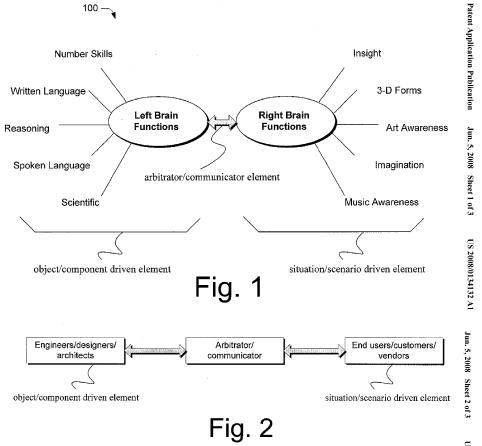
theodp writes "With its just-published patent application for Developing Software Components Based on Brain Lateralization, Microsoft provides yet another example of just how broken the patent system is. Microsoft argues that its 'invention' of having a Program Manager act as an arbitrator/communicator between a group of right-brained software users and left-brained software developers mimics 'the way that the brain communicates between its two distinct hemispheres.' One of the 'inventors' is Ray Ozzie's Technical Strategist. If granted, the patent could be used to exclude others from making, using, or selling the 'invention' for 17 years."
Usually it's not the concept of Microsoft's software that's all that bad, it's the specific implementation. This makes sure that their implementation is always the only one out there.
Also, patenting something based on the brain is ridiculous. Might as well patent "bi pedal motion", sue everyone in the world and get it over with.
1) This is only an application. Any dumbass can file an application so long as he pays the fees.
2) The poster doesn't even know how long patents last, let alone anything relating to what is *actually* wrong with the patent system.
Just my two eurocents (since they hold their value better).
Similar to the upcoming US election results
Only in America.
Not hardly. The madness is spreading.
The higher the technology, the sharper that two-edged sword.
First of all we should get rid of software patents. They are ridiculous, like patents on math.
...or so I've been told.
Is Microsoft only a victim?
Haven't they implied on more than one occasion that Linux is violating X patents?
That sure doesn't sound like a victim...
*Ahem.*
"True geeks" are interested in ideas for their own sake; money---although a certain amount is necessary for survival, and a bit more is desirable for comfort & security---is a secondary concern. And it's obvious you know absolutely nothing about mathematical culture if you would seriously consider the notion of patenting a theory or its proof; mathematicians, perhaps more than anyone else, understand the wisdom of Ben Franklin's words: "As we enjoy great advantages from the inventions of others, we should be glad of an opportunity to serve others by any invention of ours; and this we should do freely and generously."
+3 Insightful? WTF?
But if it "mimics the way the brain works" isn't that evidence of prior art?
I don't understand the world.
You are welcome on my lawn.
Unlike copyright, patents don't exist in order to protect inventors. They exist to encourage inventors to publish their inventions rather than keep them as trade secrets.
A book (which is what the first copyright systems covered) is not very useful for the author unless it is published.
Inventions on the other hand can (in many cases) be useful even if kept secret. This is why patents were invented - and why publishing is part of the patenting process.
Every mathemathical truth is obvious, since it follows from the postulates. And every algorithm is obvious in hindsight.
Simple to whom ? The patent examiner, who gets to read the obfuscated patent claim ?
Forget magic. Any technology distinguishable from divine power is insufficiently advanced.
So, just to be clear, you agree that, for example, the inventor of the Quicksort algorithm should have patented it? What about the inventor of the Binary chop search algorithm? Or how about line drawing algorithms such as this one: http://en.wikipedia.org/wiki/Bresenham's_line_algorithm
All of these algorithms were arguably non-obvious at the time.
Don't you wish you hadn't wasted 3 seconds of your life reading this sig?
Microsoft, Oracle, Adobe, and most of the other well-known software companies became successful long before software patents were widespread. The appropriate way to protect software is through copyright, not patent. (As for "business method" patents like the one this story is about, they're not an appropriate subject for any kind of IP protection at all.) The major argument in favor of proprietary software has always been that the profit motive inspires developers to work harder and create better software than those who do it for free. If this is true, then it is the obligation of proprietary software companies to make products that live up to this idea.
companies go and spend lots of money to research and develop something, then the open source community goes and takes the best of it, re-codes and gives it away for free
You seem to think this is a trivial process. Trust me, it's not.
The correlation between ignorance of statistics and using "correlation is not causation" as an argument is close to 1.
It's offtopic, but I actually agree fully... I'd love to see Slashdot's moderation system go to much higher numbers, and a few more mod points (but not too many more) be given out. e.g. Go to 15 instead of 5 as a maximum, and give out roughly twice as many mod points as currently. That way, each individual act of moderation has about 1/3 the value that it used to, but more people are given a "voice" in valuing posts.
It would also allow for finer grained modifiers - I currently have Friends and Fans at +1, but under the system I propose here, I'd put fans at +1 and friends at +3.
How about additional dimensions? +5 funny, +3 insightful, +7 interesting, -1 off topic, 0 overrated, -3 trollThe result could be plotted on a 3D graph attached to each comment.
[signature]