Slashdot Mirror


Microsoft Seeks Patent On Brain-Based Development

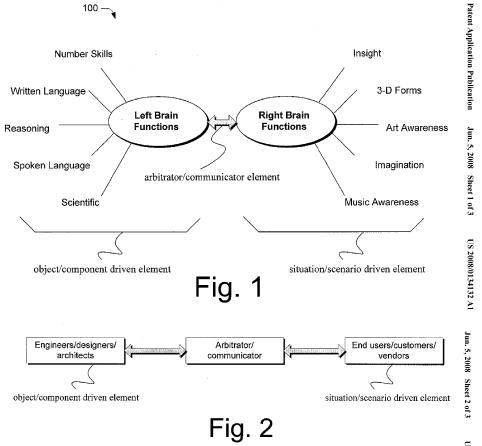
theodp writes "With its just-published patent application for Developing Software Components Based on Brain Lateralization, Microsoft provides yet another example of just how broken the patent system is. Microsoft argues that its 'invention' of having a Program Manager act as an arbitrator/communicator between a group of right-brained software users and left-brained software developers mimics 'the way that the brain communicates between its two distinct hemispheres.' One of the 'inventors' is Ray Ozzie's Technical Strategist. If granted, the patent could be used to exclude others from making, using, or selling the 'invention' for 17 years."
31 of 173 comments (clear)

  1. BOFH by AnotherBrian · · Score: 4, Funny

    So they just patented the concept of a manager. I really hope Microsoft enforces this one.

  2. You say that as if it's a bad thing by JonTurner · · Score: 5, Funny

    If granted, the patent could be used to exclude others from making, using, or selling the 'invention' for 17 years
    Not sure I understand your point of view on this one. I consider any legal device that prohibits selling software like Microsoft's to be worthy of praise.
    1. Re:You say that as if it's a bad thing by moderatorrater · · Score: 5, Insightful

      Usually it's not the concept of Microsoft's software that's all that bad, it's the specific implementation. This makes sure that their implementation is always the only one out there.

      Also, patenting something based on the brain is ridiculous. Might as well patent "bi pedal motion", sue everyone in the world and get it over with.

    2. Re:You say that as if it's a bad thing by AsmCoder8088 · · Score: 5, Funny

      ...Might as well patent "bi pedal motion", sue everyone in the world and get it over with.

      Except that would only affect people with two legs, not everyone.

    3. Re:You say that as if it's a bad thing by PopeRatzo · · Score: 3, Insightful

      But if it "mimics the way the brain works" isn't that evidence of prior art?

      I don't understand the world.

      --
      You are welcome on my lawn.
  3. The patent office - retarding development? by TRAyres · · Score: 5, Interesting
    Essentially what this does is retard the development of obvious software for 17 years.

    I wonder if I can get a patent on a 'for' loop and then declare all software that uses it to be violating my patent?

    Fucking ridiculous.

    Only in America.

    1. Re:The patent office - retarding development? by ScrewMaster · · Score: 4, Insightful

      Only in America.

      Not hardly. The madness is spreading.

      --
      The higher the technology, the sharper that two-edged sword.
    2. Re:The patent office - retarding development? by iknowcss · · Score: 5, Interesting
      This is not a troll. Please realize that as you are reading my post.

      It is clear the system is broken, but of all the comments I've ever read on slashdot (as infrequently as that may be) what is the solution? I mean you can't just throw out the thing all together. Having no patenting system would make the whole market far too volatile. If you could start over and rebuild the whole thing, what would you do?

      My first thoughts where along the lines of something like:
      • Company 1 comes up with idea and puts a "patent hold" on it. No one else can find out about it.
      • Company 2 comes up with the same / similar idea and puts its own "patent hold" on it. Again, no one finds out.
      • Company 1 finishes its product and takes it to market. Company 2 is informed.
      • Companies 1 and 2 are given patents on the idea. No more companies may put a "hold" on the patent.
      • Company 1 and 2 battle it out, creating competition, but with some market stability.
      This way, no one company can sit on it. If they want to do something about what they've come up with, they can't just sit on it. They actually have to act on it, and to minimize their competition, they need to develop it as quickly as possible, effectively incentivising progress.
      --
      Life is rarely fair. Cherish the moments when there is a right answer.
    3. Re:The patent office - retarding development? by something_wicked_thi · · Score: 4, Funny

      > Cheap +5 Insightful: just say "All Americans suck because {insert generalization here}"

      All Americans suck because all generalizations are false.

    4. Re:The patent office - retarding development? by Shai-kun · · Score: 4, Insightful

      First of all we should get rid of software patents. They are ridiculous, like patents on math.

      --
      ...or so I've been told.
    5. Re:The patent office - retarding development? by giafly · · Score: 4, Interesting

      The patent system only makes any sense for protecting inventions. The problem with IT patents - and I've read a lot - is that 99% of them are bleeding obvious. So there's no problem with others finding out about them. Unless, as in this case, the patent is pseudo-scientific twaddle, in which case who cares?

      If you're serious, how about replacing the current invention standard for new patents by a jury of software programmers who are presented with the problem and asked to design a solution. If any of them gets close to any "invention" in the would-be patent, it's "obvious" and fails.

      --
      Reduce, reuse, cycle
    6. Re:The patent office - retarding development? by Anonymous Coward · · Score: 4, Insightful

      *Ahem.*

      "True geeks" are interested in ideas for their own sake; money---although a certain amount is necessary for survival, and a bit more is desirable for comfort & security---is a secondary concern. And it's obvious you know absolutely nothing about mathematical culture if you would seriously consider the notion of patenting a theory or its proof; mathematicians, perhaps more than anyone else, understand the wisdom of Ben Franklin's words: "As we enjoy great advantages from the inventions of others, we should be glad of an opportunity to serve others by any invention of ours; and this we should do freely and generously."

      +3 Insightful? WTF?

    7. Re:The patent office - retarding development? by Inoen · · Score: 3, Insightful

      Unlike copyright, patents don't exist in order to protect inventors. They exist to encourage inventors to publish their inventions rather than keep them as trade secrets.
      A book (which is what the first copyright systems covered) is not very useful for the author unless it is published.
      Inventions on the other hand can (in many cases) be useful even if kept secret. This is why patents were invented - and why publishing is part of the patenting process.

    8. Re:The patent office - retarding development? by ultranova · · Score: 4, Insightful

      Patents on non obvious algorithms and Math are very valid and do give a great deal of advantage (plus it keeps a line of jobs for the true geeks).

      Every mathemathical truth is obvious, since it follows from the postulates. And every algorithm is obvious in hindsight.

      Patents on simple concepts however should be forbidden (not just for software)

      Simple to whom ? The patent examiner, who gets to read the obfuscated patent claim ?

      --

      Forget magic. Any technology distinguishable from divine power is insufficiently advanced.

    9. Re:The patent office - retarding development? by monkeythug · · Score: 3, Insightful

      So, just to be clear, you agree that, for example, the inventor of the Quicksort algorithm should have patented it? What about the inventor of the Binary chop search algorithm? Or how about line drawing algorithms such as this one: http://en.wikipedia.org/wiki/Bresenham's_line_algorithm

      All of these algorithms were arguably non-obvious at the time.

      --
      Don't you wish you hadn't wasted 3 seconds of your life reading this sig?
    10. Re:The patent office - retarding development? by Daniel+Dvorkin · · Score: 3, Insightful

      Microsoft, Oracle, Adobe, and most of the other well-known software companies became successful long before software patents were widespread. The appropriate way to protect software is through copyright, not patent. (As for "business method" patents like the one this story is about, they're not an appropriate subject for any kind of IP protection at all.) The major argument in favor of proprietary software has always been that the profit motive inspires developers to work harder and create better software than those who do it for free. If this is true, then it is the obligation of proprietary software companies to make products that live up to this idea.

      companies go and spend lots of money to research and develop something, then the open source community goes and takes the best of it, re-codes and gives it away for free

      You seem to think this is a trivial process. Trust me, it's not.

      --
      The correlation between ignorance of statistics and using "correlation is not causation" as an argument is close to 1.
  4. Maybe... by MrKaos · · Score: 5, Funny

    The left brain doesn't know what the right brain is doing at Microsoft.

    --
    My ism, it's full of beliefs.
  5. How telling, and how sad by Eternal+Vigilance · · Score: 4, Funny

    How sad that Microsoft considers metric-driven software development that connects users and developers a new invention. :-(

    "At Microsoft, these two halves of the brain come together in the colon."

    1. Re:How telling, and how sad by Zarf · · Score: 3, Insightful

      It's offtopic, but I actually agree fully... I'd love to see Slashdot's moderation system go to much higher numbers, and a few more mod points (but not too many more) be given out. e.g. Go to 15 instead of 5 as a maximum, and give out roughly twice as many mod points as currently. That way, each individual act of moderation has about 1/3 the value that it used to, but more people are given a "voice" in valuing posts.

      It would also allow for finer grained modifiers - I currently have Friends and Fans at +1, but under the system I propose here, I'd put fans at +1 and friends at +3.

      How about additional dimensions? +5 funny, +3 insightful, +7 interesting, -1 off topic, 0 overrated, -3 troll

      The result could be plotted on a 3D graph attached to each comment.
      --
      [signature]
  6. Ugh by Foobar+of+Borg · · Score: 4, Insightful

    1) This is only an application. Any dumbass can file an application so long as he pays the fees.
    2) The poster doesn't even know how long patents last, let alone anything relating to what is *actually* wrong with the patent system.
    Just my two eurocents (since they hold their value better).

  7. Wrong title by gmuslera · · Score: 5, Funny

    Microsoft should seek patent on brain-damaged development. At least with that one they will have the monopoly on prior art.

  8. Testing the limits? by TheNucleon · · Score: 4, Interesting

    I read some of the patent application. It's the standard format, but the subject matter is remarkable. I can only think that Microsoft is testing what they can get away with at the USPTO.

    If I had the money, I would patent the placement of pineapple on pizza in adjacent hexagonal cells to reduce juice runoff. I would have diagrams. It is novel, non-obvious, and I doubt there is prior art. Then we'd see if the folks in the USPTO are even reading these things.

    As a (small) stockholder of MSFT, I have to wonder, don't they have better things to do?

    --
    My comments are my own, and do not represent the views of my employer, my spouse, my children, or my cats.
  9. File + 20 vs. grant + 17 by tepples · · Score: 4, Informative

    The poster doesn't even know how long patents last A patent is renewable up to a total of twenty years after the day it was filed. The commonly quoted figure of 17 years after issue used to be law, but it is still reasonable because because it takes close to three years for a patent application to get through the patent office.
  10. Two degrees of separation... by fahrbot-bot · · Score: 4, Funny
    invention ... mimics 'the way that the brain communicates between its two distinct hemispheres'

    Microsoft can pry my Corpus Callosum from my cold, dead brain. I think either God can claim or Darwin can demonstrate some sort of prior art here. Just need to schedule a court appearance for one of them...

    --
    It must have been something you assimilated. . . .
  11. Comment removed by account_deleted · · Score: 3, Interesting

    Comment removed based on user account deletion

  12. Let them patent it, and enforce the patent by melted · · Score: 5, Interesting

    The concept of program manager is the single most fucked up aspect of Microsoft culture, IMO. Basically, the assumption is that developers can not, on a fundamental level:

    1. Talk to each other directly
    2. Understand what the customer needs
    3. Deliver software on time

    Anyone with any brain at all sees immediately that all three assumptions are pure bovine excrement, but there's a large layer of well entrenched PM's at Microsoft, up to about 30% of each product team. 95% of these folks do absolutely nothing but (mis)communicate, hold meetings, "manage releases" (whatever the heck that means) and manage up. The remaining 5% are worth their weight in rare earth metals, but they're a tiny minority and they would be better used in a position of authority, like a Project Manager. Program manger has no reports and no authority over either development or test. Oftentimes they have no specialized education and no area expertise. They are randomly assigned to "areas" and told to "spec them out". Most of them even have to design UI, despite not having any usability or UI design experience (I'm sure that explains a lot). So they throw together a primitive spec, and the developer (who is typically an area expert) then spends a lot of time trying to politely explain how big a pile of flaming poo their spec is and why certain things need to be done differently to be even possible.

    The worst part is, PM role is typically considered something of a fast track to management. So you end up with a lot of people who have not a slightest idea what they're talking about making strategic decisions.

    So I say, let them have it. The rest of the world will just assume that their developers and testers have a brain. Seems to be a pretty safe assumption to make, most of the time.

  13. A idea by ozonearchitect · · Score: 3, Funny

    They need to patent their OS releases... it mimics the way a human being takes a dump.

  14. It's even funnier by Moraelin · · Score: 4, Interesting

    I read some of the patent application. It's the standard format, but the subject matter is remarkable. I can only think that Microsoft is testing what they can get away with at the USPTO.

    If I had the money, I would patent the placement of pineapple on pizza in adjacent hexagonal cells to reduce juice runoff. I would have diagrams. It is novel, non-obvious, and I doubt there is prior art. Then we'd see if the folks in the USPTO are even reading these things.


    You seem to assume that if they read it, they'd send you your pizza patent back and tell you to go fly a kite. That's actually incorrect. You'd probably just get the patent anyway. Heck, you could even patent the looks of a pizza.

    A patent attorney actually patented his son's way to swing in an oval shape on a swing. The patent office originally didn't want to let it through. The father argued that although there are a couple of patents on swing designs, none is about how to swing on one. He got the patent.

    IIRC, someone patented a cap with an american football goalpost on top, and a little ball on a spring to bob around between the posts. It's so stupid, it makes even a propeller beanie seem decent by comparison.

    Speaking of american football, there's IIRC a patent on a crochet "replica" of a helmet.

    A quick googling also produced this abomination of a hat that claims to be patented.

    Etc.

    So basically not only you would probably get a patent on that pizza layout, it wouldn't even be the worst you could do with patents. By far. All legal and with them actually reading it.
    --
    A polar bear is a cartesian bear after a coordinate transform.
  15. Re:On the other hand... by Anonymous Coward · · Score: 5, Insightful

    Is Microsoft only a victim?
    Haven't they implied on more than one occasion that Linux is violating X patents?

    That sure doesn't sound like a victim...

  16. finally, a REAL reason to bash microsoft... by Anonymous Coward · · Score: 3, Informative
    Having a casual interest in what's inside my own head, I've done a little light reading about the left/right brain issue, i.e. lateralization of brain function. Even that small amount of light reading has taught me that the notion of there being "left brained" or "right brained" people is the result of no-brained journalists (redundant?) mischaracterizing the results of early functional brain-mapping research. Wikipedia says it well (emphasis mine):

    Popular psychology tends to make broad and sometimes pseudoscientific generalizations about certain functions (e.g. logic, creativity) being lateral, that is, located in either the right or the left side of the brain. Researchers often criticize popular psychology for this, because the popular lateralizations often are distributed across both hemispheres, [1] although mental processing is divided between them. ... Hines (1987) states that the research on brain lateralization is valid as a research program, though commercial promoters have applied it to promote subjects and products far out of the implications of the research. For example, the implications of the research have no bearing on psychological interventions such as EMDR and neurolinguistic programming (Drenth 2003:53), brain training equipment, or management training. One explanation for why research on lateralization is so prone to exaggeration and false application is that the left-right brain dichotomy is an easy-to-understand notion, which can be oversimplified and misused for promotion in the guise of science.[9] The research on lateralization of brain functioning is ongoing, and its implications are always tightly delineated, whereas the pseudoscientific applications are exaggerated, and applied to an extremely wide range of situations.

    A little more reading will also tell you that functional lateralization is far from exact; for example, while right-handers typically have speech centers located in the left hemisphere, lefties are more likely to have speech control divided between both hemispheres. Are there statistical tendencies in function lateralization? In so far as there are tendencies in function localization, yes. Furthermore, there's nothing wrong with saying that people have certain information-processing preferences. (Oh, and by the way, it's usually much easier to just ask people what their preferences are, rather than using one of those lame MBTI tests. Self-reported preferences don't automatically become "scientific" by assigning them alphanumerical codes.) However, the ideas that you can (1) infer properties of someone's neurological structure based on their job title, and (2) use said properties to devise an optimal communications strategy, are 100% grade-A #1 hogwash. The media's gross unwillingness (or, more likely, inability) to interpret basic research leads to all kinds of farces like this. (For example - the next time someone refers to that old chestnut about how we use only 10% of our brains, consider what the result of using 100% of your brain would be: a skull-fucking seizure. Med students, back me up! Or tell me off; I just want to know...)

    (begin microrant) But the worst exploiters of this pseudo-scientific garbage are educational consultants - you know, the ones who neurotic mothers pay (either directly, at clinics, or indirectly, through shitty-book sales) to have their children diagnosed as misunderstood geniuses. "Oh, my little Johnny! Sure, he gets Cs and Ds in every subject in school, but that's just because he's a special learner! He's a right-brained, visual-spatial prodigy with mild autism and extra cheese, just like Einstein! The teachers just don't know how to deal with him!" Here's a hint, folks: the more stringent the conditions under which someone's genius is supposed to manifest itself, the more likely that said genius is nothing more than neurotic maternal rationaliz

  17. Prior Art. by mikelieman · · Score: 4, Funny

    Tom Smykowski: Well-well look. I already told you: I deal with the god damn customers so the engineers don't have to. I have people skills; I am good at dealing with people. Can't you understand that? What the hell is wrong with you people?

    --
    Technology -- No Place For Wimps! Grateful Dead and Jerry Garcia Chatroom -- http://www.wemissjerry.org