Slashdot Mirror


Judge Rejects H-1B Visa Injunction

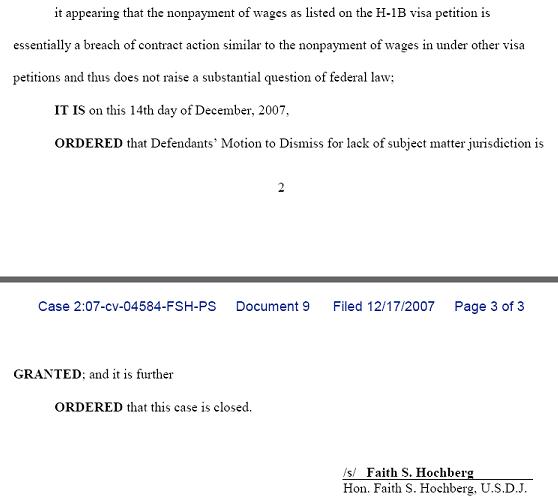
theodp writes "Judge Faith Hochberg has denied a preliminary injunction sought by the Programmers Guild to put a hold on a controversial 'emergency' rule change by the Department of Homeland Security to permit foreign students to work continuously in the US for two-and-a-half years after graduation without an H-1B visa. Hochberg indicated she failed to see how an increased labor supply could result in wage depression for engineers and computer workers. That seems disingenuous, since in Andaya v. Citizens Mortgage Corporation, Judge Hochberg recently saw first-hand how a US employer got away with paying an H-1B computer engineer as little as $15,000 to do a job with a 'prevailing wage rate' of $41,000. In that case, Hochberg ruled against Filipino H-1B visa holder Almira Andaya, arguing that 'nonpayment of wages as listed on the H-1B visa petition ... does not raise a substantial question of federal law.'"
7 of 442 comments (clear)

  1. Protection of the tech jobs market by yakiimo · · Score: 5, Insightful

    I find it interesting that Slashdotters and the posted articles tend to be quite libertarian on many issues, with one of the exceptions being protection of the tech jobs market. Isn't it a bit hypocritical or am I missing something?

    1. Re:Protection of the tech jobs market by goodmanj · · Score: 5, Insightful

      I'd mod parent down, but I'd rather explain why I disagree. In what follows, "you" refers to "libertarian Slashdotters", not necessarily to the parent.

      You say "open borders are more libertarian than the H1-B system", which is true, but a generous H-1B program would mean a more open border than what we have now. The grandparent is correct, that it's hypocritical to oppose a step in what you claim is the "right" direction.

      You say a generous H-1B program would "create an underclass of workers" -- but a truly open border would be even worse in this respect, since it would drastically increase the number of U.S. resident programmers willing to work for bottom dollar.

      And the elephant in the room here is that visas are irrelevant in this case. I can't think of a job that can be more easily offshored than computer programming. If you tightly restrict immigration of programmers into the U.S., they'll all set up shop in their home countries, where they can charge even less due to lower cost of living.

      And if you as a programmer don't think you're going to be seriously competing against China- and India-resident programmers in a few years, you haven't been paying attention.

      I say, open the borders, let everybody in, in every profession. It'll depress our wages, but at least it'll keep immigrant workers spending their money in *our* economy, and hopefully some of them will decide to become citizens and come to expect our standards of living.

    2. Re:Protection of the tech jobs market by Anonymous Coward · · Score: 5, Insightful

      I've heard that some companies are finding that the language and time-zone barriers involved often make this totally not worth it.

      Because they're doing it wrong. You need to outsource the project management and a level of QA too, you can't go half-way.

      Once you've got enough that they can effectively run the project on their own time in their own language, all that's left to do in the States is a final QA check to make sure what was created matches the requirements.

      Programming isn't magic. There's nothing about it that makes US programmers better than foreign programmers. If you've been paying attention to the US school system, you'd notice that there is quite a lot that makes foreign programmers superior to US programmers. There's a reason most Linux programmers aren't from the US.

    3. Re:Protection of the tech jobs market by goodmanj · · Score: 5, Insightful

      Or to put it another way: to make stuff, you can either bring the workers to where the factories are, or vice versa. US immigration policy prevents the labor from moving ... so the factories move to where the labor is.

      It's futile to restrict labor while allowing free flow of goods.

      Tech jobs are an extreme case: there are no raw materials, there is no factory, the products are nothing but data bits. Moving the jobs elsewhere is a piece of cake, so restricting immigration is utterly pointless.

    4. Re:Protection of the tech jobs market by hairyfeet · · Score: 5, Insightful

      The problem with the H1-B is sh*t like this. The WHOLE POINT of the H1-B program was so that when the US had a SHORTAGE of skilled workers in an area of expertise the H1-B would be a CYA until our schools caught up with supply and demand. Instead it has been perverted into a way to turn jobs that require a college degree into McJobs that no American can afford thanks to our high cost of education.

      Actually,if you think about it,it is a lot like another popular slashdot subject,copyrights. The copyright laws were originally written to fill an important role: to allow the small playright or musician a LIMITED amount of time to earn money from his creation,in order to encourage him/her to create more and add to our public domain. Just like the H1-B,the corporations perverted it into an unlimited source of revenue creation.

      I have NO problem with bringing an Indian over here when we have a SHORTAGE in a field,just as I have no problem with a 15-25 year copyright to allow creators to profit from their creations. What I DO have a problem with is having to try to compete on my own soil with a guy who can live on $15K thanks to his low cost of education while mine will cost in the end nearly $100K,just as I have a problem with my great grandkids being dead before they'll ever see Steamboat Willie end up public domain. But as always this is my 02c,YMMV

      --
      ACs don't waste your time replying, your posts are never seen by me.
  2. FAIL! by danwesnor · · Score: 5, Insightful
    People who pretend to be the media should be cautioned against editorializing new facts into existence. Show does not say:

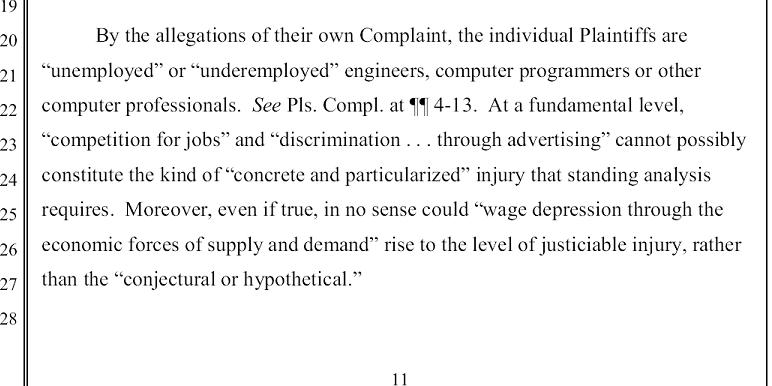
    she failed to see how an increased labor supply could result in wage depression for engineers and computer workers.

    She says:

    in no sense could "wage depression through the economic forces of supply and demand" rise to the level of justiciable injury, rather than the "conjecture or hypothetical."

    Instead of assuming the judge is an idiot, why not favor the much more likely scenario that the suit failed to show how the plaintiffs would be harmed and to what degree. They are claiming they are would be harmed by having their salaries reduced, when in fact they are "employed" or "underemployed". You can't claim you'll be harmed by having you salary reduce if your salary is already zero. It is not the judges job to "see" how harm could be done. It is the plaintiff's job to demonstrate how harm will be done. If they cannot do that, the judge's hands are tied.

  3. Re:I think you're missing the point by Anonymous Coward · · Score: 5, Insightful

    H1B visa holders can quit and change jobs at will.

    Sounds like you are not applying for a green card. Most H1B visa holders are looking for green cards. The process takes at least 3 years - probably more now with all the DHS bullshit. In order to get a green card, your employer has to sponsor you. If you change jobs, that means you change employers which means starting the green card application process all over again. Since H1B visas (last I checked) can only be used for up to 6 years max, changing employers after the first year or two puts the green card at risk. Once the H1B visa expires, all green card application paperwork is terminated.