 Slashdot Mirror
Judge Rejects H-1B Visa Injunction
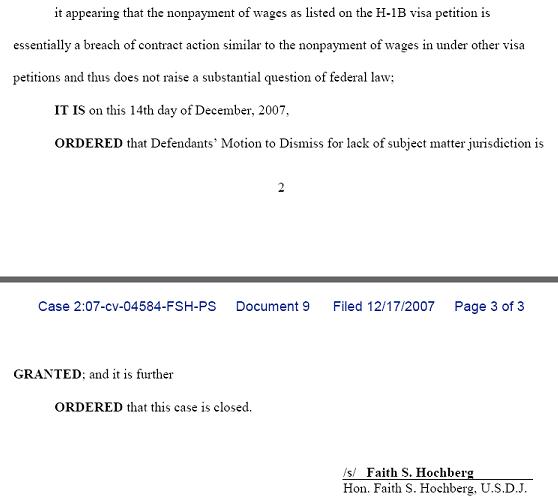
theodp writes "Judge Faith Hochberg has denied a preliminary injunction sought by the Programmers Guild to put a hold on a controversial 'emergency' rule change by the Department of Homeland Security to permit foreign students to work continuously in the US for two-and-a-half years after graduation without an H-1B visa. Hochberg indicated she failed to see how an increased labor supply could result in wage depression for engineers and computer workers. That seems disingenuous, since in Andaya v. Citizens Mortgage Corporation, Judge Hochberg recently saw first-hand how a US employer got away with paying an H-1B computer engineer as little as $15,000 to do a job with a 'prevailing wage rate' of $41,000. In that case, Hochberg ruled against Filipino H-1B visa holder Almira Andaya, arguing that 'nonpayment of wages as listed on the H-1B visa petition ... does not raise a substantial question of federal law.'"

I find it interesting that Slashdotters and the posted articles tend to be quite libertarian on many issues, with one of the exceptions being protection of the tech jobs market. Isn't it a bit hypocritical or am I missing something?
Last month I asked the aging Bob Johnsonâ"former CTO of Burroughs Corporation when it was a leading mainframe company in Minneapolis where he developed the magnetic ink you see on the bottom of your checksâ"what he thought caused the loss of the Midwestern high tech leadership to the coasts, and he said it was the financial dominance of the coasts.
That squares with what I observed while at Control Data Corporation/Cray Research, Inc.
The reason Bill Norris and Seymour Cray were able to start CDC thence Cray Research was because they violated SEC regs and went around selling stock at PTA meetings, making a lot of middle class people retire very comfortably. My late father bought some Cray stock early on which helped greatly with his retirement.
When I was at CDC in Arden Hills, MN attempting to deploy the mass market version of the PLATO network with Internet-like capabilities (the system that Ray Ozzie (Bill Gates' replacement at Microsoft) cut his teeth on) in 1980 the primary resistance was from a middle management that, due to the financial press' hostility toward Norris's vision of a society disintermediated by computer networking, small high-tech farms and locally produced and consumed essentialsâ"had itself grown hostile to Norris.
My proposed solution is simple to state but will perhaps require a war to institute:
Replace all taxes on economic activity with a tax on net-assets, assessed at their in-place liquidation value, at the risk free interest rate (which according to modern portfolio theory is the short-term US Treasury rate) so as to extract all economic rents from the private sector, and then, to prevent public sector rent-seeking in pork-barrel politics, disperse those funds evenly in a dividend to all citizens, as the beneficiaries of the land-trust called the United States.
That will not only stop the vicious centralization of power in the private and public sectors, but it will clarify the role of immigrationâ"it is a dilution of the benefits intended for the Posterity of the Founders of the land trust called The United States of America.
Seastead this.
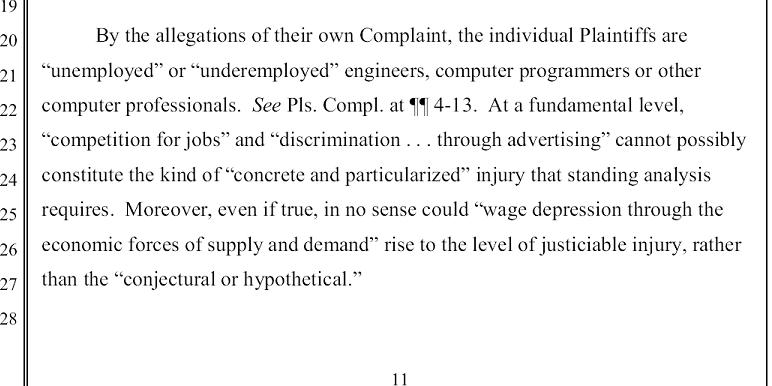
she failed to see how an increased labor supply could result in wage depression for engineers and computer workers.
She says:
in no sense could "wage depression through the economic forces of supply and demand" rise to the level of justiciable injury, rather than the "conjecture or hypothetical."
Instead of assuming the judge is an idiot, why not favor the much more likely scenario that the suit failed to show how the plaintiffs would be harmed and to what degree. They are claiming they are would be harmed by having their salaries reduced, when in fact they are "employed" or "underemployed". You can't claim you'll be harmed by having you salary reduce if your salary is already zero. It is not the judges job to "see" how harm could be done. It is the plaintiff's job to demonstrate how harm will be done. If they cannot do that, the judge's hands are tied.
In New Zealand they have a pretty reasonable solution solution; the minimum salary for a foreign worker on their equivalent of an H-1B visa is $55,000. Since your salary is usually a pretty direct measure of how scarce people with your abilities/training are and how much demand there is, anyone who is coming into the county to fill a shortage in a particular field should almost by definition be getting a relatively high salary.
No, it's not hogwash.
I've worked for employers who do this routinely.
But let's talk about the process. If a visa holder wants to leave, he must first find another employer willing to accept (a) H1B's (which eliminates all but large businesses (b) H1B transfers (which eliminates even more companies).
If you are an H1B, and you make noise about leaving, your employer simply calls the IMS and you have a few days to leave the country.
Let's be real here... if H1B visa holders had freedom of movement, then their wages would be no different than prevailing wages. The fact that you have skilled professionals from overseas working for $25-50K (I made more than that out of college 30 years ago) either says that (a) the wage supply is too large (which undercuts the arguments for H1B's) (b) there is an economic barrier people with H1B's that prevents them from exercising their rights.
I don't have an ax to grind here, and I think that there really should *not* be a barrier for skilled people to come into the United States, but I think it benefits everyone to eliminate the H1B and simply allow any highly skilled person to enter the United States. I don't see the downside, provided they have the same ability to negotiate wages as people who live here.
Your post is almost 100% bullshit political conjecture about 'illegals,' corporate american, and employment. BTW, RN salaries here:
http://swz.salary.com/salarywizard/layouthtmls/swzl_compresult_national_HC07000001.html
Yeah, they make 60k, not 10-20k.
H1B visa holders can quit and change jobs at will.
Sounds like you are not applying for a green card. Most H1B visa holders are looking for green cards. The process takes at least 3 years - probably more now with all the DHS bullshit. In order to get a green card, your employer has to sponsor you. If you change jobs, that means you change employers which means starting the green card application process all over again. Since H1B visas (last I checked) can only be used for up to 6 years max, changing employers after the first year or two puts the green card at risk. Once the H1B visa expires, all green card application paperwork is terminated.