 Slashdot Mirror
Review: Crysis Warhead
- Title: Crysis Warhead
- Developer: Crytek Budapest
- Publisher: Electronic Arts
- System: Windows
- Reviewer: Soulskill
- Score: 4/5
In the original Crysis, a team of American soldiers was dropped into combat on an island controlled by the North Korean Army. The game followed one of the soldiers, call sign "Nomad," as he made his way across the island to complete his objectives. In Warhead you control another member of the team, Michael "Psycho" Sykes, as he attempts to retrieve some cargo thought to be a nuclear warhead. While Psycho assisted Nomad throughout the first game, there is very little interaction with Nomad in this offering.

What differentiates Warhead from typical first-person shooters is the "Nano Muscle Suit," which provides limited protection and a number of enhanced abilities. You can only use one at a time, and you toggle the suit between the various enhancements through a very simple interface. It's similar to the interface used in Crysis, but slightly improved. The suit has an energy tank which runs dry quickly, but regenerates quickly as well. As a result, it's not feasible to just turn on all the goodies and annihilate everything in your path; each mode has an energy budget, which forces you to be creative, picking the right tool for the job. Armor mode will allow you to take extra hits, the damage coming out of your energy bar rather than your health bar. It drains quickly, though. It'll give you extra seconds to get to cover, but it won't let you take on a dozen guys. Strength mode will let you jump really high, throw things extra far, and land punches that would drop a buffalo. Speed mode makes you run a bit faster and gives you the ability to sprint incredibly fast for very short periods of time. Between Speed and Strength modes, you can get to a lot of interesting places. Dash up behind a building, jump to the roof, and smash your way through the ceiling to surprise the enemies inside. You also get Stealth mode, which is reminiscent of the Predator. You're camouflaged well, but not perfectly, so enemies who get close enough will still see you. Don't get caught running out of energy in the middle of sneaking through a battlefield. Through the same interface, you can add attachments to your weapon, such as a flashlight, a silencer, or different sights.
The different suit modes add a great deal of replayability to Warhead. If you want, you can literally sneak through the majority of the game, dropping out only to recharge your energy and fire your weapon. You can also just blitz your way though on Speed mode, dodging enemies and beelining from one obstacle to another for cover. Sometimes you do have to stop and shoot the roses, though. The modes combine in interesting ways. You can stealth from vantage point to vantage point, then use your Strength mode to steady your aim for sniping. You can dash past a group of enemy soldiers and get them to follow you to a group of aliens, then disappear. The two forces will lose you, see each other, and start shooting.
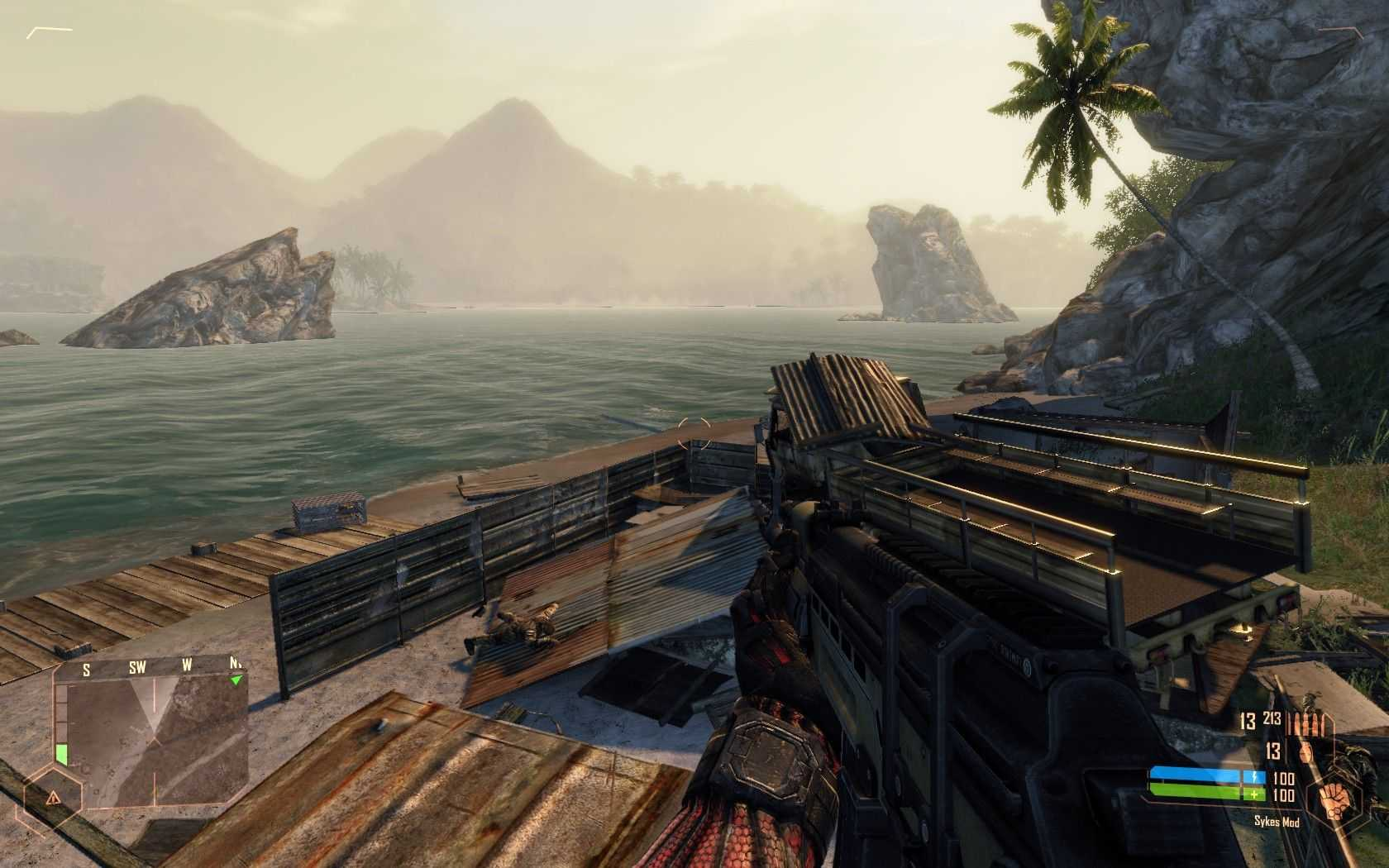
The AI in Warhead is definitely a step up. When you're spotted, enemy soldiers will converge on your position, calling over their friends to help. They'll flank you and use cover quite well to avoid your fire. They'll even duck behind a corner to reload. You can use stealth mode to get out of a lot of sticky situations, but even then, they'll continue to shoot at and around where you were last seen, knowing that if you're low on energy, you can't move very far without being revealed. I felt that the overall difficulty of the game was often hit-or-miss. Warhead was done in the (fairly common) style that strives for realistic aiming. In other words, holding down the trigger increases the spray radius, and headshots do more damage than shots to the center mass. It leads to fairly inconsistent encounters; sometimes you'll drop a group of three or four enemies without getting hit, and sometimes they'll absolutely demolish you. You'll also run into vehicles carrying more powerful guns that can pick you off from far away after a couple of lucky hits, and you may not have any recourse. It doesn't happen often enough that it's a major problem, but you'll almost certainly die a few frustrating deaths where you just didn't have time to cloak yourself or dive for cover. Occasionally, you'll run into opponents wearing their own version of your suit, and it can be annoying to (seemingly) pump 20 rounds into somebody and have them still kill you.
Vehicle use is a bit better, too. You get a couple new toys to ride around in, and they're easier to handle than in the original game. It's not perfect, but it's awfully entertaining once you have the hang of blazing down a road while taking out everything along the sides. The rides vary in maneuverability and firepower, but they're all useful for something. You can zoom around in an unarmed hovercraft, or putter along in a large truck. As with the normal combat, your durability usually depends on how lucky you are. Sometimes you'll feel invincible running over enemy soldiers while taking potshots at passing helicopters, and other times it seems like you have to find a new ride every hundred yards. There's nothing stopping you from taking out the gunner and driver of another vehicle and stealing it. I was a bit disappointed that you can't drop inside enemy-controlled tanks, though. It was hard enough to get on top of one. Make sure to keep an eye on your vehicle's damage meter; if they explode while you're inside, you die.
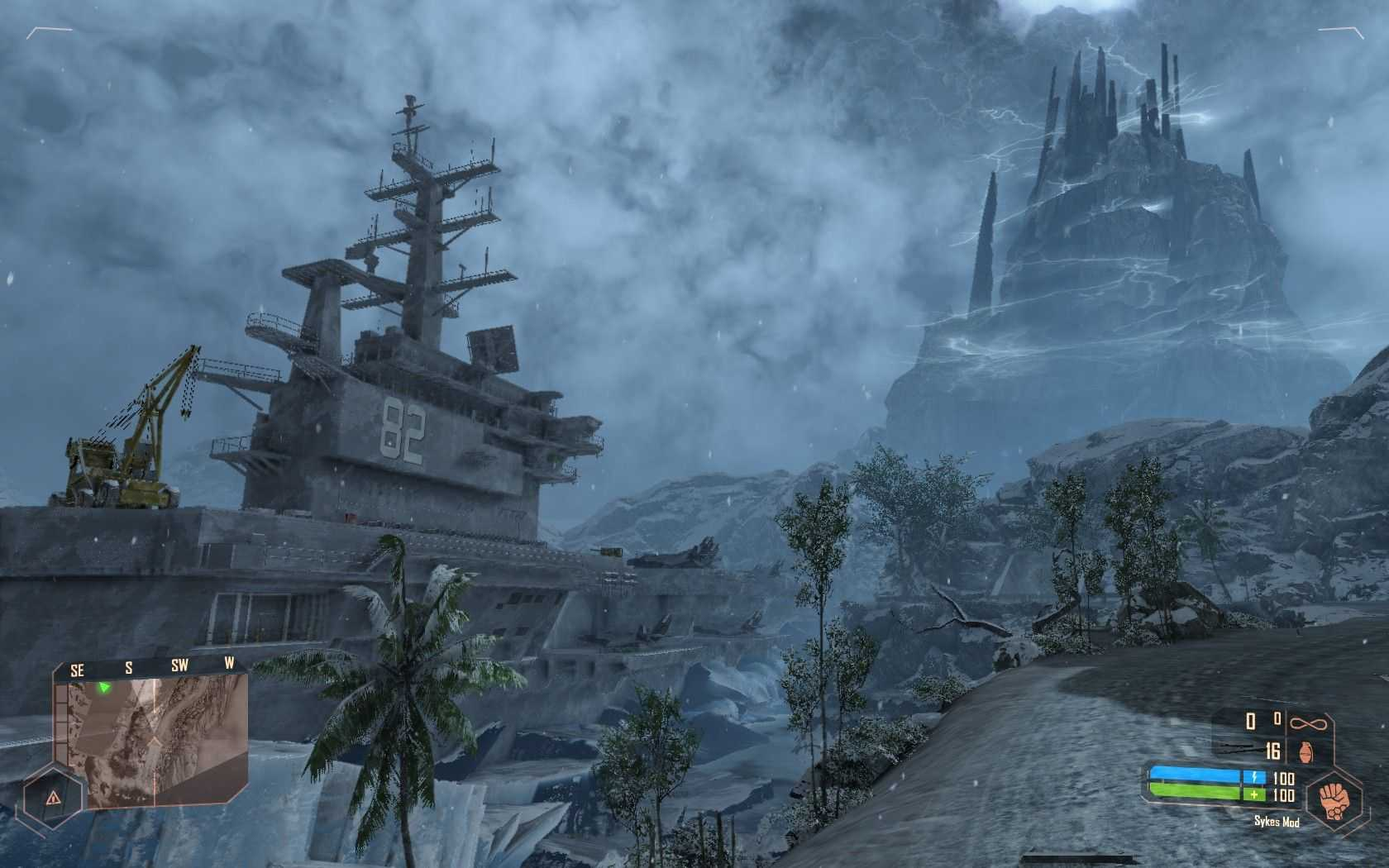
The story itself is simultaneously an upside and a downside of the game. Depending on your playstyle, you'll make it through Warhead in 5-7 hours. That said, the game is an expansion, and it's priced as such, so with the replayability and multiplayer options, the length isn't a gripe. Part of the reason the game clocks in where it does is that the pacing is excellent. The missions objectives are thrown at you quickly, and your military contacts are constantly checking in with new problems or to provide motivation. The game is designed to make you want to see what's over the next metaphorical hill, reward you for getting there with a battle or a visual "holy crap" moment, and then pointing you towards the next hill. The music contributes greatly to this with a driving, energetic, and dramatic score. In fact, it's some of the most appropriate music I've ever heard in a game. Another factor that mitigates the game's brevity is the options for replayability mentioned earlier. There's a great driving mission partway through that has you following a comrade through a hostile zone, taking a ton of heat from roadside stations and patrols. You can follow him and shoot your way to the objective on your first time through the game, and then ditch the vehicle and sneak safely through the next time. Or take the time to clear out all the enemy stations on your way. Crytek does a good job of offering you options without requiring that you take them, and pushing you toward your objectives without insisting on particular tactics.
Warhead, much like Crysis, is a very visually impressive game. The artwork is stunning, but not obtrusive; it only served to deepen the immersion for me. I found myself rubbernecking when I made an enemy vehicle crash or knocked an alien out of the sky. When I had spare moments to collect my thoughts, I was torn between watching the scenery and keeping an eye out for the next Big Thing so I wouldn't miss it. Fortunately, Crytek has us covered; they consistently give you some warning or do something to draw your eye to the big, impressive sights. The graphic settings for Warhead are either intuitive or stupid, depending on whom you ask. The minor settings (for textures, shadows, etc.) have four options: Minimum, Mainstream, Gamer, and Enthusiast. The default is Mainstream, and that's what I used my first time through the game. On a middle-of-the-road PC, it was completely smooth. I bumped it up to Gamer and noticed a performance hit, but it was still playable. At Enthusiast, the game got very choppy in graphically intense sequences. It was borderline playable — I wouldn't use it for anything but exploring or showing somebody else the game. Sure looked good, though. TechSpot did a more in-depth analysis on the relation between hardware and framerate.

Warhead's multiplayer system, Crysis Wars, is basically a refined version of what was offered in the original Crysis. There are three different types of games: Instant Action (a basic free-for-all deathmatch), Team Instant Action (team deathmatch), and Power Struggle. The latter divides players between two teams and gives them a variety of buildings to capture and vehicles to unlock on their way to destroying the enemy's headquarters. The use of vehicles adds to the gameplay without dominating it. Given the option, I was happy to hop into a truck, but it was always to get somewhere so I could hop out again. I had trouble finding servers with enough people to make Power Struggle interesting, but if you get a lot of people involved, it could be quite fun. The other, more traditional game types are well-done, but a matter of personal preference. I tend to prefer Quake-style games rather than the ones more dedicated to realism. In Crysis Wars, encounters with enemies players are often over in seconds, with very little ability to break off an encounter that's not going well, or to overcome bad odds. I enjoyed the team version more, because having teammates is synonymous with having some target dummies scouting ahead to draw enemy fire. That said, having access to your suit puts a nice spin on an old concept. Players who make full use of them are incredibly dangerous. If that style of combat is your preference, you'll enjoy it. The maps are well crafted and provide many opportunities for unique interactions, and they make good use of all three dimensions.
Crytek is a great example of a developer who produced something good and then turned around and produced something better. That's the kind of progression I like to see in a company, but so rarely do. Warhead is an improvement on Crysis in almost every way. Fans of the original will be fans of the expansion, and the price tag is appropriate for the amount of content the game provides (even more so if the multiplayer community takes off). This time around, the hardware situation is much less of an issue. The streamlining of the graphics engine is evident, and technology has had some time to catch up as well. Be aware that Warhead ships with the same DRM as Spore, which we've discussed at length recently, so if that's a deal-breaker for you, give it a pass. The game itself, however, plays quite well, and its flaws are minor. I'm definitely looking forward to the next parts of the proposed Crysis trilogy.
Actually, the DRM is becoming more of an issue with me.
My friend lent me his copy of Crysis right after I upgraded my PC, but I never installed it specifically because of the packaged DRM. I'm finding that I research DRM as part of the purchasing decision these days. That and educating others about it (and if they ask, teaching them about torrents).
Too bad companies don't realize that unreasonable DRM on games actually costs them sales while not really affecting piracy.
My thoughts exactly. It was very generic and arcadish. But you know what, I played it with a GeForce 6200 at the lowest settings, and I tend to think that the shiny graphics hypnotise people into believing it's a great game, when really it's just a shiny game.
You just got troll'd!
It's my understanding that the Steam version doesn't have SecuROM. You may want to verify that, though.
Whoever modded this insightful needs to go back to 4chan.
Crysis, for those of us who actually have "Enthusiast" systems, was actually entertaining. The suit-power gimmick works really well to give you diverse playing styles. I remember playing it several different ways, the first time like a normal FPS, shooting and taking cover. The second time I played a stealth game, using strength-boosted jumps to reach high sniping spots. The third time, I just left it on speed mode and dashed past everyone at ludicrous speed.
Most importantly, it was entertaining every time. Not only did I have to adapt my strategies to each event, but that freedom was available to me, not forced down my throat with fixed paths. Doom, Half-Life, Fear - they all suck at the freedom aspect. They have a detailed storyline that forces you to do follow their exact plan, kill specific bad guys, solve stupid switch puzzles... Crysis has none of that. You're a super-soldier, you do super-soldier missions like recovering intel and disabling enemy forces.
It had its flaws, but overall, for a game company that's only made two games so far, both have been pretty freakin' awesome. Could they benefit from the genius designers at Valve ? Sure. But then again so could Sierra, and id, and even Bungie.
-Billco, Fnarg.com
Mentioning that the game has Spore-like DRM on Slashdot is really the exact opposite of advertising.
Abaddon: An Xbox 360 Indie game
Collapsing a shack full of enemies with a grenade or a melee attack in strength mode is always satisfying, and I think it qualifies as a physics-based opportunity to kill enemies.
And while it wasn't unique to Crysis, I found lobbing a grenade under a moving vehicle awesomely satisfying. I must have it it just right, because it went off right as the truck was coming around a bend, prompting said truck to perform about three barrel rolls fifteen feet in the air sending it off the edge of the cliff. You can take out vehicles with grenades in any game, but that explosion was, pardon my french, fucking awesome.
Shooting down trees on enemies works OK too, but it's better as a demo of the engine than a practical tactic.
How are sites slashdotted when nobody reads TFAs?