 Slashdot Mirror
Amazon 1-Click Lawyers Make USPTO Work Xmas Eve
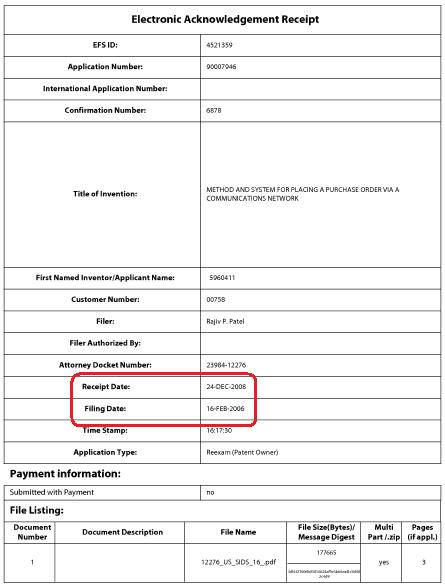
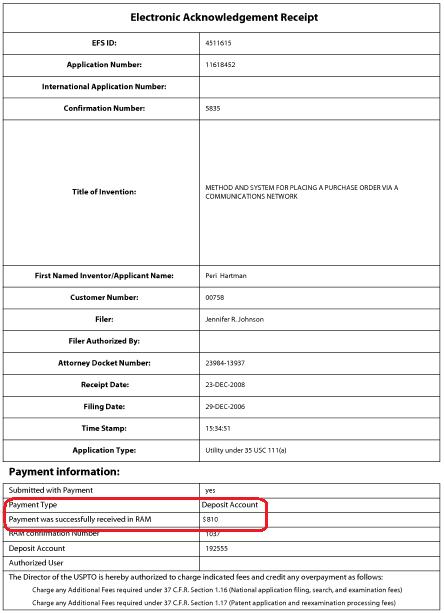
theodp writes "In a move that would do pre-makeover Ebenezer proud, Amazon.com's 1-Click lawyers put the USPTO to work on Christmas Eve. On Dec. 24th, the USPTO acknowledged receipt of yet another round of paperwork submitted by Amazon's high-priced legal muscle, the latest salvo in Amazon's 3-year battle to fend off a patent reexamination triggered by the do-it-yourself legal effort of actor Peter Calveley. Amazon CEO Jeff Bezos' 1-Click patent is also under attack on another front — on Dec. 23rd, the USPTO received $810 from Amazon's attorneys together with a request that the agency invalidate Patent Examiner Mark A. Fadok's final rejection of 1-Click patent claims on the grounds of obviousness. On the bright side, patent clerks — unlike Bob Cratchit — get the day after Christmas off!"
Pushing this absurd patent is costing Amazon more in negative PR than the patent could possibly be worth.
-jcr
The only title of honor that a tyrant can grant is "Enemy of the State."
Is there an assumption that USPTO has to somehow reply to this latest submission by midnight on same day?
The story seems silly. There is no life or death situation. I would expect no action from USPTO for 3 month or more.
It just shows how little some people know about the patent system. A request for continued examination can be filed with the electronic system on Dec 23rd, and very few humans would see it, if any, until the docket clerk looks at it. The examiner won't be looking at it for quite some time, so they aren't working overtime for Bezos. Further, they aren't asking for an invalidation of the final rejection, they are asking for reconsideration on the merits, and a withdrawal of the rejection (very different things). If you know about the system, the summary the submitter put forward was good for a laugh, but nothing else.
Loosely translated means they filed the paperwork online and the whole thing was accepted automatically. So if anything, it was Amazon being Ebenezer making its lawyers work Xmas eve, the USPTO didn't have to do anything.
Way back in the day, nobody could even figure out how to do credit card processing, much less buy anything online. I have a vague recollection of one of the backbone providers in the Northeast or Midwest trying to prohibit commerical traffic over their network.
One-click buying was pretty radical. Even buying stuff online was pretty unbelievable. I mean, think about this: some company you never heard of would store your credit card number and other information so you could buy stuff without entering in all the supporting info. This was back in the day when the big debate was PPP vs SLIP, and you couldn't get a commercial PPP account (except via netcom, I think).
Now all this stuff is pretty obvious. Back in the day, just buying stuff online was pretty wild. One-click, from the engineering side, was really original. The fact that it sounds so quotidian shows how far things have come since then.
I'm working now.
You're posting to Slashdot, my guess is that you're *not* working. Unless you're an editor ;)
What's REALLY needed is a law which prohibits the storing of people's credit card numbers. The only people who need access to your credit card info are you and your bank.
That would moot this stupid patent, but who cares.
No sig today...
As far as I can tell this patent fails the Bilski test. It is neither tied to a particular apparatus or machine, nor does perform a unique transformation.
IANAL, but the test outlined in Bilski seems to make this patent NULL. Anyone can implement a one-click system on any machine connected to the internet.
The obviousness test is also valid in this case - at the time Amazon was pushing this through the USPTO... Well, my boss was handing me work from different clients that wanted a sign-in and one-click ordering system for their commerce sites. I had to tell him it was legally impossible each time.
So failing the "obviousness" test - it was a clearly obvious step to take. To both the people writing the code for commerce sites and to the people paying to have them written... And also seeming, to me (and I repeat - IANAL), failing the tests outlined in the Bilski case... Amazon can fight as much as they want, but this patent is a dud.
What's religion got to do with it? OK, sure. There are still those who maintain religious traditions around this time of year. And that's fine. But much of what we celebrate as Christmas is secular.
Looking around my household, I only find one religious trapping; a figurine of an angel reaching for a star. It is far outnumbered by the reindier, wreaths, nutcrackers, canycanes, snowmen, santas, christmas trees, and other assorted decorations. I haven't attented church in years. We didn't even say grace during Christmas dinner with the family.
I've seen the bumper stickers that read "Put Christ back in Christmas." And that's telling. For much of the wider population has left the religious pinnings aside. Or, at best, the religion is only a part of the holiday. Instead Christmas is a time of celebration, friends, family, and community.
Yes there are still echoes of Christian tradition in even a secular Christmas. But there are also echos of traditions that are decidedly non-Christian as well (never mind the history of all those traditions). So if Christmas is decidedly religious to you, then that's great for you. Enjoy the season as you would have it. But don't kid yourself in to thinking it is solely religious in nature much less religious to everyone else.
And even then his work would be questionable at best.
I may agree with what you say, but I will defend to the death your right to face the consequences of saying it.
One wonders why Amazon bothers spending money on lawyers to defend a patent that's irrelevant now. All loss of the patent means is that competitors can create 1-click features on their sites, something that's far from a selling point in Amazon's favour now. Back in the day when ecommerce was the realm of pornographers, it was a slick feature to offer, but nowadays it would seem almost quaint to tout that as a reason to use one site over another.
Anyone who loves or hates any language, platform, or manufacturer, doesn't know what they're talking about.
Not every job requires 100% attention 100% of the time. I have a friend, for example, who spends much of his night shift sitting. His duty is making sure none of the juveniles in custody leave through the door next to him. I think he could manage a slashdot post or three and still be doing the job he was paid to do.
If you pay your respects to Jesus/Santa/Novi God then you are taking part in a religious celebration whether you believe in it or not.
Please feel free to point out what in my description depicted religious ceremony. And please - are you really implying that Santa Claus is a god?
Again - there are underpinnings of Christianity in many Western Christmas traditions. Sure. But then, there's also lots of underpinnings of other religions as well. Just because one follows such a tradition, does not make one a participant of that religion. If it was otherwise, Christmas as most Westerners observe it would present some serious problems for devout Christians (who are pretty uncomfortable with the idea of practicing multiple religions).
I should also note that I do not claim to be an athiest. My religious beliefs are, frankly, nobody's business but my own. The point isn't that Christmas is some Atheist field-day but rather you do not have to be religious to participate in the holiday.
I know that upsets the "reason for the season" folks. They'll have to get over it (they won't).
Unions are great!
Aside from the usual mismanagement, unions are also one of the biggest reasons US car companies can not compete with foreign auto makers.
Unions do serve an important function in many industries but they are also destroying many of those same industries. In the end, we all pay much, much higher prices for US goods which prices many of them right out to extinction. Simply put, if unions ONLY did their job to ensuring a safe/healthy work environment with fair wages, then there would be nothing but goodness. Unfortunately, unions work as well as the government, which means they are self destructive and ineffective in the end. It is to the union's own benefit to destroy a company with over paid wages. After all, higher wages means far higher salaries, benefits, and perks for those running the unions.
Do you really believe a worker who wields a paint gun should be paid $50/hr? Sure, a nice respirator and air exchange unit makes sense, but since when should we pay a worker $50/hr, $75/hr for overtime, $100/hr for holiday pay, and $175/hr for holiday with overtime for an inferior job compared to what a robot can do, which costs far, far, less in the long run. And let's not forget the health and retirement benefits many of the workers also earn - which can add up to an extra $50/hr for each worker. Being generous of what some unions actually provide, that works out to be over ***$225/hr*** for what should be a $50-65/hr worker - including all benefits, overtime, and holiday pay. Many doctors and/or lawyers don't make that kind of money and those are highly skilled professions.
Frankly, $15/hr + benefits + respirator, air exchange unit, painter's suit, is more than fair given the type of unskilled labor involved. The price difference adds thousands and thousands of dollars per vehicle - often resulting in a lower quality product to boot.
Now consider someone who moves a paint gun. That person can be fired despite the fact not moving the paint gun caused an entire assembly line to shut down. How about a better example. Someone missteps causing a piece of pipe, which was leaned against a corner, to fall onto the assembly line. Now let's assume it's either a holiday or a weekend where plumbers are all off. The assembly line is now shutdown costing the company hundreds of thousands of dollars per hour. If anyone moves the pipe they can be terminated - so the pipe doesn't get moved. Someone now calls a plumber. The plumber lives an hour away. The plumber already maxed out his hours. The plumber shows up, moves the pipe, and goes home. For that simple feat, the plumber is paid a minimum of four hours. But wait, that's over time. And since it was a holiday, that's holiday pay plus overtime. That plumber is paid $60/hr. He drives home having "earned" $840.00 and cost the company hundreds of thousands of dollars.
Frankly, these days unions do far, more damage than they help. Who wants to pay a premium for an inferior product? That, by in large, is why US auto manufacturers are failing.
My sister worked for a closing GM plant - and just got laid off. Worked there for over 20 years and her job is union-classified as skilled. Her particular job is being bandied about in the media as paying $71/hour. She gets a bit over a third of that, GROSS, not net. Her pension funding is going south - because they fund more by contingency than by trust accounting, I suppose (I am not an expert).
Now her friends and neighbors are giving her the same $71/hour shit.
You can pontificate about unions all you want - and you do - but you have no idea what you're talking about.
It's not the unions that destroyed the auto industry - it's that the entire industry, like so many others in the world today (and the US especially) are really run by the accountants and/or driven by accounting practices, with "professional" managers or promoted salesmen believing that they know crap about the ramifications of their decisions.
By the way - if any company you've worked for bills your time at less than a multiple of about 2.5 on your salary, then they're losing money.
Yes, pensions, 401ks, insurance, employer's portion of social security, compliance with unemployment and disability laws - those all come for free in your world, as do power, etc, etc. And if you think for one minute that those things aren't being "creatively" managed on the books and they aren't added into inflated labor reports - in short, if you think you know thing one about accountancy in the auto industry you're delusional.
That's just my friendly opinion.
You are correct in much of the over-specialization and waste that are union-caused. But that was the insane result of insane management forcing people (under threat of firing) of doing dangerous jobs requiring skill. It may not excuse what the union response was, but the simple fact is that what goes around, comes around.
And I close by criticizing your decision that a painter should get $15/hour. I don't know if you got that number along with the flying monkeys or not, but frankly - that amount does nothing to compete against a lot of jobs whose end products are in lower demand and carry lower costs than automobiles.
Take a course in economics and work in the real world for a while. You clearly have some idea of auto-manufacturing ops - but little else in what you postulate is even close to reality.
Pathological kinda promises Path + Logical - but instead, you get stuck with pathetic.