 Slashdot Mirror
1-Click Smacked Down Again, While Reexam Languishes
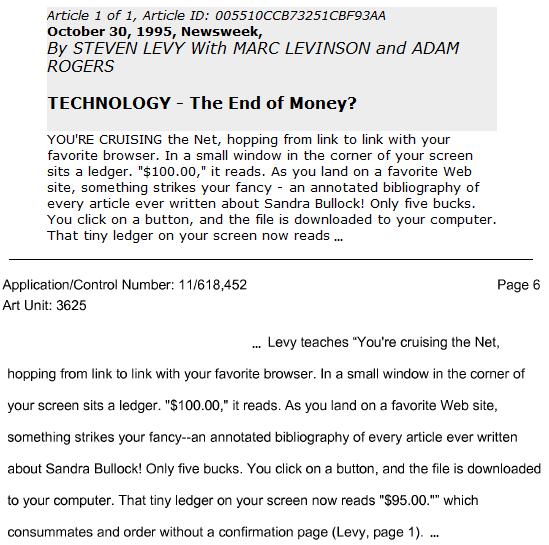
theodp writes "Pressed on Amazon's 1-Click patent, then-USPTO Chief Q. Todd Dickinson got testy: "I make this challenge all the time. If you're aware of prior art out there that invalidates a patent that is existing, file a re-examination. We'll be happy to take a look at it." Really? It's been 3+ years since unemployed actor Peter Calveley submitted prior art that triggered a USPTO reexamination of the 1-Click patent. Still no 'final answer' from the USPTO. To put things in perspective, 1-Click inventor Jeff Bezos once proposed a three-year lifespan for patents (later retracted), let alone patent reexams. In the meantime, other patent examiners have repeatedly smacked down 1-Click — the latest (non-final) rejection was issued on Feb. 10th with Sandra Bullock's help."
Please don't say that the one-click experience was "invented" by Jeff Bezos - it completely trivializes the entire creative process. It reduces those who are truly innovative to the status of mere dilettantes.
I truly don't know what that sentence is supposed to mean. Is "smack down" a legal term?
Defense: Your Honor, the defense would like to smack down the prosecution's evidence.
Prosecution: Objection, Your Honor. The defense has not demonstrated it possesses the balls to smack us down. We'd also like to put on the record that we've had intercourse with the defense's wife.
Judge: Objection sustained. It has been demonstrated to the satisfaction of the court that the defense has no balls. We also note that the prosecution could not have had intercourse with the defense's wife, for lack of penis.
This is a transcript of an interview conducted 24-May-2000
Dipshits = /.
Actually, a final rejection was made on the re-exam case, but Amazon filed an RCE (request for continued examination). Essentially, as long as Amazon is willing to (a) pay the fee and (b) make some sort of submission that merits further examination (e.g., amending the claims or presenting another prior art reference they want considered), they can keep the re-exam going until the cows come home. The next action after an RCE is usually non-final - it's a bit like starting the examination process over again.
On a side note, after the RCE and before the subsequent non-final Office action, Amazon submitted an IDS (information disclosure statement, on which they list further references they wish to have considered) that was 36 pages long. That's not a 36-page reference - the list of references itself took 36 pages.
The obviousness test relies upon prior art. If somebody does something, and nobody can show that any part of it has been done before, then surely it's not obvious?
Ironically, Stephen Levy - whose 1995 article The End of Money is now being used by USPTO examiners to reject 1-Click patent claims as obvious - reported back in 2000's The Great Amazon Patent Debate about the conversation he sat in on in which Jeff Bezos just wouldn't hear that 1-Click was obvious. Responding to Tim O'Reilly's charge that "trying to enforce a patent claim on something as obvious as 1-Click is downright selfish," Bezos countered: "When we applied for the patent, 1-Click wasn't obvious...When we introduced it, people were surprised...They called it innovative."
Sorry if it came across that way; certainly wasn't the intent. Indeed, Peter's efforts here even left legal professionals impressed: "It turns out that New Zealander Peter Calveley is one of the actors who provided the motions for computer-generated elves and orcs in Two Towers. He also has been laid up of late due to an accident (I can relate). He has now put his free time to use taking on a David and Goliath effort against Amazon...I have to admit, I was quite intrigued by the whole affair given that a Request for Re-Exam is not something average citizens take on in their spare time. After some correspondence, we spoke by telephone briefly -- since I was unwilling to write about his efforts if this was all a scam. I found that Calveley is extremely bright and has his own inventions and understands computer patents and procedures quite well. He has the time and will to do this even if it won't bring him a direct benefit."