Slashdot Mirror


1-Click Smacked Down Again, While Reexam Languishes

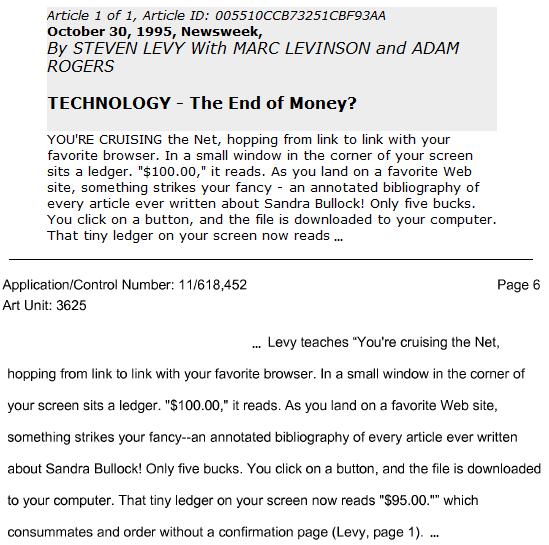
theodp writes "Pressed on Amazon's 1-Click patent, then-USPTO Chief Q. Todd Dickinson got testy: "I make this challenge all the time. If you're aware of prior art out there that invalidates a patent that is existing, file a re-examination. We'll be happy to take a look at it." Really? It's been 3+ years since unemployed actor Peter Calveley submitted prior art that triggered a USPTO reexamination of the 1-Click patent. Still no 'final answer' from the USPTO. To put things in perspective, 1-Click inventor Jeff Bezos once proposed a three-year lifespan for patents (later retracted), let alone patent reexams. In the meantime, other patent examiners have repeatedly smacked down 1-Click — the latest (non-final) rejection was issued on Feb. 10th with Sandra Bullock's help."
9 of 72 comments (clear)

  1. Invented? by symbolic · · Score: 5, Insightful

    Please don't say that the one-click experience was "invented" by Jeff Bezos - it completely trivializes the entire creative process. It reduces those who are truly innovative to the status of mere dilettantes.

  2. required car analogy by enter+to+exit · · Score: 3, Interesting

    let us say a car manufacturer invents a wireless device that unlocked your car when you are within a certain range automatically. let us also say they patented this

    technically, there are devices that sort of do this, except you have to press a button. Suddenly every car manufacturer realizes this is a much better method of opening doors and they decide to implement the same design in their cars.

    The original car manufacturer has spend time and money conducting usability studies, adding this, removing that in an effort to give their customers greater satisfaction.

    suddenly they see every car company has copied their design and have piggy-backed on the research they spent money on, on the grounds that there is already prior art (the button keys) and the idea is obvious anyway.

    Don't the inventors of the wireless door have the right stop and say "hey you guys didn't invent this, there was something similar but it's not the same thing, we spent money perfecting the things that in hindsight seem startlingly obvious, don't steal our work"?

    1. Re:required car analogy by Xylaan · · Score: 4, Insightful

      Your analogy really isn't that far off, however, I think it all comes down to the invention in question.

      In your example, I think the inventive step is how your car figures out how you're close to it, but does so in a way that is effective with one half of the system required to be low power (the keyfob), and is accurate enough that it doesn't unlock while you're not present, as well as determining that you want it to be unlocked, and you're just not walking around with your keys inside your house (which could trigger it, based on how close you are). A workable, comprehensive, and accurate solution to this could be fairly non-trival.

      On the other hand, you're comparing it to the 1-click patent. Now, I think that the one-click is an excellent example of patenting it based on 'while no one has done it before, so it must be inventive'. Remember, when this patent was filed, e-commerce was still relatively new. Businesses were still trying to convince everyone that it was safe to use the internet to buy things. As such, the shopping cart analogues were the most popular.

      As part of a shopping cart system, assuming they have some sort of login (which was popular then, and is still quite popular even now), they will have information about the customer. If that customer has purchased from you before, they could even have all of the financial information necessary to place an order. At the time, however, most businesses didn't keep full credit card information on file after a transaction had completed, if for no other reason to avoid potential liability if that information was compromised. But they COULD have easily done so (as the customer had to enter it the previous time they placed an order).

      So Amazon's 'inventive' step was to say, hey, we should ask the customer if we can save this information, and then use it next time they order so we don't have to ask again. So their inventive step was storing the financial and address information in a database, and looking it up later. While it hadn't been done before, there wasn't a technical reason, but a social reason. To many technologists, the inventive step seems to be very weak, and shouldn't have passed the muster of 'non-obvious'.

      So, your analogy isn't really flawed. Just your choice of the invention is a bit stronger. A slightly closer analogy would be basing opening your door by passing an RFID-enabled keyfob over a sensor which is part of the doorframe. Its range would be only a few inches from the door. Now, that would be closer to the 1-click, as I have such a system where I work where the RFID is embedded in my work ID. As RFID enabled door locks already exist, I would hope it would be difficult to get a patent on an RFID enabled car door lock.

  3. smack down??? by garutnivore · · Score: 4, Funny

    In the meantime, other patent examiners have repeatedly smacked down 1-Click --- the latest (non-final) rejection was issued on Feb. 10th with Sandra Bullock's help."

    I truly don't know what that sentence is supposed to mean. Is "smack down" a legal term?

    Defense: Your Honor, the defense would like to smack down the prosecution's evidence.

    Prosecution: Objection, Your Honor. The defense has not demonstrated it possesses the balls to smack us down. We'd also like to put on the record that we've had intercourse with the defense's wife.

    Judge: Objection sustained. It has been demonstrated to the satisfaction of the court that the defense has no balls. We also note that the prosecution could not have had intercourse with the defense's wife, for lack of penis.

  4. A more precise explanation by Dachannien · · Score: 4, Informative

    Actually, a final rejection was made on the re-exam case, but Amazon filed an RCE (request for continued examination). Essentially, as long as Amazon is willing to (a) pay the fee and (b) make some sort of submission that merits further examination (e.g., amending the claims or presenting another prior art reference they want considered), they can keep the re-exam going until the cows come home. The next action after an RCE is usually non-final - it's a bit like starting the examination process over again.

    On a side note, after the RCE and before the subsequent non-final Office action, Amazon submitted an IDS (information disclosure statement, on which they list further references they wish to have considered) that was 36 pages long. That's not a 36-page reference - the list of references itself took 36 pages.

  5. Re:From May,2000 by idlemachine · · Score: 5, Insightful
    The summary really isn't difficult to comprehend:
    • Nine years ago the USPTO chief said "Don't whine about prior art, submit evidence of it" regarding the 1-Click patent.
    • Three+ years ago, such evidence was submitted.
    • Today: Amazon still retains the patent, while the promised re-exam has yet to occur.

    So yes, if you only focus on one element of the entire summary I can understand why you might think that its someone other than you who is being a "dipshit".

  6. It's a Small, Small 1-Click Patent World! by theodp · · Score: 5, Interesting

    Ironically, Stephen Levy - whose 1995 article The End of Money is now being used by USPTO examiners to reject 1-Click patent claims as obvious - reported back in 2000's The Great Amazon Patent Debate about the conversation he sat in on in which Jeff Bezos just wouldn't hear that 1-Click was obvious. Responding to Tim O'Reilly's charge that "trying to enforce a patent claim on something as obvious as 1-Click is downright selfish," Bezos countered: "When we applied for the patent, 1-Click wasn't obvious...When we introduced it, people were surprised...They called it innovative."

    1. Re:It's a Small, Small 1-Click Patent World! by mysidia · · Score: 3, Insightful

      They weren't saying 1-Click wasn't obvious. It was obvious.

      What wasn't obvious was to patent it.

      Sure they were shocked... no-one before thought such a simple and obvious thing could be classified as an "invention"

      The "innovation" was getting the patent office to recognize such an ordinary everyday thing as a number of mouse-clicks in UI design as something patentable.

  7. Re:Peter's Talent by theodp · · Score: 3, Informative

    Sorry if it came across that way; certainly wasn't the intent. Indeed, Peter's efforts here even left legal professionals impressed: "It turns out that New Zealander Peter Calveley is one of the actors who provided the motions for computer-generated elves and orcs in Two Towers. He also has been laid up of late due to an accident (I can relate). He has now put his free time to use taking on a David and Goliath effort against Amazon...I have to admit, I was quite intrigued by the whole affair given that a Request for Re-Exam is not something average citizens take on in their spare time. After some correspondence, we spoke by telephone briefly -- since I was unwilling to write about his efforts if this was all a scam. I found that Calveley is extremely bright and has his own inventions and understands computer patents and procedures quite well. He has the time and will to do this even if it won't bring him a direct benefit."