 Slashdot Mirror
1-Click Smacked Down Again, While Reexam Languishes
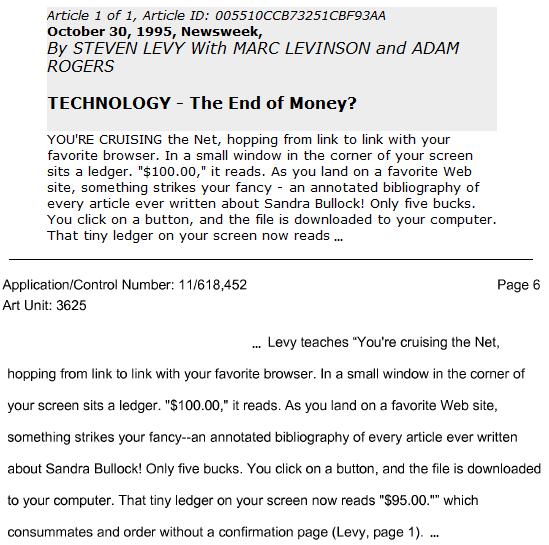
theodp writes "Pressed on Amazon's 1-Click patent, then-USPTO Chief Q. Todd Dickinson got testy: "I make this challenge all the time. If you're aware of prior art out there that invalidates a patent that is existing, file a re-examination. We'll be happy to take a look at it." Really? It's been 3+ years since unemployed actor Peter Calveley submitted prior art that triggered a USPTO reexamination of the 1-Click patent. Still no 'final answer' from the USPTO. To put things in perspective, 1-Click inventor Jeff Bezos once proposed a three-year lifespan for patents (later retracted), let alone patent reexams. In the meantime, other patent examiners have repeatedly smacked down 1-Click — the latest (non-final) rejection was issued on Feb. 10th with Sandra Bullock's help."
Please don't say that the one-click experience was "invented" by Jeff Bezos - it completely trivializes the entire creative process. It reduces those who are truly innovative to the status of mere dilettantes.
I have an amazon account, they have all my details online, and so forth.
But when I buy something through what they claim as "1 click", it sure seems like more than one to me.
Is this some new definition of "1", or am I missing something obvious here? It takes several clicks just to get to the "you are about to be charged" screen. And that's assuming I have already logged in, which I usually haven't when I just want to go there and buy a CD or something.
Well... maybe if I do all the navigation with the keyboard, it could be zero clicks, but I'm not sure that's what they mean.
Too bad... I thought they found prior art in 2005's "The Net" screenplay.
I own the gene that creates that kind of critical thinking.
So delete that comment.
It's my property.
Or just patent n!=1-click purchases.
I truly don't know what that sentence is supposed to mean. Is "smack down" a legal term?
Defense: Your Honor, the defense would like to smack down the prosecution's evidence.
Prosecution: Objection, Your Honor. The defense has not demonstrated it possesses the balls to smack us down. We'd also like to put on the record that we've had intercourse with the defense's wife.
Judge: Objection sustained. It has been demonstrated to the satisfaction of the court that the defense has no balls. We also note that the prosecution could not have had intercourse with the defense's wife, for lack of penis.
This is a transcript of an interview conducted 24-May-2000
Dipshits = /.
patent reexams aren't 1-click ...
NB: The message above might reflect my opinion right now, but not necessarily tomorrow or next year.
... is that some of the prior art (the open account) can be shown to exist in Babylonian cuneiform. Does the USPTO search back to Babylonian cuneiform for evidence of prior art in business practices?
The open account is where the customer walks into the store, is recognized by the owner or clerk, requests some goods, says "put it on my account", and receives the goods. The owner or clerk updates the account. In the one click patent the recognition is by a cookie.
Actually, a final rejection was made on the re-exam case, but Amazon filed an RCE (request for continued examination). Essentially, as long as Amazon is willing to (a) pay the fee and (b) make some sort of submission that merits further examination (e.g., amending the claims or presenting another prior art reference they want considered), they can keep the re-exam going until the cows come home. The next action after an RCE is usually non-final - it's a bit like starting the examination process over again.
On a side note, after the RCE and before the subsequent non-final Office action, Amazon submitted an IDS (information disclosure statement, on which they list further references they wish to have considered) that was 36 pages long. That's not a 36-page reference - the list of references itself took 36 pages.
Comment removed based on user account deletion
The obviousness test relies upon prior art. If somebody does something, and nobody can show that any part of it has been done before, then surely it's not obvious?
Or are:
1. On the payroll of patent whores
2. Working under congressional oversight by congress people who are on the payroll of patent whores
I wouldn't be surprised if the infamous http://en.wikipedia.org/Iron_Triangle has anything to do with this.
Usually, when a government agency makes insanely stupid decisions in the face of overwhelming evidence, someone's got a knife to their back or their pocketbook.
Ironically, Stephen Levy - whose 1995 article The End of Money is now being used by USPTO examiners to reject 1-Click patent claims as obvious - reported back in 2000's The Great Amazon Patent Debate about the conversation he sat in on in which Jeff Bezos just wouldn't hear that 1-Click was obvious. Responding to Tim O'Reilly's charge that "trying to enforce a patent claim on something as obvious as 1-Click is downright selfish," Bezos countered: "When we applied for the patent, 1-Click wasn't obvious...When we introduced it, people were surprised...They called it innovative."
It's just you. But I browse at +5, so I could be wrong.
... and then they built the supercollider.
The synopsis does not reflect peters talent. Calling peter a out of work actor is like calling Ronald Reagan a to 2 bit B movie actor. Peter is much more, he is in work with our countries major TV network, He is smart and a bit of a geek, who else be an actor/director/producer and go after IT patient abuses for a hobby. Go for it peter.
The obviousness test relies upon prior art. If somebody does something, and nobody can show that any part of it has been done before, then surely it's not obvious?
There are an infinite number of reasons why things are not done. To say that something is not done implies that something is not obvious is just one more example of PTO bogus logic.
---
The patent system. The whole edifice is based on handwaving.
This endless wrangling about prior art should be rendered moot by the Bilski Decision anyhow - I would hope. The Bilski Decision puts the whole concept of software patents into question.
The summary really isn't difficult to comprehend:
So yes, if you only focus on one element of the entire summary I can understand why you might think that its someone other than you who is being a "dipshit".
So, the promised re-exam is occurring. What do people think happens during a reexamination? A big courtroom trial? No... Reexaminations are ex parte - the patent owner vs. the USPTO examiner, same as the original examination. And they result in things such as non-final rejections.
When Palm/3Com were losing the Graffiti fight to Xerox, I gave them a published article from a IEEE journal on the "SCANC" system that was almost identical to both Graffiti and the Xerox patent and which should absolutely have been accepted as prior art.
Nope.
The system is broken, and Mr. Dickson and everybody else involved needs to be cashiered at once.
Dog is my co-pilot.
Comment removed based on user account deletion