 Slashdot Mirror
Review: Halo Wars
- Title: Halo Wars
- Developer: Ensemble Studios
- Publisher: Microsoft Game Studios
- System: Xbox 360
- Reviewer: Soulskill
- Score: 7/10
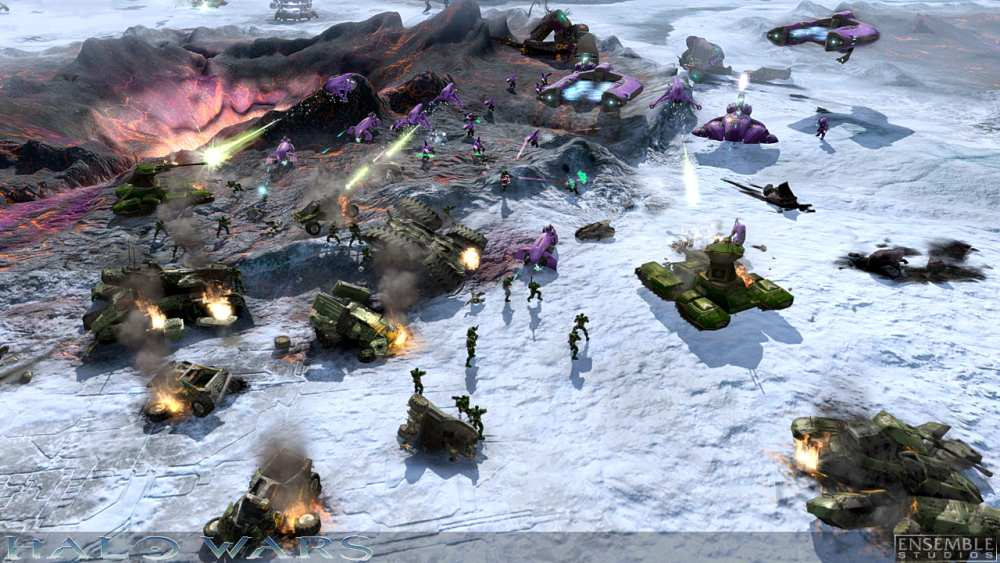
A solid camera system is the foundation of a good control scheme, and here Ensemble gets off to a running start. The left stick pans around the map at a variable speed determined by how far you push the stick. You can scroll slowly or quickly, and you can also change the maximum speed in the options menu. It's very responsive and easy to get from one place to another. You can hold the left trigger for even more speed, going all the way across the map in about a second. The right stick controls the zoom function, which is largely irrelevant — you'll probably want to keep it zoomed out as far as it will go most of the time — and pushing the stick to the sides rotates your view. You won't need to use this very often, but it's convenient and useful if you want to see things from a different angle.
The other way you can move around the map is with the directional pad. Hitting left will cycle through your base positions, and pressing down will cycle through your unit positions. Occasionally you'll get an alert — for example, a few of your units will be under attack somewhere on the map — and pressing right will take you immediately to the position of your latest alert. Getting around the map is definitely not a problem in this game. It's about as close as you can get to the ease of use that comes with a mouse and keyboard.
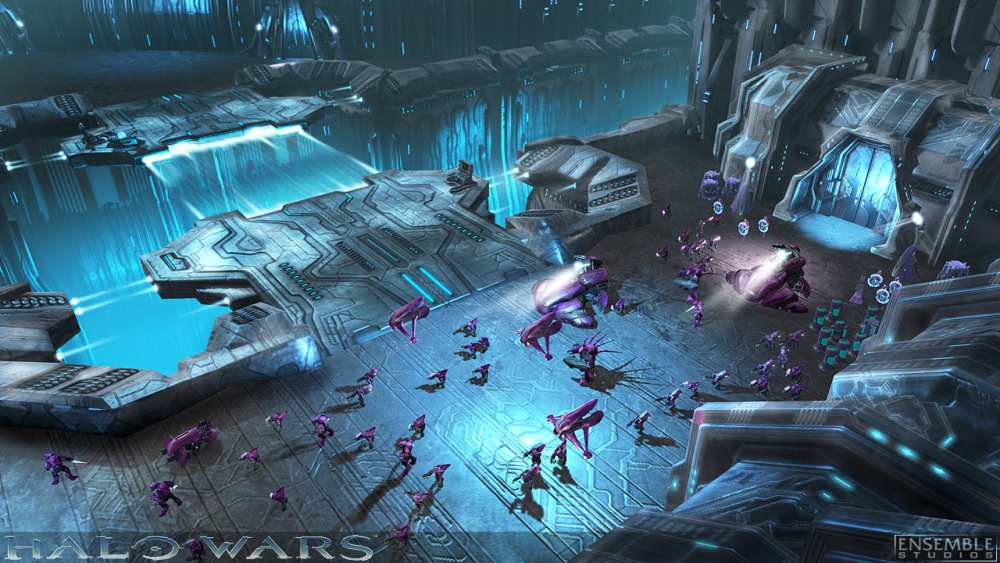
The next big hurdle was unit selection, and again, Ensemble did a fine job, giving you all the options and speed you're used to in these types of games. The A-Button selects units individually, but if you hold it down, you get a good-sized circular area which you can then sweep over multiple units to select them at the same time. This takes the place of the typical click-and-drag rectangles on the PC. It's slightly slower, but not by much, and you get the added benefit of being able to grab everyone in a circle around a unit you want to stay put. On top of that, double tapping the A-button on a unit will select all of that type of unit nearby. The right shoulder will select everything on screen, and the left shoulder will grab all units period. The only notable missing function is the inability to save certain groups and switch back to them, and even then, if your groups are spread out, it's not an issue.
If you have multiple unit types selected, the trigger buttons will cycle through the different types, making it very easy to send all your marines in one direction and all your vehicles in another. Once you've had a few missions to get used to the myriad selection options, you won't even need to actively think about what buttons to press. It's a good system because it doesn't get in the way of the actual gameplay. Finally, the means of controlling your units and buildings are simple and intuitive as well. The X-button is your standard "go here," "attack this," "grab this" button, and the Y-button activates any special attacks your selected units have. One nice feature is that you can hold down the X-button for a few seconds and a unit will finish walking to where they were already headed before they go to the new location. This lets you set up paths to take the long way around if the short way isn't safe. Buildings have a radial context menu through which you activate upgrades or pump out new units. You can queue up multiples at a time, and you can cancel an order before it finishes. Essentially, all is as it should be, and you're left to focus on what's important.
Halo Wars starts you off about 20 years before the events of the first Halo game. They send you to Harvest, the first planet to be taken by the Covenant, to establish peaceful and cooperative relations with their leaders and diplomats after five long years of combat. Just kidding — they want you to kill stuff. You get to see cinematics after every mission, which are largely responsible for driving the plot of the game. Visually, they're quite impressive, though the first few are a bit slow. As the game goes on, the cinematics become progressively cooler and more exciting. The writing and the dialogue is less than stellar, but it's serviceable, and it provides some good context to the Halo universe. There are also minor plot points shown during the mission, rendered by the game engine. Those are usually what determine your specific objectives.
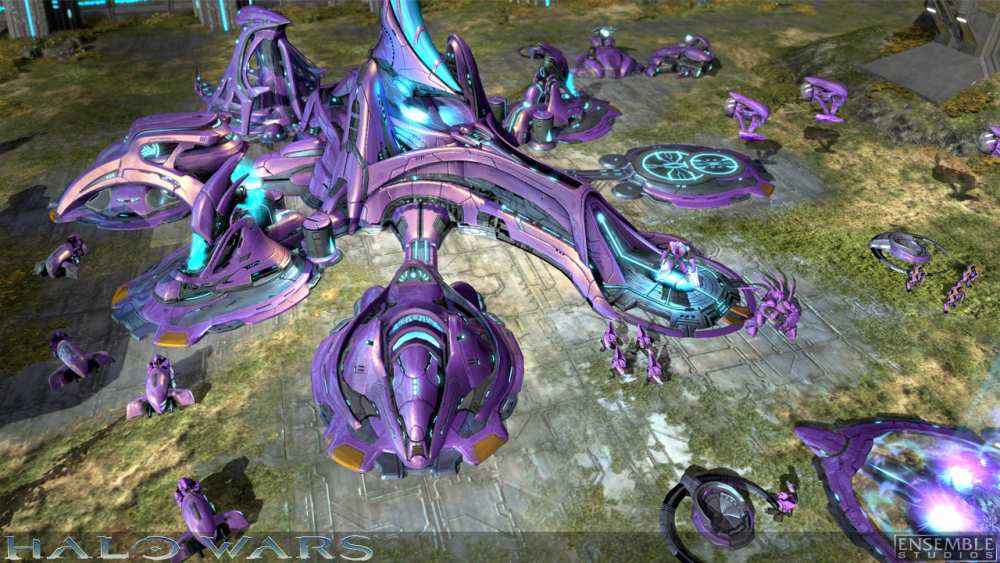
There are not many missions in the campaign — just 15 — but they're very diverse. No two are alike, and Ensemble does a decent job of creating interesting objectives and differing levels of resistance. In one, you have to defend civilians as they head for their evacuation shuttles, and you need to take care of the shuttles themselves. The mission is timed, waiting on a countdown to launch. Another mission has you faced with a large energy shield that needs to be taken down. Certain positions on the map are good attack points for a type of long-range tank, so you have to take each position one at a time and hold them all long enough to knock down the barrier. Later you fight a Covenant super-weapon (a Scarab), dodging its main attack while taking out its power supply. And, of course, you get a mission to just build a massive army and annihilate everything else on the map.
They give you a good mixture of offense and defense, though in some cases the amount of resistance you're likely to encounter is unclear. Decisions made early in the game in terms of build order and unit production can effectively eliminate your chances of winning if you guess wrong. This is important because of the way Halo Wars deals with building bases. The bases themselves can only be placed in particular spots. Once a base is built, a number of empty construction bays spring up around it, and you're only allowed to build additional structures where there are construction bays. This means that you're only allowed a maximum of seven structures per base. On top of that, resources aren't something you go out and farm; you build supply pads, which slowly get deliveries from your ship in orbit. So, you're given a tough decision early on whether you want to develop your army or your economy. If you throw down five supply pads, you'll get resources like crazy, but you won't have enough space left to build all of the other things you need to win.
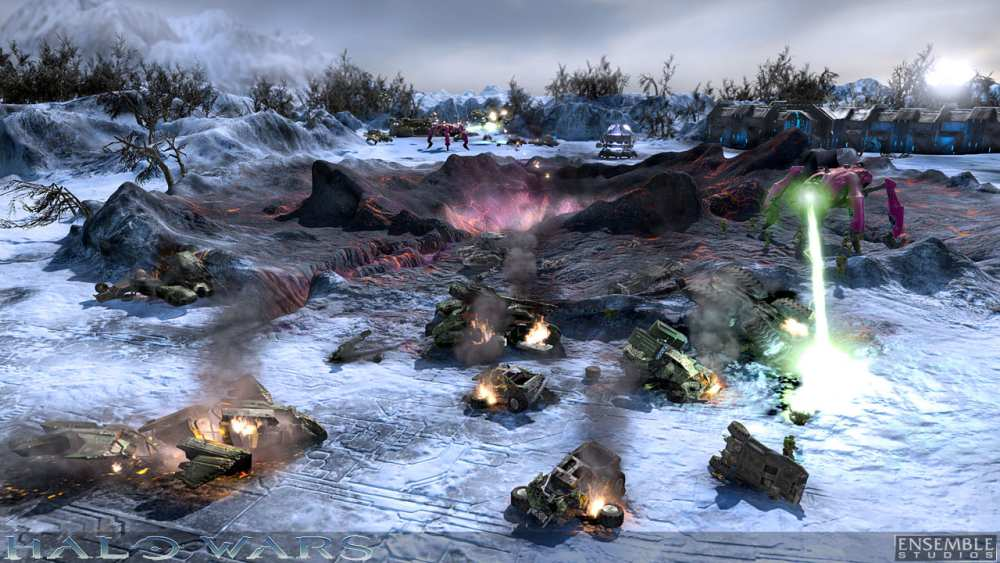
On the easier difficulty levels, this works out decently well; a ton of early resources means that you can pump out enough basic marines to handle most threats until you get fully established and perhaps take a second base. On the harder modes, you're attacked earlier and with stronger forces. Another decision they give you is what type of enemies you want to defend against. Several units are particularly strong against one type of enemy — infantry, vehicle, or aircraft — and not as useful against others. When in doubt, diversify, but if you're playing at an appropriate difficulty level, you can expect to fail a few because you just don't know what to prepare for. The timed missions, in particular, force you into early decisions that simply may not work. Since there's only the UNSC campaign, it's worth going through and doing the side missions, and also trying for some of the difficulty-related achievements.
The AI in Halo Wars is solid; pretty standard for this type of game. Your forces are reasonably smart about picking a target to focus, but not too smart; they won't switch off a full-health tank to drop one that's already almost dead. The pathing is pretty good; you won't have to spend much time micromanaging where you want them to go, but the option is there if you need it. One complaint is that when defending, your troops like to chase attackers too far, spreading out your forces and making it easy for a smart enemy to score some easy kills. There are four difficulty levels — easy, normal, heroic, and legendary. If you're just looking for a quick play-through of the game, go with normal. If you'd like to work for it, go with heroic. If you're pretty good at other real-time strategy games and/or enjoy being punched in the face, legendary will fit the bill.
The selection of units is interesting. You often get a leader and a group of three Spartan soldiers. In addition to being quite powerful, these units are essentially unkillable in the single-player campaign. When they take lethal damage, they drop to the ground and slowly regenerate health. Once they've healed enough, you can revive them by bringing another unit close by. It can lead to some surprising shifts in power. Most of the units are upgradeable to a high degree, becoming significantly more powerful late in the game. For example, the standard UNSC marines begin as a squad of four men with machine guns and grenades. Successive upgrades will: add one man, trade the grenades for long-range rocket launchers, add a medic that will heal the squad after a battle, and finally upgrade all of the marines to Shock Troopers. Each side even has "uber units;" Scarabs shoot giant lasers that fry UNSC forces in seconds, and Vultures are airborne behemoths that can eradicate Covenant buildings almost as quickly.

It would have been great to get a campaign of Covenant missions, but you can still use them in multiplayer. Their buildings are similar to the UNSC selection, but with minor variations. They get shield generators of questionable utility, and their infantry are the ones specialized to fight against particular units, rather than the vehicles. The two factions are similar enough that they'll be well balanced. You can play multiplayer maps against the AI or online with other humans, and you can also play cooperatively with your friends. You select the faction you want to play and then the leader you want, each of whom brings a different unit, ability, or potential upgrade to the table. You can expect to see players using strategies that work in other RTS games. Rushes work well, but they can be dealt with. Selecting your opening strategy tends to be more important than out-managing your opponent in battles. You don't have to have a ridiculous number of actions per minute to do well.
Ensemble succeeded quite well at establishing a control system that is powerful yet doesn't fight for intellectual real estate with the actual playing of the game. It's not a ground-breaking new entry into the real-time strategy genre, but, in a manner similar to the first Halo shooter, it demonstrates how well this genre can work on consoles. And it does well by the Halo franchise in the process. It's too bad Ensemble themselves got split up after completing this game — DLC involving some Covenant missions or making the Flood a third playable race would make this game even better. Fortunately, a team of Ensemble members now going by the name Robot Entertainment will be providing "support." If they're proactive about tuning and balancing the game, Halo Wars multiplayer could become quite popular indeed, in part because there isn't much competition. While it's not likely to be suitable for the hardcore, competitive RTS players, Halo Wars is definitely the fun and easy-to-operate console RTS many players have been waiting for.
...same exact formula as a million other RTS games, just branded with Halo; ergo, if you like Halo, this is probably an excellent game - otherwise it's like many others that came before it. If you've not played many RTS games, this one probably has polish, so pick it.
Loading...
This game takes a new, totally novel, 'Humans', 'aliens with advanced tech' and 'aliens with organic tech' approach to sides that I totally have never seen before in any space-based rts. It's good to see microsoft finally coming out with concepts that aren't direct copies of anything else.
oh wait
Redalert 3 was not a very enjoyable experience. And why should this one be any different?
I'll just wait for SC2.
“Common sense is not so common.” — Voltaire
It starts out with: "Bungie's trilogy of first-person shooters established a standard against which most similar games have been judged for the past eight years."
Uhm, no. Halo is a console game which was based on the rich and varied offerings from the PC world. To say that Halo is a standard really shows how little the reviewer knows about first pergames.
Feed the need: Digitaladdiction.net
He is only half right. Halo is actually quite good and I only really played PC FPS before I started playing it.
I have only played the third one and it is easily one of the most polished games I have ever played. The mouse is a better controller for FPS, but the Halo is a lot slower than say quake so it doesn't make as much difference (I played Quake III one day after playing halo and it was like flying, the speed didn't feel as right as halo does).
It is one of the few games of this type I have played where strangers actually communicated and planned properly in team based multiplayer. People actually talked!
Also the theater mode was fantastic. It was very interesting to play through a flag capture from numerous angles (I once replayed one where I thought I had done all the work, where in the replay it showed a sniper and others keeping people of my back).
So I would consider getting this if only for the polish, Halo doesn't break any new ground but from what I have seen what it does, it does well.
Having played both... Halo is the superior game. Yes, blasphemy, I know, but really, is there a story to Half-Life? No. I was amazed when playing HL2 that people make it out to be such a big deal. Most of it was listen to a couple minutes of conversation that suggests that there may be a story somewhere, OMG, something happened, you're separated from Alyx, now go through 2 hours of story-less FPS gaming to meet her somewhere else. Then it happens again. Oh, and occasionally there are massively long and boring vehicle sections.
About 25% of HL2 was actually interesting and fun.
Halo, on the other hand, has solid story throughout. Sure, there's nothing as cool as the gravity gun in the play, but the tank-driving sections are far more fun than anything in HL2.
In fact, the section of Halo 3 where you destroy the scarab with the tank was more fun than the entirety of HL2.
"You know your god is man-made when he hates all the same people you do."
I got this game a few days after it came out and while the game mechanics are pleasing and the controls easy enough to learn for an RTS using a gamepad, I must say one thing has me very disappointed. The soundtrack.
Where the hell is my kickass soundtrack going on in the background? The game is visually pleasing, I especially like watching the warthogs drive around. I feel like the music was ignored, but this is just my opinion. That was one of the draws for playing Halo for me, the music that would swell up and seemed to tie in with the situations very well. I just don't have that in Halo Wars. Maybe I am knit-picking. Did anyone else feel let down by the musical score or lack there of?
"Quote me as saying I was mis-quoted." -Groucho Marx
It's comments like this that prove how PC gaming is on a decline. Otherwise, it's proponents wouldn't be so sensitive and bitchy about anything that threatens the PCs homogeny over certain genres. These sorts of comments are like what we saw written about the original Halo. I'm sure the whining of 'you cant play fps/rts without a keyboard and mouse wtfbbq' are generally drowned out by the ringing of millions of tills.
Btw the parent comment is a lot funnier when you read it in a comic book guy voice.
but it remains a console RTS. Yawn.
I want my RTS to be complex, and far more open with more micro-management, I havn't seen an RTS I've liked since Empire Earth 2, since then, everything has been dumbed down again and again.
I've got, played, and liked Halo Wars. I like the Halo franchise, it's got a good storyline, and the games have been well made. This, true to form, is not a bad game. It's just not revolutionary.
That said, I am tired of people slagging off Halo continuously. Sure, I prefer the Half-Life PC games to Halo, but the Halo games remain excellent - and the game type and map customisation have yet to be beaten for a simplicity vs power balence.
-- Lattyware (www.lattyware.co.uk)
I tried the demo on Xbox 360 when it came out. I realize that not all demos are indicative of the quality of the overall game. I have not played the full version.
From my experience, the game is like playing Starcraft, while drunk, with your toes, after a frontal lobotomy. The controls are dumbed down, as is the general gameplay overall. The "pretty graphics and sound" didn't really add that much compelling to the gameplay. Any Command and Conquer game, Warcraft 1-3 or Starcraft had much deeper gameplay. For the $60 you could spend on this game, you could probably find ALL of these other games in bargain bins, or on eBay.
I fail to see why in the world consoles have the inability to use keyboard and mouse at least as an option. The 360 has USB ports, the PS3 has Bluetooth and USB. Why can't I just take my keyboard and mouse combo and use it for these systems as an option?
Some people have given me the excuse that MSFT/Sony/Nintendo want 'consistent gameplay' with the controllers that people will already have. If that's the case though, why do we have things like weird huge joysticks for mech games (360), Rockband kits, the Wii-Fit board, or the Duck Hunt stype zapper for the Wii??? These aren't your standard controllers, but are more than fine. I'm guessing that 'most' households with a game system have a USB keyboard and mouse laying around somewhere.
For me, this would make the consoles perfectly equal gaming systems for me that I'd be totally happy with for RTS and FPS genres.
Tibbon
tibbon.com
Having played both, you are a fanboy. Fun != Story. I had a heck of a time figuring out what the heck was going on in Halo. Halo 2 was even worse. The only thing i figured out was everyone was a wuss but Master Chief, and he had to backtrack so many times I almost fell asleep. My challenge to any halo player is to explain the flood, halo, and all that religious gibberish to anyone that's never played and ask them if it makes sense afterwards.
HL2 story wasn't the best either, definitely overrated, but at least I could kinda understand what was going on.
I fail to see why in the world consoles have the inability to use keyboard and mouse at least as an option. The 360 has USB ports, the PS3 has Bluetooth and USB. Why can't I just take my keyboard and mouse combo and use it for these systems as an option?
Some people have given me the excuse that MSFT/Sony/Nintendo want 'consistent gameplay' with the controllers that people will already have. If that's the case though, why do we have things like weird huge joysticks for mech games (360), Rockband kits, the Wii-Fit board, or the Duck Hunt stype zapper for the Wii??? These aren't your standard controllers, but are more than fine. I'm guessing that 'most' households with a game system have a USB keyboard and mouse laying around somewhere.
It has nothing to do with limiting the number of controllers people have. I bet it's actually that most people don't want to have to play against people with an advantage over them. No one reasonable, generally including even die-hard console fans, disputes that the mouse and keyboard is more precise. A lot of people do dispute, however, whether it's more fun to have a mouse and keyboard on your couch in the living room.
I know that as a console game player, I just wouldn't play any game online where a sizable percentage of the population is using a mouse and keyboard. They have an advantage over me, as surely as baseball players that use steroids have advantages over their clean brethren, and I don't want to adopt their tactics simply to remain competitive. I just wouldn't play, and the number of players like me is a lot larger than the number of players who want to use the mouse and keyboard, so it doesn't make sense to include the option.
Furthermore, and I'm not sure how widely held this view is, but at least for FPS, I actually prefer the lower accuracy of the game controller. The mouse makes it too easy to be unrealistically good, bunny jumping down the hallway while sniping people in the head with a high calibre rifle in mid jump. The fact that it's harder to do that on a console is a good thing to me. There's a reason we don't train our soldiers to jump all around while trying to snipe in real life.
I was going to mod this up, but thought I would add some additional thoughts instead.
I've been playing computer based FPS since Doom II. I didn't play a console based FPS until SOCOM 2 (or was it 3?) and then Halo 3.
The campaign of Halo 3 was good enough to captivate me through completion, but the campaign for HL2 was better; however...
Halo shines with respect to multiplayer. Not because of its controls. Not because of the multitude of 12 year old mic hogs. But because of its matchmaking.
I tried playing Team Fortress II, but felt like an idiot screwing over my teammates because I had no clue what I was doing. I tried playing L4D, but only rarely got a good evenly matched team together. The ranking system in Halo matchmaking, which is loosely based upon chess ranking system (IIRC), works fairly well. Pretty much every game I play in is competitive.
That's what keeps it interesting for me. No particular match is too easy and only the occasional match is completely overwhelming. And then there's grifball...
Halo/Halo 2 had some of the DUMBEST, most boring, and most repetitive cutscenes in any game I've ever played. I can't even begin to describe how simplistic and boring the story in these games was. Actually, I never really figured out too much of what was going on aside from various retarded looking aliens hissing at each other and posturing to show off how tough they are.
Halo/Halo 2 are some of the most overrated games ever in my opinion. They have fun moments but are so ridiculously repetitive. In each game you go through the same exact levels multiple times, just in different directions each time (and sometimes not even that, sometimes it's just 'do the exact same thing you did an hour ago over again'). That's how they filled out the content of those pieces of crap. My friend and I never actually finished Halo 2 because we got so bored playing it.
I'm not a fan of Halo... I HATED that whole Flood part, it's one of my most hated game scenarios. You go from fighting one kind of enemy, which look alright, to a grotesque ogranic thing with either worse AI.
All-in-all, it is over-hyped.
That being said, the storyline isn't that much gibberish.
- Aliens are attacking Earth's colonies, fortunately they don't know the location of Earth.
- Aliens are VERY religious, to the point of being zealous. They believe in ancient gods that left on a great journey, that they are chosen, etc.
- While escaping, MC and company come across a large ring-like world with its own ecosystem.
- We come to learn the Ring is actually a weapon. Several are spread across the galaxy and when activated release an energy way that destroys all biological matter.
- It was activated once before, when the rings' creators couldn't stop a parasitic organism called "The Flood" from absorbing all life in the galaxy.
- For SOME reason, samples of the flood survived on at least one of the rings and are unleashed by the humans/aliens when they explore the ring.
- Now humanity is fighting aliens that hate them, and aliens that just want to absorb them.
Wow, I can't believe someone found the Halo story hard to follow. I haven't played the original Halo in almost 3 years, but I'll give your challenge a shot from memory:
1) Humans are at war with covenant (bad guys)
2) Story starts with Pillar of Autumn (a big colony ship) being pursued by covenant. The ship comes out of hyperspace in an unknown location, and covenant are still in pursuit. There is a large ring shaped artificial planet nearby.
3) Covenant manage to board the ship, and you (Master Chief) are asked to take Cortana (the ship's AI) to protect it from capture. You are to flee from to ring planet.
4) Once on the planet, you regroup with everyone else that escaped.
5) You learn your captain was captured by the covanant, so you rescue him and several other shipmates.
6) While captive, the captain learned that the covenant believe Halo is not just a planet, but a super weapon. He also learned the covenant are attempting to gain control of Halo so they can use it.
7) You try to find out where the control room is
8) You head for the control room so that YOU can get control of the weapon first.
9) On the way there, you run into the flood, which is a sort of parasitic creatures race. They were apparently in containment on Halo and accidentally released by the covenant in their attempt to get control of Halo.
10) You run into Guilty Spark, who is a service bot responsible for caring for the installation (ie: Halo). When he learns you are there to activate Halo, and he wants to help you because he needs to stop the flood, and activating Halo will do that (he can't activate it on his own because of security protocol).
11) He leads you to recover the activation index...the key you will need to activate Halo.
12) You then proceed to the control room to activate it. However, as you activate it, Cortana discovers that Halo is not a weapon, but a device to purge the galaxy (or maybe just some large portion of it) of life.
13) You try to abort, but Guilty Spark tries to stop you by sending Halos defensive system against you. You succeed anyway.
14) You now decide that leaving the Halo intact is too dangerous (in case someone else activates it) so you are going to destroy it. You head back to the crashed Pillar of Autumn to have it self destruct (taking Halo with it).
15) You then escape in a small ship before Halo explodes.
That's just from memory. Might have missed a few points, but that covers the basics. Nothing very complex or confusing there. If you want to argue that the story is lame or otherwise not compelling, that's fine (your choice). But to say it's difficult to figure out what's going on....well, if that's the case, I suggest "Hello Kitty Island Adventure" is probably a better match for your intellect.
Its to control the market. They control what controllers the system can use, and because of that they control who makes the controllers. Once you start allowing mouse and keyboards, your opening the door to more third parties making things for your console which means lower profits. Since they can only use the one (or very few) the makers and thus flow of money can be controlled.
and before even Quake was DOOM.
And before DOOM was the hunting sequence in Oregon Trail.
From the article: ..."It's about as close as you can get to the ease of use that comes with a mouse and keyboard."
So why not just use a mouse and keyboard? I notice that this game is for the XBox. Why not make a PC version? Doesn't Microsoft have some stake in PCs as well as XBoxes?
You are welcome on my lawn.
If posts on the web being sensitive and bitchy about anything that threatens X proves that something is on the decline, then I think everything is on the decline.
Really, one person's ramblings means that PC gaming is on the decline? I think all it proves is that you are one of those weird people who have a bias against PC gaming.
Support a great indie game: http://www.abaddon360.com
A lot of good science fiction does this. Authors are entitled to expect the reader (or player) to do some imaginative legwork.
The problem I had with Halo is that I could never shake the feeling that there was much more interesting stuff going on somewhere else then the stuff I was forced to play. The story around Master Chief did never really do anything that was very interesting and the whole flood thing was just annoying and out of place, I guess thats what you get when you player as the indestructible hero instead of a human being. Now at least with Halo you later got comics and books and stuff, so there actually is more going on, to bad that none of that ever made it into the games.
Half Life on the other side has the G-Men, which sadly just feels like a walking deus ex machina with legs. You never get a satisfying conclusion or backstory or anything. You play a clueless character who saves the earth by accident and nothing ever feels like an accomplishment, because you just stumble around in the world shooting dudes. Half the story of Half Life 2 is just transporter malfunction and then having to manually walk the way by foot, not exactly great storytelling.
That said, when it comes to video games I don't think overtelling a story is a problem, I think quite the opposite is true, most games these days try to avoid explain anything. Thanks to the first person view you are quite often limited to exactly that which you see through the main characters eyes, which sadly just isn't much. So instead of story, you simply get a few sad piece and pretty graphics thrown at you, maybe with a little dialog thrown in to connect things. Its kind of ridiculous when one looks back, the first 10 minutes of story and dialog in Monkey Island have more variety and interesting stuff going on then most todays games manage to cram into 10 hours.