Slashdot Mirror


Sunspots May Be Different During This Solar Minimum

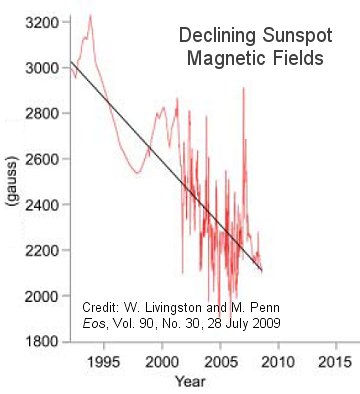
PhreakOfTime writes "According to Bill Livingston and Matt Penn of the National Solar Observatory in Tucson, Arizona, sunspot magnetic fields are waning. The two respected solar astronomers have been measuring solar magnetism since 1992. Their technique is based on Zeeman splitting of infrared spectral lines in radiation emitted by iron atoms in the vicinity of sunspots. Extrapolating their data (PDF) into the future suggests that sunspots could completely disappear within decades." To motivate their interest the researchers mention the Maunder Minimum, which occurred beginning in 1645 and coincided with the coldest part of the so-called "Little Ice Age." Sunspot counts during this period were as low as 1/1,000 of the numbers seen in modern times.
26 of 95 comments (clear)

  1. Re:WHERE IS YOUR GLOBAL WARMING NOW??? by spike1 · · Score: 5, Insightful

    So, we're back to the pre-global warming "We're due another ice-age" 1970s doom-mongering eh?

    Never mind, since then, we've inadvertantly added a few blankets. We'll be fine.

    At least until the ice-age ends. Then we'll be really in trouble.

  2. Re:Global climate change by Anonymous Coward · · Score: 2, Interesting

    This should counteract global warming.

  3. Obligatory comic link by pc486 · · Score: 4, Funny

    Extrapolating? Sounds like a job for Randall Munroe! http://xkcd.com/605/

  4. global warming heretic by teac77 · · Score: 4, Interesting

    Some look at ice core samples. Others count sunspots. This suggests that we will have "lower than average global temperatures". Call me a heretic, but I think that we get better data from counting sun spots.

    1. Re:global warming heretic by BrightSpark · · Score: 3, Interesting

      I agree. Check out this background website which helps to show how the cycles are developing. http://www.predictweather.co.nz/assets/articles/article_resources.php?id=89 I am sure counting sunspots was not as sophisticated in the 1700s but it was still straightforward so the science should be solid. The risk is in drawing cause and effect conclusions. Our atmosphere gets a real bashing from the distortion to the Van Allen belt caused by solar emissions. Sound principals to show how this affects climate are more difficult to demonstrate.

    2. Re:global warming heretic by maxume · · Score: 2, Insightful

      I plan on boiling in demississippi.

      --
      Nerd rage is the funniest rage.
    3. Re:global warming heretic by techno-vampire · · Score: 2, Informative
      Have fun roasting in denial!

      Personally, I'm not going to worry until and unless I can do so while sipping a nice, light wine from a Scottish vineyard and nibbling on a sharp Greenland Chedder. These were both possible during The Early Medieval Warm Period, but quickly became impossible during The Little Ice Age that followed. The climate is always changing; sometimes it's getting warmer, sometimes cooler. Deal with it and stop pretending that mankind has any meaningful effect on it.

      --
      Good, inexpensive web hosting
    4. Re:global warming heretic by metaforest · · Score: 3, Interesting

      Oh FFS, we are talking about a net change in arriving solar radiation of less than 0.1% over 11 year cycles, and though its likely there are some larger fluctuations that modulate the 11 year cycle, we haven't been measuring long enough. The notion that this data predicts a 'mini-ice age' is about as useful as using sunspot counts to predict the weather. Which is not useful at all. Sun spot counts don't predict weather at all. Even the proxies don't really link us to what is going on, though they do seem to loosely track solar oscillations. How long is the lag on those proxy relationships? Are they indicative of some other process that is being influenced by solar activity? No one knows. We don't have long enough direct solar activity measurements.

      As the dominant dim bulbs around here are fond of echoing: Correlation is not causation.

      As for global climate change due to our Industrial Age farting dinosaurs back into the atmosphere, we do need to get a grip on that. I doubt very seriously that some prediction of a long solar minimum is going to change the outcome much, if at all.

  5. Something doesn't add up. by MartinSchou · · Score: 2, Insightful

    So, in the 1600s we had a very low number of sun spots and a little ice age.

    In the last decade we've had a low number of sun spots and a temperature spike.

    But the people who says that global warming isn't caused by human factors, primarily claim that it's due to this low number of sun spots.

    So ... normal sun spot count, normal temperatures. Low number of sun spots, high temperatures. Very low number of sun spots, very low temperatures.

    I wonder what happens if we get a high and very high number of sun spots - one will probably push the average global temperature to 300 Kelvin while the other will send it to 350. Wonder which will do what.

    1. Re:Something doesn't add up. by BadAnalogyGuy · · Score: 4, Insightful

      It doesn't add up, and that is where the controversy lies. If there is proof that humans are causing global warming, it should be easy to show. However, if the Earth's temperature changes as a result of uncontrollable events happening at the sun, then we need to take that into consideration.

      The controversy is very important, and having a calm, level-headed debate where both sides of the issue can discuss the topic without getting shouted down as "unscientific" (sunspot theorists) or "religious crackpots" (human-caused warming theorists) is just as important. Evidence is what will decide this one way or the other, but in order to have clear evidence, we must be able to express our theories in a respectful and open scientific environment. This is why we must teach the controversy.

    2. Re:Something doesn't add up. by Eudial · · Score: 2, Interesting

      I think the controversy basically boils down to the following: Correlation is not causation.

      --
      GAAH! MY PRINTER IS ON FIRE!!! PUT IT OUT! PUT IT OUT!
    3. Re:Something doesn't add up. by Gordonjcp · · Score: 4, Interesting

      I don't see what's "unscientific" about claiming that low numbers of sunspots cause global cooling. Fewer sunspots mean less energy from the sun. Although the spot is relatively cool, the area around it is very much hotter.

    4. Re:Something doesn't add up. by itsdapead · · Score: 4, Insightful

      If there is proof that humans are causing global warming, it should be easy to show

      Why should it be easy? That's part of the problem. The Earth is not a pan on a cooker that just gets hotter when you turn up the gas and cools down when you turn it down. The Earth is a complex web of cycles and equilibria that we don't completely understand.

      Heck, stick some ice, water and salt in the pan, clamp on a slightly leaky lid and even that becomes non-trivial - and that's peanuts alongside the Earth.

      Global warming (or not) is always going to be a guessing game: if you want irrefutable proof, wait 100 years and see whether Bangladesh is still there. Until then, its a risk/benefit analysis, not a scientific study.

      What is known is that basic physics says that increasing CO2 levels in an atmosphere will increase the proportion of solar heat retained by the planet: that much can be proven in the lab. Anybody who rejects AGW needs to come up with some theory that explains why that magically won't happen in the real world. Instead, they're exploiting the fact that its very, very difficult to predict how that extra heat will translate into temperature and climate changes. Sadly, I suspect that there are those on both sides of the argument who don't even know that heat is not the same thing as temperature...

      --
      In a survey of 100 programmers, 111111 thought that duck-typing was a good idea.
    5. Re:Something doesn't add up. by bitemykarma · · Score: 2, Informative

      Mean global temperatures have been rising throughout the 2000s

      Not according to NASA's satellites: http://www.mcclatchydc.com/226/story/74019.html

    6. Re:Something doesn't add up. by Mr.+Slippery · · Score: 3, Informative

      So, in the 1600s we had a very low number of sun spots and a little ice age.

      Except that no, we didn't have a "little ice age". We had a mild cooling period in the Northern Hemisphere, which had intense effects in some areas; but, according to to IPCC, "current evidence does not support globally synchronous periods of anomalous cold or warmth over this timeframe, and the conventional terms of 'Little Ice Age' and 'Medieval Warm Period' appear to have limited utility in describing trends in hemispheric or global mean temperature changes in past centuries."

      --
      Tom Swiss | the infamous tms | my blog
      You cannot wash away blood with blood
    7. Re:Something doesn't add up. by Anonymous Coward · · Score: 2, Insightful

      You're citing a "trend" over the last 9 months ?!? I bet most places north of the equator notice a warming trend between January and September.

    8. Re:Something doesn't add up. by Gordonjcp · · Score: 2, Insightful

      correlation != causation. As it is, we have a STRONG CORRELATION of man's interaction causing global warming, and likewise, there is a strong correlation of lack of sunspot to global cooling, BUT, can it be PROVEN? Nope.

      Did you actually read what I wrote, or did you just decide to throw man-made global warming in there as a kneejerk reaction?

      Let's try the Wikipedia Simple English-style explanation.

      When there are more sunspots, the surface of the Sun is hotter. This makes it radiate more heat than when there are less sunspots. When there are less sunspots, the surface of the sun is cooler. When the sun radiates more heat, the Earth heats up. When the sun radiates less heat, the Earth cools down.

      Human activities have no bearing on this process at all.

    9. Re:Something doesn't add up. by Daniel+Dvorkin · · Score: 2, Informative

      Here's a hint: think about what a greenhouse is -- an actual greenhouse like you'd build in your garden -- and why CO2 is called a "greenhouse gas."

      --
      The correlation between ignorance of statistics and using "correlation is not causation" as an argument is close to 1.
    10. Re:Something doesn't add up. by itsdapead · · Score: 2, Informative

      It would seem that Co2 in the upper atmosphere would absorb more heat and prevent it from hitting the earth in the first place before it bounces back and gets traped by the Co2 on the way out.

      The energy doesn't "bounce off*" - it is absorbed by the Earth and re-radiated. All objects radiate energy, but the frequency spectrum of that radiation depends on the temperature.

      Because the sun is very hot, it radiates a lot of energy in the form of visible light.

      Because the Earth isn't as hot as the sun, most of the energy it re-radiates is as lower frequency infra-red.

      CO2 is transparent to visible light, but absorbs infra-red. So it acts as a one-way valve: the visible light from the sun gets in, the re-radiated infra-red from the Earth can't get out.

      (* It only bounces off the white shiny bits - which unfortunately tend to melt as the earth 'warms up'...)

      --
      In a survey of 100 programmers, 111111 thought that duck-typing was a good idea.
  6. Re:WHERE IS YOUR GLOBAL WARMING NOW??? by KDR_11k · · Score: 3, Interesting

    At least it stomps right on all the "it's just solar activity!" claims when it comes to temperature differences.

    --
    Justice is the sheep getting arrested while an impartial judge declares the vote void.
  7. Re:Global climate change by mehrotra.akash · · Score: 2

    global warming was done by us in order to survive the next ice age(there will be none as the extra greenhouse gases will trap more of the heat, so even what should be an ice age would be normal weather) infact thats why our fossil fuels are running out now, they were planned in such a way that the reserves would end at a time near the beggining of the ice age...

  8. Re:Something doesn't add up (I think it does) by uassholes · · Score: 3, Interesting

    But something is unusual about the current sunspot cycle. The current solar minimum has been unusually long, and with more than 670 days without sunspots through June 2009, the number of spotless days has not been equaled since 1933

    As to the "low number of sun spots and a temperature spike", more from TFA:

    ...posted on the Internet and led to some misunderstanding when a few authors from other fields cited that post and erroneously concluded that a lack of sunspots could explain global warming

    This is something worth following closely:

    Four years after the first draft paper, the predicted cycle-independent dearth in sunspot numbers has proven accurate. The vigor of sunspots, in terms of magnetic strength and area, has greatly diminished...Whether this is an omen of long-term sunspot decline, analogous to the Maunder Minimum, remains to be seen.

    Note in this chart on Wikipedia that temps have been trending downward for thousands of years, as if we are plunging into the next glacial period.
    Chart: http://en.wikipedia.org/wiki/File:Holocene_Temperature_Variations.png
    See here in general about the time since the most recent glacial period: http://en.wikipedia.org/wiki/Holocene

  9. Re:Something doesn't add up (post is good timing) by Informative · · Score: 3, Interesting
    Global temperatures peaked in 1998 and are now declining according to this ews story about the NASA satellites that have been measuring such things since the 1970s: http://www.mcclatchydc.com/226/story/74019.html

    According to data from the National Space Science and Technology Center in Huntsville, Ala., the global high temperature in 1998 was 0.76 degrees Celsius (1.37 degrees Fahrenheit) above the average for the previous 20 years. So far this year, the high has been 0.42 degrees Celsius (0.76 degrees Fahrenheit), above the 20-year average, clearly cooler than before.

  10. Maybe it does (Re:Something doesn't add up) by bitemykarma · · Score: 2, Informative

    Al Gore seems to have been barking up the wrong tree. This chart (http://en.wikipedia.org/wiki/File:Temp-sunspot-co2.svg) shows a much better correlation between sunspots and temperature, than between CO2 and termperature.

    1. Re:Maybe it does (Re:Something doesn't add up) by Mr.+Slippery · · Score: 4, Interesting

      This chart (http://en.wikipedia.org/wiki/File:Temp-sunspot-co2.svg) shows a much better correlation between sunspots and temperature, than between CO2 and termperature.

      Uh, no, it doesn't. The trend line for sunspots on that chart, peaked in 1960, and have been on a declining trend ever since. Meanwhile temperatures (on that chart) have been on the upswing.

      Solar variations over the past 20 years should have had a cooling effect, but instead we've seen warming. Solar variations are not the main driver of the climate change we are currently experiencing.

      --
      Tom Swiss | the infamous tms | my blog
      You cannot wash away blood with blood
  11. Re:Breathing space. by sumdumass · · Score: 2, Informative

    Still rising is a misnomer. The data in that graph ended in 2006 and doesn't reflect anything present or the past two years. More accurately would be the global temperatures were still rising until 2006. But again, that was before the solar cycles switched and these observations.