 Slashdot Mirror
Sunspots May Be Different During This Solar Minimum
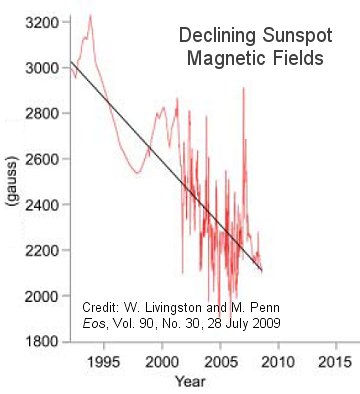
PhreakOfTime writes "According to Bill Livingston and Matt Penn of the National Solar Observatory in Tucson, Arizona, sunspot magnetic fields are waning. The two respected solar astronomers have been measuring solar magnetism since 1992. Their technique is based on Zeeman splitting of infrared spectral lines in radiation emitted by iron atoms in the vicinity of sunspots. Extrapolating their data (PDF) into the future suggests that sunspots could completely disappear within decades." To motivate their interest the researchers mention the Maunder Minimum, which occurred beginning in 1645 and coincided with the coldest part of the so-called "Little Ice Age." Sunspot counts during this period were as low as 1/1,000 of the numbers seen in modern times.
It seems we may be heading towards another ice age. Time to start buying up some of that precious offshore land! Global climate change, whether caused by humans or natural processes is not something to be feared but something to be profited from.
Speaking of global change. The Slashdot front page still hasn't changed the appearance of that +- bar yet. Does anyone think it looks good? Has anyone found it to be functional?
When sunspots stop occurring, we're in for some global cooling. Perhaps this could reverse the damage we humans have done to the environment. What with our cars and factories and stuff.
sorry, this joke kinda wrote itself.
I wish it was a joke.
So, we're back to the pre-global warming "We're due another ice-age" 1970s doom-mongering eh?
Never mind, since then, we've inadvertantly added a few blankets. We'll be fine.
At least until the ice-age ends. Then we'll be really in trouble.
Extrapolating? Sounds like a job for Randall Munroe! http://xkcd.com/605/
I presume...he knows what he's talking about!
I tried to think of a good sig, and this wasn't it.
Some look at ice core samples. Others count sunspots. This suggests that we will have "lower than average global temperatures". Call me a heretic, but I think that we get better data from counting sun spots.
So, in the 1600s we had a very low number of sun spots and a little ice age.
In the last decade we've had a low number of sun spots and a temperature spike.
But the people who says that global warming isn't caused by human factors, primarily claim that it's due to this low number of sun spots.
So ... normal sun spot count, normal temperatures. Low number of sun spots, high temperatures. Very low number of sun spots, very low temperatures.
I wonder what happens if we get a high and very high number of sun spots - one will probably push the average global temperature to 300 Kelvin while the other will send it to 350. Wonder which will do what.
At least it stomps right on all the "it's just solar activity!" claims when it comes to temperature differences.
Justice is the sheep getting arrested while an impartial judge declares the vote void.
Oh no! Global cooling is coming! Kill some pirates to raise the temperature back to normal! Invade Somalia and give the RIAA a license to kill!
sorry, this joke kinda wrote itself.
I wish it was a joke.
Yeah, the joke is on us really. Really.
Moved to http://soylentnews.org/. You are invited to join us too!
But something is unusual about the current sunspot cycle. The current solar minimum has been unusually long, and with more than 670 days without sunspots through June 2009, the number of spotless days has not been equaled since 1933
As to the "low number of sun spots and a temperature spike", more from TFA:
...posted on the Internet and led to some misunderstanding when a few authors from other fields cited that post and erroneously concluded that a lack of sunspots could explain global warming
This is something worth following closely:
Four years after the first draft paper, the predicted cycle-independent dearth in sunspot numbers has proven accurate. The vigor of sunspots, in terms of magnetic strength and area, has greatly diminished...Whether this is an omen of long-term sunspot decline, analogous to the Maunder Minimum, remains to be seen.
Note in this chart on Wikipedia that temps have been trending downward for thousands of years, as if we are plunging into the next glacial period.
Chart: http://en.wikipedia.org/wiki/File:Holocene_Temperature_Variations.png
See here in general about the time since the most recent glacial period: http://en.wikipedia.org/wiki/Holocene
According to data from the National Space Science and Technology Center in Huntsville, Ala., the global high temperature in 1998 was 0.76 degrees Celsius (1.37 degrees Fahrenheit) above the average for the previous 20 years. So far this year, the high has been 0.42 degrees Celsius (0.76 degrees Fahrenheit), above the 20-year average, clearly cooler than before.
Al Gore seems to have been barking up the wrong tree. This chart (http://en.wikipedia.org/wiki/File:Temp-sunspot-co2.svg) shows a much better correlation between sunspots and temperature, than between CO2 and termperature.
That damned Karl Rove.
However global temperatures are still rising while sunspot activity is decreasing that only gives us breathing space. When sun spot activity increases again and global temperatures increase driven upwards by both solar and man made factors.
Who?
I'm not saying that at all. The climate changes in cycles, with warmer periods and cooler periods. Please, spare me the drama.
Or it's just the calm before the storm, and we are going to get hit with a lot of sunspot activity, or nice solar flares or maybe even something cooler.
ps thats not cooler as in cold, but cooler is in something pretty fucking awesome that we didn't expect, and oh, look, as a side product, we are dead. or not.
Be seeing you...