 Slashdot Mirror
Serious Design Failure At USAspending.gov?
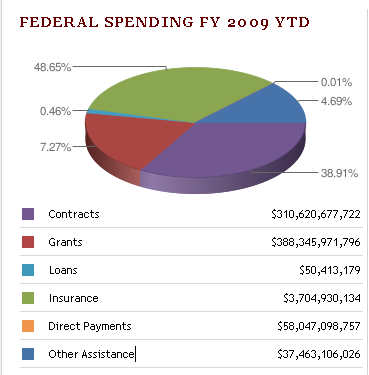
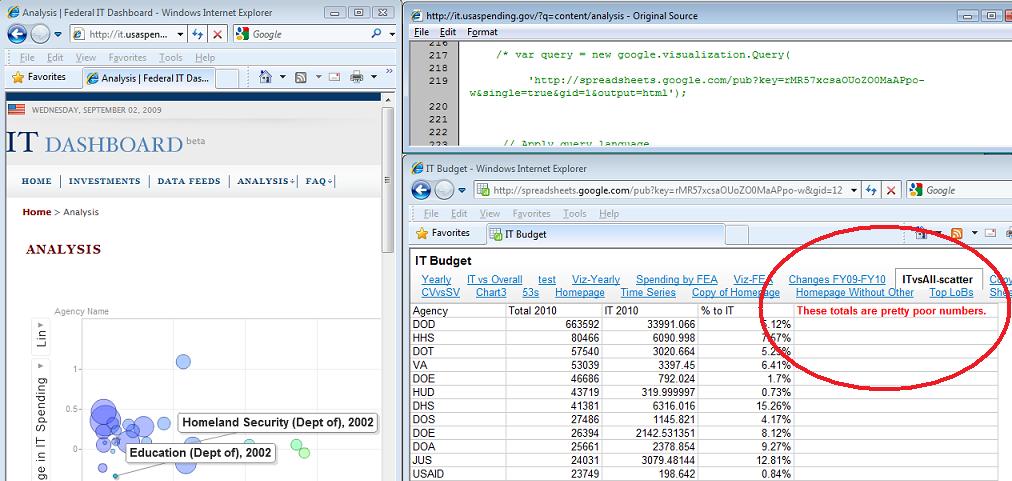
theodp writes "Over at Intelligent Enterprise, Seth Grimes declares the Federal Government's USAspending.gov website a travesty, calling it 'almost a parody of a government-transparency site.' Among the faults cited by Grimes is a botched 'Federal Spending FY 2009 YTD' pie chart that graced USAspending.gov's home page. Not only were the sizes of pie segments not in proportion to the percentage labels (due to a Google Chart API error), the colors in the pie chart didn't even match the colors and values in the table immediately below the chart. Lucky for the Feds, Grimes didn't get a chance to look behind the curtain at the Federal IT Dashboard, where they forgot to remove a (commented) reference to a Google spreadsheet that states 'These totals are pretty poor numbers' (Google workbook). Oops!"
Read the blog article, and I think that a better title for this slashdot article would be "minor design failure."
I agree. When I first read the title, "Serious" jumped out at me (possibly with the assistance of being the first word), and luckily for me I actually RTFA'd. Speaking for myself and more than likely any one who's done any web programming, a minor mistake of data passing being in the incorrect format for the Google APIs to digest is much much less than a "serious" design failure. In fact, its not a design failure at all. Its a code error, and luckily (or possibly unluckily) for the guys at USAspending.gov, Google's APIs don't just segfault out and crash the page, instead they try to parse it in a "is this what you wanted?" sort of way.
TL:DR - its not serious, its not a design failure, its a coding bug, and as TFA says its a 2-3 line fix. Not newsworthy if you ask me.
The site's pages don't even have a proper BODY or HTML close tags..
Jeez.
Eric
Eric Aitala
www.f1m.com
You mean something like this?
Microsoft Contracts
I mean come on, the search by contractors was only one click from the main page ;)
It should at least flag these errors (see Postel's Law). Maybe it does; just wanted to note that there is something between "reject" and "accept without even a warning".
a system to systematically scrape all non-hidden data on popular sites like facebook and myspace
Did you even read that link? The job it describes consists of archiving all the web content produced by the EOP (Executive Office of the President). Where does it say anything about facebook or myspace? Is it after the secret paragraphs that talk about the death panels and hiding the President's birth certificate?
How's that *any* different than now? See, what I see is people crying and whining that we shouldn't have any form of government/universal health coverage (even a 'basic' health plan, which could then be supplemented by private insurance, or if you prefer, completely opt out of the public program and buy fully private healthcare), because you make the claim that resources are finite, so therefor, someone's gonna die because the government decides it's 'not worth paying for'.
How exactly, do private health insurance companies get around the lack of infinite resources? Your statement can easily be turned around and directed at the private insurance companies: "There are not infinite resources. Some people will have their health care yanked so others will live. Surely you don't think that resources are infinite?"
It appears that, in your world, the lack of infinite resources is an insurmountable problem for a public healthcare plan, but magically, private insurance companies have infinite resources? What about all the people who are getting sick and/or dieing simply because they have no healthcare, so the only option for them is to go to the emergency room when it's already too late, and too expensive? What about the people who get screwed by the penny-pinchers at the health insurance companies who deny their legitimate claims?
Surely, a problem which universally affects both private and public healthcare plans, cannot be used as an argument against *either* of them?
Actually, my mistake, this is the correct link:
Microsoft Corporation Contracts
The initial search (linked in parent) for some reason included the "United States Government" in the search results for Microsoft as a parent company.
I work at the Sunlight Foundation, where we're pretty familiar with the people and data systems powering USASpending.gov. I've seen a lot of comments here saying that the important thing is that the government is publishing something, and that it's understandable that their first pass might not be perfect.
But this isn't their first pass. The underlying data systems -- FAADS and FPDS -- have existed since the 90s, and have been riddled with errors throughout their existence. Instead of fixing the problems, OMB continues to slap new coats of paint on the same lousy data.
It's nice that we've got a new USASpending.gov, and I agree that it would be a mistake to put too much emphasis on a buggy visualization. But the underlying data is terrible, and so far no one is showing the will to fix it. Just look at USASpending's "data quality" tab -- it talks about the completeness of each row. Well, that's great, but it tells you nothing about the thousands upon thousands of missing rows, nor about the rows that massively under- or over-report their dollar amounts.
At Subsidyscope, the project on which I work, we've delved into these problems in more depth. Those who'd like to learn more about the shortcomings of the data systems powering USASpending can find a discussion of the relevant issues here.
Like this? http://www.usaspending.gov/fpds/tables.php?tabtype=t2&subtype=t&year=2009 Or any of the other easily available charts on the site...
What healthcare lies are you referring to? Perhaps the lies spread by the Republicans? You can hardly blame the administration for those.
When it is a problem in the private industry, people stop investing and/or the company goes bankrupt. It took government to bail them out and basically support the rewarding of bad performance. Meanwhile, government can print money and increase taxes without any kind of "check" in the marketplace.