 Slashdot Mirror
The Languages of "The Office"
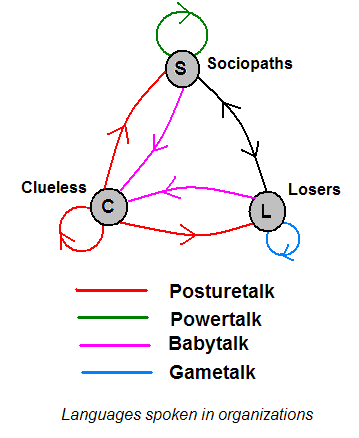
Venkat Rao has followed up his analysis of office dynamics as reflected in The Office, which we discussed last month, with one titled Posturetalk, Powertalk, Babytalk and Gametalk. The Office is running a little thin of meaty examples to make his points in delineating the ways of PowerTalk — the language of the Sociopaths — so Rao reaches out to Goodfellas, Wall Street, The Boiler Room, and Making Jack Falcone. The entire analysis illuminates and is illuminated by a diagram of the disparate languages that Sociopaths, the Clueless, and Losers speak to each other and among themselves.
Didn't read TFA - just skimmed it a bit, but let me get this straight, some guy has analysized a bunch of fake conversations (that were created by the various shows' writers) in order to produce an explanation of real world office dynamics?
Do I have that right?
I am Slashdot. Are you Slashdot as well?
There's certainly layers of nuance and meaning that can get heaped onto human communication. As an aspie geek, it's very easy for me to get what was literally said and completely blow past the subtext. "What's wrong?" "Nothing." "Ok! I'll be on my way." Nooo, that's the nothing that means there's something and I'm supposed to fish.
However, the author really starts heaping on the layers of meaning in his examples. It reminds me of the conference scenes from Dune where whole conversations are intuited from the lifting of an eyebrow. "I knew it, he knew it, he knew I knew he knew it, but he didn't realize I knew he knew I knew he knew it. The twitching of my pinkie finger drew his attention away from my own eyebrow thus concealing my knowledge." Puts me in mind of great bits of comedy where sophisticated and devious characters are speaking obliquely around a topic of great significance, doing so in such a way that they soon realize they're not entirely sure if they're both having the same conversation.
Kwisatz Haderach
Sell the spice to CHOAM
This Mahdi took Shaddam's Throne
that these stereotypes of behavior are aspects of everyone's personality, including yours
i would have hoped that people would have realized thinking about the world in this cliquish way went out of fashion in high school. simply because you realized in high school (or should have realized) that people aren't cartoonish cardboard cut-outs of one dimensional behavior
show me someone who is supposedly dead center for being, say, the "sociopath", and i'll show you their empathetic qualities. now also show me someone who is supposedly far removed from being the "sociopath" and i'll show you the sociopathic side to their personality
it makes for good television, but real people are a lot more complex than this derivative reductionist thinking that sells people short. its entertaining, but in real life, its brutalizing to your social interaction
thinking about people this way only hurts you, in the end, by hobbling you with a poor model of human thinking and interaction. such that you reduce the richness of your own social experience up front before you even have a chance, because your mentality has overly simplified the people around you. you sell them short, and in turn, you only wind up selling yourself short
in other words, you've become the source of the problem: i would call a person who uses these stereotypes as a way of thinking about people around them the only truly one-dimensional stereotype that has a ring of truth: "the feckless tool"
intellectual property law is philosophically incoherent. it is your moral duty to ignore it or sabotage it
Look, I don't really care which one is better, but one is certainly more relevant. And that's the one that is currently on the air and has produced seven times more episodes.
This article is about the sociological maladjustment of screenwriters.
It has nothing to do with real dynamics, or actual language used by anybody.
"Speaking the Truth in times of universal deceit is a revolutionary act." -- George Orwell
Shhhhh..... Big Brother Balmer does not like to hear things like that! *sigh* I guess we'll have to do another ritual sacrificial to set things right again.
GET THE NEW INTERN READY GUYS!
I love random hex numbers! Just like this one, 09f911029d74e35bd84156c5635688c0.
And it's "TPS Report"
Just an FYI
I love random hex numbers! Just like this one, 09f911029d74e35bd84156c5635688c0.
The Office and other Workplace fiction are written by people who have never worked in a real world workplace, or if they have it was merely as a stopping point for them.
Thus they don't know a thing about it...but...they're creating an entertaining fiction. To acurately reproduce workplace interaction would be very boring TV. So they're doing what they need to do...but there's no reason to try and interpret that dialogue as if it were real.
Just because there's a lot of crap, doesn't make it good.
The article seems to be inaccessible, so here's a link to the Google Cache (text-only version)
My response to what people have said here so far (and I haven't read any of the article yet) is that this is not social theory, it's business theory. It's not supposed to define how you relate to people or how you perceive them. It's intended as an analysis of business dynamics, which is to say it's about how workers in different positions respond to their position and the position of those around them. From what I remember about the earlier article, I would say that even just among the "Losers," their goal is to focus energy into other parts of their lives, parts that have nothing to do with business or their job. When the characters leave the office, this entire analysis falls apart, and this does not invalidate the analysis because it's not intended to reflect each person's entire life.
I sometimes ask revealing, often ignorant-seeming questions. Maybe they're harder to answer than you think.
Somebody who is all three is either schizophrenic or has multiple personality disorder- in which case they'd speak the language that best fits their current personality in that relationship.
I say this because the clueless stereotype and the sociopath stereotype in the description are mutually exclusive; the first is honorable and goes beyond the call of duty without motivation or recompense, the second you can't get out of bed without offering a six digit salary.
The losers are the people somewhere in the middle.
SJW: a person who perceives an injustice, and while correcting it, commits a greater injustice.
Wow, nice subtle dig at the military there... if that's what you were going for... Personally I'm proud to have served those 5 years, and I'm going to college full time for free... in fact I actually make a little bit of money off the GI Bill
Here's to the crazy ones
I have two words for you: "Dr. Who"
My blog. Good stuff (when I remember to update it). Read it.
The "old, dirty and cheap" effect is actually a fairly accurate representation of what it looks / feels like to live and work in Slough, where the UK version of the office is based.
Not meant to be a dig at the military- if anything, I have great respect for those willing to go above and beyond the "bare necessity" that I do.
In fact, I'd say that the country *owes* a full retirement to anybody who has ever been in combat- that "little bit of money off the GI Bill" is an example of the sociopaths politicians disrespecting the value of your service. The reason this stereotype calls you clueless is because you don't realize just how little they gave you in return for you risking your life.
But they're definitely an example of the "clueless"- because that's what the clueless do; risk their lives in return for a "little bit of money off the GI Bill".
SJW: a person who perceives an injustice, and while correcting it, commits a greater injustice.
Sociopaths (that is, people with a brand of Antisocial Personality Disorder that have a pathological failure at true interaction with society) is probably not the correct term for the people at the top. What these people actually have is more likely Narcissistic Personality Disorder.
Let's translate the diagram into a logical statement:
if you're not a sociopath, you are either clueless or a loser
I don't think the author fully understands what a sociopath is.
"Only a schmuck works for somebody else."
Enlisting for these reasons (patriotism and service to your country, honor, tradition and personal development) are what mark the clueless. Losers know they will get material benefits and dispense with the patriotism -- they are willing to make the (questionable) trade-off of risking their own lives for tuition and health care. Sociopaths benefit from "most normal people" who you say "know" to equate military service with patriotism.
Semi-related questions and comments: Why are other forms of service and sacrifice not considered patriotic? Like, Americorps or Peace Corps or volunteering within the community? Surely these may offer a better trade-off for the clueless than being a target in a foreign country?
Tradition and personal development can be achieved and maintained non-militarily as well. Why admire someone who buys into the military's brands of tradition and personal development, which are clearly marketed to the clueless? "The Few. The Proud. The Marines." cleverly manages to leave out that enlistees will be expendable grunts and used as such.
Congratulations, AC, you just outed yourself as clueless