 Slashdot Mirror
The Languages of "The Office"
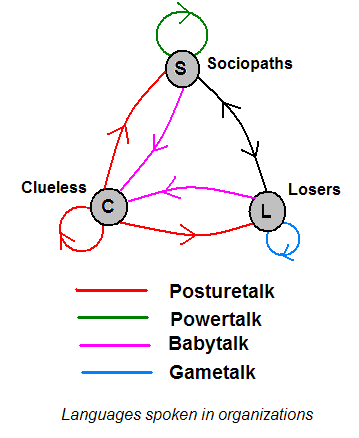
Venkat Rao has followed up his analysis of office dynamics as reflected in The Office, which we discussed last month, with one titled Posturetalk, Powertalk, Babytalk and Gametalk. The Office is running a little thin of meaty examples to make his points in delineating the ways of PowerTalk — the language of the Sociopaths — so Rao reaches out to Goodfellas, Wall Street, The Boiler Room, and Making Jack Falcone. The entire analysis illuminates and is illuminated by a diagram of the disparate languages that Sociopaths, the Clueless, and Losers speak to each other and among themselves.
Didn't read TFA - just skimmed it a bit, but let me get this straight, some guy has analysized a bunch of fake conversations (that were created by the various shows' writers) in order to produce an explanation of real world office dynamics?
Do I have that right?
I am Slashdot. Are you Slashdot as well?
There's certainly layers of nuance and meaning that can get heaped onto human communication. As an aspie geek, it's very easy for me to get what was literally said and completely blow past the subtext. "What's wrong?" "Nothing." "Ok! I'll be on my way." Nooo, that's the nothing that means there's something and I'm supposed to fish.
However, the author really starts heaping on the layers of meaning in his examples. It reminds me of the conference scenes from Dune where whole conversations are intuited from the lifting of an eyebrow. "I knew it, he knew it, he knew I knew he knew it, but he didn't realize I knew he knew I knew he knew it. The twitching of my pinkie finger drew his attention away from my own eyebrow thus concealing my knowledge." Puts me in mind of great bits of comedy where sophisticated and devious characters are speaking obliquely around a topic of great significance, doing so in such a way that they soon realize they're not entirely sure if they're both having the same conversation.
Kwisatz Haderach
Sell the spice to CHOAM
This Mahdi took Shaddam's Throne
that these stereotypes of behavior are aspects of everyone's personality, including yours
i would have hoped that people would have realized thinking about the world in this cliquish way went out of fashion in high school. simply because you realized in high school (or should have realized) that people aren't cartoonish cardboard cut-outs of one dimensional behavior
show me someone who is supposedly dead center for being, say, the "sociopath", and i'll show you their empathetic qualities. now also show me someone who is supposedly far removed from being the "sociopath" and i'll show you the sociopathic side to their personality
it makes for good television, but real people are a lot more complex than this derivative reductionist thinking that sells people short. its entertaining, but in real life, its brutalizing to your social interaction
thinking about people this way only hurts you, in the end, by hobbling you with a poor model of human thinking and interaction. such that you reduce the richness of your own social experience up front before you even have a chance, because your mentality has overly simplified the people around you. you sell them short, and in turn, you only wind up selling yourself short
in other words, you've become the source of the problem: i would call a person who uses these stereotypes as a way of thinking about people around them the only truly one-dimensional stereotype that has a ring of truth: "the feckless tool"
intellectual property law is philosophically incoherent. it is your moral duty to ignore it or sabotage it
This article is about the sociological maladjustment of screenwriters.
It has nothing to do with real dynamics, or actual language used by anybody.
"Speaking the Truth in times of universal deceit is a revolutionary act." -- George Orwell
I have two words for you: "Dr. Who"
My blog. Good stuff (when I remember to update it). Read it.