 Slashdot Mirror
Introducing L2Ork, World's First Linux Laptop Orchestra
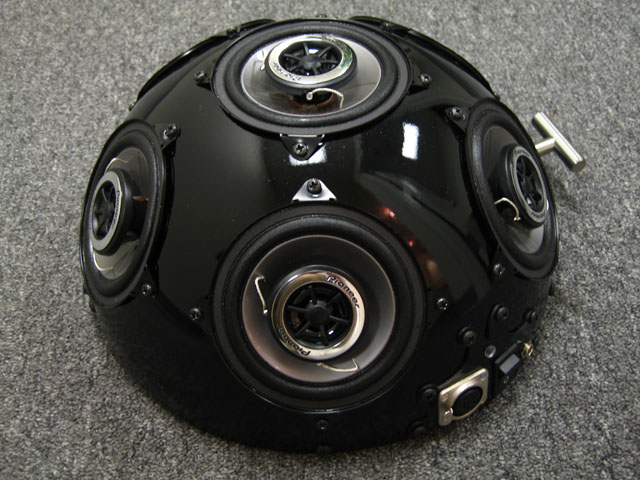
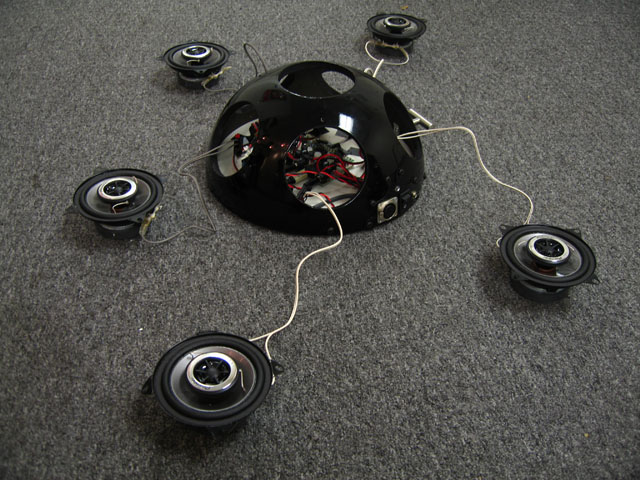
Agram writes "Take a netbook, Wiimotes, Nunchuks, and hemispherical speakers (which were once IKEA salad bowls), toss it up with some Ubuntu goodness and what you get is Virginia Tech's L2Ork, the world's first Linux-based laptop orchestra. With its affordable design and support from the Linux community, L2Ork hopes to bring laptop orchestras to K-12 education and beyond. So, regardless whether you wish to hear how L2Ork might sound or to learn how to build your own Linux-based *Ork infrastructure, perhaps this is a good opportunity to reopen the age-old debate: is Linux finally ready for some serious audio work?"
Unfortunately companies that make good DACs, like MOTU, don't provide Linux drivers. It's no good to try and work on a Linux box if you're limited to the built in stereo 1/8" soundcard.
So while it can work for small hemi-speakers, trying to drive a full surround setup is near impossible without good proper DACs.
I still can't figure out exactly what this does. I've even looked up SLOrk and PLOrk, and I don't have any idea what they do, either. Is it a sort of MIDI-esque endeavour? Some kind of networking for digital instruments? Something entirely different?
Screw the rules, I have green hair!
Windows has had a stranglehold on laptop orchestras for such a long time that it's really good to be reading about the world's first Linux Laptop Orchestra.
I have a laptop orchestra that I play regularly too, but I sure as heck wouldn't do so in front of a K-12 classroom...
Based on the headline (and reading it a bit too fast) I was expecting some sort of cool Linux Zork tie-in. I think I'll go find a grue now... It's almost dark enough in my office for one.
Damn_registrars has no butt-hole. Damn_registrars has no use for a butt-hole.
doing audio work I got unstuck immediately. Really bad delays on my midi keyboard. I googled and was told I needed a low latency kernel or something. This was of course wrong. Linux needs a low latency kernel so that it can be taken seriously out of the box. Why would you want, by default, a high latency kernel? Also, I needed to stick together several apps, to turn midi input into something I could hear. I don't understand why. Why can't there be an app which takes midi input and plays sounds (from a sound font file, wav file, etc) when it gets them?
How are they choosing notes, keys and other aspects of music? This looks a lot like a very complicated version of the historical crank organ.
It's an interesting idea and may have beneficial applications for entertainment, music therapy or childhood education, but I don't see much potential for any real [read artistic] musical applications. Excepting, possibly, interactive performance art or something.
The richness of a real symphony orchestra's sound is tied to the complexity and expertise of about a hundred different musicians at levels of superb mastery working together as individuals to recreate and interpret a composer's vision. I don't see how it would be possible to do anything different from the already tired new-agey synthesizer muzak with a tool like this. Of course I feel similarly about replacing the big band with an electric guitar.
And I thought Wii Music stank ... this is actually worse.
It was a relief to see it end. What are they trying to do - encourage a run on Excedrin?
I'd hate to think how much more enhanced^Wworse it would have been if they had the MotionPlus.
The scene is quite odd, but the result is hypnotic - and *way* more musical than most things infecting the Billboard these days! Where do we get the album? Will they tour?
Help feed homeless animals - Free! www.theanimalrescuesite.com
Ok, if we want electronic musical instruments, wouldn't getting schools one or two Theremins be a lot cheaper and more reliable?
I'm sure lots of schools are already struggling to fund basic music programs, and get kids 'ordinary' instruments (although, I suppose it's quite possible these Laptop Virtual instruments may be cheaper than some analog instruments). Do we really need to be complicating things and making them more expensive, and for what benefit? If the goal is to educate kids about music, I don't think you need some gee-whiz laptop-and-wiimote based 'virtual instruments' to introduce more points of failure? Aren't broken reeds and strings enough for kids to worry about?
Now get off my lawn. *grin* (Seriously, I hate to be a cranky old geezer - I mean, I'm only 31, but even after scanning the article, I'm not really sure I see any advantage to this)?
Ill be there and i think the after party is at Connor's
While I'm not into Laptop Orchestra's, I do use Ubuntu Studio now for MOST of my audio processing.
Only 4 years ago, I couldn't make it work. I use a Presonus Firepod to record my band, and also have some other gadgets. The only thing I am really missing is something like Gearbox for my Line 6 PodXT, there just isn't a substitute yet for Linux. No worries though, I pretty much have my board setup the way I want, so rarely even use Gearbox anymore.
Anyway, back to my point. I now use Linux as my DAW, as a sequencer, and increasing for my general computing needs. I love Jackd with Ardour and Patchage. It's gotten to the point where it's not just a suitable replacement for Cubase or Pro-Tools, but is my preferred setup. Now that my ATI drivers are finally working properly with the RT kernel in Ubuntu 9.10, I am finding the cube desktop actually useful instead of just eye candy. I can have my mixers, editors, patchage, etc. on separate workspaces and get to them easily.
Just a month ago, I had a friend of mine come over to check out my setup. He is a drummer that also wanted to start home recordings. He bought a ART Tubefire 8, and was very disappointed with the crippled Cubase LE that came with the hardware. After seeing my setup, he went out, bought a $300 computer and a firewire card and asked me to get him setup. Knowing nothing about Linux, or Ubuntu, etc, he is now using the setup to great success.. If there was ever a killer app for Linux, this is it, at least for music professionals and hobbyists.
The major drawback is hardware support still has a ways to go. But, right now there is the ability to get high end music recording equipment working very well right out of the box. I am a very satisfied "customer". And to think, 4 years ago I never thought it would get there.
Hope they're not hoping to sell many tickets for performances just yet.
29 mpg. YMMV.
I have a laptop orchestra. Any floutists wanna play?
In a cool or scary development, depending on how you want to look at it, computers can do an amazing job of replicating symphonies and other musical groups. Powerful CPUs, lots of RAM and big harddrives mean it is feasible to extensively sample instruments and then have a computer make music using it. Go have a look around EastWest's site and you can see all the various kinds of instruments and groups they've got sample sets for. For orchestra's it is their Symphonic Orchestra product (http://www.soundsonline.com/product.php?productid=EW-177). Listen to some of the demos, it is impressive stuff.
While this L2Ork does look like a silly toy, that doesn't mean computer based music is primitive. It has gotten exceedingly good in recent years. You toss a few hundred gigs of samples at the problem with a good engine, turns out you can give a composer a tool that sounds very real.
Why do people always ask if the OS is ready for audio/video/futuristichyper3dmedia work? Of course the OS is: its job is to provide interfaces for hardware drivers and schedule processes to run, some of which might just be audio/video/you-get-it application programs. Ever since Windows, the original Mac OS, and a few others started bundling all of these apps into the OS distribution, people have confused operating systems with the toys they're shipped with. Of course, I'm old and cranky and mainframe based where we automatically delineate apps from OS functions - but I'd still like to see discourse about such things be a little more precise.
So far Linux does have musical capabilities but not enough and not easy enough either.
For example converting a treble clef trumpet part to a bass clef trombone part should be a no brainer and printing it out should be a breeze as well. Further converting a melody played through the system into a score should also be simple.
Having to use different programs to print a score, convert a score and play a score will not attract many musicians.
So far one of the very, very few excuses for running Windows is the production of music by musicians. Online DJs may fare better as they may alter music but do not usually create it.
Huh? Change the gain of what? Why?
Is a firetruck responsible for maintaining proper water pressure at the fire hydrant it is hooked up to? No. That's not its job.
It's a DAW, not a preamp. If you have to change the "gain" of something in Ardour, you're already doing it wrong. If it could... all it'd be doing is allowing you to continue to do it wrong.
If you are feeding it a weak signal, fix the damn signal.
If you are feeding it an overly strong signal, fix the damn signal.
"Fix the damn signal" means adjust your outboard equipment (preamp, mixer, noise generator, or whatever) and/or your soundcard's mixer to get a proper signal happening to begin with. Don't feed your DAW a crappy signal, unless you WANT to record a crappy signal. Get it right as early in the chain as possible, because once you are in the DAW, it's too late. You're already past the AD conversion... any gain is nothing more than a little math to make it louder, which can be done at any time. It'll never make it "better".
If it is too late fix the signal, and you are dealing with pre-recorded audio that is too weak (or outboard equipment that isn't up to snuff), fix it right (permanently) with an audio editor. That way you aren't wasting CPU doing that same digital math over and over again every time you hit play.
And if you absolutely, positively can't do it the right way, and insist on changing your gain in the DAW itself... yes, you can do it with a plugin. (Not exactly hard to find... I found no less than three already installed, and I've never installed any but the most common/basic plugin packages. And that's on a plain vanilla Ubuntu machine, not a studio machine with lots of goodies on it.) In the end, doing this with a plugin is no different than having it built in. It is better, because it gets it off the damn screen for most people, who will not and should not need it 99% of the time.
Sounds like a lack of either minimal effort or minimal understanding of recording in general. Go get a Mac and use Garageband. It was made for you.
(And hey, I'm not knocking it. I do have a Macbook, and have used GB for sketching around with. It's not bad. Inability to export midi is probably the only really major drawback.)
If you wanna knock Ardour, say something like "it lacks MIDI functionality found in most other DAWs", which would be true. Until v3 comes out, at least.
Because it sure ain't no orchestra. That's be a collection of musical instruments. This is a collection of pseudo-random musical background sound generators. Music is replicable, hence "songs". This is self-similar. Any collection of sounds can be called music, but the brain decides if it sounds like 'real' music when a power curve representing the output of all notes/sounds fits a particular dimensionality; details are in Mandelbrot's first fractals picture book. If these can be tweaked to produce that, I'd agree it could play a piece of music. But I wouldn't cop to the more generic "music" unless they can be used in such a way that any number of unique pieces of music are created. If there's to be a debate, let's have it over the above details, not over the mistaken idea that it's the OS, rather than music apps, that make a machine music capable. Linux was music capable when the first audio CD driver allowed a CD to be played through a sound card and speakers. Other ways are possible but this one channel was sufficient for prerecorded song playback, so it was certainly good enough for a simulated instrument's output.
"I may be synthetic, but I'm not stupid." -- Bishop 341-B
I have moved to GNU/Linux two and a half months ago. I wanted to move before but as a musician I did not want to give up music and what I saw on GNU systems was very weak and simply did not allow me to do anything. I have to point out that I am not an orchestra man, I am an electronic musician. So I don't care for much recording (although I do for some), I care more for effects, synthesizers and sequencers. What can I say? Apart from a long learning curve (which is okay, actually, I don't mind learning something if I know it will get me somewhere) the biggest problem are the plugins. the sequencers and all that general stuff is more or less usable, Ardour is cool as a multitrack editor and recorder, LMMS is already in a pretty good state as an intergrated DAW. Apps for live performance are basically killer apps. JACK itself, ardour, kluppe, sooperlooper, being able to route that stuff, JACK Rack - all of that is great. But... But the lack of good plugins and software synthesizers is a blocker for studio work. In electronic music sound manipulation is the core of what you are doing. On PC and on Mac you have VST and AU plugins, and loads of them - effects and synthesizers alike. There are literally hundreds of high quality stuff. On GNU/Linux, unfortunately, there are only LADSPA effects, which have ugly GUIs and most importantly are mostly very basic effects, in many cases buggy and not so well sounding. There is literally not one really good reverb. There are a couple of good reverbs for voice, but they are very specific. Apart from CALF pack, most of the LADSPA plugins are almost useless. They either don't work or offer you twenty parameters which you have to tweak to get some basic delay. Absolutely no presets makes it difficult for non-engineers to get some simple stuff done. But the effects, while very important, is not the biggest problem. After all, I can eventually create my own presets and there are also LV2 which have potential (although I found no way to actually check any of those as I simply do not know how to install them and how to plug them in), but there are almost NO SOFTWARE SYNTHESIZERS. Apart from a ZynAddSubFx, which from a point of view of a Linux user is a genius product, while to a Windows user is just a normal VSTi plugin you would find dozens of in the VST world. Yeah, it may be closer to stuff like Sytrus, since it is potentially a great synthesizer and you can do lots of cool synth work, but honestly - I've seen many-many synths like that and the fact the GNU system has just one is really a good way to highlight the problem. Eventually, having observed that the switch to GNU/Linux basically stopped my music production, I decided to install FL Studio, a proprietary app, through WINE and have to use it for its plugins. As soon as LV2 plugins become better and there will be much more of them, I would say that GNU/Linux has finished its transition to being a good OS for audio work.
Do you have any document about how your set up is?
Do you have any sources of information for somebody that would be trying to start producing music with Linux?
Any tutorials you know about?
IANAL but write like a drunk one.
tickled and laughing.