Slashdot Mirror


Yes, Google Does De-List Pages; But When?

Frequent Slashdot contributor Bennett Haselton writes "Google finds itself inserting a disclaimer once again above some offensive search results. But the disclaimer still leads many to believe (incorrectly) that Google doesn't tamper with search results even in cases of 'harmful' or 'offensive' material. We know that Google has in fact de-listed some pages at the request of offended parties. What is their real policy on the issue?" Read on for Bennet's essay.

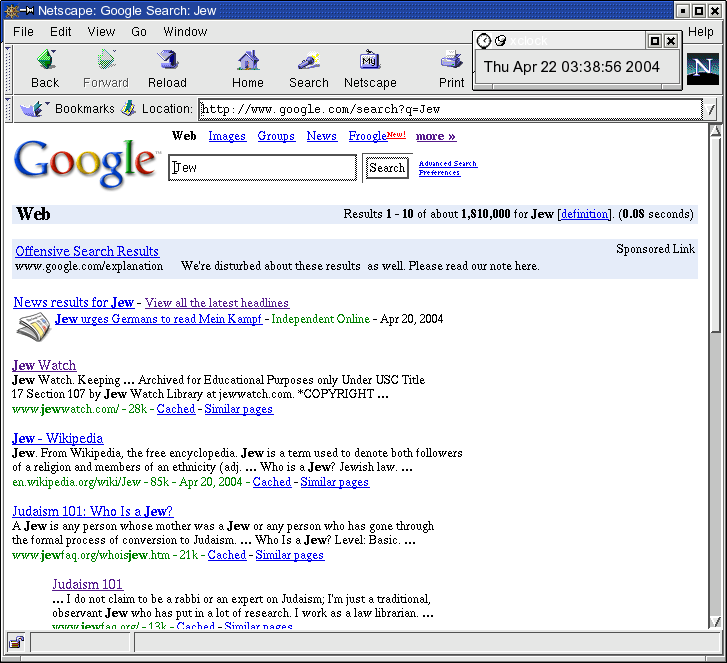
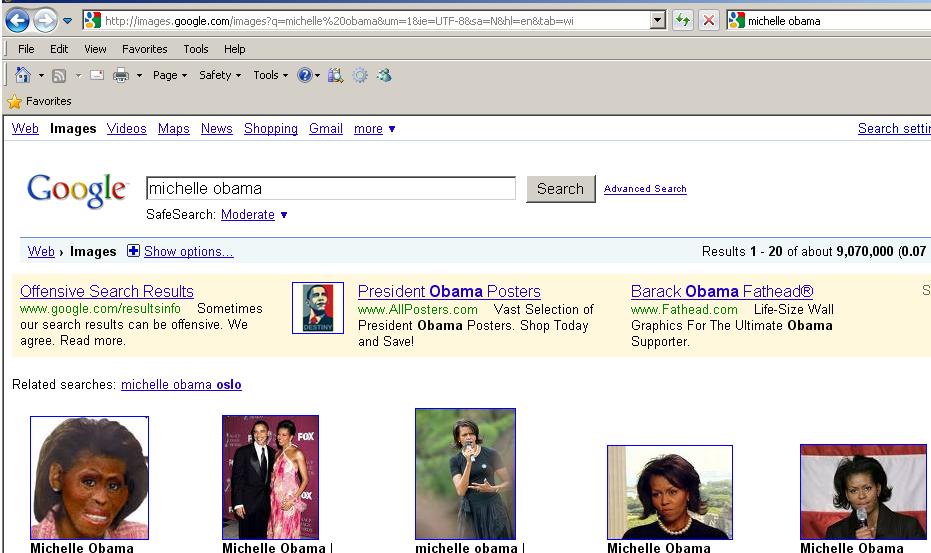
In 2004, when Google users discovered that the top search result for the word "Jew" was the anti-semitic site Jew Watch, Google ran a disclaimer in the space usually reserved for ads, explaining that their results only reflected the reality of link counts on the Web, and that they did not endorse any Web sites which appeared at the top of their listings. Now the disclaimer has been dusted off again, as the top result on Google Images for "Michelle Obama" is a picture of a monkey's face with Michelle's hairdo. (Ironically, it looks as if the original image would have fallen out of the rankings, if it hadn't been for a follow-up blog post about the controversy, which itself now comes up as the first result.)
I first heard about the controversy from Dennis Prager's column in which he takes a New York Times columnist to task, because the columnist complained about "racially offensive images of the first couple" that come up in Google searches. Prager was unable to find any examples from Googling "first couple" or "Michelle and Barack Obama pictures," so he concluded that the NYT columnist "wildly exaggerated, if not made up" his claims. I tried Google Image searches for "first couple," "Barack Obama," and some other terms, and I couldn't find anything controversial either. However, it only took 10 seconds to enter "first couple google images controversy" on the regular Google Web search and find multiple blog posts explaining what all the fuss was about. Back to Google 101 for Dennis.

Many of the blog posts refer to Google's disclaimer about not tampering with search results. Those on one side are urging Google to make an exception and "fix" the results, while others sagely observe that Google just reflects reality, it doesn't create it.

All of this punditry is starting from a premise that's wrong. Google has actually removed pages from their search results — not because the pages were illegal or because the webmasters were search engine spamming, but because of the page's "offensive" content. In the "Chester's Guide" incident, a councilman in Chester, England discovered that one of the search results for "chester guide" was a satirical page titled "Chester's guide to picking up little girls." Although the page itself was obviously just someone's idea of sick humor, a Chester city councilman (who admitted that he hadn't looked at the page, saying that the title told him everything he needed to know) urged Google to remove the page from their index. Google at first refused, but later manually blacklisted the page to prevent it from appearing in their search results.

Whether or not you think this was the right decision, probably depends on what you think is the purpose of Google. If Google's purpose is to return the most useful results, then it made sense to remove the link, as Danny Sullivan of Search Engine Watch argued at the time, since it almost certainly was not a useful result for people searching for "Chester Guide." On the other hand, if the primary purpose of Google is to reflect the reality of what pages on the Web feature certain words most prominently (combined with all the other factors that Google weighs, of course), then the results shouldn't be altered.

But more people should at least realize that it happened. The Google disclaimer doesn't precisely say that they never blacklist pages or modify search results ("Google reserves the right to address such requests individually"), but it seems to give most people the impression that that's the case. According to that crudest of Googling techniques for which novice searchers are so frequently lampooned, there appear to be about 400 times as many stories on the Web about the Google "Jew Watch" controversy (where Google stood their ground) as there are stores about the "Chester's Guide" incident (where Google caved).

And Google-number-three Matt Cutts posted on his blog back in March explaining why Google does not remove "offensive" pages from search results; over a hundred comments followed, debating the pros and cons of the position, but none of them mentioned the Chester incident or any other case where Google actually had removed pages except as a result of a court order. One isolated comment from "Anonymous" said:

This is not quite true. I know of at least one web site that was de-listed for containing illegal content and/or promoting illegal activity.

which may or may not have been a reference to the Chester Guide incident. And that was it.

Is this a lot of hay to be making over something that happened years ago? Well, for one thing, I doubt if it happened just once. Consider that the Chester Guide incident involved a public declaration of outrage by a city council, and a public statement from Google, and still hardly anyone knows that it ever happened. If other incidents occurred without those high-profile elements, it would be even harder to discover them now. We'll probably never know how many such incidents took place, unless someone sues Google (maybe the owner of a blacklisted website, or maybe the victim of a RipOffReport hatchet job wondering why that site hadn't been blacklisted long ago), subpoenas Google for a list of cases where pages were de-indexed, and publishes the list if it's not sealed by a court order.

But whether it was one time or a handful, consider that political candidates like Arnold Schwarzenegger and Al Franken got asked during their campaigns about things they did 20 years earlier, and it's fair to ask a candidate about their past, because it's the same person standing in front of you now. Why did you do that? Have you stopped? Why?

And in the big scheme of things, Google is probably more powerful than a single US senator or the governor of California. So, can't we ask? What are their real rules about page removal? Have those rules changed since the Chester's Guide controversy? Can they even tell us what their rules are, or do they consider it a trade secret?

It is well known, of course, that Google censors some results in their search engines branded for different markets like China and even in liberal democracies like Germany. But nobody would call that a slippery slope towards censorship in the US version of Google, because the censorship in the Chinese and German versions is done at the behest of the governments there. On the other hand, Google does admit that they will de-index pages which include credit card numbers or social security numbers (which are all too easy to find on the Web). This might not seem like a controversial position, but even this act of voluntary self-censorship may be dipping their toe in the water further than it seems. Most people do consider their credit card information more private than their home address. But surely there are people like J.D. Salinger who less about the privacy of their credit card number (which is easily changeable) than their home address (which isn't). If someone finds Salinger's address and posts it on the Web, should Salinger be able to demand that Google de-index the page? Why should Google cater to the majority who want to keep their credit card number secret, but not to the minority who care more about keeping their address secret? Another commenter on Matt Cutts's blog post asked:

"hi. I have a question. My mom 'googled' herself and it shows some of her medical problems. She wants/needs these pages removed from search engines."

Again, why shouldn't that be considered at least as private as a credit card number?

And finally, even Google's decision to display an "offensive results" disclaimer, for some results but not for others, raises the same "Where do you draw the line?" questions as the issue of page removal. The Michelle Obama monkey picture gets a disclaimer. But search for 'george w bush' and the first row includes a photoshopped (I think!) image of Bush flipping off the press. Does that warrant a disclaimer as well? (Maybe that's considered less unfair because, even though the picture is fake, it does depict something that actually happened.) The first image result for "bristol palin" is a photo of her engaged in underage drinking — a real photo, but probably unfair to call it the single most relevant photo of her on the Web.

So while Google might consider credit cards and social security numbers and search engine spam to be on one side of a "bright line," and everything else is served up without alteration, I think the line is blurrier than that, for at least those three reasons: (a) credit cards and SSNs are less private than some other that things that Google serves up anyway; (b) Google has unambiguously removed some content that fell outside that bright line, as in the Chester's guide incident, and (c) they make other "slippery slope" judgment calls about search results all the time (as in the question of when to show the disclaimer). So I hope that Google someday comes out with a more complete answer to the question. What is their real policy on what they will remove? The Chester's guide incident — would they do that sort of thing if the same situation came up today, or have their rules changed? If they want to go really deep, then is there a general set of principles from which their rules follow — explaining why, for example, they treat credit card numbers as more private than sensitive medical information? (Google did not respond to my request for comment, either through official channels or the unofficial back channels of friends who work there.)

I hope Google gives an answer some day. Even just to say, "It's a classified internal policy and that's all we're going to tell you." But once and for all, the answer is not "Google doesn't remove content just because it's 'offensive' or 'harmful.'"

Meanwhile, a modest suggestion about the disclaimer displayed above the search results: Put it where people will actually see it, in a separate line below the ads, but above the search results. Right now the link to the disclaimer is displayed as one of three ads across the top, and people don't look at the ads. But hey, people do buy ads, so if you push the disclaimer down a bit where people will read it, you also free up space for 50% more ad revenue!
133 comments

  1. Dear Sir, by u38cg · · Score: 4, Insightful

    Am I alone in thinking that whoever Bennett is, I have no interest in his vague ramblings?

    --
    [FUCK BETA]
    1. Re:Dear Sir, by Hognoxious · · Score: 5, Funny

      Well I didn't read it, did you?

      --
      Confucius say, "Find worm in apple - bad. Find half a worm - worse."
    2. Re:Dear Sir, by clang_jangle · · Score: 4, Interesting

      Am I alone in thinking that whoever Bennett is, I have no interest in his vague ramblings?

      Certainly you are not alone. AFAICT he's a self-appointed pundit who's in love with his own rather murky ideas. No doubt it's all about the ad sense dollars.

      --
      Caveat Utilitor
    3. Re:Dear Sir, by swanzilla · · Score: 1, Flamebait

      30+ links? I don't know if his inflated self worth offends me more than his tainted view of the average /.er, or visa versa.

    4. Re:Dear Sir, by Anonymous Coward · · Score: 0

      they why did you read the article & post your inane commentary?

    5. Re:Dear Sir, by u38cg · · Score: 1

      I've read several of his punditisations in the past. The leopard does not change his spots.

      --
      [FUCK BETA]
    6. Re:Dear Sir, by Monkeedude1212 · · Score: 1

      I know, eh? 30?

      He can't even get me to click on half of one!

    7. Re:Dear Sir, by Anonymous Coward · · Score: 0

      Since when did one have to read the article to post a comment? You must be new here.

    8. Re:Dear Sir, by Anonymous Coward · · Score: 0

      yeah, I sort-of nodded off around the third paragraph.

    9. Re:Dear Sir, by Anonymous Coward · · Score: 0, Troll

      AFAICT he's a self-appointed pundit who's in love with his own rather murky ideas.

      So, he's a Slashdot user and poster.

    10. Re:Dear Sir, by Anonymous Coward · · Score: 2, Informative

      Wow a DRTFA. That's gotta be a /. first...

    11. Re:Dear Sir, by MaerD · · Score: 4, Informative

      Bennett is the founder of Peacefire.org. He's been involved in things against spammers, censorware, etc.
      And I agree, some of his rants do ramble a bit long, but they tend to make me think about something I may not have otherwise.

      For more information, try the wikipedia page on him and or Peacefire

      --
      I put on my robe and wizard hat..
    12. Re:Dear Sir, by religious+freak · · Score: 4, Insightful

      I think he had some interesting points, but it could've been summed up in a couple paragraphs.

      --
      If you can read this... 01110101 01110010 00100000 01100001 00100000 01100111 01100101 01100101 01101011
    13. Re:Dear Sir, by retchdog · · Score: 1

      "Manually altering the eigenvectors of a link matrix, is like cutting warm butter..."

      "I'll be back, Bennett!"

      --
      "They were pure niggers." – Noam Chomsky
    14. Re:Dear Sir, by Hurricane78 · · Score: 1

      who's in love with his own rather murky ideas. No doubt it's all about the ad sense dollars.

      You already said that when you said:

      AFAICT he's a self-appointed pundit

      --
      Any sufficiently advanced intelligence is indistinguishable from stupidity.
    15. Re:Dear Sir, by Sloppy · · Score: 1

      No, you're not alone, but you (plural) are missing out.

      --
      As copyright owner of this comment, I authorize everyone to defeat any technological measure which limits access to it.
    16. Re:Dear Sir, by kestasjk · · Score: 1

      Would you?

      --
      // MD_Update(&m,buf,j);
    17. Re:Dear Sir, by Anonymous Coward · · Score: 0

      Google is inconsistent in censorship and the displaying of the "on offense" ad.

    18. Re:Dear Sir, by alex_guy_CA · · Score: 1

      And whom may I ask was forcing you to read it? Over hear at my terminal, there is nobody with a gun to my head, and so I am able to choose which articles I find interesting, and which I'd rather ignore. I recommend this strategy, it saves time not only in not reading articles I don't want to read, but also in not having to make comments about how I didn't want to read the article I read.

    19. Re:Dear Sir, by kdemetter · · Score: 2, Interesting

      Personally , i don't think it's google's job to remove the page.
      It's easy enough to find to owner of the site , and ask them to remove the content.

      If the owner refuses , you can still decide to take legal action , and then it can be sorted out in court , like it should.
      The effect is that now , a third party can decide it anyway , and gets pressured to remove the content.

      Which is pointless , because people find ways around it : they only have to apply changes in such way that google show them anyway ( change the domain , the keywords , etc ...) .

    20. Re:Dear Sir, by Anonymous Coward · · Score: 0

      I think he reached the end of the article here:

      If Google's purpose is to return the most useful results, then it made sense to remove the link

      Everything after that was pointless rambling, one justified removal of a site != a change in policy.

    21. Re:Dear Sir, by citizenr · · Score: 1

      Am I alone in thinking that whoever Bennett is, I have no interest in his vague ramblings?

      Certainly you are not alone. AFAICT he's a self-appointed pundit who's in love with his own rather murky ideas. No doubt it's all about the ad sense dollars.

      I read that he likes to pick up little girls, but Google blacklisted that information.

      --
      Who logs in to gdm? Not I, said the duck.
    22. Re:Dear Sir, by LrdDimwit · · Score: 0

      Did he just say Google is more powerful than the Governor of Califoria? The Governor of California can call up the national guard. I admit I haven't checked recently, but I don't recall there being a "click here to deploy National Guard troops to this address" button on Google Maps.

    23. Re:Dear Sir, by Anonymous Coward · · Score: 0

      Actually so could most things. An observation made famous by Mark Twain when he wrote "I didn't have time to write a short letter, so I've written a long one instead." And even before that, there was Blaise Pascal in his Lettres Provinciales (1656-1657), no. 16, in which he wrote "Je n'ai fait celle-ci plus longue parceque je n'ai pas eu le loisir de la faire plus courte," or "I have made this letter longer than usual, because I lack the time to make it short."

      So maybe he just has a day job, a family, friends, and/or a hobby.

    24. Re:Dear Sir, by Lemming+Mark · · Score: 1

      Dunno who he is but I didn't think the essay was overly vague or rambling. Certainly I found it more interesting than most of the articles I see on Slashdot these days...

    25. Re:Dear Sir, by Anonymous Coward · · Score: 0

      A couple OF paragraphs.

      You wouldn't ask for "a glass water", would you?

    26. Re:Dear Sir, by Ash+Vince · · Score: 1

      Am I alone in thinking that whoever Bennett is, I have no interest in his vague ramblings?

      It does not matter if you are alone in having no interest in read this, what matters is if I am alone in finding it interesting reading. Nothing can appeal to everyone the best you can hope for is to appeal to some, maybe even a majority but not necessarily.

      Most people are able to simply read what interests them and ignore what doesn't, why cant you? Must every article on slashdot go through your own personal approval?

      --
      I dont read /. to RTFA, I read /. to offend people in ignorance.
    27. Re:Dear Sir, by Anonymous Coward · · Score: 0

      Is English not your first language? Your attempted comparison doesn't even include the same parts of speech. I would indeed ask for a "couple waters" or a "couple glasses of water" because that makes sense.

  2. Then make users vote for content by Bragador · · Score: 2, Interesting

    If each IP adress can give a mark to each web page based on if they think the result is relevant and useful enough, then that should filter the "problems". On the other side... bye bye anonymity!

    1. Re:Then make users vote for content by H0p313ss · · Score: 1

      If each IP adress can give a mark to each web page based on if they think the result is relevant and useful enough, then that should filter the "problems". On the other side... bye bye anonymity!

      What could possibly go wrong?

      --
      XML is a known as a key material required to create SMD: Software of Mass Destruction
    2. Re:Then make users vote for content by Anonymous Coward · · Score: 0

      0mg HaX

    3. Re:Then make users vote for content by Bragador · · Score: 2, Interesting

      Many things, but Slashdot, Ddiggs and the like seem to be doing pretty well, no?

    4. Re:Then make users vote for content by gedrin · · Score: 1

      Now, I had mod points, and considered using them to show a point, but it seemed in apropriate. I'm not sure if my pesonal restraint disproves the point. Still, I think without the ability to restrain a user's modding ability (like M2) you could get swarm modding on sites directed by interest groups. I think it probably has all the issues that /. modding has, but far too many users to implement an M2. Additionally, there's the possibility of owners of large numbers of IP's simply using their block vote to overwhelm the system.

      --
      Moderation : -1 Conservative Viewpoint
    5. Re:Then make users vote for content by Bragador · · Score: 1

      Would that really be bad? At first glance, yes. On the other hand, if Microsoft has tons of IP adresses compared to "Microsoft Sucks", then the first link would be the official website. Not a bad deal uh?

      Also, the search results would be based on links first and foremost, but with a rating you could get a better idea of what to select. I'm using http://www.ixquick.com/ and the first results are rated based on how many other search engines have these results in their top 10. Ratings can help and those by users could be useful. Or add the ratings to the search results without affecting the order in which they are listed?

    6. Re:Then make users vote for content by Magic5Ball · · Score: 1

      Logged in users already have this option for their own search results. It's unclear how personal choices affect search results for everyone else.

      --
      There are 1.1... kinds of people.
    7. Re:Then make users vote for content by H0p313ss · · Score: 1

      Many things, but Slashdot, Ddiggs and the like seem to be doing pretty well, no?

      Slashdot is not (very) politically sensitive. As soon as you have content that is and a mechanism that can be manipulated by individuals you will find you have attracted the attention of people like the government of China and their masses of individuals that they PAY to astroturf.

      --
      XML is a known as a key material required to create SMD: Software of Mass Destruction
    8. Re:Then make users vote for content by Bragador · · Score: 1

      Simply to add to my ideas... People could then filter searches by number of links, popularity (if tracked) and also by ratings. That would give different choices to explore the web.

    9. Re:Then make users vote for content by gedrin · · Score: 2, Insightful

      The Microsoft example is benign, but suppose all searches for news on scandal X redirected to poltical supporters (or opponents). It just seems like a mechanism that allows for exploitation by power blocks.

      --
      Moderation : -1 Conservative Viewpoint
  3. Neutral Party by Reason58 · · Score: 3, Insightful

    It seems to me like it would be in Google's interest to remain neutral regarding search results. Now that Google has started censoring sites at their discretion I would think this forces them to take responsibility for all the results they provide. They are no longer simply a neutral party providing indexed results.

    1. Re:Neutral Party by maxume · · Score: 1

      They are responsible (in some sense, that word invokes both community and legal standards), no matter what, clearly they are doing whatever they can to maintain the appearance of neutrality while also trying to avoid controversy that is of no benefit to them.

      --
      Nerd rage is the funniest rage.
    2. Re:Neutral Party by Reason58 · · Score: 1

      Is the maker of a cork board responsible for whatever bulletins are placed on it? Why should it be different for Google (if they were neutral)?

    3. Re:Neutral Party by maxume · · Score: 1

      That analogy is insufficient, they are the maker of the cork board and the owner of the wall that it is mounted on.

      --
      Nerd rage is the funniest rage.
    4. Re:Neutral Party by Reason58 · · Score: 1

      That analogy is insufficient, they are the maker of the cork board and the owner of the wall that it is mounted on.

      To carry that analogy further, why would the wall owner be responsible for what I post on the board? Can I go out and put a flyer on a telephone poll saying Obama is a homosexual martian and then sue AT&T for libel?

    5. Re:Neutral Party by maxume · · Score: 1

      Say Mr. Baker owns a store and puts up a cork board, and Little Billy puts up a note that Sally is a whore. At a minimum, people are going to think Mr. Baker is an asshole if he doesn't take down the note.

      I'm not saying that Google is necessarily legally liable for their results, just that the results come up on pages with "Google" logos on them, and people are going to associate the results with Google no matter what Google does.

      --
      Nerd rage is the funniest rage.
    6. Re:Neutral Party by Interoperable · · Score: 4, Insightful

      You make a couple of good points. I completely agree that the slippery slope that Google has to tread carefully on is not one of censorship, but one of liability. Many people seem to think that Google has a moral imperative to objectively reflect the "reality" of the web. They don't. Anyone who feels that Google does or should act in way that is not in their best interest is going to be disappointed.

      Google does what they must in each country to remain the dominant search engine. That means abide by local censorship laws, bow to public opinion and avoid becoming liable for search results. Google will always do what will funnel the most money into their coffers but so far they have been very clever to recognize that neutrality and openness can accomplish that goal very well. The debate of "should Google censor results?" hinges on only one criterion: profitability. That goal, in turn, depends on what will preserve the largest possible ad revenue while mitigating liability.

      Google is not a public service, it is a publicly traded corporation.

      --
      So if this is the future...where's my jet pack?
    7. Re:Neutral Party by ColdWetDog · · Score: 1

      To carry that analogy further, why would the wall owner be responsible for what I post on the board? Can I go out and put a flyer on a telephone poll saying Obama is a homosexual martian and then sue AT&T for libel?

      You can (it's in a public place). The owner of the pole (or anyone else for that matter) could take it down if they felt sufficiently motivated to do so. Back to the cork board, though - if the board is say, in a business, then the business owner may have an interest in removing inflammatory / off topic / whatever material. Since they own the board, they get to do what they want to.

      --
      Faster! Faster! Faster would be better!
    8. Re:Neutral Party by ajs · · Score: 4, Insightful

      "Now that Google has started censoring sites at their discretion"

      Nope, I don't read anything above which in any way suggests that it's at their discretion. The only example that might imply that we have too little detail to know for sure (the local government official that got Google to delist a page, which Google initially refused, but then complied... implying that there's an intermediate conversation we're not privy to).

      This all seems to run the usual route: when compelled to remove information by law, or when certain information presents an obvious legal and financial liability to Google (e.g. exposing credit card numbers), they delist pages as technical means of identification allow, as a matter of compliance.

      This is exactly what Google and every other search engine have been doing since the dawn of Web search, and it's the only reasonably correct solution.

    9. Re:Neutral Party by cthulu_mt · · Score: 1

      What is Sally's phone number?

      --
      Virginia is for lovers. EVE is for griefers.
    10. Re:Neutral Party by Sloppy · · Score: 1

      It seems to me like it would be in Google's interest to remain neutral regarding search results

      No, because if they did that, no one would ever use Google. When you search for "foo" you want a page about foo, not the page that says the word "foo" the greatest number of times. They have to analyze for true relevance and utility.

      But that can't be done objectively. When programmers create heuristics, they're really (in a roundabout way) stating personal opinions, about what works "best." And "look it up in the human-maintained blacklist" is actually a pretty damn useful heuristic sometimes.

      When you search for Michelle Obama images, is a caricature relevant? How relevant? There is no "neutral" answer to that; it comes down to whether you're looking for the most referenced image, or the image that happens to look the most like her, or some other criteria.

      When you use Google, you don't know what that criteria is. But it's not "neutral" and it never will be, because 0% of users want neutral. They want "best" but can't even formally describe what "best" is, because if they could do that, then they would be Google.

      --
      As copyright owner of this comment, I authorize everyone to defeat any technological measure which limits access to it.
    11. Re:Neutral Party by Anonymous Coward · · Score: 1, Insightful

      If you were to post child porn on the board, and the board owner said "well, I didn't post it, so it's not my problem if I just leave it up there", do you think that owner would end up in jail?

      I do.

    12. Re:Neutral Party by SirWinston · · Score: 3, Insightful

      > Google is not a public service, it is a publicly traded corporation.

      And that, in a nutshell, is what's wrong with this country. Publicly traded corporations can and will maximize short to medium-term profit at any and all costs, including costs to the health and well being of the country, its citizens, and their own long-term viability. In corporate persons, moral, ethical, and sometimes legal, obligations are trumped by fiduciary ones in ways which natural persons could never so compromise.

      Google's credo of "Don't be evil" remains so because it's profitable for the time being; but we should never believe it makes Google any different from Microsoft, Goldman Sachs, or Enron, in the long run. Until corporations, which have been given by the courts and legislatures the same rights as individual people, are held to the same moral, ethical, and legal responsibilities, we cannot have a well-functioning society which operates to preserve and further the rights and abilities of all.

      --
      "It's a damn poor mind that can only think of one way to spell a word."--Andrew Jackson
    13. Re:Neutral Party by Toonol · · Score: 1

      Google is not a public service, it is a publicly traded corporation.

      And that, in a nutshell, is what's wrong with this country.

      That's the reason Google and all other decent search engines exist in the first place. If the state created a search engine as a 'public service' Google alternative... people would still flock to the ones ran by businesses. They're going to be better.

    14. Re:Neutral Party by Reason58 · · Score: 1

      That's the reason Google and all other decent search engines exist in the first place. If the state created a search engine as a 'public service' Google alternative... people would still flock to the ones ran by businesses. They're going to be better.

      Google existed, and was wildly popular, for years before it went public.

    15. Re:Neutral Party by SharpFang · · Score: 1

      Google shouldn't 'blacklist' pages, that's for sure. No altering the reality - if the page contains a keyword, it should be listed, period.

      Now, as for -where- the page should be listed, this is sole discretion of Google. They are the authors of the ranking algorithm and they can tamper with it as they see fit. And manually reducing rank of a site down to oblivion seems like a very reasonable option. So if I want to find Chester's guide to picking little girls, I'll have to either dig through all the guides to Chester city and guide dogs called Chester, or make my request more precise.

      --
      45 5F E1 04 22 CA 29 C4 93 3F 95 05 2B 79 2A B2
    16. Re:Neutral Party by Anonymous Coward · · Score: 0

      Google BOOSTS search results from the rip off report, which is a site that not only uses major SEO (SEO that goes against Google's policy) but also is an extortion scheme masquarading as a consumer activist site. Anyone can go on that site and talk shit about anyone else in the world - even if they're not a business. Even if they don't have anything to do with the person. And entirely ruin their reputation -- because google boosts the results to the top couple results for the person's name (Yahoo and other sites actually DEMOTE the site's results). Of course the rip off report will work with the person being complained about and remove the results... for a few thousand dollars of a "business associate fee". And GOOGLE PROMOTES THIS.

      SO.. really. Fuck google. Google ACTIVELY PROMOTES these results. As they do wikipedia and others. So don't give me the "google is just a carrier and has nothing to do with the results... really!" bullshit.

    17. Re:Neutral Party by KingAlanI · · Score: 1

      867-5309.
      The Sally & Jenny bulk-purchase deal is worthwhile... ...Or so I've heard, heh heh.

      --
      I listen to both RIAA and non-RIAA stuff if I like the music, tangential business/politics nonwithstanding.
    18. Re:Neutral Party by CAIMLAS · · Score: 1

      They do this by 'tweaking' their indexes to preference one thing over another thing in a results page, anyway. Granted, it's not as obvious or as overt, but it still happens. Many times, it seems they're doing it to de-emphasize "unpopular" data. People tend to not want to think about it, or even acknowledge it, though.

      --
      ~/ssh slashdot.org ssh: connect to host slashdot.org port 22: too many beers
    19. Re:Neutral Party by yuhong · · Score: 1

      And that, in a nutshell, is what's wrong with this country.

      I would not go that far. But I have a slashdot submission coming about the problems of "shareholder value" and "agency theory". And yes Google did address that back when it IPOed.

      Google is not a public service, it is a publicly traded corporation.

      Actually Google is a publicly traded corporation that makes money by providing a public service.

    20. Re:Neutral Party by BoothbyTCD · · Score: 1

      Is this post really supporting the notion that web search should be a public utility controlled by the gov't rather than a corporation? I really hope not...

      --
      snig
    21. Re:Neutral Party by yuhong · · Score: 1

      But I have a slashdot submission coming about the problems of "shareholder value" and "agency theory".

      Finally it is ready: http://slashdot.org/submission/1138906/The-problem-of-shareholder-value-and-agency-theory

  4. How do they rank pages to begin with? by Anonymous Coward · · Score: 1, Interesting

    Is there a firm algorithm for how Google ranks relevant pages, or is that a proprietary black box? Because if it is, I don't understand the problem - we are already unsure what they're doing behind the curtain, so who cares if they follow their usual algorithm for a page or treat it specially because someone finds it offensive? Incidentally, it'd be nice if Google kept their inner workings a mystery so we didn't have companies devoted entirely to increasing websites' rankings for more page views.

    1. Re:How do they rank pages to begin with? by jgtg32a · · Score: 1

      Keeping the inner-workings of Google a secret won't stop SEO companies

    2. Re:How do they rank pages to begin with? by ajs · · Score: 3, Informative

      Google's page rank is part proprietary, part public.

      There are, of course, many who believe they've found ways to exploit it.

  5. I suppose that asking Google to delist info by bugs2squash · · Score: 3, Interesting

    is just one step prior to suing them if someone obtained your credit card info via google and used it to rip you off.

    --
    Nullius in verba
    1. Re:I suppose that asking Google to delist info by Anonymous Coward · · Score: 0

      Yeah right, AFTER you find the company actually responsible for leaking your info onto the net.

    2. Re:I suppose that asking Google to delist info by stimpleton · · Score: 1

      Agreed. I think though, the resulting searched info would be from a web admins carelessness. A log file, or non-validated input variables for example.

      As such, liability is easily passed to that web admin.

      The exception might be if google tries "mini brute force" in its searches.

      Someone setting a honey pot for google...there is a risk for them.

      --

      In post Patriot Act America, the library books scan you.
  6. robots.txt by StripedCow · · Score: 1

    Time for a new format of robots.txt:

    User-agent: *
    Allow: /
    Conditions: only_when_delist_possible
    Remarks: please_leave_your_name_when_done

    --
    If Pandora's box is destined to be opened, *I* want to be the one to open it.
  7. The problem by Ziekheid · · Score: 1

    It's not google that is hosting the questionable content so why should anyone sue google for it? The problem is though, if you would sue the hoster or webmaster instead you might run into problems of websites being hosted in certain countries with almost no jurisdiction on this area or countries that simply don't give a damn.

  8. SS on Google by greymond · · Score: 1

    No wonder I couldn't find Lloyd C. Blankfein SS on Google...I guess I'll have to try finding it via Bing

  9. What is their real policy on the issue?" by girlintraining · · Score: 3, Insightful

    What is their real policy on the issue?

    I thought it was obvious simply because they're a publicly-traded company: Protect their own asses first. If Google could be subjected to substantially negative press, delist the site. Rationalizations come later in the form of policies, laws, rules, and procedures.

    --
    #fuckbeta #iamslashdot #dicemustdie
    1. Re:What is their real policy on the issue?" by city · · Score: 1

      I would tell them to Google "Streisand Effect" before they did that.

      --
      I am a v1ral sig. Plse c0py me and h3lp me spread. Thank y0u?
  10. Obama and Muhammad by Shivetya · · Score: 2, Interesting

    I'm pretty much convinced they delist more than the author suspects. Many court orders have gone out in cases where the resolution was sealed and I would expect those related to internet postings could be buried the same way. Of course nothing stops the listing of material faster than leaving it out for all to see and having aggrieved parties (direct or indirect) going after hosting sites if not the actual people who generated the offensive content. Still much of this has to do with what side of you political spectrum you are in.

    As in I find it amusing authors examples of questionable photos/links about people associated with conservatives while using the most obnoxious example in regards to the current Administration. I am quite many can remember the all similarly racist and hate based pictures of Condoleeza Rice or Colin Powell. Yet where was the outrage? I guess its OK if one side improperly credited with doing the most for minorities in turn is most likely to turn a blind eye to those minorities if they leave the "plantation".

    Nah, deification of elected officials is dangerous and now I bet any picture which distorts Obama or members of his families appearance is automatically sacrilegious.

    --
    * Winners compare their achievements to their goals, losers compare theirs to that of others.
  11. Sometimes Google makes the wrong call by Anonymous Coward · · Score: 0

    I know of one web site that was un-indexed for over a year because the site allegedly hosted illegal activity or encouraged it.

    The site categorically did not host illegal content. In fact it used both technical and human screening to keep illegal activity off the site.

    Whether it encouraged illegal activity or not is a matter of opinion. It categorically prohibited blatant or even *wink wink* encouragement of illegal activity. However the nature of the site was such that Google might have thought it's very existence encouraged illegal activity. If so, that would be Google's opinion.

    If Google wants to remove all web sites that they think encourage illegal activity that is their prerogative but to single out one while leaving many similar web sites as well as web sites that were equally encouraging different illegal activities is playing favorites. Playing favorites when you are the biggest web search engine on the planet is being evil.

  12. Re:Bennett Haselton is a careful thinker. by larry+bagina · · Score: 3, Funny

    Are you his mom or something? Got big plans for the basement once he moves out?

    --
    Do you even lift?

    These aren't the 'roids you're looking for.

  13. Meh. Call me when they've stopped keyword spam by TomXP411 · · Score: 4, Interesting

    I'm waiting for the Google Labs option that automatically filters out the "direct download" sites that don't actually offer any added value, things like "freewareseeker.com" and "findyourdownload.net". You can drop individual search results, but where's the "never show me this domain or any other domain from this company ever again" button?

    1. Re:Meh. Call me when they've stopped keyword spam by Chrutil · · Score: 4, Insightful

      and experts-exchange please. I would pay hard cash to have them removed from any future search result.

    2. Re:Meh. Call me when they've stopped keyword spam by TomXP411 · · Score: 5, Funny

      Please subscribe so I can show you the answer. :)

    3. Re:Meh. Call me when they've stopped keyword spam by Anonymous Coward · · Score: 0

      Try the CustomizeGoogle addon for Firefox.

      captcha: succor

    4. Re:Meh. Call me when they've stopped keyword spam by danomac · · Score: 4, Informative

      I second this. Although recently I found if you scroll to the bottom of the page the answers from experts-exchange are there. Given the replies I've seen because of that I'm glad I didn't give them any money. Bug on their website maybe?

    5. Re:Meh. Call me when they've stopped keyword spam by base3 · · Score: 1

      OptimizeGoogle does this for Firefox, at least on a domain by domain basis. It would be nice if Google would do it. Another thing I've found useful is to minus out the spammy search terms (e.g. -"direct download" -"full version" -keygen).

      --
      One CPU cycle wasted on digital restrictions management is ONE TOO MANY.
    6. Re:Meh. Call me when they've stopped keyword spam by base3 · · Score: 1

      Thirded. I don't know why they haven't been removed for cloaking.

      --
      One CPU cycle wasted on digital restrictions management is ONE TOO MANY.
    7. Re:Meh. Call me when they've stopped keyword spam by base3 · · Score: 1

      CustomizeGoogle has been unmaintained for over a year and is broken.

      --
      One CPU cycle wasted on digital restrictions management is ONE TOO MANY.
    8. Re:Meh. Call me when they've stopped keyword spam by Anonymous Coward · · Score: 0

      I thought so too. The addon was sitting in Firefox, disabled. But I went to the Firefox addons site and it was there and updated to run with the latest version of Firefox. Not sure if it's broken like you said though.

    9. Re:Meh. Call me when they've stopped keyword spam by thetoadwarrior · · Score: 1

      Yes, please!

      I do like that you can remove a site from results which I've used to remove those god awful rose india sites that pop-up in Java results. But then you slightly tweak your search and the site is back in that result. I'd love to just wipe sites completely from all searches.

    10. Re:Meh. Call me when they've stopped keyword spam by Bigbutt · · Score: 1

      Or can automatically filter out the ExpertSexchange site from my technical queries (yes, I can -expertsexchange tyvm).

      [John]

      --
      Shit better not happen!
    11. Re:Meh. Call me when they've stopped keyword spam by TomXP411 · · Score: 1

      You have to wonder: I'm betting this is the single most requested (realistic) feature. I wonder why they haven't implemented it yet. It'd be simple to do. Simply don't return results on specific domains (or wildcards), and optionally look up the domain's owner and refuse to return results from any other domain owned by that organization.

    12. Re:Meh. Call me when they've stopped keyword spam by colesw · · Score: 1

      Not a bug, they do this to get indexed on Google. If they didn't do that they would be providing different results to users and Google, which is a no no for Google.

      Once I realized this, I've found you can actually find some good answers on the site.

    13. Re:Meh. Call me when they've stopped keyword spam by Anonymous Coward · · Score: 0

      That's not remotely close to what cloaking means. It was a technique used in the old days to keyword stuff when search engines weren't as sophisticated. If Google sees the entire page and nothing is hidden or changes based on IP, then it's perfectly fine. Nothing to do with any blackhat techniques.

      See wikipedia for further info.

    14. Re:Meh. Call me when they've stopped keyword spam by Anonymous Coward · · Score: 0

      Now, if we can get enough moderators to mod you up to informative, would that end up attracting enough attention to get them to send slashdot a cease and disist copyright takedown notice of some sort? Since you're facilitating the access of "paid-only" information?

    15. Re:Meh. Call me when they've stopped keyword spam by Anonymous Coward · · Score: 0

      OptimizeGoogle for Firefox has a filter option to remove certain websites from results. I personally use it to remove experts-exchange and a few other sites.

    16. Re:Meh. Call me when they've stopped keyword spam by mehlkelm · · Score: 1

      I installed Greasemonkey just to get rid of experts-exchange. This script does it: http://userscripts.org/scripts/show/1898

    17. Re:Meh. Call me when they've stopped keyword spam by Joebert · · Score: 2, Interesting

      I've been wondering the same thing. Despite what the anonymous coward replied with about it not being cloaking, it is in their case.

      Try entering from the index page of experts-exchange and making your way through to any topic on the site. There's no scroll down and get the answer gimmick if you do it that way. However, if you copy that URL into a Google search box and then click the link in the SERP so that when you go to the same exact URL but having Google as the referer, you get that scroll down and see the answer stuff.

      Clearly they're providing different content to visitors associated with Google.

      --
      Wanna fight ? Bend over, stick your head up your ass, and fight for air.
    18. Re:Meh. Call me when they've stopped keyword spam by Anonymous Coward · · Score: 0

      Yes it is--they're serving the Googlebot the full content without Javascript (the Googlebot doesn't interpret Javascript) to get their answers indexed then serving a page that hides the answers behind JavaScript for browser users.

    19. Re:Meh. Call me when they've stopped keyword spam by molecular · · Score: 1

      there's a firefox-plugin called "customizegoogle" that lets you regex-filter search results, among other nifty things like stream search results.

  14. Re:Obama and Muhammad by asylumx · · Score: 1, Informative
    Do you really not recall the googlebombs around "Miserable Failure" or "Weapons of Mass Destruction" or are you just ignoring them because they invalidate your point?

    deification of elected officials is dangerous

    What are you doing in their bathroom?

  15. Rambles on but does raise some points by fast+turtle · · Score: 4, Insightful

    The first point that needs to be thought about is the U.S Privacy laws regarding Health/Medical Records. There is absolutely no reason for any pages from those two topics to be in the search results, particularly as Google is a United States Corporation. Means they can be sued/fined heavily under HIPPIA for violations.

    Another is the censorship issue in general. I'll agree that I don't like the Idea of them Caving in to China's demands but only the People of China have any say in their governments decision unless you are willing to declare war and attempt to enforce those requirements upon them by force of arms.

    In regards to the Chester Guide, I'm open to debate on whether the page should have been removed from the index or simply gotten the disclaimer? It's important to note that Censorship of any kind is the beginning of a very slippery slope and who's to say that Google hasn't already started the long slide into irrevelency by caving in to both China and Germany's demands and that's the bigger issue. Google has stated that they want to make all known information available but if they're censoring pages at the request of governments, who's to say they aren't censoring pages that governments have not requested? On the China and German Censorhip issues, keep in mind that the censorship only applies within the country that asked for it. Outside still gets access to it. This means the information is only censored on a regional level instead of worldwide as happened with the "Chester Guide".

    --
    Mod me up/Mod me down: I wont frown as I've no crown
    1. Re:Rambles on but does raise some points by Anonymous Coward · · Score: 0

      It would be HIPAA (not HIPPIA), if it were any authority, but AFAIK that only pertains to medical providers, payers and clearing houses, none of which is a service that Google provides (yet, up next we'll have medical records via GoogleHealth!)

      I do believe that they could, theoretically be sued for posting what should be private information. Much like that Jane Doe Lesbian is sueing Netflix.

    2. Re:Rambles on but does raise some points by Anonymous Coward · · Score: 0

      Easy on the HIPPA quotes dude - the responsibility for protecting the records does not come under Google's problem, but rather under the organizations that collect and maintain the data - hospital, doctor office, lab. If those companies screw up how your PHI is protected, they are liable, not Google.

    3. Re:Rambles on but does raise some points by Anonymous Coward · · Score: 0

      In regards to the Chester Guide, I'm open to debate on whether the page should have been removed from the index ... This means the information is ... censored ... worldwide as happened with the "Chester Guide".

      (I believe I have quoted fast turtle's meaning fairly - my deepest apologies if I've misunderstood.)

      I just did the unpleasant work of searching with more precision in Google for this fabled guide (via Tor + Private Browsing - I don't trust my (Canadian) ISP that much). I confirm, as SharpFang noted above, that the Chester Guide has not been removed from Google's index, or at least not from the Google Denmark index. The page is now just at what most would likely agree is a more appropriate level of prominence now. (It is a classic example of early '90s text-only Internet humor in rather questionable taste - the sort of stuff it was hard for an active Internet user not to stumble across back in those latter USENET + FTP days.)

  16. No blacklists needed by FrankSchwab · · Score: 2, Interesting

    Google is a business. It is giving users a service (useful search results), and selling your eyeballs to advertisers (customers). I have no problem with that.

    If I searched for "Chester's Guide" because I was planning a trip to England and got a link to (even in-jest) pedophilia, that's not a search result that I would be looking for - it's a failure for Google's search engine. Frankly, if I were Google, I would want people to tell me when they think my search results weren't working well, so I could update my algorithms to serve the users better so I could get more money from the customers.

    This doesn't need to involve blacklists - all it requires is Google rejiggering it's algorithms to move more relevant links higher in the returned results, and less relevant links lower. They must do that on a regular basis anyway - heck they already (claim to) do it in cases of detected SEO abuse. Now, if its the case that a book on Pedophilia is more relevant given the search terms than a guide to a city in England, not only is Western Civilization in serious jeopardy, a certain city in England has its own issues of irrelevance. /frank

    --
    And the worms ate into his brain.
  17. SSNs and Credit Cards vs. Addresses by AllenL · · Score: 1

    The main difference here is that listing people's social security numbers, credit card numbers, etc. make Google a one-stop source for identity theft on a large scale. Indeed, there's almost no other use for these types of personally identifying numbers. On the other hand, millions of people do want their addresses published in order to conduct business or maintain correspondence, and millions of other people want to find those same addresses for perfectly legitimate reasons. Since Google can't economically deal with these issues on a case-by-case basis, their policy seems like the only option they have.

  18. tl;dr by baKanale · · Score: 2, Funny

    What the hell? This is Slashdot! If I wanted to read an article then I would have gone somewhere else!

  19. Google does censor by Anonymous Coward · · Score: 0

    From TFA: "All of this punditry is starting from a premise that's wrong. Google has actually removed pages from their search results -- not because the pages were illegal or because the webmasters were search engine spamming, but because of the page's "offensive" content."

    Search on certain child porn terms - and you'll find that Google does censor pages and remove them from their index because of illegal content. They even serve you up a link to the third party that requested the page be taken down because of illegal content.

  20. Federal Standards by Dinatius · · Score: 1

    I think that at least the latter half of this post is missing one huge piece of information. How can you be sure that it is Google that is defining public/private data. A lot of organizations are required to follow federal standards which in themselves define what is public and private. Social Security Numbers and Credit Card Numbers are always at the top of every one of those lists. For reference look at PCI DSS (http://en.wikipedia.org/wiki/PCI_DSS), FERPA (http://www.ed.gov/policy/gen/guid/fpco/ferpa/index.html), and HIPPA (http://en.wikipedia.org/wiki/Health_Insurance_Portability_and_Accountability_Act). Now while FERPA and HIPPA might not have anything talking about SS#s and CC#s take this excerpt from FERPA: "Schools may disclose, without consent, "directory" information such as a student's name, address, telephone number, date and place of birth, honors and awards, and dates of attendance." If a school can publicly disclose addresses without consent which they collect mandatorily, why can't Google, who is just indexing information that was already public not link to it? The problem with the private data online isn't Google, they are just the biggest target that happens to have been hit by this guy's particular wild shooting.

  21. Re:Bennett Haselton is not a good writer by Xtifr · · Score: 2, Insightful

    Perhaps you have a short attention span.

    Or perhaps he's just not a very good writer. I got several paragraphs in, and had no idea where he was going or what point he was trying to make. He presented some interesting facts, then started to recap them, and showed no signs of drawing any conclusions, so I skimmed ahead a little, and it still didn't seem like he was adding anything more. It was interesting till it started to ramble aimlessly, at which point, I gave up. I read extensively, and polish off several books a week usually. I read Knuth for fun. I plowed my way through Stephenson's Baroque Trilogy, and even managed to enjoy parts of it. I don't think anyone could accuse me of having a short attention span. But I couldn't finish this--or, more precisely, I had no interest in finishing this. The topic seemed interesting, but if he had a conclusion, it was lost in the noise.

    The man seems to be in love with his own words, but, unfortunately, has no idea who his audience is. If he's writing for anyone but himself, it doesn't show.

  22. Why couldn't he just say, by countertrolling · · Score: 1

    "Google probably de-lists anybody who doesn't offer to install a google toolbar or other similar junk(ad)ware like Earth, or Chrome." Maybe he did, but who could tell in that mess? I get as little as five results on searching for common errors messages. Google is not a search engine in the way most people think it is. Guess I gotta send out my own droids if I want it done right.

    --
    For justice, we must go to Don Corleone
  23. Google? I am amazed by robinstar1574 · · Score: 1

    Uhh... why? I thought that google was this great big evil company that made me lots of money. But this thing just pointed makes me want to sell my share in google.

  24. Why Jew? by thetoadwarrior · · Score: 0, Flamebait

    And not kike? Or for that matter, nigger, faggot and chink. None of these hold that warning and yet they're more likely to produce "distributing" results.

    1. Re:Why Jew? by Anonymous Coward · · Score: 0

      Because Jew is not a derogatory name for the group it identifies.

      If someone were to search nigger, faggot, kike or chink, it could reasonably assumed that they were actively seeking such vitriol or, maybe at best, a definition for the unfamiliar term. Therefore, hate sites using such phraaseology would likely be the meaningful and relevant result the user was looking for.

      When I search for German Shepherd Dog on Google, the top results are predictable: links to breeders and breed information. There is an expectation that this would be a rather innocuous search; even if some sites do have bestial sex acts with dogs and pictures of dogs being hurt or dogs hurting people.

      I would expect that Jew would be, at least in the top few pages of results, an equally innocuous search to German Shepherd Dog.

  25. use an open index engine by davek · · Score: 1

    Google may not be evil, but they /are/ a corporation, which means they are primarily concerned with their own persistence. If you actually want an index engine that "just reflects reality, [and doesn't] create it," I would suggest using a more open search plugin, such as majestic

    And BTW, kdawson, well written article. I'd like more of these.

    --
    6th Street Radio @ddombrowsky
  26. Only the people of China... :-) by Anonymous Coward · · Score: 0

    "only the People of China have any say in their governments decision " Ha Ha Ha :-)

    I think you got that wrong. China is a one party state with a habit of putting dissenters in prison.

    Save your, "it's up to the people of China" for some other chump.

  27. Re:Bennett Haselton is not a good writer by Anonymous Coward · · Score: 0

    thanks for summing it up I couldn't finish it either.t up

    makes a change for the summary to be in the comments

  28. Hi, Twitter! by Futurepower(R) · · Score: 0, Offtopic

    Twitter, thanks for responding. You are exactly the person who should have responded so that I can make another point.

    You also are obviously a very intelligent person. But you don't use your intelligence well, or carefully enough.

    Bennett Haselton is an example of someone who uses intelligence sensibly, for the good of everyone. Even if he doesn't yet have all the answers, he is helpful in my thinking.

    To answer your point: Maybe I vaguely remember the name Bennett Haselton, possibly from his previous article on Slashdot, linked in this story. Otherwise, I didn't remember he existed until I read this Slashdot story and re-read the linked story.

    Google has some very tough public relations problems. Fixing those problems will require serious original thinking. Bennett Haselton is beginning that thinking.

    I've thought about the issues myself. I wrote to Google CEO Eric Schmidt expressing some opinions about the challenges Google faces. There was no reply.

    In case you don't know Twitter: He has several Slashdot accounts, including the one he used in the parent comment. Here is a Slashdot post he wrote, the first one I found in a Google search: Nothing massive here. Below that is a discussion about him. (The "Twitter" in that Slashdot story title is a different Twitter.)

    I don't know Twitter, either, except from reading about him on Slashdot.

    Twitter, your anger comes from childhood. Stop acting it out toward everyone. That just makes you more conflicted.

  29. A few random comments... by Restil · · Score: 2, Insightful

    First off, home addresses and phone numbers never used to be a private matter. Everyone was always in the phone book, student directories with phone numbers AND addresses were passed out to all the students every year. IF someone had an unlisted number, it seemed to be noteworthy for some reason. Of course, I'm talking 20+ years ago. Now, people seem to be much more cautious about having their home addresses and phone numbers listed. Of course, now that you can be targeted for prank calls by anyone on the internet... perhaps hiding this information seems to make more sense.

    As for medical information, how did that end up on the searchable internet to begin with? Hospitals don't tend to create public webpages detailing the medical conditions of their patients, complete with real names. About the only way news of her extreme toenail fungus would end up on the internet is if she were blogging about it.... or telling friends about it, who in turn feel the need to discuss it in front of a world audience.

    As the post made clear, if you want something to disappear, the quickest way to do so is to STOP TALKING ABOUT IT. Nothing stirs up popularity in the age of the internet more quickly than someone complaining about, and then posting a link to, offensive content.

    Also, while Google can pretty much do whatever they want as far as delisting or rank adjusting, it's not in their best interests to censor information just because it's mildly offensive to someone, as it provides precedent and opens them up to potential lawsuits when they don't... or do... Common carrier defense and all that. However, in the
    age of pedophile witch-hunts, they can pretty safely de-link something of that nature without getting anyone too upset about it. Nobody is going to mount a strong opposition to the removal of that type of material, and anyone who supported it has no fight once it has been removed, so nobody talks about it. No talking, no linking, and therefore no Googling.

    -Restil

    --
    Play with my webcams and lights here
  30. Delisting vs. algorithm changes by snowwrestler · · Score: 3, Insightful

    Google may have delisted a few pages. I wonder if it happens in situations where they could have been concerned about (or maybe faced) legal action. Note that the Chester example is a person in the UK, about whom were written harmful things that are untrue. I believe the UK has libel laws that strongly favor the complainant.

    In many cases what Google has done is updated their algorithm. This is not the same as delisting, as the content is still findable. For instance it was not long before the monkey image of Michelle Obama was no longer on the first page for a GIS of "Michelle Obama." However if you searched "Michelle Obama monkey," it was the very first result. From the point of view of Google, this is probably an improvement to their product. IIRC when they defused the "miserable failure" Googlebomb of George W. Bush, many Googlebombs were shuffled out of the top spots as well.

    Google says their mission is to organize the world's information and make it findable. My guess is that they are firmly on the side of "search represents general relevance" rather than "search reflects online popularity at that moment in time." I think people too easily fall into thinking about how Google works, rather than what its ideal results should be. If I opened a history book 30 years from now and looked up "Michelle Obama" in the index, it would not make sense for that monkey image to be the illustration.

    --
    Build a man a fire, he's warm for one night. Set him on fire, and he's warm for the rest of his life.
  31. Re:Obama and Muhammad by Toonol · · Score: 1

    Nah, deification of elected officials is dangerous and now I bet any picture which distorts Obama or members of his families appearance is automatically sacrilegious.

    The article writer, I think, was even-handed; mentioning a specific instance about Michelle Obama, and contrasting it with different handling of images of the 'opposing' political spectrum. That's reasonable. Now, the way Google and others reacted to the actual pictures isn't reasonable... how Michelle Obama's caricature was handled is a sad indication of a twisted form of racism; but it's a culturally approved racism, so they probably didn't have much choice. It'll be embarrassing a few decades from now, though.

  32. Who was Aramark's mob connected CEO during 1996 by Thrustworthy · · Score: 1

    Who was Aramark's mob connected CEO during the 1996 Summer Olympics in Atlanta. In spite of Aramark taking out back cover ads in Time Magazine that summer there is no trace on the internet of him ever being associated with Aramark or the Olympics. That's one example of Google's mysterious delisting practices and The Way Back Machine's as well.

  33. Gee... by Anachragnome · · Score: 1

    Gee, I always assumed Google simply ranked 1st page search results depending on who paid them the most, with people that COST them money simply disappearing.

    They do otherwise?

  34. Re:Obama and Muhammad by reidleake · · Score: 1

    deification (d-f-kshn, d-) n. 1. a. The act or process of deifying. b. The condition of being deified. 2. One that embodies the qualities of a god. deification != defecation.

  35. Visit Chilling Effects by efalk · · Score: 3, Informative

    You can go to Chilling Effects and read up on many, many cases of Google censorship. The bottom line is that Google gets something like 1000 C&D notices per week, and they just can't afford to fight them, so in most cases, Google just immediately rolls over and complies.

  36. Alternative? by dissy · · Score: 2, Interesting

    I am curious why the submitter of this article did not include a link to his own search engine, that works as well as Google does but does not abide by any laws and actively breaks them as he suggests search engines should do.

    I'd definitely use it for the few hours it was in operation before the owner was hauled through court and the servers confiscated...

  37. wtf over by Anonymous Coward · · Score: 0

    Bennet has an interesting article?

  38. just scroll down to the bottom of the page by circletimessquare · · Score: 1

    and you will see the real search results on the experts-exchange page

    this situation has evolved over time i noticed

    experts-exchange used to hide the real results a few years ago

    then they seemed to be delisted from google results

    then they came back to google results, and all you had to do was scroll all the way down to the bottom of the page to see the genuine text you searched for and the entire unobfuscated threaded discussion

    so there's a story behind that. what i don't know, but i would guess google saw the scamminess of what they were doing, punished their results ranking, and experts-exchange belatedly "corrected" their obfuscations, and google gave them back their ranking

    --
    intellectual property law is philosophically incoherent. it is your moral duty to ignore it or sabotage it
  39. Er, what? by Anonymous Coward · · Score: 0

    I'm not even sure what he's suggesting.

    I own a site that had some old IRC chat stats. Somewhere along the line, Google's spiders reached it and indexed it. Not a big problem, there was nothing really suggestive or problematic... ... except that if you knew certain things about me, and certain things about another online alias of mine, you could piece the two together and discover quite a bit about the real me.

    I realized the problem, submitted it to be delisted. I checked back a few weeks later and it was properly delisted, and I haven't seen the page on a search since.

    Is that not how it works?

  40. I think you are not interested in the subject. by Futurepower(R) · · Score: 0

    I think you are just not interested in the subject. He's not writing to entertain you. He is writing about very complicated social problems. His thinking is in progress.

    Someone must think about the issues. The investigation will certainly continue to be messy. Only when the solutions are found will everything seem clear.

    If you think you can do better, please write your ideas here.

  41. Googles Dilemma by Anonymous Coward · · Score: 0

    Imagine Google's dilemma when someone asks them to delist a page from a Google group or a Blogger-hosted blog or a Google-Pages site.

    Or a popular page carrying lucrative AdSense ads on that page ?

    Google rather happily hand over the identity of the page owner to any complainants. I know at least one case in which Google has handed over the IP address of a blogger to Indian Police. And the blogger was not based in India. Google may have their own reasons, after all they are a commercial company.

  42. Algorithm changes ? Remember the Turing test! by Anonymous Coward · · Score: 0

    Someone suggested algorithm changes to bring the "relevant" links on top.

    Imagine a company X which produces really bad products/services. Naturally company X gets bad reviews from consumers. They complain to Google and Google says, we just search the web.

    Now company X gets smarter and set up blogs and web sites and PR release postings to various sites (astroturf) full of praise for their products and services.

    Presto... these sites get higher up in the Google's ranking. Company X likes it, but the result is bad for the "public good".

    Isn't this realistic ?

    Google's ranking has no way of discovering the "truth". But the problem is they just can't !

    If you say Google should change the algorithms, there is no algorithm out there which can follow a conversation and figure out whether it is relevant, or has any merit. Isn't that what Turing's test was about ?

  43. Re:Obama and Muhammad by Anonymous Coward · · Score: 0

    or members of his families appearance is automatically sacrilegious.

    Only the black side, not the white side of course.

  44. Re:What's racist? by operagost · · Score: 1

    What's racist? (Score:-1, Troll)
    by operagost (62405) on Friday December 18, @03:14PM (#30492354) Homepage
    Pictures and articles depicting George W. Bush as a monkey: not racist.
    Pictures and articles depicting Barack or Michelle Obama as a monkey: racist.
    Why?

    Posts pointing out truths the left likes: modded up.
    Posts pointing out truths the left doesn't like: modded down.
    Why?

    --

    Gamingmuseum.com: Give your 3D accelerator a rest.