 Slashdot Mirror
Google Patents Telling Time
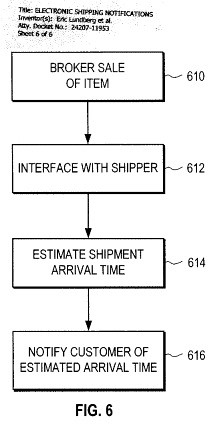
theodp writes "Will Google's battle against Microsoft and Apple over their use of 'bogus' patents result in greater scrutiny of its own IP holdings? Take Google's new patent on 'Electronic Shipping Notifications' (please!), which might pique the interest of Amazon.com, UPS, the USPS and others in the shipping business, since providing customers with guesstimates of what time The King of Queens will show up at their door with Christmas presents could now constitute patent infringement. From the patent: 'The broker sends an electronic message, such as an email or text message, to the customer prior to the estimated shipment arrival time to inform the customer of the impending arrival. The customer can thus arrange for someone to be at the shipping address to receive the shipment at the estimated arrival time.' To help the USPTO understand its invention, Google supplied this diagram."
Chill. It's Google doing this, so it must be okay.
These are not the absurdly obvious patents you are looking for.
#DeleteChrome
No! That means no more pizza tracking from Dominoes!!! :-(
too many cookie requests! so to screw them back, here's the article for all that its worth:
Google’s battle against Microsoft and Apple over their use of “bogus” patents promises to result in greater scrutiny of its own intellectual property holdings. And we have a hunch that Amazon.com, UPS, the U.S. Postal Service and pretty much everyone else in the shipping business will be highly interested in this new addition to Google’s portfolio.
The search giant this week was awarded a patent on electronic shipping notifications, of all things. Here’s the abstract, explaining the approach.
A broker facilitates customer purchases from merchants. Shippers ship shipments containing the purchases from merchants to the customers. A shipper identifies a shipment using a shipment identifier. The broker uses the shipment identifier to obtain the status information for the shipment from the shipper. The broker analyzes the status information in combination with other information to calculate an estimate of the time that the shipment will arrive at the customer’s address. The broker sends an electronic message, such as an email or text message, to the customer prior to the estimated shipment arrival time to inform the customer of the impending arrival. The customer can thus arrange for someone to be at the shipping address to receive the shipment at the estimated arrival time.
Of course, the real test is whether Google will assert the patent against anyone who does something similar, as Microsoft and Apple are doing against Android with their own patents.
In the meantime, we’ll be left scratching our heads over the need to patent something like this.
man, last time I leave cookies enabled on FF's prefbar. sheesh! I had forgotton how NASTY some sites really are.
fuck them. so here's the text - no need to visit their damned site.
--
"It is now safe to switch off your computer."
perhaps the useful and novel part of the patent was in steps 1-500?
Perhaps. But where's the non-obvious part?
This is about as close as I've seen to a "System for accomplishing a well known task with a computer".
This patent sounds like complete rubbish. I'm pretty sure that FedEx and several other companies have been giving me an estimate as to when my parcel will arrive for some number of years.
Lost at C:>. Found at C.
This is Google poking fun at the patent office. They probably have hundreds of these in the pipeline, all with the same purpose: find out "How stupid a patent can you get?"
Help stamp out iliturcy.
Software patents are patently ridiculous. When I worked for a subsidiary of Microsoft, I was harassed (it's how I felt, being interrupted from writing code for what I perceived as silliness) into helping finding any angle in the code which could be turned into a patent, and to help with the serious-sounding language to describe the patent. I'm ashamed my name is out there attached to silly laughable software patents which purpose is just to perform the obvious.
We've had such package tracking in use for YEARS. Now, all of a sudden, someone can patent it? I wonder who will patent the wheel? How about a patent on picking one's nose or walking across a street? Aren't there rules that prevent such absurdity? Or is the entire patent office about as incompetent as the White House?
Looking at the actual patent, what they're doing is figuring out based on historical delivery information a more accurate estimated time of day for the delivery and sending an email to the recipient with that information *on the day of delivery*.
Basically it saves the recipient having to constantly check the tracking page for the courier.
Not earthshaking, but more than is currently offered.
Sounds to me like Google is playing the system as it is currently designed to be played - but with a different intent. I hope they continue to file for more and more ridiculous patents until the real patent trolls (or, more importantly, the government) have nothing left but to call for reform.
Why do slashdotters insist on reading some kind of noble intent into this, just because it's Google? If Microsoft or Yahoo! or somebody like that did it, they'd be mass outcry. Google, and all the other big corporate names, patent things like this to give them more ammunition in the inevitable patent battles that come up from time to time with their competitors. Eventually, somebody will get pissed at Google and sue them for some kind of patent infringement. Google will then compile a counter suit, alleging infringement of all sorts of patents like this one, and the two parties will settle out of court by signing some kind of cross-licensing agreement. That's how the game is played, and Google is not going to play it any less effectively than anybody else.
For those that are so quick to jump on Google about this (which I suppose is understandable these days), you would hope that one would actually read the patent, or understand that the only important part of a patent is the claims, NOT the abstract or diagram provided. Yes, Google has patented providing delivery notifications...but the important, relevant question is HOW it calculates and provides those notifications. For, example, Google has decided that it is more efficient to, during shipment, halt the queries to the shipper's computer system until the day before the expected delivery date, then resume so as to provide up-to-date notifications. It has also claimed analyzing historical data of shipping routes and times to determine, down to the minute (theoretically) estimates of an arrival time, not based on what the shipper says, but what it has demonstrated in the past. Finally, UPS or other shippers could not possibly infringe because the patent clearly provides for a "broker" computer, which is explicitly not the shipper's computer, to query the shipper's database. The point is that Google has a novel idea here, and has defined it as such. Boiled down to its essence, it provides shipping notifications just like others do. But ice and a/c units both cool air, coffee cups and vases both hold liquid, dial-up and cable both provide access to the internet. The method is what is important, not the end result. To infringe a patent, one has to infringe on all claims. While some claims may be obvious, it is the (sometimes few) non-obvious ones that actually matter. Google has provided some of those non-obvious, novel claims (at least it appears to have) and it seems to have a valid patent.
We've had such package tracking in use for YEARS.
This patent was actually filed in 1952, according to a Google search.
Yeah, and everyone else is "trying to make a point" too. How awesome of Google to be just like everyone else when it comes to patents.
I was all with you, till you said "To infringe a patent, one has to infringe on all claims". That is actually not true.
It depends on how the patent is structured and how nice the court is when the patent is tried there (Hello Texas!).
For example, typically claim one says "Claimed is the same thing you all are used to, but with an improvement".
Then claim 2 says "The object of claim one, with yet another improvement", then claim 3 either says "The object of claim 2, with yet another improvement" or "The object of claim one, with yet another improvement".
Most of the time if you infringe on claim one, infringing is what you do.
Suppose claim one is bad. When tried in court, for some strange reason courts sometimes allow e.g. claim 2 to stand by itself, even if claim one is found to be obvious. So you can be found infringing on claim 2 even if claim one is a bad claim.
Hey don't blame me, IANAB
"To infringe a patent, one has to infringe on all claims."
Wrong - you only need to be covered by one claim in a patent to infringe the whole patent. Source: http://en.wikipedia.org/wiki/Patent_infringement#Elements_of_patent_infringement (2nd paragraph).