 Slashdot Mirror
Google Patents Telling Time
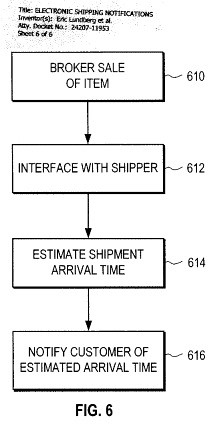
theodp writes "Will Google's battle against Microsoft and Apple over their use of 'bogus' patents result in greater scrutiny of its own IP holdings? Take Google's new patent on 'Electronic Shipping Notifications' (please!), which might pique the interest of Amazon.com, UPS, the USPS and others in the shipping business, since providing customers with guesstimates of what time The King of Queens will show up at their door with Christmas presents could now constitute patent infringement. From the patent: 'The broker sends an electronic message, such as an email or text message, to the customer prior to the estimated shipment arrival time to inform the customer of the impending arrival. The customer can thus arrange for someone to be at the shipping address to receive the shipment at the estimated arrival time.' To help the USPTO understand its invention, Google supplied this diagram."
Chill. It's Google doing this, so it must be okay.
These are not the absurdly obvious patents you are looking for.
#DeleteChrome
No! That means no more pizza tracking from Dominoes!!! :-(
From the supplied (extremely complex) diagram I can see that Google put a great deal of effort into this. Looks like Google is finally learning to play the silly patent game like the rest of corporate America.
Sometimes the light at the end of the tunnel is the headlight of an oncoming train.
too many cookie requests! so to screw them back, here's the article for all that its worth:
Google’s battle against Microsoft and Apple over their use of “bogus” patents promises to result in greater scrutiny of its own intellectual property holdings. And we have a hunch that Amazon.com, UPS, the U.S. Postal Service and pretty much everyone else in the shipping business will be highly interested in this new addition to Google’s portfolio.
The search giant this week was awarded a patent on electronic shipping notifications, of all things. Here’s the abstract, explaining the approach.
A broker facilitates customer purchases from merchants. Shippers ship shipments containing the purchases from merchants to the customers. A shipper identifies a shipment using a shipment identifier. The broker uses the shipment identifier to obtain the status information for the shipment from the shipper. The broker analyzes the status information in combination with other information to calculate an estimate of the time that the shipment will arrive at the customer’s address. The broker sends an electronic message, such as an email or text message, to the customer prior to the estimated shipment arrival time to inform the customer of the impending arrival. The customer can thus arrange for someone to be at the shipping address to receive the shipment at the estimated arrival time.
Of course, the real test is whether Google will assert the patent against anyone who does something similar, as Microsoft and Apple are doing against Android with their own patents.
In the meantime, we’ll be left scratching our heads over the need to patent something like this.
man, last time I leave cookies enabled on FF's prefbar. sheesh! I had forgotton how NASTY some sites really are.
fuck them. so here's the text - no need to visit their damned site.
--
"It is now safe to switch off your computer."
Telephone systems are electronic. Calling up the customer by phone and telling them you'll be there around 3pm is therefore delivering an electronic message. There's prior art, but getting the messenger service or the pizza or the cable repair guy to actually show up around 3pm is a bit more tricky.
The diagram was "Page 6 of 6" and showed steps 610-616 - perhaps the useful and novel part of the patent was in steps 1-500?
Bill Stewart
New Fast-Compression-only CPR http://preview.tinyurl.com/dy575ks
perhaps the useful and novel part of the patent was in steps 1-500?
Perhaps. But where's the non-obvious part?
Well, now we know why we can never a package on time from anybody. It is because Google Patented the ETA system for package delivery.
Sounds to me like Google is playing the system as it is currently designed to be played - but with a different intent. I hope they continue to file for more and more ridiculous patents until the real patent trolls (or, more importantly, the government) have nothing left but to call for reform.
"Careful! We don't want to learn from this!" -Calvin & Hobbes
called me on their phone/smart phone about making sure someone was at the house for my last two orders from Dell.
by TheSpoom (715771) Uncaring Linux user here. I have nothing to add to this but please continue. *munches popcorn*
Irony - gotta love it.
This is about as close as I've seen to a "System for accomplishing a well known task with a computer".
This patent sounds like complete rubbish. I'm pretty sure that FedEx and several other companies have been giving me an estimate as to when my parcel will arrive for some number of years.
Lost at C:>. Found at C.
This is Google poking fun at the patent office. They probably have hundreds of these in the pipeline, all with the same purpose: find out "How stupid a patent can you get?"
Help stamp out iliturcy.
Software patents are patently ridiculous. When I worked for a subsidiary of Microsoft, I was harassed (it's how I felt, being interrupted from writing code for what I perceived as silliness) into helping finding any angle in the code which could be turned into a patent, and to help with the serious-sounding language to describe the patent. I'm ashamed my name is out there attached to silly laughable software patents which purpose is just to perform the obvious.
We've had such package tracking in use for YEARS. Now, all of a sudden, someone can patent it? I wonder who will patent the wheel? How about a patent on picking one's nose or walking across a street? Aren't there rules that prevent such absurdity? Or is the entire patent office about as incompetent as the White House?
I'm afraid Google may have reached the tipping point. Companies generally start off with high goals and innovations, but they eventually degenerate into lumbering behemoths who's only goal is to squeeze every last penny out of their customers.
I'm pretty sure music players, touch screen phones, tablets, etc were all out far before apple tried their hands at it, and they're still the ones out suing other makers of said products.
...the life out of inventiveness.
Sadly in the current "patent" climate, everyone have to obtain as many patents as they possibly can, bogus and all, simply to have enough of a patent portfolio to scare off competitors who might try and quench competition, as we see ... well all of them do at the moment.
The best thing that could happen would be an immediate stop for new patents, and a permanent stop and revocation of all "software" patents.
But because it'll be the best thing to happen, it never will.
Looking at the actual patent, what they're doing is figuring out based on historical delivery information a more accurate estimated time of day for the delivery and sending an email to the recipient with that information *on the day of delivery*.
Basically it saves the recipient having to constantly check the tracking page for the courier.
Not earthshaking, but more than is currently offered.
I do believe that the sentiment you express here is exactly what Google are hoping the patent office, lawmakers, etc, will finally realize. It's what I first thought when I read it. I also believe they already have a list of examples prepared when they get challenged on this new patent. I also think they will also patent all kinds of other silly things real soon. The sillier the better. The system is broken, clearly, and perhaps they think that if they lean on it a little it will come crashing down. Here's to hoping.
For those that are so quick to jump on Google about this (which I suppose is understandable these days), you would hope that one would actually read the patent, or understand that the only important part of a patent is the claims, NOT the abstract or diagram provided. Yes, Google has patented providing delivery notifications...but the important, relevant question is HOW it calculates and provides those notifications. For, example, Google has decided that it is more efficient to, during shipment, halt the queries to the shipper's computer system until the day before the expected delivery date, then resume so as to provide up-to-date notifications. It has also claimed analyzing historical data of shipping routes and times to determine, down to the minute (theoretically) estimates of an arrival time, not based on what the shipper says, but what it has demonstrated in the past. Finally, UPS or other shippers could not possibly infringe because the patent clearly provides for a "broker" computer, which is explicitly not the shipper's computer, to query the shipper's database. The point is that Google has a novel idea here, and has defined it as such. Boiled down to its essence, it provides shipping notifications just like others do. But ice and a/c units both cool air, coffee cups and vases both hold liquid, dial-up and cable both provide access to the internet. The method is what is important, not the end result. To infringe a patent, one has to infringe on all claims. While some claims may be obvious, it is the (sometimes few) non-obvious ones that actually matter. Google has provided some of those non-obvious, novel claims (at least it appears to have) and it seems to have a valid patent.
Because it's not the same thing. What you see on UPS's website when you provide your tracking code and what Google is claiming is actually different.
Not that I support this patent.
We've had such package tracking in use for YEARS.
This patent was actually filed in 1952, according to a Google search.
Yeah, and everyone else is "trying to make a point" too. How awesome of Google to be just like everyone else when it comes to patents.
So this is like the twentieth "They're just making a point!" post from Google fans. Ignoring the fact that every other company could claim that too, did you know Sergey Brin filed a patent for Google Doodles--a.k.a., the changing of their logo for special events and holidays?
The patent describes their revolutionary method of simply uploading a new logo:
"A non-transitory computer-readable medium that stores instructions executable by one or more processors to perform a method for attracting users to a web page, comprising: instructions for creating a special event logo by modifying a standard company logo for a special event, where the instructions for creating the special event logo includes instructions for modifying the standard company logo with one or more animated images; instructions for associating a link or search results with the special event logo, the link identifying a document relating to the special event, the search results relating to the special event; instructions for uploading the special event logo to the web page; instructions for receiving a user selection of the special event logo; and instructions for providing the document relating to the special event or the search results relating to the special event based on the user selection."
Yes, absurd patents are absurd, but when you have people suing you using absurd patents *coughapplecough*, and absurd patents are how the US landscape is, then you file absurd patents too. This is only problematic if Google goes and attempts to use this to sue people with. There's mountains of absurd patents, and the vast majority only come into play as defense against trolls *coughapplecough*
Welcome to any Apple-themed post, except this time it's Google.
You didn't expect any of these armchair patent experts to actually *read* more than the headline before offering their infallible expert opinion, did you?
Also, hilarious that we have apologists out for Google too. When Apple patents something absurd it's "evil, greedy, anti-competitive", but when Google is perceived to do the same they are "doing it as a protest to put a spotlight on absurd patents". Nice hypocrisy, slashdot!
Excuse me, but what content did you supply that was not in the summary?
Sig Battery depleted. Reverting to safe mode.
"Hello? Mr. Smith? Will you be at home between 2pm and 5pm tomorrow? Excellent, you package will be delivered between those hours. Thank you."
Oh, thank you for the cut and paste. Why I might never have known the content without your diligent efforts.
Sig Battery depleted. Reverting to safe mode.
Something which seems to be overlooked by most of the commenters is the fact that the human readable description of a patent does not define the patent. The part you need to read to really understand a patent is the claims. Some patents which seem fairly obvious when reading the title, and description of the patent are actually very narrow when looking at the claims. Other patents seem fairly narrow when reading the description whereas the claims are very broad.
I'm not a lawyer, so take the remaining parts of this part with a big grain of salt, but it seems as if there are fairly obvious way to work around this patent without infringing it. As I understand it, the independent claims are the most important parts of a patent. They are reproduced below for your enjoyment. Note that both claims discusses periodic queries. It seems likely that you wouldn't infringe the patent if you did away with the periodic queries and instead had the shipper computer notify you whenever it had new information available. (As a side effect, this would be less bandwidth and processor intensive, similar to how it is usually better to use IRQ driven I/O instead of polling based I/O in an operating system...)
In both independent claims they also discuss that the periodic queries are halted and restarted a day prior to the estimated delivery. If you never halted the periodic queries you may have another possibility of avoiding infringement.
Nevertheless, this seems fairly close to "System for accomplishing a well known task with a computer" as gstoddart mentioned in an earlier comment.
Independent claims:
"1. A method of providing notification of impending delivery of a shipment shipped by a shipper to a shipping address specified by a customer, comprising: periodically querying, by a broker computer system independent of the shipper and a merchant and which enabled the customer to purchase an item contained in the shipment from the merchant, a shipper computer system to obtain status information for the shipment with each query, wherein a periodic query of the shipment computer system comprises: requesting status information from the shipper computer system by providing a shipment identifier of the shipment to the shipper computer system; and receiving status information in response thereto; responsive to status information obtained with a periodic query indicating an estimated delivery date for the shipment, halting, by the broker computer system, the periodic queries and scheduling the restart of periodic queries of the shipper computer system a day prior to the estimated delivery date; restarting, by the broker computer system, periodic queries of the shipper computer system the day prior to the estimated delivery date to obtain updated status information with each query; responsive to updated status information obtained with a periodic query indicating that the shipment is out for delivery to the customer, halting, by the broker computer system, the periodic queries and calculating an estimated delivery time for the shipment based at least in part on the status information; and sending, by the broker computer system, an electronic message including the estimated delivery time to the customer. "
"11. A system for providing notification of impending delivery of a shipment shipped by a shipper to a shipping address specified by a customer, comprising: a computer processor; and a computer-readable storage medium storing computer program modules configured to execute on the computer processor, the computer program modules comprising: a shipper interface module for: periodically querying, by a broker independent of the shipper and a merchant and which enabled the customer to purchase an item contained in the shipment from the merchant, a shipper computer system to obtain status information for the shipment with each query, wherein a periodic query of the shipment computer system comprises: requesting status information from the shipper computer system by providing a shipment identifier of the shipment to the sh
I was all with you, till you said "To infringe a patent, one has to infringe on all claims". That is actually not true.
It depends on how the patent is structured and how nice the court is when the patent is tried there (Hello Texas!).
For example, typically claim one says "Claimed is the same thing you all are used to, but with an improvement".
Then claim 2 says "The object of claim one, with yet another improvement", then claim 3 either says "The object of claim 2, with yet another improvement" or "The object of claim one, with yet another improvement".
Most of the time if you infringe on claim one, infringing is what you do.
Suppose claim one is bad. When tried in court, for some strange reason courts sometimes allow e.g. claim 2 to stand by itself, even if claim one is found to be obvious. So you can be found infringing on claim 2 even if claim one is a bad claim.
Hey don't blame me, IANAB
I suspect you did not even read the entire summary, let alone the actual patent.
I have used it and it works. Based on past history and experience I can say with confidence and with scientific proof: The check is in the mail and will be there tomorrow.
Don't fight for your country, if your country does not fight for you.
It's called a track record. Until Google actually sues people with patents, I'm more inclined to be more forgiving on google especially since they are on the receiving end of all patent disputes so far.
Our patent system is broken, and you can't realistically not play by it's broken rules out in the real world. Until things change, defense patents are the only decent defense besides mountains of lawyers.
This.
Claim 1 breaks down like this:
1. A method of providing notification of impending delivery of a shipment shipped by a shipper to a shipping address specified by a customer, comprising:
(a) periodically querying, by a broker computer system independent of the shipper and a merchant and which enabled the customer to purchase an item contained in the shipment from the merchant, a shipper computer system to obtain status information for the shipment with each query, wherein a periodic query of the shipment computer system comprises:
--requesting status information from the shipper computer system by providing a shipment identifier of the shipment to the shipper computer system; and
--receiving status information in response thereto;
(b) responsive to status information obtained with a periodic query indicating an estimated delivery date for the shipment, halting, by the broker computer system, the periodic queries and scheduling the restart of periodic queries of the shipper computer system a day prior to the estimated delivery date;
(c) restarting, by the broker computer system, periodic queries of the shipper computer system the day prior to the estimated delivery date to obtain updated status information with each query;
(d) responsive to updated status information obtained with a periodic query indicating that the shipment is out for delivery to the customer, halting, by the broker computer system, the periodic queries and calculating an estimated delivery time for the shipment based at least in part on the status information; and
(e) sending, by the broker computer system, an electronic message including the estimated delivery time to the customer.
If one does not do even one of these five elements, one doesn't infringe on the patent (well, there's the other independent claim 11 to review, too).
Before people get worked into a lather about the latest patent scandal, may I suggest that we all mentally add the phrases "A method of. . ." or "An apparatus for. . ." to the title of every patent we see? Because that's really what is meant.
The point is that Google has a novel idea here, and has defined it as such. [..] To infringe a patent, one has to infringe on all claims. While some claims may be obvious, it is the (sometimes few) non-obvious ones that actually matter. Google has provided some of those non-obvious, novel claims (at least it appears to have) and it seems to have a valid patent.
No, you need to infringe at least 1 of the claims. Not all of them. (You do need to infringe on all the elements in a single claim, though.)
Claim #1 here is absurdly generic. This is yet another example of the patent office granting a ridiculously obvious patent.
So then how is your comment modded to +5 informative? Can it be that here on Slashdot we are so pro-Google that we praise them for filing and receiving bogus patents? Please tell me it hasn't really come to that!
To infringe a patent, one has to infringe on all claims.
Sorry, no. To infringe a patent, one has to infringe on any single one claim. That's why you split your concept in several claims, actually: so you can patent the very thing you invented by clearly exposing it (usually the last, most specific claim) but also similar ideas (the previous, more general claims).
How is this different from the delivery man who phones you up on the delivery day to say, "I'll be there about 2:00?" You're getting the notification on the day of delivery, and I'm sure he's taking historical information (his own experience) into account when generating the estimate. Ok, it's a human rather than a computer, but a human brain is functionally equivalent to a computer in this situation. Simply substituting an electronic computer for a biological one does not make something patentable. The electronic computer needs to be doing something fundamentally different from what the human was doing.
"I'm too busy to research this and form an educated opinion, but I do have time to tell everyone my uninformed opinion."
and then sue the government for infringement.
We are eternal, all this pain is an illusion.
Mod parent up. I read the summary and thought "I've never had USPS or UPS notify me of an eta in advance." Seriously wish they would, then I wouldn't need these silly scripts that poll the tracking websites looking for changes.
I don't know about the U.S., but here in Germany, paying the cable does not pay the TV broadcasters. It's just like with the internet: You pay your provider for the delivery, but the content providers are separate. You can also get the very same stations per satellite (where you don't have to pay because the senders pay all the transmission fees).
The Tao of math: The numbers you can count are not the real numbers.
Or maybe I'm just being entirely too naive.
Almost...It's more like a friend calling the delivery guy every few minutes, seeing how the progress is going, comparing that to historical data on the delivery guy's reliability, then, when your friend has determined the delivery time to an acceptable estimate, letting you know. This saves you a bunch of time, is much more precise, and much more efficient. Those benefits themselves potentially make this patentable more than any other reason.
The difference between Apple and Google with regards to patents is very obvious. Both companies own a gun but Google uses it for self defense while Apple uses it to go on a murder spree.
Somebody sympathetic has to be deliberately harmed. What have you got here? Nothing.
Help stamp out iliturcy.
If google used their patents the way Apple does, you would have a point. As it stands, you don't.
Well, not exactly.
When Apple uses some ridiculous patent to troll others out of business - then they are evil.
You can't say the same about Google. Not yet, anyway.
In today's news, Slashdot has obtained a patent for misleading article summaries and intentionally overblown headlines.
This patent involves honestly estimating when the package will arrive, you see, not just when the guy will show up with the slip saying he tried to deliver it, at the same moment when your doorbell miraculously fails to work, but only for him.
-- IANAL, this isn't legal advice, and definitely isn't legal advice for you. Also, Squee!
you know, this stuff is volatile enough without the misleading headline.
The Kruger Dunning explains most post on
You pay for the services, not the shows.
If it was to also pay for the shows, the cable bill would be many thousands of dollars.
The Kruger Dunning explains most post on
"We've had such package tracking in use for YEARS."
no, we haven't. I don't think anyone has won like this even today.
But, yeah be sure to let a bad summary to a poorly written article determine your opinion, otherwise you might have to think.
The Kruger Dunning explains most post on
What they've come up with isn't non-obvious. Any group of experienced engineers can come up with this optimization. That's the litmus test and this fails. If you do extensive research on the properties of materials and build a super-strong alloy--OK. That's a patent. But if someone asked me to come up with a way to optimize notification times based on actual delivery, I and a bunch of people I know could come up with this without much struggle. Not appropriate for a patent. Just because Google was the first company to get the people controlling engineering time to sign-off on implementing this trivial solution, doesn't make it patent-worthy.
The patent system is broken and it's hurting our ability to innovate.
The only thing hilarious is your belief that Slashdot is one person's opinion.
And by hilarious, I mean Fucking Stupid.
The Kruger Dunning explains most post on
How will this patent acquirement go? Only time will tell.
The more you know, the more you have to say and the more you should listen.
I think you just missed the point of the joke, and by doing so became the living embodiment of it, along with the several other AC posts I got in response to this. You're the first one with the stones to actually log in.
You see, what I did (since you clearly didn't see it - I probably should have appended "did you see what I did there?" to the end of my original post) was to use a literary device called a "generalisation". This is often used, quite frequently in the company of hyperbole, to emphasise a point.
For example, "The buses are never, ever on time. You wait for hours and then three turn up at once" is an example of a generalisation combined with hyperbole. No one reading the sentence (unless lacking in basic reading comprehension) believes that the writer *literally* had to wait hours, or that his assertion that the busses are "never ever" on time was a literal statement.
Do you need me to help you with applying that to my post? I can break it down piece by piece with quotes and explain it as I go if it makes it easier, or do you have enough to go on from here on your own?
Concur -they may have something really cool. Trying to conduct estimation problems on large graphs >1 M nodes ( our road system), taking into account traffic, constraints, real time updates of actual location is really hard. Since this is a more complex traveling salesman problem it is AT LEAST NP Hard and that is for one shipment. Never mind trying to do those level of calculations on the computational scales that Google works at. The current issue of IEEE Intelligent Systems has some good articles about using mass scale computations for intelligent transportation. Lets see if instead of it being a package to get from point "a" to point "b", it was you in a car, this patent would potentially be valid. For all we know they have published the actual math's on how they do it is just doubtful that no more than a 100 people in the world could actually understand the concepts used to solve the problem.
makes you wonder why we are pissing all this money down the drain for an office
So it is like taking a GPS navigation unit that bases arrival time on past traffic patterns (standard feature even on basic units for a few years now), type in the delivery addresses and notify when you are x minutes away according to the readout? Not much of an invention, IMHO.
"To infringe a patent, one has to infringe on all claims."
Wrong - you only need to be covered by one claim in a patent to infringe the whole patent. Source: http://en.wikipedia.org/wiki/Patent_infringement#Elements_of_patent_infringement (2nd paragraph).
It only means that if Google is going to sue, and they wouldn't do that would they?
If Google really cared they would fix Android Chrome to reflow text, instead of discriminating
And do you realize that that is what is broken in software patents? You just write down some well through steps, one that anyone with a little bit common sense is able to think of, write "with a computer" and you have your patent.
A patent is something like a Otto-motor, a television, even a chair is more an invention then a software patent. A patent should be applied to something that actually have a physical form, not an idea. Maybe Google's idea is novel, but it's just some steps a computer can do, and as such an algorithm, and as such it's math.
In a patent of a physical process or a physical machine I have an implementation, that works. It's not just an idea. Where is the implementation, where is the source code? Ideas should not be patentable, if they would, we would stop any progress in science, literature, music and art.
http://www.mueller-public.de - My site http://www.anr-institute.com/ - Advanced Natural Research Institute
That's almost as much as the TV license fee in the UK!
Confucius say, "Find worm in apple - bad. Find half a worm - worse."
Correction. . .
Yeah -- poor wording on my part. To infringe, one needs to perform all elements of a claim. What I was trying to emphasize is that to avoid infringement, one can do any four of the five elements of the claim, as long as one does not do the fifth: Infringement is a Boolean "and" operation. I was trying to point out that patent avoidance is usually easier than is thought, since one needs merely to find a claim element that one can do differently.
Thanks for the edit.
Who was harmed? Was the harm avoidable, or the lesser evil? Is the harmed entity sympathetic, or itself evil? Is the harm actual, or potential?
It's not evil to cut a hole in the devil, nor to choose the path of least harm. Collecting cutlery is not an expression of intent to become a slasher.
Help stamp out iliturcy.