Slashdot Mirror


Committee Offers Scenarios for Japan's Energy Future

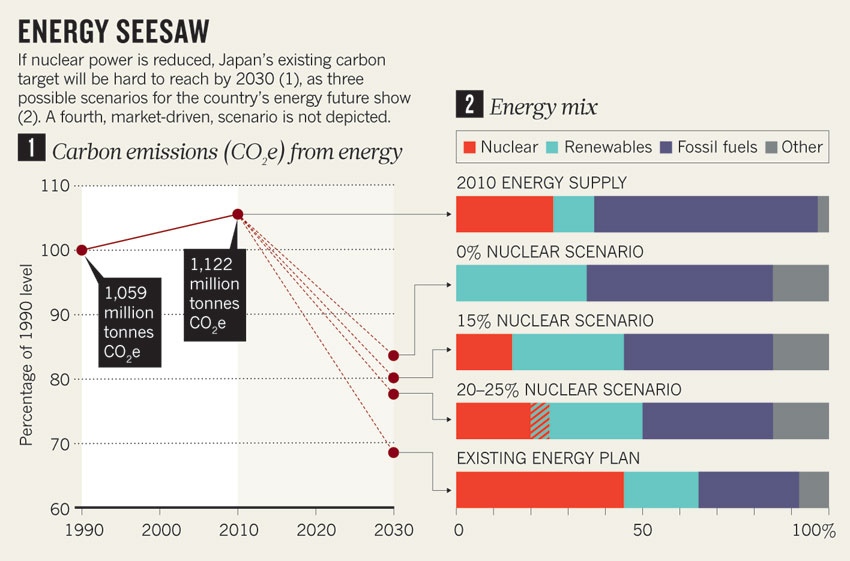
ananyo writes with a story about more concrete plans for a reduced or nuclear-free energy future for Japan. From the article: "It's official: nuclear power will have a much smaller role in Japan's energy future than was once thought. Since the meltdowns and gas explosions at the Fukushima Daiichi nuclear power station in March 2011, all of Japan's remaining reactors have been shut down for inspections and maintenance. The government offered a glimpse of their future, and that of the country's nuclear power in general, when it published an outline of four ways to satisfy Japan's future energy demands. One scenario recommends using a market mechanism to determine the nuclear contribution. Under the other three, nuclear power would supply at most one-quarter of Japan's energy by 2030 — and in one case, none at all. The scenarios come from a 25-person advisory committee to the industry ministry. The sharp reductions in the nuclear power part of the country's energy mix mean that Japan will struggle to reach the 31% reduction in carbon dioxide emissions that it had planned by 2030 (PDF)."
131 comments

  1. Pick one by crazyjj · · Score: 4, Insightful

    1) Reduced nuclear
    2) Reduced coal, oil, and natural gas

    Any third option for the foreseeable future is a hippie pipe dream (unless you count regular, sustained blackouts as an option). And if anyone thinks that solar panels and wind turbines are going to supply Tokyo with even a fraction of its power needs, you've obviously never been there.

    --
    What political party do you join when you don't like Bible-thumpers *or* hippies?
    1. Re:Pick one by Darkness404 · · Score: 2

      Yep, nuclear, coal, oil and natural gas are the only 4 cost-effective methods of large-scale power generation, especially in a crowded region such as Japan. Solar panels are not yet cheap enough and wind requires such a large area (so do solar panels but they could be mounted on roofs).

      --
      Taxation is legalized theft, no more, no less.
    2. Re:Pick one by Ironhandx · · Score: 4, Informative

      This is entirely accurate for Japans current situation. Even in areas like the US where land per capita is relatively abundant they can't possibly supply all of the countries power needs on wind, hydro, and solar alone. At least not any time soon, and by soon I mean within the next 30-40 years, which is our immediate concern.

      Only a very few countries in the world have enough land to supply completely sustainable energy. Canada is one, Australia is another. There are maybe 3-4 other countries that could at least mostly get onto these energy sources.

      Since as you can see this is a very small club to be in, Nuclear is unfortunately the way forward for the foreseeable future.

    3. Re:Pick one by sycodon · · Score: 1, Flamebait

      Shhhhh! MDSolar might hear.

      --
      When Fascism comes to America, it will call itself Anti-Fascism, and tell you to give up your guns.
    4. Re:Pick one by pellik · · Score: 4, Interesting

      Nuclear power will only do serious damage to the environment if mistakes are made. Fossil fuels will damage the environment no matter what. I wonder if there is any logic behind Japan's decision or if this is just some politicians cashing in on public fear.

    5. Re:Pick one by Trepidity · · Score: 2

      Both the United States and Japan actually have considerable unexploited hydroelectric capacity, but construction of major new dams has been effectively discontinued for several decades now, because of a mixture of local opposition and environmental worries. It's renewable, but not sure it's really "green", since it requires a massive, permanent change to a river basin. Nuclear is probably greener, despite not being renewable.

    6. Re:Pick one by AbrasiveCat · · Score: 4, Informative

      Yep, nuclear, coal, oil and natural gas are the only 4 cost-effective methods of large-scale power generation, especially in a crowded region such as Japan. Solar panels are not yet cheap enough and wind requires such a large area (so do solar panels but they could be mounted on roofs).

      Those of us who live in the northwest of the United States, or western Canada, might argue that hydro belongs on your list. There aren't many big hydro opportunities left to develop around here, but hydro plants we have seem be cost efficient.

    7. Re:Pick one by sycodon · · Score: 1

      San Francisco/CA have pretty much put the kibosh on Geothermal because "it causes earth quakes".

      --
      When Fascism comes to America, it will call itself Anti-Fascism, and tell you to give up your guns.
    8. Re:Pick one by Anonymous Coward · · Score: 0

      "3-4" others like Algeria, Libya, Saudi Arabia, Mauritania, Sudan, Greenland, Russia and Argentina?

    9. Re:Pick one by Urban+Garlic · · Score: 4, Insightful

      One thing we have learned is that, in nuclear power, "not making mistakes" can cost a lot of money and take a lot of time. One of the mistakes we heard about when the Fukushima Daiichi event happened was continuing to operate these poorly-designed older-generation reactors for so long.

      From the sounds of it, this new report has come out strongly in favor of not repeating that mistake, which sounds pretty logical to me.

      --
      2*3*3*3*3*11*251
    10. Re:Pick one by Anonymous Coward · · Score: 0

      They may be cost efficient, but alot of enviromental harm exists from diverting natural water flow. In your region you have only to look at the issues regarding samon. However impacts to humans are fairly common as well, as the midwest US and India know.

    11. Re:Pick one by Kokuyo · · Score: 2

      So the problem is operating old tech for too long? Well, not using that tech at all is one thing they could do... or they could upgrade in security conscious intervals. They could try other products. I mean, the iPhone isn't the only smartphone out there and neither are reactors like Daiichi the only types available.

      The only problem with this discussion is that a viable alternative is not considered due to fear and bad publicity.

    12. Re:Pick one by taiwanjohn · · Score: 1, Interesting

      Ironically, part of the fossil fuel damage is also radioactive. Coal contains trace amounts of thorium, uranium, radium, etc., which are simply released into the atmosphere -- far more radiation than any nuclear facility would be allowed to release in normal operations. Advocates of some Gen-IV reactor designs claim that there's more nuclear energy potential in these waste particles than is produced by the coal-fired plants that release them.

      --
      XML is like violence. If it doesn't solve your problem, you're not using enough of it. --AC
    13. Re:Pick one by Luckyo · · Score: 1

      Hydro has a severely limited capacity based on local geography. In case of industrialized countries like Japan, pretty much anything that can be dammed has been dammed and no additional capacity is available.

      Japan *may* have some luck with geothermal due to its favourable location, but I imagine they have quakes that are bad enough already, like one that killed over 30.000 people, displaced some hundreds of thousands and fucked up Fukushima etc with the tsunami it caused. So basically they're stuck with burning coal/oil/natural gas or nuclear. That or basically shutting down their society as it exists today as factories need steady power and financing their society is very dependent on production at those factories running smoothly and efficiently.

    14. Re:Pick one by Luckyo · · Score: 1

      Afaik even Canada and Australia can't really do that. About the only country in the world that can is Iceland, because of its volcanic composition, small populace and general lack of heavy industry.

      Even if you have a lot of rivers to dam up, you still need to move the electricity, meaning countries with large distances between potential dams and city centres that need lots of power are no likely going to be feasible. We simply do not have material technology that is good enough for this yet.

    15. Re:Pick one by Luckyo · · Score: 3, Insightful

      This is the devastating irony of modern nuclear power. The more we invest in it, the safer it becomes. Yet investments in nuclear power are often viewed as something that increases risk of accidents due to "more power plants".

      It's a self-fulfilling prophecy as a result of it we're still running many plants built in sixties when nuclear energy generation was not even a decade old.

    16. Re:Pick one by ch-chuck · · Score: 2

      I'm beginning to think that, realistically, just like we put up with (US) 50,000 highway deaths per year because we like our cars, or an airline crash every so often because we like flying, we are going to have to sacrifice a 3 Mile Island or Chernobyl every once in a while for our love of electrical power. It's not a perfect world and never will be, stuff happens, and all you can do is be able to respond to contain and minimize the damage when it does. Like the town in PA that was moved due to an underground fire, towns near nukes that failed will just be closed off and make no man's land for a few hundred million years.

      --
      try { do() || do_not(); } catch (JediException err) { yoda(err); }
    17. Re:Pick one by Quiet_Desperation · · Score: 1

      Get moving on thorium based reactor tech? I would have expected more out of the box thinking from Japan. They were the only ones doing any serious research into extracting uranium from seawater, for example.

    18. Re:Pick one by AmiMoJo · · Score: 2, Insightful

      Japan has vast amounts of geothermal and plenty of off-shore wind. The former is cheaper than nuclear and coal, not sure about gas. The latter... Well, post Fukushima it is cheaper than nuclear, and possibly coal if you count the environmental and health costs of burning it.

      There is another option too: reduce energy consumption by becoming more efficient.

      --
      const int one = 65536; (Silvermoon, Texture.cs)
      SJW, n: "Someone I don't like, and by the way I'm a fuckwit" - AC
    19. Re:Pick one by rmdingler · · Score: 2

      How many lives are lost due to not generating enough power? What is the cost in infrastructure loss? There is such a thing as acceptable loss in any rational equation.

      --
      Happiness in intelligent people is the rarest thing I know.

      Ernest Hemingway

    20. Re:Pick one by AmiMoJo · · Score: 2

      0.3% of the Sahara could supply all of western Europe. There is more than enough solar available in southern US states for the whole country. Try googling solar thermal collectors. They work 24/7, BTW.

      --
      const int one = 65536; (Silvermoon, Texture.cs)
      SJW, n: "Someone I don't like, and by the way I'm a fuckwit" - AC
    21. Re:Pick one by Anonymous Coward · · Score: 0

      You can mound up dirt and do geothermal above ground too.

      The problem is that it breaks in earthquakes.

      But shades that can be removed in winter for buildings would reduce a lot of the cost to cool them. If you made the shades out of solar panels, it would work even better.

    22. Re:Pick one by peragrin · · Score: 1

      The problem is distance. Until you have superconductors for the distribution grid the losses are just to great. While Texas can sell some power to California. NY or Florida can't

      --
      i thought once I was found, but it was only a dream.
    23. Re:Pick one by dj245 · · Score: 2

      Both the United States and Japan actually have considerable unexploited hydroelectric capacity, but construction of major new dams has been effectively discontinued for several decades now, because of a mixture of local opposition and environmental worries. It's renewable, but not sure it's really "green", since it requires a massive, permanent change to a river basin. Nuclear is probably greener, despite not being renewable.

      Not only that, but until last year, Japan had been decommissioning a lot of their hydro units since they were fish choppers. Some of them had to be brought out of mothball status because of the power crunch.

      Anyone who proposes hydro as a solution to Japan hasn't been there. Pretty much any piece of land which is even slightly flat has buildings or rice paddies on it. They don't have enough space as it is. in the US, we call them "not in my backyard" (NIMBY) people who just want to oppose anything. The local opposition in Japan to such large projects is more like "don't displace me, bro". I'll exclude nuclear from those people though, as the current nuclear opposition in Japan is about as fanatical and misinformed as the US antinuclear movement was in the 1970's.

      --
      Even those who arrange and design shrubberies are under considerable economic stress at this period in history.
    24. Re:Pick one by khallow · · Score: 1

      How many lives are lost due to not generating enough power?

      It can be quite a few. Heat waves and such have killed hundreds to thousands at a time before. If a heavily urbanized area (let's say Tokyo) experiences extremely hot weather (for the region) and the power fails at the same time, that could lead IMHO to more deaths than could come from a poorly handled nuclear reactor meltdown.

      What is the cost in infrastructure loss?

      What's the cost of someone not working because the power is out? What's the cost of a huge traffic jam because signal lights are out? Or the strategic cost of being more vulnerable to embargoes or fluctuations in fossil fuel prices?

    25. Re:Pick one by Jens+Egon · · Score: 1

      If current trends continue world solar panel production will surpass world energy needs by 2023-24.

      (Ok, so this cause so much change in energy prices and the ways we do things, that obviously current trends wont continue.)

      Tokyo obviously have little room for solar in Tokyo, but we do know how to move electricity.

      ... and the Pacific is rather large, maybe there's room for a solar panel or two.

    26. Re:Pick one by spire3661 · · Score: 0

      Yeah, those silly japanese and their fear of radiation. Its totally unfounded. No Fat Man or Little Boy could possibly understand why the Japanese have an extraordinary fear of nuclear energy.

      --
      Good-bye
    27. Re:Pick one by Anonymous Coward · · Score: 0

      I'm curious, why does such a long-standing /. user have so few comments (and have most of them modded down to -1)?
      P.S. Spelling and grammar pedants have to write impeccably or they just look silly.

    28. Re:Pick one by Anonymous Coward · · Score: 0

      "but I imagine they have quakes that are bad enough already"

      You seem to be suggesting that geothermal power increases the force of earthquakes, I don't think that is possible with anything even approaching near term geothermal energy systems. If put right on a fault they could possibly increase the frequency of seismic events, but that would decrease the severity of the events which is likely an advantage. Remember that earthquakes happen because of energy built up in the crust because two continental plates have "snagged" on each other, they'll release that energy one way or another. Its quite arguable that it would be better that happened in a small earthquake every 10 years or so, instead of a massive earthquake every 100 years.

    29. Re:Pick one by rmdingler · · Score: 1

      For generations, first world citizens have been coddled and believe there is a Utopian solution to every societal problem that arises. The very best solutions always have downsides...Public panic and knee jerk reactionism are not qualified moderators.

      --
      Happiness in intelligent people is the rarest thing I know.

      Ernest Hemingway

    30. Re:Pick one by AmiMoJo · · Score: 0

      I agree, and the question now is what does Japan do next? Develop new and hopefully safer nuclear power or something else. Since many of the problems with nuclear power that Japan has had so far (not just thinking about Fukushima) have been due to thinks like cost cutting and poor regulation people are sceptical that those problems can be overcome. Plus the cost of developing this new technology will be pretty high, and its not like there is a growing global market you can sell to in order to recover some of the costs.

      On the other hand green power generation and energy saving technology is very much in demand and there are no export restrictions to worry about. In fact you would doing the world a favour.

      So in the short term more fossil fuel is unfortunately necessary, but in the medium to long term the government can choose to poor more money into nuclear, making itself unpopular in the process. Or it can invest in renewables and efficiency, which is already being heavily invested in by private companies too, and ensure that Japan is a major player in a growing global market.

      It should be a no-brainer but the nuclear lobby is powerful and there is some vested interest in propping up an industry that could then pay back a bit more of the cost of dealing with Fukushima.

      --
      const int one = 65536; (Silvermoon, Texture.cs)
      SJW, n: "Someone I don't like, and by the way I'm a fuckwit" - AC
    31. Re:Pick one by AmiMoJo · · Score: 0

      Solved problem, just use DC. The EU is planning to run long distance DC from north Africa back to western Europe for solar thermal.

      --
      const int one = 65536; (Silvermoon, Texture.cs)
      SJW, n: "Someone I don't like, and by the way I'm a fuckwit" - AC
    32. Re:Pick one by rasmusbr · · Score: 1

      If we ignore countries with ridiculously large hydro dam resources (Norway, Sweden, Finland, etc) the only currently available economic way of storing sufficient amounts of energy is by storing methane, and the only currently available method of getting enough methane is by tapping natural gas out of the Earth. So natural gas is a given if we're going to use intermittent energy sources such as wind and solar on a large scale, which we are by the looks of things.

      Maybe we'll come up with a better way to store energy eventually, but it looks like natural gas, which as you probably know is a fossil fuel, is going to play an important part for decades to come.

      What all this adds up to is the simple fact that nuclear is still the cleanest alternative and that nuclear is going to continue to be the cleanest alternative for the foreseeable time. If only there was a way to build nuclear plants that didn't take 10 to 20 years and require extensive construction work and hyper-specialized labor on site!

    33. Re:Pick one by Anonymous Coward · · Score: 0

      until a tsunami comes along and moves down your offshore turbines like matchsticks...

    34. Re:Pick one by mpe · · Score: 1

      And if anyone thinks that solar panels and wind turbines are going to supply Tokyo with even a fraction of its power needs, you've obviously never been there.

      Even if the could on paper the problem with both systems of generation is that supply is variable and in no way matched to demand. About the only technology which can store a useful amount of energy to help with this is pumped hydro. It's rather harder to build even one of these in the sea...

    35. Re:Pick one by mpe · · Score: 1

      Even in areas like the US where land per capita is relatively abundant they can't possibly supply all of the countries power needs on wind, hydro, and solar alone. At least not any time soon, and by soon I mean within the next 30-40 years, which is our immediate concern.

      The major problem with wind (along with solar) is that supply and demand rarely match. It's rather optimistic to expect that a problem which has been around for thousands of years will suddenly be solved within a few decades.

    36. Re:Pick one by AmiMoJo · · Score: 2

      If we ignore countries with ridiculously large hydro dam resources (Norway, Sweden, Finland, etc) the only currently available economic way of storing sufficient amounts of energy is by storing methane, and the only currently available method of getting enough methane is by tapping natural gas out of the Earth.

      Or molten salt, or pumped hydro...

      --
      const int one = 65536; (Silvermoon, Texture.cs)
      SJW, n: "Someone I don't like, and by the way I'm a fuckwit" - AC
    37. Re:Pick one by mpe · · Score: 1

      If only there was a way to build nuclear plants that didn't take 10 to 20 years and require extensive construction work and hyper-specialized labor on site!

      Possibly the same techniques used to build Calder Hall. Took less that 4 years to build and operated for the best part of 50.

    38. Re:Pick one by nojayuk · · Score: 1

      "Japan has vast amounts of geothermal and plenty of off-shore wind."

      Yes, Japan has lots of off-shore wind, so much their word for this has been Nicolled by the English language. "Taifu" or as we in the West spell it, "Typhoon". See the reports of the typhoon that hit Japan in September 2011 for an example of how bad they can get (over 90 people dead and missing).

      Imagine what will happen to a farm of wind turbines standing out in open ocean when it gets hit by even a mild typhoon. It doesn't help that the coastal shelf of Japan is very narrow or non-existent so offshore wind turbines will have to be positioned on floating rafts rather than on towers fixed to the seabed.

    39. Re:Pick one by Luckyo · · Score: 2

      Wrong. Resistivity of materials is not solved by switching to DC. It does have some advantages over AC but it most certainly does not eliminate the problem.

    40. Re:Pick one by Luckyo · · Score: 1

      I'm not "suggesting" it. It's a known problem, down to causing significant and noteworthy earthquakes in areas that had no earthquakes of such size in entire known history.

    41. Re:Pick one by Anonymous Coward · · Score: 0

      I'm curious, why does such a long-standing /. user have so few comments (and have most of them modded down to -1)?

      Because it's clearly been invented as a troll account from the beginning.

      Look closely at the name and user number in brackets, and you'll see it doesn't say

      kdawson (3715)

      as it would for the user named kdawson (i.e. user 3715), but

      kdawson (3715) (1344097)

      i.e. the user is "kdawson (3715)" (the number being part of the name) followed by their user number of 1344097.

      Of course, it's clear that the intention was that people would just notice the "kdawson (3715)" bit and assume it was kdawson, so it's an obvious bad faith troll.

    42. Re:Pick one by Anonymous Coward · · Score: 0

      Well-spotted. Thanks.

    43. Re:Pick one by ChatHuant · · Score: 2

      Resistivity of materials is not solved by switching to DC

      That's true; the solution is to also increase the voltage (losses are inversely proportional to the square of the voltage), which is easier to do with DC (and a line from Africa to Europe needs to use DC anyway, if you want to go underwater for any significant length).
       
      Look up Path 65, which connects the LA area to a converter station all the way north in Oregon, close to the WA border, that is more than 800 miles away. It uses +/- 500 kV DC and can carry up to 2 GW

    44. Re:Pick one by khallow · · Score: 1

      For generations, first world citizens have been coddled and believe there is a Utopian solution to every societal problem that arises.

      While there's no achievable Utopia around which to have Utopian solutions, it does remain that there are usually many choices which qualify as solutions. Which are best depend on one's weighing of the costs and benefits of each choice.

      The realization that most problems have solutions is probably one of the key ideological differences between First World residents and others.

    45. Re:Pick one by Ironhandx · · Score: 1

      30-40 years is way way overly optimistic. I have doubts that we will solve that particular problem at any point within the next 100 years but I will admit that 30-40 was put there just to avoid the arbitrary mod-downs from the fanatical solar power advocates.

    46. Re:Pick one by Anonymous Coward · · Score: 0

      There is a large area conveniently devastated by an exploded nuke plant that could be used for a wind farm. ;-)

    47. Re:Pick one by Luckyo · · Score: 1

      There are many problems with using voltage this high, and there's an issue of resistivity regardless. If you tried to pull the suggested Sahara-Germany route, your losses would still be huge.

    48. Re:Pick one by antifoidulus · · Score: 1

      Japan also does a lot of hydroelectric, problem is there are basically no more rivers left to dam in the entire country, so thats a problem.

  2. So in other words... by Darkness404 · · Score: 3, Insightful

    So in other words Japan will make nuclear power taboo so there will be little research/upkeep on the remaining reactors making another Fukishima more likely. Wonderful!

    --
    Taxation is legalized theft, no more, no less.
    1. Re:So in other words... by Anonymous Coward · · Score: 0

      Well, the soil's already irradiated, so not much more damage inflicted there. It would be like detonating a nuke on Pripyat.

    2. Re:So in other words... by AmiMoJo · · Score: 1

      On the contrary it is now being heavily researched and large sums of money spent finding ways to make the existing plants safer. The most comprehensive monitoring exercise ever is being carried out, and we will probably learn more about the effect of low radiation doses on human beings and the environment than we ever have before in the next few years.

      --
      const int one = 65536; (Silvermoon, Texture.cs)
      SJW, n: "Someone I don't like, and by the way I'm a fuckwit" - AC
    3. Re:So in other words... by Asic+Eng · · Score: 1

      Those were US-designed reactors. The Japanese should have simply kept up with the manufacturer's upgrades, just like the plants in the US did. Japanese research is somewhat irrelevant to that. Turning off nuclear power plants (which is just one of the suggested options) does not mean research into it becomes taboo. In any case there is still nuclear waste to be handled for generations, so there will be a nuclear industry of sorts in Japan, whether it produces energy or not.

  3. Solar, batteries, and efficiency by Anonymous Coward · · Score: 1

    Add in some large scale wind farms along the coast.

    If they passed a law saying that individuals had to create 30% of their power using green methods, or buy into a green energy co-op that would pool the money to purchase large systems, it would work.

    They also have to build more efficiency into their designs, use geothermal cooling, and energy efficient lighting. Also reduce the amount of stuff they have running when no one is home.

    1. Re:Solar, batteries, and efficiency by CptNerd · · Score: 1

      Right, build them along the coasts so they can all be destroyed by the next tsunami.

      --
      By the taping of my glasses, something geeky this way passes
  4. Toshiba and Terrapower by sycodon · · Score: 1

    This is an excellent opportunity for Toshiba to seize the moment and take nuclear power generation in a whole new direction.

    --
    When Fascism comes to America, it will call itself Anti-Fascism, and tell you to give up your guns.
    1. Re:Toshiba and Terrapower by taiwanjohn · · Score: 1

      On a similar note, I ran across this today. Chubu Electric Power Co. is investing some R&D bucks "specifically looking into an alternative reactor design that would use liquid thorium fuel in a reactor cooled by molten salt." That ought to make the thorium geeks happy.

      --
      XML is like violence. If it doesn't solve your problem, you're not using enough of it. --AC
  5. The choice was made well over a decade ago by dbIII · · Score: 3, Insightful

    They haven't built a new reactor in a very long time. This announcement is not much different to the German government one - letting the existing plants run down and not putting in a huge amount of capital to revive an almost abandoned reactor construction industry to build new ones. Everyone involved in building the previous ones has long moved on and spare expertise outside of their country is scarce.

    1. Re:The choice was made well over a decade ago by Anonymous Coward · · Score: 0

      Japan has been building new reactors fairly constantly from the 70s right up to the present. Several have come onstream in the last decade and several more are under construction.

      http://www.world-nuclear.org/info/inf79.html

      So this is nothing like the German situation.

    2. Re:The choice was made well over a decade ago by Mashiki · · Score: 1

      That's not really true. Fukishima had a new reactor being brought online and it was I believe 6 years old with plans for two more. There was a backlog order for containment vessels in Japan around a 20 year wait, because they make all the reactor vessels by hand instead of using forms.

      Oh well, it just means us Canadians will make money off Japan. They're buying coal, and coalmines as fast as we can dig it out of the ground and at the rate they're going, they'll be outstripping the chinese for demand for our coal.

      --
      Om, nomnomnom...
    3. Re:The choice was made well over a decade ago by tp1024 · · Score: 3, Informative

      In fact reactor #6, while shut down at the time of the tsunami, was the only reactor that still had a functioning power supply after the tsunami. It was the only BWR5 design (#1 was a BWR3, #2 to #5 were BWR4) - unlike the others, it had three separate subdivisions each capable of cooling the reactor in the event of a power outage. Redundancy works. Just as in the Tokai, Fukushima Daini and Onagawa nuclear power plants that were also hit by the tsunami.

      However, neither TEPCO nor the Japanese Government should be spared any criticism for failing to upgrade the power plants. Hydrogen explosions were a known problem in those plants and could be prevented for a very modest sum of a few million dollar per reactor. Filtered containment vents were also implemented all over europe, Japan was attending the Paris conference on filtered containment vents in June 1988 and the only nation not to issue any official statement at all about them or initiate any studies on the problem.

      Until 2011 I thought Japan was basically a modern country with decent safety standards - now I know better.

    4. Re:The choice was made well over a decade ago by AmiMoJo · · Score: 1

      Until 2011 I thought Japan was basically a modern country with decent safety standards - now I know better.

      It is a modern country with decent safety standards, that's the problem. When corporate greed and low probability risk is involved the same thing happens everywhere.

      --
      const int one = 65536; (Silvermoon, Texture.cs)
      SJW, n: "Someone I don't like, and by the way I'm a fuckwit" - AC
    5. Re:The choice was made well over a decade ago by tp1024 · · Score: 1

      The same thing happens everywhere? How come, then, that most european countries did in fact upgrade their safety systems?

  6. Dear Japan by Sparticus789 · · Score: 1

    Since you don't want your Uranium anymore, please send it over here so the U.S. can build more carbon-free power plants. Otherwise, how will we power all of the Japanese-made electronics that you so graciously sell us?

    --
    sudo make me a sandwich
    1. Re:Dear Japan by Yvanhoe · · Score: 1

      Don't forget to send the wastes to us in France, after you'll have finished decommissioning the last nuclear fuel reprocessing facility in USA. We'll be very happy to sell you back the resulting MOX fuel.

      --
      The Wise adapts himself to the world. The Fool adapts the world to himself. Therefore, all progress depends on the Fool.
    2. Re:Dear Japan by Sparticus789 · · Score: 1

      Capitalism at work!

      --
      sudo make me a sandwich
    3. Re:Dear Japan by Yvanhoe · · Score: 1

      Actually our reprocessing facilities are owned by Areva, our public company that manages France's nuclear power plants. Not that anything of this is incompatible with "capitalism"...

      --
      The Wise adapts himself to the world. The Fool adapts the world to himself. Therefore, all progress depends on the Fool.
  7. I Don't Get It by eldavojohn · · Score: 2, Insightful

    Any third option for the foreseeable future is a hippie pipe dream

    I don't get it, all the free market preachers are promising that my energy problems will shortly be solved by the free market but your view is such a fatalistic-don't-even-try-jaded response that you seem to doubt the free market can provide.

    And if anyone thinks that solar panels and wind turbines are going to supply Tokyo with even a fraction of its power needs, you've obviously never been there.

    I haven't been there. But no one's asking those solutions to go from zero to powering Tokyo over night. Look how gradually it's taken wind power to start in the United States (current numbers here). Japan is comparable at our state level and is looking at connecting with Korea, China, Russia and Mongolia power grids to buy more renewable energy. So why call these hippie pipe dreams? If these are hippie pipe dreams, when will our innovation kick in and 'save us' from nuclear and coal?

    (unless you count regular, sustained blackouts as an option)

    Did you hear that Japan did actually make small adjustments following Fukushima and called the movement setsuden?

    I don't think the situation is as dire as you describe it and, frankly, dismissing all the alternative efforts really undermines what we should be working toward which are transitional phases until some breakthrough comes in fusion or an unforeseen source.

    --
    My work here is dung.
    1. Re:I Don't Get It by CrimsonAvenger · · Score: 3, Informative

      I don't get it, all the free market preachers are promising that my energy problems will shortly be solved by the free market but your view is such a fatalistic-don't-even-try-jaded response that you seem to doubt the free market can provide.

      No, the "free market preachers" aren't saying that. Because the "free market preachers" know perfectly well that energy production is one of the most heavily regulated industries in the world.

      And as long as NIMBY exists, there isn't really an answer to increasing energy production - the people want green, but they pretty much stop wanting that as soon as the price tag is mentioned (yes, going all solar and wind will increase energy costs).

      On a related note, saw in the news this AM that the windpower industry is really peeved that Congress hasn't gotten around to renewing their tax credits, and is expecting massive layoffs as a result.

      Which reminds me, I really need to get off my duff and get some solar panels on my roof before the tax rebates end - much better to buy while the neighbors are paying for it than to wait until I have to pay for it myself.

      --

      "I do not agree with what you say, but I will defend to the death your right to say it"
    2. Re:I Don't Get It by Anonymous Coward · · Score: 1

      Government regulations stop a lot of projects from even getting off the drawing board. The whole reason the nuclear power industry developed based on uranium instead of thorium was for military reasons.

      But, yeah, keep being a little ideological twerp and railing against the free market. That's working out so well for the world.

    3. Re:I Don't Get It by nojayuk · · Score: 2

      "The whole reason the nuclear power industry developed based on uranium instead of thorium was for military reasons."

      Crap. Uranium reactors are physically simple devices, steam kettles heated by spontaneously fissioning uranium. Thorium isn't fertile enough by itself to initiate and sustain fission in a simple reactor structure. India has been building and trying to sell thorium-fuelled reactors but they include quantities of medium-enriched (ca. 20%) uranium and plutonium in the fuel mix to provide enough sustained neutron flux to fission the thorium fuel.

      The LFTR designs being touted by assorted folks are monstrously more complex than the existing uranium-fuelled reactor designs already built and operating today, and would have required decades of development back in the 1950s to make them work. The simple fertile uranium fission power reactors were an easier path to take and every country which started builing research and power reactors in that time took that route.

    4. Re:I Don't Get It by AmiMoJo · · Score: 0

      And as long as NIMBY exists, there isn't really an answer to increasing energy production - the people want green, but they pretty much stop wanting that as soon as the price tag is mentioned (yes, going all solar and wind will increase energy costs).

      Only because the true cost of nuclear was hidden until recently. The EU banned government subsidy of nuclear power so the UK government is now trying to subsidise it on sly through a mandatory levy on energy bills. In other words instead of subsidising nuclear through taxation where it is mostly hidden we are now seeing the true cost by subsidising it directly through energy prices and are alarmed at the prospect of paying a few hundred pounds a year more.

      This article is about Japan where the cost of nuclear is now astronomical due to the Fukushima clean up costs, the cost of relocating people, of paying them benefits because their jobs disappeared and of compensating them, of insuring against future health problems and buying monitoring equipment. Not to mention the economic damage. So no matter what Japan does now nuclear was always and will always be the expensive option, it's just that they already paid a lot in so are rather heavily committed.

      --
      const int one = 65536; (Silvermoon, Texture.cs)
      SJW, n: "Someone I don't like, and by the way I'm a fuckwit" - AC
  8. Struggle? by JWW · · Score: 2

    "struggle to meet their emissions targets."

    I think they misspelled the word struggle, it should be spelt FAIL.

  9. Hooray for Mercury! by Anonymous Coward · · Score: 0

    Because coal is so much safer!

  10. Hot hot Hot by ciderbrew · · Score: 1

    Years ago when I live in Japan I remember it being extremely hot. The sun would bake down and roast the street at 7am. If every house had to have panels on it's roof by law, would that help? Cover the whole place. Put it on sides of buildings.
    they do the future there quite well. Now that there is a need I can see them being first.

    1. Re:Hot hot Hot by drinkypoo · · Score: 1

      Every last light must be replaced with something efficient, and they're going to need solar-thermal systems so they can do away with inefficient electric on-demand hot water heating systems, and so on... but they can certainly make massive improvements along those lines... for massive amounts of money.

      --
      "You're right," Fisheye says. "I should have set it on 'whip' or 'chop.'"
    2. Re:Hot hot Hot by Anonymous Coward · · Score: 0

      If every house had to have panels on it's roof by law, would that help? Cover the whole place...

      ...and drive the whole country bankrupt.

    3. Re:Hot hot Hot by ciderbrew · · Score: 2

      When I first went the country wasn't very disability conscious. Skip a few years later ..... every main sidewalks, rail and subway stations had bobbled track bright yellow of floor ties. Braille on hand rails - lifts and loads of other bits. Social conscience has drive there too. If you can make it cool people will want them. Tax breaks for the supply chain and many more false economy drivers can be put in place. The tax make work they use builds good infrastructural items. Use the trillion yen subsidy for power stations corruption money and hand out contracts to install panels.

    4. Re:Hot hot Hot by g8oz · · Score: 1

      Their hot water systems are getting efficient. Very efficient. See EcoCute

      http://en.wikipedia.org/wiki/EcoCute

      "The EcoCute derives two units of energy from ambient air temperature for every unit of electrical power it requires"

    5. Re:Hot hot Hot by TheLink · · Score: 1

      It won't help (unless their roofs are already painted black or close to black).

      Otherwise it would get hotter than before. Solar cells absorb sunlight and convert about 25% to electricity. Much of the other 75% becomes heat (only some of it is reflected back to the sky). So if their roofs were not black and were a lighter colour and reflecting more light to the sky, then installing solar panels would make things hotter.

      You can use the 25% for air-conditioning, that makes the houses cooler, but the heat is just transferred outside. So it is unlikely to make the streets cooler unless the streets are shaded and cooled too...

      --
    6. Re:Hot hot Hot by Solandri · · Score: 2

      Japan (and Korea and the coastal areas of SE and E Asia) are in a monsoon area. The heat is due to the humidity. The sun does not magically shine stronger there (if anything it shines less due to the pollution from China).

      Once you subtract out government subsidies, solar is currently almost an order of magnitude more expensive per kWh than fossil fuels. Wind is a much better choice, at a bit less than 2x the cost. Nuclear is the best scalable option, at roughly the same cost as fossil fuels, but is a political hot potato. Hydro and geothermal are the best choices (cheaper than fossil fuels). But hydro is tapped out in most modern countries, and geothermal is limited in where it's available.

      Why is cost so important? Because our modern standard of living is based on cheap energy. In medieval times, the average person had to work 12 hours a day, 7 days a week in the fields just to generate enough productivity not to starve. Our modern standard of living is achieved by using cheap energy as a productivity multiplier. Instead of using nearly all our productivity to feed ourselves so we can produce more food, we spend a fraction of our productivity (money) on cheap energy. The energy powers machines which we then use to provide the majority of our productivity. People directly or indirectly just "work" by controlling those machines, thus generating enough productivity (income) to feed themselves in about 1 hr a day. The rest of your productivity (money) is spent buying a house and car and various entertainment -- things that would be considered lavish luxuries by medieval standards.

      Take away cheap energy and you can't run those machines as much. The average productivity per person plummets, and a greater portion of their workday is needed to generate enough productivity to feed themselves. That means less income left over for a house, car, and entertainment. Our standard of living goes down.

    7. Re:Hot hot Hot by Anonymous Coward · · Score: 0

      Actually, PV panels are installed with a 10 cm air gap, so they shade the roof very effectively, contributing to lower power needed for air conditioning.

    8. Re:Hot hot Hot by Anonymous Coward · · Score: 0

      That's fine if you're the only one in your area with PV panels.

      It'll be warmer if the whole area is covered with them.

    9. Re:Hot hot Hot by ciderbrew · · Score: 1

      That's a very sad way to look at it. I think we'd better invest in power tech and be ready when the oil and gas run out. have my + interesting/informative
      As for magically shine stronger, - being from the UK, that amount of sun did seem magical.

      To sum up then, every roof covered with panels within the next 30years is a daft idea; but I'm still sticking to it :)

  11. Nukes will come back when they are safe by cryfreedomlove · · Score: 3, Interesting

    We need nuclear power generator technology that can be safely run by corrupt liars. Most government and regulatory agencies are run by corrupt liars, as we saw in the handling of the Fukushima crisis.

    1. Re:Nukes will come back when they are safe by Delarth799 · · Score: 2

      Thorium based reactors are pretty safe and with some investment you can build a few trash burning plants which produce fairly clean and cheap energy. Of course this requires people to actually learn about this sort of technology which isn't convenient for most people to do.

    2. Re:Nukes will come back when they are safe by AmiMoJo · · Score: 1

      Even if such a thing existed you still have to get it built to spec, install it, fuel it, remove the spent fuel, decommission it and store the waste. People on Slashdot bang on about developing safer reactor designs that can't melt down, but that is only part of the problem and far from the most common type of accident.

      --
      const int one = 65536; (Silvermoon, Texture.cs)
      SJW, n: "Someone I don't like, and by the way I'm a fuckwit" - AC
  12. Somebody Died in a Car Crash Yesterday by Anonymous Coward · · Score: 0

    Cars are clearly too dangerous. We need to all go back to walking by 2030. Heavy Goods Vehicles will be replaced by the horse and cart.

    As for space exploration, forget that. The proportion of deaths to space flights is incredibly high so clearly we need to give up on that.

    In fact, let's all just go back to living in caves and wearing animal skins.

    1. Re:Somebody Died in a Car Crash Yesterday by CptNerd · · Score: 1

      Some people think coming down out of the trees was a bad idea.

      --
      By the taping of my glasses, something geeky this way passes
  13. Do the math instead of doing the propaganda by Medievalist · · Score: 1

    Instead of stating your gut instinct as if it were fact, why don't you figure out mathematically if Japan has the geothermal energy to cleanly power their entire nation. Geo thermal is cheap and easy and Fuji-sama is a volcano, ã?

    Iceland makes over 25% of their power from geothermal sources and is on track to cut over to 100% in the "forseeable future" as you put it. Japan has far more manpower and technological ability than Iceland, and the exact same equipment that is used to exploit a boiling water reactor can be used to exploit a geothermal resource. It's just heat, and the same antique technology that is used for nukes works for any other sort of hot rocks with little modification.

    1. Re:Do the math instead of doing the propaganda by CptNerd · · Score: 1

      The problem is the time it takes to design, locate, get permission to build, build, test and bring online any new power plant over the next 20 years. Not every hotspot is stable enough to accomodate multi-megawatt power plants.

      Plus, you want to talk about environmental impact, since people are so hung up about fracking causing mini-earthquakes, what do you think pumping huge amounts of water into hot rock on various faults would do?

      Not to mention the water picking up large amounts of sulfur, creating sulfuric acid amongst other compounds. Yes, these can all be worked around, but not cheaply, and not quickly.

      We've lived for over 30 years under the cloud of NukeFUD, and it's time we started getting over it. We have brains, we can figure out how to make dangerous things safer. It's not like we haven't done it before, and there's nothing special about nuclear technology that makes it uniquely impossible to fix.

      --
      By the taping of my glasses, something geeky this way passes
    2. Re:Do the math instead of doing the propaganda by Medievalist · · Score: 1

      There's also nothing special about nuclear technology that makes it worth fixing.

      No currently available terrestrial nuclear fission reactor has ever been economically viable without government sponsorship, and taxpayers overwhelmingly do not want it.

      Do something better instead of fixating on old crappy technology like nuclear fission reactors. You may as well be burning whale oil - nobody has ever made a better oil lamp than a whale oil lamp!

  14. This is a mistake by WOOFYGOOFY · · Score: 2

    Look nuclear could lead to bad scenarios, but civilization destroying climate change is the Worst Possible Thing. Why not spend the money to build them better? They knew beforehand that their older gen nukes were vulnerable. It has to be at least one option. It's great that there are super incentivized to find sustainable alternatives but is incentive what is lacking on the part of researchers or is it now time we're running out of ?

    Systematically lower carbon emissions- at the point of gun if necessary. Full throttle research into green technology - using deficit spending if necessary. Conservation and maximum usage of current alternatives , by law if necessary. That's what's got to happen and it will the only question is will we do it in time?

  15. Japan has 400 times the population of Iceland by tp1024 · · Score: 1

    Do the math. 40% of of the energy for 0.25% of the population means 0.1% of the total energy use of Japan if Japan used as much geothermal as Iceland.

    No, Japan doesn't have enough geothermal.

    Geothermal energy is an extremely limited resource, even though most people claim otherwise. New Zealand had to scale down several geothermal powerstations because they took too much heat from the reservoirs. Japan has about 30 times as many people as New Zealand. And New Zealand (itself the place of the largest volcanic eruption of the last 2500 years or so) only gets 10% of its energy from geothermal.

    1. Re:Japan has 400 times the population of Iceland by Anonymous Coward · · Score: 0

      Good start. Keep going. Use real references instead of gross comparisons. Compare Tesla's calculations with your own.

    2. Re:Japan has 400 times the population of Iceland by Medievalist · · Score: 1

      That's not the kind of math I was talking about. I prefer real numbers. You might want to start with the geothermal map of Japan, instead of waving your hands about impressively.

    3. Re:Japan has 400 times the population of Iceland by tp1024 · · Score: 1

      Then try an average heat flux of 100mW/m^2 for the whole country (which is roughly accurate). If you take out more than that, you simply cool down the rocks - fossil heat if you will. The heat flux is what you can take out sustainably.

      An efficiency of 20% is actually too high for geothermal (most geothermal power stations have efficiencies well below 10%), but, whatever. You'll get 20mW/m^2 of electricity. 50.000km^2 per GW. For a country the size of Japan that's no more than 8 GW of electricity - and that's being extremely generous as you would have to install pipes below the whole of the country and the efficiency is too high.

      Real enough?

  16. Solar power is worse than Fukushima by tp1024 · · Score: 2

    If you want to replace just Fukushima Daiichi with solar power, you'd have to blanket the whole evacuation zone with one huge solar power plant like that one. (Notice the incredible environmental friendliness of solar power in that place!). But in fact, you'll lose about half of that energy due to storage issues or inefficiency.

    In order to replace all Japanese nuclear power plants with solar power, you need ten of those power plants - if you ignore storage losses.

    1. Re:Solar power is worse than Fukushima by Jens+Egon · · Score: 1

      Ye, gods, you mean they'd have to roof over ten! parking lots.

      The Horror!

      Ok, so huge parking lots, but still ...

    2. Re:Solar power is worse than Fukushima by Jens+Egon · · Score: 1

      Just did the numbers

      Daiichi was 4.7 GW, solar is 1kw/m^2 at peak insolation, average is .25 kw/m^2, so 18.8 kw/m^2.

      That's asuming total cover and no clouds or other inefficiencies. In other words multiply land need by the inverse of your efficincy.

      Now compare that to the 13,400 km^2 that Japan used for roads in 2007 (source). And I'm sorry, but I couldn't find a reliable number for rooftops.

    3. Re:Solar power is worse than Fukushima by tp1024 · · Score: 1

      The solar park i linked to delivers an annual average of 4W/m^2. That's 60MW peak, 6MW average, 160 hectars of land. That's the real numbers. Since Japan is further south, I used 6W/m^2.

    4. Re:Solar power is worse than Fukushima by Jens+Egon · · Score: 1

      Japan is quite cloudy, though. We might as well just use the real numbers.

      Landing at 128km^2 to replace Daiichi.

      By the time they've roofed over every road, they're at more than a hundred times that. And again rooftops haven't been counted.

      My point is simply that land use is in no way a deal killer for solar.

    5. Re:Solar power is worse than Fukushima by tp1024 · · Score: 1

      That area is far too small. Even at 10W/m^2 you'd only get 1.28 GW on that area.

      You forget about the unavoidable gaps you need between the solar panels to avoid casting a shadow on neighbouring panels. On houses that is no problem, because the shadow is where the other half of the house is and you don't count the area of the other half of the house. But when you try to saturate an area with solar panels that cannot be ignored.

    6. Re:Solar power is worse than Fukushima by Jens+Egon · · Score: 1

      No. I got that from 160 hectares yields 6MW -> so to get 4.7GW we need 4.7GW / 6MW * 0.160km^2 = 125.3km^2

      Rounded to nearest "easy to calculate in my head" number. ;-)

    7. Re:Solar power is worse than Fukushima by tp1024 · · Score: 1

      Ahh, I see your mistake:
      1ha = 0.01 km^2
      160ha = 1.6 km^2

    8. Re:Solar power is worse than Fukushima by Jens+Egon · · Score: 1

      Hmm. And so they do indeed need to roof all roads with solar panels in order to replace nuclear with that.

      Putting it into the Pacific might well be a better idea ;-)

      Mind that Japan actualy has quite a lot of inaccessible land. Of course if they could access it to place solar panels there ... They'd plant rice instead!

    9. Re:Solar power is worse than Fukushima by Josef+Meixner · · Score: 1

      Yeah, because the previous state was much better. That area was a military training ground of the red army. It couldn't be used because of remains (chemicals, hand grenades, amunition and other nice stuff), cleaning it was deemed too expensive. Now the area has been cleaned by the company which built that solar park. They have leased the area and intend to use it for 20 to 30 years for solar power. Then the panels will be removed and recycled.

      Oh, and it is indeed very friendly to the environment, as now the environment has time to regenerate after all the nice remains have been removed. The area in question is supposed to be heathland, so no high plants growing.

      That is the gist of the text, which goes with your photo.

    10. Re:Solar power is worse than Fukushima by tp1024 · · Score: 1

      Actually, the inaccessible land is forest for the most part and the Japanese are quite proud of it and happen to like their landscape.

      I also doubt that just putting solar on all roofs is enough. (Japan has multistory houses and rather dense urban settlements. Quite unlike american suburbs that are ideally suited for solar, but for all the wrong reasons - namely extremely high energy needs for driving, heating, air conditioning etc.) And roofing all roads is not really an option. Some of them perhaps (and parking lots of course!) , but I couldn't imaging not seeing the sky while traveling.

    11. Re:Solar power is worse than Fukushima by tp1024 · · Score: 1

      The area is supposed to be heath land? In the middle of a forest?

  17. When life offers you lemons ... by Anonymous Coward · · Score: 0

    I wonder if tsunami could be used for energy capture? Like, making extensive double (one on shore, other off the coast, keeping elevated sea water between them) hydropower dams which occasionally replenish when huge wave brings high water over the sea-ward wall.

  18. Sea wind by ShanghaiBill · · Score: 4, Informative

    wind requires such a large area

    No land is needed for wind power. Japan is an island nation at a latitude that has plenty of trade winds. Wind turbines can be located at sea, where the wind is steadier and twice as strong as on land.

  19. American Forest Dwellers by Dareth · · Score: 1

    You would need something the size of a redwood tree to hold the average American right?

    --

    I only look human.
    My mother is a halfling and my dad is an ogre, so that makes me an Ogreling
  20. Japan has no worries by Anonymous Coward · · Score: 0

    Their population will decline, reducing energy needs. At some point, when enough people are gone, they can go back to being an agrarian society and eliminate all forms of energy use other than biological. That includes the horrible, bird-killing windmills.

  21. All of the west needs to change by WindBourne · · Score: 1

    We need to have a diversified energy matrix. For example, America is using around 40% coal, and thankfully, that will be below 33% within 5 years. However, much of the replacement is Natural Gas. What is needed is for us to make coal/NG be around 33% MAX, with Nukes around 33% MAX and likewise, the various AE around 33%. By doing this, we can limit damage from any one area.

    --
    I prefer the "u" in honour as it seems to be missing these days.
    1. Re:All of the west needs to change by g8oz · · Score: 1

      In America there is enough land that wind can do 25% and solar can do another 25%

      Wind is under a million per megawatt. Competitive with new natural gas or coal capacity - and without fuel input costs.

      Solar is dropping fast. First Solar says its manufacturing costs are $.73 a watt or $730,000 per megawatt. Don't know what the installation & profit margin is but the point is alternative energy has a bigger role to play than you might think.

      I see a lot of technological determinism on Slashdot. Talk about energy and everybody turns into a Soviet technocrat. They contrast dozens of elegant nuclear plants with the hundreds of thousands of wind turbines and solar panels needed and decide that former will be a better bet for the next 5 Year Plan. But the bottom line is nuclear is horrendously expensive. I recall the new Areva plant in Finland costing $5 million a megawatt. What a joke. Plus nuclear capacity is not modular enough. Utilities can't just plunk down 5 megawatts the way they can with wind or solar. The *financial* flexibility is just not there.

      (The hyped mini-nuclear reactors are still unproven and undeployed after years of talk)

      Finally nuclear requires a lot of smart people to keep it safe, and they are in short supply.

      All of my objections to nuclear have answers, answers that depend on unproven technology, subsidies, or transformation of Congress into a bunch of engineers.

      Meanwhile new wind, solar and nat gas capacity is coming online everyday.

    2. Re:All of the west needs to change by Rising+Ape · · Score: 1

      I keep hearing about these $1 per watt solar panels, but whenever I actually look at installed system costs they remain many times that. Combine that with a maybe 20% load factor, and that $5 per watt nuclear's suddenly not looking so bad. And that's before we even get into the costs of storage and backup to handle the intermittency.

      I don't see why plonking down 5 megawatts here and there is relevant when the extra capacity the world needs is more like hundreds of gigawatts.

    3. Re:All of the west needs to change by Jens+Egon · · Score: 1

      In America there is enough land that wind can do 25% and solar can do another 25%

      The USA could easily accomodate 100% solar in some corner of one of the desert states, there are other reasons why going fully solar is a bad short term solution, but lack of land is not one of them. Not even in Japan.

      In the long run solar under one form or another is likely to be as dominant an energy supply as fossil is today.

  22. I'll make it simple by koan · · Score: 1

    Nuclear, because nothing else is going to run places like Tokyo.

    Start looking at the modern tech, I'm sure you will find your safe nuke tech because Japan has always been able to solve challenges.

    --
    "If any question why we died, Tell them because our fathers lied."
  23. energy options by Anonymous Coward · · Score: 0

    While I certainly have some understanding of those that oppose nuclear power, I feel that it is a naive point of view.

    1) If an accident happens in Russia, it's not really an accident, it's cutting corners.
    2) 3 Mile Island didn't actually blow up and take out the east coast despite all the failings.
    3) The Japanese reactors were improperly maintained, inspected, and their safety systems were not tested.
    4) Modern reactor design is an order of magnitude more safe and produces far less waste than the old designs used in Japan.

    Modern nuclear plants are the solution for today. We need to be retiring coal and other fossil fuel burning plants and get serious about developing other energy sources. Wind and Solar power is not realistic yet, but it can be if we continue to develop the technology.

    Japan and other countries with access to oceans should develop tidal and wave electrical generation. The math says that there is a massive amount of energy available, we just need to develop the tech.

  24. How about reality? by Anonymous Coward · · Score: 0

    Japanese officials confronted with question wether people in Fukushima has the same rights as other people to protect themselves against radiation, and their surprising answer:
    http://www.youtube.com/watch?feature=player_embedded&v=rVuGwc9dlhQ [youtube.com]

    VIDEO: Fukushima children forced to drink radioactive milk at school:
    http://www.youtube.com/watch?feature=player_embedded&v=Aq4JG9ULVNE [youtube.com]

    Fukushima-get up to date on repressed news:

    http://endoftheamericandream.com/archives/much-of-northern-japan-uninhabitable-due-to-nuclear-radiation [endoftheam...ndream.com]
    http://www.independentaustralia.net/2011/media-2/fukushima-meltdown-caldicott-says-japan-may-become-uninhabitable-media-silent/ [independentaustralia.net]
    http://blog.alexanderhiggins.com/2011/06/10/japan-deal-radioactive-sewage-crisis-produce-cement-25231/ [alexanderhiggins.com]
    http://www.zerohedge.com/news/remember-fukushima-its-back [zerohedge.com]

    Secret pacts to NOT check for radiation in imported goods and foods from Japan (made after Fukushima started melting down):
    http://www.nuclear-news.net/2011/08/20/hillary-clintons-pact-with-japan-to-downplay-fukushima-radiation-risks/ [nuclear-news.net]
    http://www.examiner.com/human-rights-in-national/radiating-americans-with-fukushima-rain-food-secret-clinton-pact [examiner.com]

    Experts: Fukushima 'off-scale' lethal radiation level infers 100 millions dying:
    http://www.examiner.com/human-rights-in-national/experts-fukushima-off-scale-lethal-radiation-level-100s-millions-deaths [examiner.com]

    Independent measurements (uncalibrated, non-discriminatory - but shows no "need" for global mass-panic yet):
    http://www.radiationnetwork.com/Message.htm [radiationnetwork.com]

    Independent news (only ones still covering Fukushima):
    http://www.fairewinds.com/ [fairewinds.com]
    http://enenews.com/ [enenews.com]

    Japanese government changing the "safe health standards" just moments after disaster struck. Now includes absurd amounts of radiation 20-30 times more than previously, which were already 2-10 times more than most Western countries'. The change document is of course provided, also with a "safe" limit of "plutonium and other ALPHA emitters". Plutonium! The most toxic substance known to life!

    Raising the exposure limits were allegedly done to increase safety for citizens, something you'd expect in a Hitchcock movie..

    "Becquerels" and Japan's changing "safety" standards for radiation in food and water
    http://www.youtube.com/watch?v=oc6FPIK1VaY [youtube.com]

    "Detoxify or Die: Natural Radiation Protection Therapies for Coping With the Fallout of the Fukushima Nuclear Meltdown":

    http://www.health-matrix.net/2011/03/19/detoxify-or-die-natural-radiation-protection-therapies-for-coping-with-the-fallout-of-the-fukushima-nuclear-meltdown/ [health-matrix.net]

    Experiences after Chernobyl and the multitudes of diseases, chronic fatigue and lessened immune disorders inflicted upon Europeans, and how Fukushima can learn from history.

    VIDEO: "Evacuate Children!" Rally & Demo in Koriyama City, Fukushima Pref. on Oct. 15, 2011"
    http://www.youtube.com/watch?feature=player_embedded&v=b6RAwEBxaa4 [youtube.com]

  25. Missing Option. . . by JSBiff · · Score: 1

    3) Reduced GDP

    You can cut your power usage a lot by reducing a) manufacturing, transportation, and export of goods, and b) Construction of new buildings, structures(bridges, railroads, etc) and roads or renovations of old buildings, structures and roads.

  26. 8GW is way way off by Medievalist · · Score: 1

    Nobody has ever come up with a figure as low as 8GW before that I can find. I think you've got something fundamentally wrong with your assumptions.

    In 1998 the Geothermal Research Society of Japan and AIST were estimating a maximum exploitable capacity of 23.4 GW - assuming a series of conventional power plants that resembled absolutely nothing like "installing pipes below the whole of the country".

    It's always been difficult to develop geothermal power in Japan because of the Japanese reverence for the hot springs that occur in the vicinity of the most favorable sites, and because of the Japanese government's active discouragement of geothermal investment in favor of nuclear plant subsidies. Some of that is changing.

    All the reputable research I can find inside 15 minutes indicates Japan should be able to replace around half their nuclear capacity with geothermal using off-the-shelf technology. That's without doing anything with hydrothermal vents or anything else particularly innovative, just using the same old creaky victorian steam technology that their obsolete nuclear plants use.

    They can probably make up the rest by putting their entertainment centers on power strips and switching to LED lights. There's really no need for aging, poorly designed nuclear plants that cost more to clean up than they can ever earn selling power.

    1. Re:8GW is way way off by tp1024 · · Score: 1

      What you're saying amounts to saying how many trees you can fell in a forest using nothing more than axes. Hint: It's a lot more than the number of trees growing back in the same time.

      If you don't care about sustainabliity then say so.

      Where sustainability is concerned, you must not extract more energy than is coming back from the interior of the earth - completely independent on whether or not you could extract more than that - because you can.

    2. Re:8GW is way way off by Medievalist · · Score: 1

      Where sustainability is concerned, you must not extract more energy than is coming back from the interior of the earth - completely independent on whether or not you could extract more than that - because you can.

      Japan is on the Ring of Fire. There's far more heat coming up than you think, at least according to every scientific survey I can find online. And since the existing Japanese geothermal plants are already pulling more heat from the earth than you say is possible, I think your math has been empirically shown to be incorrect.

      But we don't have to argue theory - the Japanese are going to put our opposing claims to the test. Check this out:

      http://articles.marketwatch.com/2012-03-22/markets/31224074_1_japan-s-fukushima-nuclear-reactor-plant

      And more in the works, too. Energy farming is the growth industry of our time - sustainably harvesting resources instead of permanently depleting them.

    3. Re:8GW is way way off by tp1024 · · Score: 1

      I prefer real numbers. You might want to start with the geothermal map of Japan, instead of waving your hands about impressively.

    4. Re:8GW is way way off by tp1024 · · Score: 1

      You might also want to refer to this map to see that 100mW/m^2 is realistic.

    5. Re:8GW is way way off by Medievalist · · Score: 1

      Source?

  27. Harness all the tentacle power by bryan1945 · · Score: 1

    From what I gather from the media, Japan is rather overrun with monsters with tentacles and such.

    --
    Vote monkeys into Congress. They are cheaper and more trustworthy.
  28. LENR by gedw99 · · Score: 1

    Cold Fusion / Low Energy Nuclear Reactions.

    There are many companies moving towards commercialisation.
    Both large system and small decentralised systems for homes.

    Japan could lead the world and make a fast and rapid rollout of this technology, and bypass all the others and have close to free energy costs.