Slashdot Mirror


Towards a 50% Efficient Solar Cell

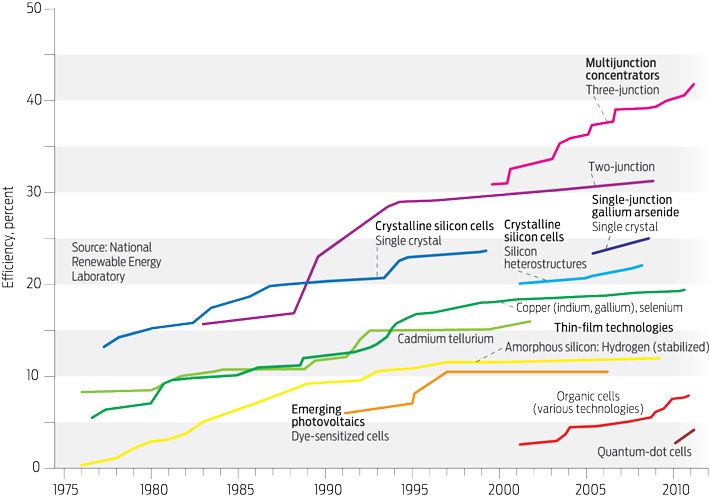
necro81 writes "IEEE Spectrum magazine has a feature article describing DARPA-funded work towards developing a solar cell that's 50% efficient, for a finished module that's 40% efficient — suitable for charging a soldier's gadgets in the field. Conventional silicon and thin-film PV tech can hit cell efficiencies of upwards of 20%, with finished modules hovering in the teens. Triple-junction cells can top 40%, but are expensive to produce and not practical in most applications. Current work by the Very High Efficiency Solar Cell program uses optics (dichroic films) to concentrate incoming sunlight by 20-200x, and split it into constituent spectra, which fall on many small solar cells of different chemistries, each tuned to maximize the conversion of different wavelengths."
78 of 129 comments (clear)

  1. No problem with this by Dyinobal · · Score: 1, Insightful

    Republicans would have no issue with this. It's military spending and that is fine, but if we ever want to invest in solar in the USA for purely clean energy purposes they'd call it wasteful spending and all sorts of crap.

    1. Re:No problem with this by Firehed · · Score: 5, Insightful

      Know your audience. As long as DARPA's research comes to the public eventually (we got the internet, after all) it's still beneficial. Quite possibly delayed and almost certainly more expensive than it should be, but slow and expensive progress is still progress.

      --
      How are sites slashdotted when nobody reads TFAs?
    2. Re:No problem with this by Charliemopps · · Score: 1, Troll

      Governments do not "invest", Governments move money from one place to another... VERY inefficiently.
      How are Obama's solar investments doing? Oh, that's right, they taxed you... took your money, then gave it to some businessmen that promptly filed bankruptcy and drove off in their BMWs. Congrats.

    3. Re:No problem with this by mikech2000 · · Score: 1

      And Bush Jr. delivered pallets of cash to Iran which 'got lost'.

    4. Re:No problem with this by Anonymous Coward · · Score: 2, Informative
      Except in the case of Spacex, where that model is dandy and fine, right? Which side of the Space Nutter camp are you on??

      "As of May 2012, SpaceX has operated on total funding of approximately one billion dollars in its first ten years of operation. Of this, private equity has provided about $200M, with Musk investing approximately $100M and other investors having put in about $100M (Founders Fund, Draper Fisher Jurvetson, ...) [22]. The remainder has come from progress payments on long-term launch contracts and development contracts. NASA has put in about $400-500M of this amount, with most of that as progress payments on launch contracts."

    5. Re:No problem with this by hawguy · · Score: 5, Interesting

      Governments do not "invest", Governments move money from one place to another... VERY inefficiently.
      How are Obama's solar investments doing? Oh, that's right, they taxed you... took your money, then gave it to some businessmen that promptly filed bankruptcy and drove off in their BMWs. Congrats.

      In this list of recipients of the DOE's 1705 Loan program, 5 of out 26 are listed as being in serious financial difficulty, the majority of the projects on the list are on-track.

      Direct costs of the war in Iraq were $800B, by the time all direct and indirect costs are accounted for (interest, injured and wounded, veteran care and pay), it could hit $4T. The Loan Program cost $34B (and that's only if all $34B loans are defaulted on).

      So, for somewhere between 5% and 0.8% of the cost of war that we shouldn't have started, the US Government can help to move us toward alternative energy sources, and off of foreign oil (I know we have domestic sources for much of the oil we use, but since it's a global commodity, any oil we consume means more that volatile middle eastern states will sell)

      I'm not sure that the vetting process for all companies is fair and balanced, but I do think it's a useful program.

    6. Re:No problem with this by Anonymous Coward · · Score: 4, Informative

      No, he means forward-looking scientists working for government money (so, just like it should have been). So far the general public was the greatest beneficiary of DARPA projects. Computers, Internet, GPS to name the few...

    7. Re:No problem with this by JesseMcDonald · · Score: 1, Interesting

      So, for somewhere between 5% and 0.8% of the cost of war that we shouldn't have started, the US Government can help to move us toward alternative energy sources, and off of foreign oil...

      This may become a reasonable argument when you find a way to ensure that spending on alternative energy sources (and other projects) comes instead of, rather than in addition to, the money wasted on war. The "balanced budget amendment" proposal would be a reasonable place to start. Until then, massive overspending in one area cannot possibly justify spending other areas, no matter how small the latter might be by comparison. Quite the opposite, really; when you're that far over budget to begin with, any additional spending requires more justification, not less.

      --
      "The state is that great fiction by which everyone tries to live at the expense of everyone else." - Bastiat
    8. Re:No problem with this by Anonymous Coward · · Score: 2, Informative

      I am not sure you understand what DARPA is. They don't do the research, they read proposals submitted by companies, universities, non-profits, etc, and allocate US tax dollars to whoever they think is most likely to successfully develop the technologies they need. For example, the solar cells noted in this article are being developed by University of Delaware, using DARPA money.

    9. Re:No problem with this by ShanghaiBill · · Score: 2, Insightful

      Direct costs of the war in Iraq were $800B, by the time all direct and indirect costs are accounted for (interest, injured and wounded, veteran care and pay), it could hit $4T. The Loan Program cost $34B.

      This is a logical fallacy. You can't prove that something makes sense just by pointing out that something else is even stupider.

    10. Re:No problem with this by jcr · · Score: 1

      >In this list of recipients of the DOE's 1705 Loan program, 5 of out 26 are listed as being in serious financial difficulty,

      Does that seem like a low level to you? I can tell you that any private lender looking at that many of his loans going bad would be in deep shit.

      -jcr

      --
      The only title of honor that a tyrant can grant is "Enemy of the State."
    11. Re:No problem with this by jcr · · Score: 1

      started selling panels for less than it cost to make them

      If that were true, then it would basically be a gift from China to their customers.

      -jcr

      --
      The only title of honor that a tyrant can grant is "Enemy of the State."
    12. Re:No problem with this by ajaxlex · · Score: 1

      I don't think that a Lender is the right analogy. Rather, the Govt is an investor, where the benefits are measured in repaid loans PLUS jobs created PLUS new technologies developed PLUS strategic resource concerns alleviated. Investing in startups means taking different kinds of risks than traditional lenders do - higher risk of default, but bigger payouts when things succeed.

    13. Re:No problem with this by RobbieCrash · · Score: 3, Insightful

      Are you suggesting that we shouldn't be looking into alternative energy sources?

      Private industry hasn't exactly done a whole lot to do anything other than prolong our dependence on fossil fuels. The oil, and oil related, industries are bigger than ever, more money than ever is spent on refining more and more difficult sources of crude. Oil sources that 15 years ago were thought would never be cost effective are now major suppliers in the whole chain.

      Solar power has made slight inroads, but only on a personal level. There's no significant widespread power generation through solar. We're NIMBYing wind turbines. Everyone is reluctant to invest in tidal power.

      Everyone just keeps pouring more and more money into oil. Spending money thinking about how to stop doing that is sensible, even if 90% of it goes nowhere. Only spending money on things that are proven to work is what got us here, if private companies aren't willing to risk failing, then fucking A rights the government should help out.

      --
      Keep on knockin'
      https://robbiecrash.me
    14. Re:No problem with this by jamstar7 · · Score: 1

      Read what you wrote. NASA paid the 400-500 mil for launch capabilities, i.e., delivered assembled vehicles to stand up on the pad, fuel, and go.

      --
      Understanding the scope of the problem is the first step on the path to true panic.
    15. Re:No problem with this by hawguy · · Score: 1

      >In this list of recipients of the DOE's 1705 Loan program, 5 of out 26 are listed as being in serious financial difficulty,

      Does that seem like a low level to you? I can tell you that any private lender looking at that many of his loans going bad would be in deep shit.

      -jcr

      Of course they are risky investments, if their business plan was so sound that they were able to get traditional loans, they'd just get traditional loans.

      The government is acting more like a VC firm for these companies, and the average silicon valley VC firm has around a 50% success rate.

    16. Re:No problem with this by DamonHD · · Score: 1

      My expectation of VC success rate is ~20%, having several times been in receipt of VC money (and arguably succeeded once!)...

      Rgds

      Damon

      --
      http://m.earth.org.uk/
    17. Re:No problem with this by ShanghaiBill · · Score: 1

      Are you suggesting that we shouldn't be looking into alternative energy sources?

      Not at all. But investments in alternative energy should be judged on their merits. The fact that the Iraq War was a colossal fiasco is completely irrelevant.

    18. Re:No problem with this by 1369IC · · Score: 2

      Just because it's DARPA doesn't mean government employees don't do the work. I work at the Army's RD&E command, and we have people who do research for DARPA or run their projects. I'm not at work, so I can't be sure, but we have a CRADA (cooperative R&D agreement) with UDel, so I'm guessing we're involved in this. And our Communication-Electronics center does work in solar, as does our research lab. So don't bet that no government folks are working on this or responsible for it. It's not unusual for our CRADA partners to publish their results and neglect to mention the contributions of the Army folks involved. Again, not sure in this case, but I really wish I had a magic HTML stamp so I could mark every story done by a university or industry touting something they've done that relies on something that started with the Army.

    19. Re:No problem with this by hawguy · · Score: 1

      Are you suggesting that we shouldn't be looking into alternative energy sources?

      Not at all. But investments in alternative energy should be judged on their merits. The fact that the Iraq War was a colossal fiasco is completely irrelevant.

      It's only irrelevant if you look at each expenditure independently.. if you look at government spending as a whole, then you wonder why the same congress that supported getting into the Iraq war for no reason at all and ended up costing us trillions of dollars is suddenly worried because we're spending $34B to help USA industry compete on the world market. I guess we may as well keep buying our Solar cells from the Chinese - what possible harm could there be in sending more of our money to China?

    20. Re:No problem with this by hawguy · · Score: 1

      We still need tech advances in alternative energy. Subsidizing manufacturers of current tech does not get us there. We need basic R&D, which this program does not fund. The entire premise is flawed.

      What good is R&D if no one can afford to make the new product? A researcher may come up with a 50% efficient solar cell, but who is going to invest $2B into a manufacturing plant for large scale manufacturing when they know that Chinese manufacturers will just undercut their prices with older and cheaper technology? Given enough time, the product will slowly enter the market as a manufacturer starts up a small production facility, then as the product is sold he can afford to upgrade and expand, but I'd rather not wait 2 decades for that to happen when it already took a decade to come up with the product in the first place.

      The USA has huge subsidies for the shipbuilding industry, as they feel that having shipbuilding capacity in the USA is of strategic importance. Shouldn't energy also be deemed of strategic importance?

    21. Re:No problem with this by Rostin · · Score: 1

      I know I shouldn't respond to trolls, but your argument (to the very limited extent that you actually made an intelligible argument) seems to assume that "private industry" was in a race with the government and lost. The real situation is not that simple. It's possible that government funding displaces private spending on this kind of research, and that absent government funding, some company or other would have achieved this result more quickly and cheaply.

    22. Re:No problem with this by galanom · · Score: 1

      No, slow progress is not that useful, if it is outpaced by others. Because with or without DARPA progress will be made and solar cell efficiency will continue to increase. That would be a chance to accelerate it.

      But I don't care that much. I've seen trillions of stories in Slashdot about huge capacity batteries of bizarre materials, huge capacity storage media for the masses, etc, etc, but never seen these discoveries to bear fruit.

    23. Re:No problem with this by galanom · · Score: 1

      Direct costs of the war in Iraq were $800B, by the time all direct and indirect costs are accounted for (interest, injured and wounded, veteran care and pay), it could hit $4T.

      They say that was is business, but I fail to see what kind of businessman would invest $4tn in a high risk bid to control some oil, a control that IF it is gained, may be lost in a regime change, something that seems to get frequent in Middle East.

    24. Re:No problem with this by Anonymous Coward · · Score: 1

      You violently hate reality. You hate it because it does not contain any of the "Space Nutters" over whom you obsess. This is proven by your habit of constantly lying about other people and their statements in order to pretend they are actually the people you invented. You insist on seeing "Space Nutters" everywhere because you want them to be there.

      He has several times made fake pro-space nut posts, "to illustrate how crazy space nutters are," then acts all surprised that people call out the ideas within the fake post as stupid. There seems to be a much larger disconnect from reality here, in the sense he thinks he alone can see space nutters' folly, and doesn't know how to react when it turns out most people, even pro-space exploration types, see his caricatures of space nutters as stupid too. At the time he will admit he faked the posts as part of expressing this surprise and disbelief at people not falling head over heals to surprise his fake nuttery. Later on, of course, if you bring it up, he denies it and demands proof. But with it being such a pain in the ass to track down AC posts that are voted down, it definitely is not worth it, as he just stops responding to a thread when someone actually links to examples.

      If he see this, he'll make all sorts of claims about me having fantasies of space travel etc., but that is just part of the delusion. I couldn't care less about space exploration, and think a fair amount of it may be an inefficient waste of money (excluding observations of Earth and Sun that have some rather direct economic benefits). Maybe he'll try to convince me I'm a space nutter and don't realize it again, which is entertaining but sad.

    25. Re:No problem with this by jcr · · Score: 1

      > the Govt is an investor,

      No, the governent has nothing to invest. What it is, is an incompetent and utterly irresponsible gambler, wasting money earned by the people who perform productive work.

      -jcr

      --
      The only title of honor that a tyrant can grant is "Enemy of the State."
    26. Re:No problem with this by jcr · · Score: 1

      It's called dumping.

      "Dumping" is a bullshit term for "we can't compete, so we're asking the government to intervene."

      -jcr

      --
      The only title of honor that a tyrant can grant is "Enemy of the State."
  2. Screw soldiers, NASA will love this. by Anonymous Coward · · Score: 3, Interesting

    There's basically two ways to get power in space. One involves plutonium, the other high efficiency solar cells.
    Since launch costs are related to weight, anything that increases panel efficiency, even if expensive, is great
    for solar applications.

    1. Re:Screw soldiers, NASA will love this. by Anonymous Coward · · Score: 2, Informative

      The solar (photovoltaic) panels used in space are already very efficient and use some of the most expensive materials such as being made out of Gallium Arsenide (GaAs) with multiple doped layers to collect at different valence levels. Panels used in space also receive sunlight that doesn't pass through the atmosphere allowing for higher power gains.

      The problem has always been with getting high efficiency rates on earth without the high cost.

  3. The end justifies the means by deatypoo · · Score: 3, Insightful

    When the US starts paying what other countries pay for fossil fuel (as any European could say), then maybe solar power research will skyrocket. Until then, as it's not even currently appealing profit-wise, it's quite sad to say but only military applications and some rare initiatives (often subsidized) remain and that's just because soldiers can't be carrying their weight in oil to fuel the devices they use and batteries are still inconvenient. Let's give it a few more years, but recent events in the middle east should help a few make up their minds.

    --
    Any sufficiently advanced incompetence is indistinguishable from malice.
    1. Re:The end justifies the means by SeaFox · · Score: 1

      When the US starts paying what other countries pay for fossil fuel (as any European could say), then maybe solar power research will skyrocket.

      So why isn't this research a hot field in Europe?

    2. Re:The end justifies the means by gewalker · · Score: 1

      The US generally pays the same for fossil fuels as any other country in the world -- O you mean the US should raise taxes on fossil fuels to the levels seen in Europe, etc. so that the end-user has to pay a painfully high price. There are a number of different possible ways to reduce your carbon footprint if that is the goal. Tax policy is usually best left to the locals -- taxation without representation seems to be a bit of a sticking point here in the US.

      I believe we should be reduce our carbon footprint by quite a bit, but I think the idea of taxing fossil fuels to double costs smells worse than an oil refinery and I'll tell my congressmen to vote against it. I might even use strong language.

    3. Re:The end justifies the means by strangeattraction · · Score: 1

      Just raise them high enough to pay for the unfunded wars which we are only in because of energy dependency. Oops then we would be paying what they pay in Europe I guess. Our 2 parties seem to give of only 2 choices Tax and spend Democrats and No Tax Just Spend Republicans.

    4. Re:The end justifies the means by manu0601 · · Score: 2

      So why isn't this research a hot field in Europe?

      Because the hot field can be another research. France is a top player at nuclear energy, for instance.

    5. Re:The end justifies the means by hairyfeet · · Score: 1, Interesting

      The simple fact is, whether anybody likes it or not, is that we simply haven't found ANY tech that can replace oil when it comes to the amount of energy per unit. Last I checked oil gives you a return of something like 30 to 1, most of the other techs are around 3-5 to 1. that isn't even close folks.

      Then there is the problem of the NIMBYs, that frankly have a living shitfit if you do ANYTHING anywhere near them. Look at China, they are gonna have a good 25 nuclear reactors online in the time it takes the USA to get ONE through the 560 levels of paperwork and NIMBY bullshit. The smart way to go would be a combination of nuclear, molten salt and solar panels, wind and tide power generation cutting the living hell out of fossil fuel usage so pretty much the only thing we'd need it for is vehicles, but that will never happen here thanks to NIMBY.

      Frankly I truly believe we could solve our energy problems within the next 15 years but sadly the whole damned thing has gotten too political. Instead of doing what will be best for the country you have lobbyists pushing blank checks for pointless programs like cap&trade, you've got NIMBYs having a shitfit if you build ANYTHING and the greenies are nearly as bad only they'll claim your new plant is gonna kill a frog or something. The whole damned thing here is so fucked up.

      --
      ACs don't waste your time replying, your posts are never seen by me.
    6. Re:The end justifies the means by DamonHD · · Score: 2

      Germany (and others) for example already *has* a lot of *installed* solar PV.

      But yes, research is going on in the EU too.

      Rgds

      Damon

      --
      http://m.earth.org.uk/
    7. Re:The end justifies the means by SonnyDog09 · · Score: 1

      When the US starts paying what other countries pay for fossil fuel (as any European could say), then maybe solar power research will skyrocket.

      Just because Europeans let their governments gouge them on fuel taxes, you think that everyone else should, too? The price of oil is the same in Europe and the U.S. The price difference between what an American and a European pay at the pump is primarily due to the taxes that European citizens let their governments add.

      --
      Your "fair share" is NOT in my wallet.
    8. Re:The end justifies the means by Maxo-Texas · · Score: 1

      Because several european countries are past the research phase and buying 100% of the output of the last breakthru solar (for another year or so too) and installing it in industrial scale solar power plants.

      --
      She was like chocolate when she drank... semi-sweet at first and then increasingly bitter.
  4. unfortunatley... by queazocotal · · Score: 1

    In order to do this, it relies on the sun being a nice bright disk.
    If you try to split the image of the sun on a prism, it works well.
    If you do the same with a cloudy sky, it totally fails,

    So, this technique will not wWork at all during light cloud.
    In many places, that more than halves the output.

    1. Re:unfortunatley... by dbIII · · Score: 1

      There are some photovoltaics that work well when it is cloudy.

    2. Re:unfortunatley... by jamstar7 · · Score: 1

      They work okay when it's cloudy. Hell, a Junior Scientist Kit solar cell will still put out some power in an indirectly lit room. It'll put out more in direct sunlight.

      --
      Understanding the scope of the problem is the first step on the path to true panic.
  5. Yeah, maybe by Anonymous Coward · · Score: 1

    but that still means it's 50% not efficient. I don't know, I'm just in a pessimistic mood tonight.

    1. Re:Yeah, maybe by icebike · · Score: 1

      Even a half glass of water gets a thirsty man's attention.

      50% efficiency as something approaching today's cost is probably enough of an improvement to start a world wide movement toward Solar.

      --
      Sig Battery depleted. Reverting to safe mode.
  6. PV works on cloudy days, too. by Anonymous Coward · · Score: 1

    Too many people still believe (and want others to believe) that PV output drops to zero at the first sign of a cloud, but it simply isn't so.

    My array is something like 15% efficient, give-or-take a few percent. Even on cloudy days it manages to charge my battery banks and power my loads.

    Granted, the output decreases as the density of cloud increases, but, even on the most dismal and rainy days, there is still usable output from the array.

    It's true that some places aren't exactly ideal for PV. (Seattle?) However, most other locations - those that aren't particularly prone to prolonged periods of thick cloud and heavy rain - manage quite well.

    It's time to stop telling yourself that "Solar power just doesn't work!!!!!1111eleventyoneone" and go talk to people who actually know something about it.

  7. Don't be a PV efficiency snob by TrumpetPower! · · Score: 4, Informative

    Developments like this are awesome, because they open up the possibility of doing exactly what the summary describes -- using solar power to recharge things where size / weight / surface area is at a premium.

    But those sorts of scenarios are few and far between. Most of the time, cost is the limiting factor, and these high-efficiency designs are always costly.

    That's okay, though: PV panels are already plenty efficient for their desired function in most cases.

    A typical location within the U.S. gets an annual average of 5 full-sun-equivalent hours per day. This means that the 1000 W/m solar flux reaching the ground when the sun is straight overhead is effectively available for 5 hours each day. Each square meter of panel is therefore exposed to 5 kWh of solar energy per day. At 15% efficiency, our square meter captures and delivers 0.75 kWh of energy to the house. A typical American home uses 30 kWh of electricity per day, so we’d need 40 square meters of panels. This works out to 430 square feet, or about one sixth the typical American house’s roof (the roof area of a two-car garage). What’s the problem?

    Cheers,

    b&

    --
    All but God can prove this sentence true.
    1. Re:Don't be a PV efficiency snob by Anonymous Coward · · Score: 1

      Price.

    2. Re:Don't be a PV efficiency snob by TrumpetPower! · · Score: 1, Interesting

      Don't be a price snob, either.

      If we wanted to go 100% solar for electricity generation over the next 50 years, it'd only take about as much as we're currently spending on federal government pensions. No small chunk of change, to be sure, but peanuts compared to the other big projects our society doesn't even bat an eye on.

      (Assume $2 / watt installed, not much below the current bottom end but well above what such huge economies of scale would push it to. Assume 1 MWH per year per kW of panels, quite pessimistic -- I'm in Arizona, and I'm getting 2 MWH / year / kW, and Olympia, the dreariest part of the country, gets more than half the sun-hours we do here. Now plug in the Wikipedia figures for annual US electricity consumption, divide by 50, and compare with budget figures.)

      Cheers,

      b&

      --
      All but God can prove this sentence true.
    3. Re:Don't be a PV efficiency snob by Anonymous Coward · · Score: 1

      $6 per watt average installed cost = no payback. And you still need a grid connection.

    4. Re:Don't be a PV efficiency snob by Anonymous Coward · · Score: 1

      Assume $2 / watt installed

      That is rather low, rather 80% low.

      Including wiring and batteries, and battery housing, and battery maintenance, typically it costs around $10 per watt initially and an additional $2-5 per watt every five years thereafter just to replace the batteries. Did I mention batteries?

      The current cost of a complete solar solution is significantly higher than the cost of an average house and would take more time than an average person lives in any one house to recoup the cost.

    5. Re:Don't be a PV efficiency snob by Anonymous Coward · · Score: 2

      The return on investment for PV just doesn't make sense. It is non-existant. You could spend a fraction of the cost of PV insulating everyone's attic, replacing windows, buying tubes of caulking, or changing furnace filters and save tons of energy. The program would actually payback!

      PV is a marketing statement more than a practical energy saving strategy.

    6. Re:Don't be a PV efficiency snob by HornWumpus · · Score: 1

      Does insulation, double glazed windows, caulking and new furnace filters make hippie chicks puddle?

      There goes that idea. I bet you don't even own a hybrid.

      --
      John McAfee 'It was like that time I hired that Bangkok prostitute; to do my taxes, while I fucked my accountant'
    7. Re:Don't be a PV efficiency snob by nocain · · Score: 1

      So I am missing something because this does not add up, 40 meters squared is nowhere near 430 sq feet, unless my drunken math is that bad or I am missing something entirely, hoping since its from UCSD and titled do-the-math.... I get 1 meter about 3.3 foot so 40x3.3=132feet so 132ft x 132ft area... thats a lot bigger than my 2 car garage, maybe they meant 2 airplane garage?

    8. Re:Don't be a PV efficiency snob by Anonymous Coward · · Score: 1

      Yes, you are missing an education. Assume 1m=3ft, then 1msq=9ftsq so 40msq=360ftsq. Right in the ballpark.

    9. Re:Don't be a PV efficiency snob by nocain · · Score: 1

      lol thanks.... don't drunk and math

    10. Re:Don't be a PV efficiency snob by pev · · Score: 1

      A typical location within the U.S. gets an annual average of 5 full-sun-equivalent hours per day.

      You do realise that there is a whole world outside of the US that does not have the same weather as the US? It is conceivable that the rest of us in the world (including us UK folks with, er, not as sunny weather) are interested in more efficient solar panels too.

      As a second point, no improvements in science (or manufacturing tech) ever got made by people saying "Oh, the stuff we've got now works alright so lets not bother trying to improve it..."

  8. No. by mosb1000 · · Score: 3, Informative

    If that were true, this would only work if the sun were at a very specific angle. But that's not how it works. It concentrates light from the entire sky into a narrow beam which is then split into different wavelengths. It says that right in the summary.

    1. Re:No. by Squirmy+McPhee · · Score: 2

      It concentrates light from the entire sky into a narrow beam which is then split into different wavelengths. It says that right in the summary.

      No, it doesn't say that in the summary. It says (incorrectly) that dichroic films are used to concentrate sunlight 20-200X, but nothing accurate about how it achieves that concentration. TFA says that for the concentrators to work, they would have to be pointed at the sun.

      This is consistent with my personal experience. I've never seen a concentrator that can collect light from the entire sky and deliver it in a tight, focused beam. It's part of the reason concentrator systems have never quite managed to live up to their economic promise -- the diffuse portions of the solar spectrum go unused, reducing available energy by about 20% even in cloudless locations, and output drops to near zero as soon you have a few clouds or some haze.

      And the dichroic films are used to split the light into its constituent parts, a bit like a prism. They play no role in the concentration of the light (though that is not your error).

    2. Re:No. by ChrisMaple · · Score: 2

      FWIW once the light is truly diffuse, it cannot be concentrated. This is fundamental physics, closely related to the laws of thermodynamics.

      --
      Contribute to civilization: ari.aynrand.org/donate
  9. Re:Current generation is still good by icebike · · Score: 1

    With a larger view than just your project, doubling the efficiency MAY make a HUGE difference to the solar market as a whole.

    But You can't tell from just the output side of the equation, you also need the cost side.

    For fun, lets assume it can be brought in with mass production for the same 10,000 to cover the same area you installed.
    Maybe you get all your summer cooling for free. Maybe you charge your battery operated car.

    That's where I see the big advantage. If we can start getting a significant portion of our automotive power, for simply the capital investment costs, no continuing consumables, we are way ahead. In Australia, a survey found most people willing to make Solar roofs mandatory in new construction.

    Its the same equations you are working on your project taken to a grand scale. Solar is already cost effective in some places, marginally cost effective in many more places, With with twice the efficiency it becomes phenomenally more cost effective in huge sections of the world.

    --
    Sig Battery depleted. Reverting to safe mode.
  10. Why focus on solar? by evilviper · · Score: 2

    Why would the military focus so heavily on solar power? I mean, the research is a very good thing, and will be a huge boon for satellites, and maybe electric vehicles as well, but for soldiers, they have a lot more options available.

    The main thing which comes to mind is the backpack which converts motion into electricity, which happens to have a side-effect of altering one's stride into a more efficient motion as well:

    http://www.msnbc.msn.com/id/9245155/ns/technology_and_science-science/t/backpack-generates-its-own-electricity/

    This could be supplemented by a set of foot-pedals, so if the soldiers are stationary, they could assign one guy to generate the power they need... If they're stationary and not marching, I'd suppose the workout might even be welcome.

    These options have the added advantage of working just as well in high latitudes, bad weather, and during sandstorms, and not requiring soldiers with other concerns to deal with panels hanging off their pack, and needing to be oriented to catch the sun.

    --
    Slashdot gets worse every day... Pipedot: News for nerds, without the corporate slant
    1. Re:Why focus on solar? by evilviper · · Score: 1

      Your complaints really aren't relevant to the real world. Soldiers aren't in a situation of facing starvation, where burning "a few more calories" will be an issue. They would cease to be a fighting force long before that point. And besides, solar panels on everything adds weight, too.

      You may be correct that the tradeoff isn't worth it. However, in order to determine that, you need both systems.

      No, it's pretty damn easy to calculate the possible benefit versus the alternatives. You can also calculate 60% efficient, 70% efficient solar panels as well.

      --
      Slashdot gets worse every day... Pipedot: News for nerds, without the corporate slant
    2. Re:Why focus on solar? by Squirmy+McPhee · · Score: 3, Interesting

      Why would the military focus so heavily on solar power?

      It's not just solar, they are also very interested in wind, geothermal/ground source, and biofuels. But they think solar and wind have the most potential for their purposes (it's mostly only the Air Force interested in biofuels, for fueling their planes).

      As for why, well, 80% of the convoys run in Iraq and Afghanistan are fuel convoys. On average, a soldier died or was wounded in one of every 46 of those convoys in 2010. And by the time you take into account the cost of the fuel and the expense of moving it, the military is paying something like 5-10 times the price you pay at the pump when you fill your gas tank.

      What is this fuel used for? Some of it is used to power vehicles, of course, but the vast majority of it is used to provide electricity at remote and forward bases. They dump it in a generator, burn it, and wait for another convoy. On the other hand, the sun and the wind come to many of their locations without the need for a convoy.

      The upshot of all of this is that with sufficient energy densities, the military could spend a whole lot more on solar panels and wind turbines that would seem justifiable to the average homeowner and still have it be economical -- I mean, just think of the money and lives that could be saved if a base could reduce the number of convoys it needs by 80%.

      For all of that, you probably don't need cells with 50% efficiency, and I guess that's why TFA focuses on soldiers' gear instead of base power.

      Your concern about a soldier contending with solar panels hanging off his back is a bit misplaced, I think. TFA says that at 50% efficiency, a 10-cm square panel is all that would be needed. That is already smaller than a single standard silicon cell in production today (standard is 15-cm square). And if you're worried about bad weather, sandstorms, and distractions then I would think that the last thing you want is a mechanical device with moving parts like foot pedals.

    3. Re:Why focus on solar? by evilviper · · Score: 1

      I pointed to a specific technology, which won't "tire them out faster". The reasons for that I briefly mentioned, and can be found in detail by reading about the technology.

      --
      Slashdot gets worse every day... Pipedot: News for nerds, without the corporate slant
  11. Re:Cue yet another Solar Cell dream article... by icebike · · Score: 4, Interesting

    Is science just filled will bullshit these days? Here's an idea, instead dreaming of the 50% solar cellfor the year 2030, just focus on better manufacturing methods for the 20% cells? How about increasing the durability of the 20% cells?

    Lets try the old car analogy... heck, it almost fits.

    Instead of working hard toward developing more fuel efficient cars, we should have found better ways to manufacture the 60's vintage cars and continued to accept the 8mpg that was common then.

    See how dumb that sounds?

    What's wrong with research? It is after all what got solar from 5% efficiency to where it is today.

    I'm not convinced its wise to build massive amounts of not-very-cost-effective solar installations when twice the capacity might be available in 5 years. (Finished and installed Solar is in the mid teens, not the laboratory figure of 20%).

    --
    Sig Battery depleted. Reverting to safe mode.
  12. Something wrong with this picture by __aaltlg1547 · · Score: 2

    And this is going to be cheaper than triple-junction cells? And DARPA is going to be in charge of making it cheap?

    I'm not holding my breath.

  13. Re:Current generation is still good by Billy+the+Mountain · · Score: 1

    You should consider shopping around because for the bare panels you can easily find 300 watt panels for $400 in the U.S. And if you estimate the installation and other goodies, let's say that doubles the cost, you are still talking about $5000 installed.

    --
    That was the turning point of my life--I went from negative zero to positive zero.
  14. Annd.... by jameshofo · · Score: 1

    100% more expensive, brok brok brok.

    --
    Good leaders run toward problems, bad leaders hide from them.
  15. Re:Cue yet another Solar Cell dream article... by HornWumpus · · Score: 1

    How about addressing the GP's point. Not what you wish he had said. You attacking strawmen sounds really dumb BTW.

    The fact is efficiency is only part of the story. Efficiency has to be measured per dollar to reflect market reality. $/peek watt installed is one traditional rule of thumb way (we're looking for $1/peek watt installed).

    Cutting the cost of 20% efficient cells by 60% is much like increasing the efficiency to 50% at the same cost (installation costs do matter, but I'm squinting at the problem and ignoring them). We're nowhere near being out of rooftop space.

    In the real world you pursue all paths of research that are economical reasonable.

    --
    John McAfee 'It was like that time I hired that Bangkok prostitute; to do my taxes, while I fucked my accountant'
  16. Not new with DARPA by Geoffrey.landis · · Score: 3, Informative

    I'm surprised that DARPA is getting all the credit here; the approach isn't new with DARPA.

    That approach is known as the "spectrum splitting" approach. Some older work was the NASA "rainbow concentrator" array concept:
    http://ntrs.nasa.gov/search.jsp?R=20110024141
    http://www.techbriefs.com/index.php?option=com_staticxt&staticfile=/Briefs/June03/NPO21051.html

    In general, spectral-splitting concepts do need to track the sun, and so they're envisioned more for concentrator systems than for flat-plate arrays.

    --
    http://www.geoffreylandis.com
  17. Re:LOL idiot by jcr · · Score: 1

    Hate to break it to you, but DARPA's not a logistics organization.

    -jcr

    --
    The only title of honor that a tyrant can grant is "Enemy of the State."
  18. Re:Cue yet another Solar Cell dream article... by Daetrin · · Score: 2

    He did address the GP's point. The GP said "Here's an idea, instead dreaming of the 50% solar cellfor the year 2030, just focus on better manufacturing methods for the 20% cells?".

    I agree with you that pursuing all paths of research is good, however the GP didn't say "also", they said "instead." And both you and the GP seem to be missing the point that although cheaper low efficiency cells are good, they can't cover every case. Roofs aren't the only place people want to put solar cells. Sometimes you have a limited area of real estate to work with, at which point the efficiency, i.e. the power density, becomes rather important.

    --
    This Space Intentionally Left Blank
  19. Re:Great! by jamstar7 · · Score: 1

    Not if they can get the costs down. If they could produce a 50% efficient PV cell for what they spend today, solar would start looking viable, even without massive subsidies and tax rebates that keep the current cells just barely around breakeven in cost vs output ratios. At the moment, without tax rebates and subsidies, solar is way too niche to work properly.

    Unless you like paying 2 bucks a kilowatt hour...

    --
    Understanding the scope of the problem is the first step on the path to true panic.
  20. Trying again by dbIII · · Score: 1

    There are some photovoltaics that work better on wavelengths that are blocked less by clouds than the normal silicon cells. If you expect a lot of cloud cover then those are the ones you pick for that job. They cost more because they are not a byproduct of making microprocessors like the silicon cells, but they have been available for probably a longer time than the poster complaining above has been alive.

  21. Re:O, come on. by Yoda222 · · Score: 1

    20% is already close to the 30% efficiency of a nuclear power plant.

  22. Why couldn't these companies get private loans? by bradley13 · · Score: 1

    There's a reason these companies came to the government: they could not get private sector financing. Why not? Most likely, because they have no convincing business case. However, they have good contacts in the government, so they get to waste your tax dollars.

    Note these tidbits from a report written for the House Oversight Committee:

    - "The Government Accountability Office (GAO) found that the DOE loan guarantee program was riddled with program inefficiencies"

    - "the absence of government intervention the private sector builds the infrastructure to assess risk, the federal government has neither the expertise nor the incentive..."

    - "...once the government subsidizes a portion of the market, the object of the subsidy becomes a
    safe asset. Safety in the market, however, often means low return on investments, which is likely to turn venture
    capitalists away. As a result, capital investments will likely dry out and innovation rates will go down"

    - "loan guarantee programs are unable to save failing industries or to create millions of jobs,
    because—he explained—the original lack of access to credit markets is caused by serious industrial problems, not
    vice versa. If an applicant’s business plan cannot be made to show a profit under reasonable economic assumptions, private lenders are unlikely to issue a loan. And they would be right not to."

    - "the systematic economic harm done by rewarding companies that forgo value creation in favor of pursuing
    financial benefit through the political system creates long term consequences for our economy and our country"

    The fact that the government is wasting less money on this cronyism than it is wasting on useless wars is irrelevant. It is still waste, and it is still our money they are wasting.

    --
    Enjoy life! This is not a dress rehearsal.
    1. Re:Why couldn't these companies get private loans? by RabidReindeer · · Score: 1

      There's a reason these companies came to the government: they could not get private sector financing. Why not? Most likely, because they have no convincing business case.

      That's because in this day and age, a "convincing business case" isn't "Give me funding for R&D and I can probably exceed your wildest expectations eventually", it's "We'll give you a guaranteed 6 billion dollar payback next quarter". Corporations have all but abandoned long-term thinking and speculative research in pursuit of the largest profit in the shortest interval.

      Governments, for all their faults, are not expected to show a profit (and, in fact, if they do, it probably means there's something amiss), don't live from quarter-to-quarter, and are therefore at liberty to pour money down assorted ratholes knowing that few of them will pan out. AND, when something does, they'll then unload whatever discoveries have been made to private enterprise.

      It may not be the best solution around, but it's better than any of the alternatives.

  23. Re:Cue yet another Solar Cell dream article... by HornWumpus · · Score: 1

    He didn't say ignore efficiency. He said focus on manufacturing and make incremental improvements. 'instead dreaming of the 50% solar cellfor the year 2030, just focus on better manufacturing methods for the 20% cells?'. He then gave an example of an incremental improvement.

    Incremental improvements where how 50's cars turned into modern cars. Breakthrough thinking got us the 'Tucker'. Before anybody defends the Tucker realize that it was made with an aviation engine. Does anybody think putting helicopter engines into cars is remotely economical?

    --
    John McAfee 'It was like that time I hired that Bangkok prostitute; to do my taxes, while I fucked my accountant'
  24. Re:you only get 8,250wh out of that gasoline by ChrisMaple · · Score: 1

    And you'll be refilling that battery with energy made HOW?

    --
    Contribute to civilization: ari.aynrand.org/donate