 Slashdot Mirror
Observed Atmospheric CO2 Hits 400 Parts Per Million
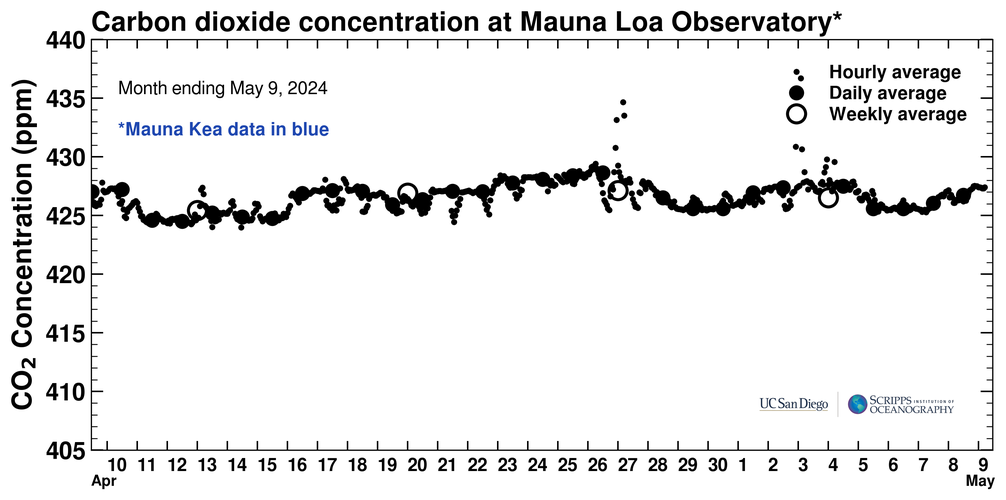
symbolset writes "Over the past month a number of individual observations of CO2 at the Mauna Loa Observatory have exceeded 400 parts per million. The daily average observation has crept above 399 ppm, and as annually the peak is typically in mid-May it seems likely the daily observation will break the 400 ppm milestone within a few days. This measure of potent greenhouse gas in the atmosphere should spark renewed discussion about the use of fossil fuels. For the past few decades the annual peak becomes the annual average two or three years later, and the annual minimum after two or three years more."
Graphs of natural phenomena are rarely linear. This is true for global temperature... this graph of average global temperatures, however, very clearly shows a trend. Picking small sections of data (portions of a graph) whilst ignoring the rest to try and make a point is scientifically dishonest at best (and wrong/completely inaccurate at worst).
"False hope is why we'll never run out of natural resources!" - Lewis Black
The Muana Loa observatory measures only at night, when air is descending from far up high. That air has come from across the Pacific Ocean, far from any specific CO2 sources.
At night, the volcanic gasses are trapped in a thin layer near the ground by a temperature inversion. The observatory measures the air at several towers at different altitudes and also closer to the volcano so as to get a comparative reading.
You can read more in this report.
"We mustn't be caught by surprise by our own advancing technology" -- Aldous Huxley
You can't make predictions when a human factor is involved. If we were all controlled by a hivemind and made CO2 decrease our highest priority, stopping CO2 production could be done in 20 years (there's enough nuclear power to sustain our needs, and we have electric vehicles - technologically it's already possible). After that, the oceans would absorb the excess CO2 and bring it below 300ppm in about 300 years (according to a study I sadly can't find now). So absent some miracle like fusion reactors even in a best case scenario it would take at least 150 years to get below 350.
But the most important thing is the human factor which depends on our decisions, and can make that time much much longer.
Once again I am saddened by The depths to which the Slashdot community has fallen. This used to be a technology site. Technology that could not happen without extremely advanced science. And yet here you are, questioning global warming and the effect of human induced rises in CO2 levels. This stuff has been studied for going on 125 years. There is no doubt what has happened, what is happening, and what will happen. It's Grade School physics for goodness sakes. We should be the ones leading the charge to shift away from Fossil Fuels before great harm to our civilization becomes inevitable. But here we are, mired in the same ridiculously simplistic arguments about stuff that has been proven or disproven by science over and over. This isn't a matter of science being wrong, it is a matter of society not being allowed to trust a very small subset of scientists because they threaten a very profitable economic paradigm. Eventually, that will turn, I hope not before it is too late to avoid catastrophe.
Once again I am saddened by The depths to which the Slashdot community has fallen. This used to be a technology site. Technology that could not happen without extremely advanced science.
As long as I've been here, it's been a technophile site for advertisting consumer electronics.
This isn't a matter of science being wrong, it is a matter of society not being allowed to trust a very small subset of scientists because they threaten a very profitable economic paradigm.
You've hit the nail on the head. The Slashdot community as a whole touts the virtues of science, unless it's the kind of science that discovers the uncomfortable reality about capitalism and unlimited economic growth. Then they go apeshit and cover their ears as if it makes the evidence go away.
I'm not weighing in on this "debate", but the temperatures in the UK are artificially warm because of the ocean currents. Compare the UK to other regions of similar latitude to demonstrate this. If those ocean currents are disrupted by larger climate changes, expect to see the UK and most of western Europe get much colder overall, even though the global temperatures may be higher.
Being coastal and bounded on the west by an ocean, I wouldn't be surprised if Alaska is in the same situation.
If you want a vision of the future, imagine a youtube comments section scrolling - forever.
Sometimes, trying to remain undecided just isn't an option. At least, not a morally acceptable one. In this case, whatever we do or don't do will have a profound impact on the lives of billions of people. So how do you respond? Well, there are a few options:
1. "This is a really important issue, so I'm going to study the science involved. That'll take a lot of work, but this issue is so important I have a responsibility to do it."
2. "I don't have time to study the science involved and really understand it. Therefore, I'll accept the judgement of the people who do study it."
3. "I don't have the time or interest to study this issue and form an educated opinion, but I don't really want to accept anyone else's opinions either. Therefore I'll just use this as an opportunity to look down on people on both sides of the issue."
I submit that what you are doing is basically #3. I also submit that in this case, that's a morally reprehensible way to respond.
Also note my signature quote, which is remarkably appropriate to this topic.
"I'm too busy to research this and form an educated opinion, but I do have time to tell everyone my uninformed opinion."
Presumably you're referring to "scientists." Also, I've repeatedly said:
Since climate is an average over ~20 years ... climate is only meaningful when discussing averages over ~20 years. ... I've repeatedly stressed that we need ~20 years to average out weather noise. ... professional climatologists usually smooth data and model output using ~20 year averages. ... It's also important to remember that a ~20 year timespan is necessary to obtain statistically significant temperature trends...
In fact, I've repeatedly told you that ~20 years are needed:
As I've explained, climate is the global average over ~20 years. [Dumb Scientist to Jane Q. Public, 2010-02-16]
This graph shows why scientists prefer trends calculated over at least ~20 years. [Dumb Scientist to Jane Q. Public, 2013-01-21]
I've even gone into more detail, showing you a paper that says at least 17 years are required:
Of course, you ignored me just like you previously ignored riverat1:
And 10 years has what to do with climate trends? Not much. A recent paper by Santer et. al. calculated the signal (climate) to noise (weather/natural variation) ratio for climate trends. For 10 years the S/N ratio is less than 1. They found it takes 17 years to be sure the signal is greater than the noise. [riverat1 to Jane Q. Public, 2011-11-19]
For global temperatures, Santer et al. 2011 shows that one needs to average over ~17 years of data to obtain statistically significant climate trends. Here's another explanation by Tamino. Also, the Skeptical Science trend calculator helps visualize statistical significance. [Dumb Scientist, 2012-08-15]
Perhaps your ode to conspiracy theories distracted you, but I also linked to another method of calculating significance which is even more conservative:
Also, Bart