Slashdot Mirror


Observed Atmospheric CO2 Hits 400 Parts Per Million

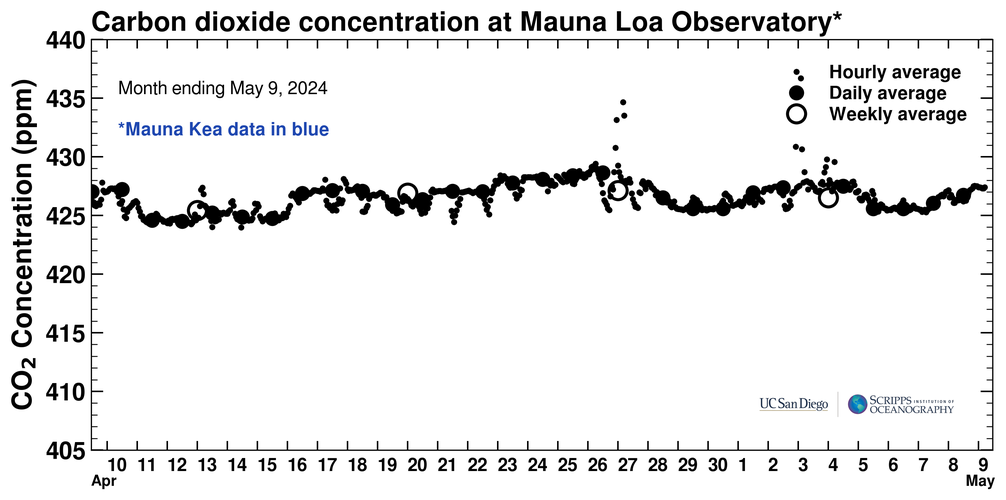
symbolset writes "Over the past month a number of individual observations of CO2 at the Mauna Loa Observatory have exceeded 400 parts per million. The daily average observation has crept above 399 ppm, and as annually the peak is typically in mid-May it seems likely the daily observation will break the 400 ppm milestone within a few days. This measure of potent greenhouse gas in the atmosphere should spark renewed discussion about the use of fossil fuels. For the past few decades the annual peak becomes the annual average two or three years later, and the annual minimum after two or three years more."
260 of 367 comments (clear)

  1. Yawn by DoofusOfDeath · · Score: 3, Insightful

    This measure of potent greenhouse gas in the atmosphere should spark renewed discussion about the use of fossil fuels.

    No it won't. It's not like politicians and the public have been just sitting on the sidelines, waiting util a value about 400 PPM was observed. I don't believe the public really doubts that atmospheric CO2 is increasing, and so a wonky measure of it is pretty irrelevant to public sentiment.

    1. Re: Yawn by cplusplus · · Score: 4, Insightful

      Graphs of natural phenomena are rarely linear. This is true for global temperature... this graph of average global temperatures, however, very clearly shows a trend. Picking small sections of data (portions of a graph) whilst ignoring the rest to try and make a point is scientifically dishonest at best (and wrong/completely inaccurate at worst).

      --
      "False hope is why we'll never run out of natural resources!" - Lewis Black
    2. Re: Yawn by tmosley · · Score: 3, Insightful

      I like how the chart at the end actually looks a lot more like a peaking temperature. They set up a strawman to make "skeptics" look ridiculous by having them "believe" that temperature was flat while it was rising. That ridiculous fake argument masks the fact that they are doing a linear extrapolation, and that that extrapolation is pulling away from the moving average. And we all know how linear extrapolation always works as a predictor, right? That's why the DOW is now at 72,000 and Pets.com is the powerhouse of the world economy. Also why my Dad has 11,300 wives.

      Of note is that that temperature chart looks a LOT like a log chart of planetary industrial output, which has leveled off in recent years. Almost as if the warming hasn't come from a persistent gas who's concentration continues to rise even as production falls, but by a transitory gas that is forced into higher concentrations by continuous industrial output, but which falls quickly with falling production and actually works as a significant greenhouse gas. You know, water vapor. The other product of combustion.

      But that doesn't mean that CO2 isn't a problem. It is a world-killing problem, but not because of some stupid idea like global warming. It is OCEAN ACIDIFICATION that will destroy us all, not balmy temperatures and poorly defined "increases in violent weather". Might want to stock up on canned tuna.

    3. Re: Yawn by Snocone · · Score: 1, Insightful

      Any reconstruction less than Milankovitch cycle scale is cherry-picking. Your link to three decades is not qualitatively superior to the decade and a half of standstill enough to in any way merit "completely false".

      For a particularly fascinating recent paper calling the hypothesis of C02 driving into question, check out:

      http://www.clim-past.net/9/447/2013/cp-9-447-2013.pdf

      Six identified oscillations with NO -- repeat, NO! -- parameter fitting result in an almost spooky close match to instrument records. Not a single model used in any of the IPCC reports can produce backcasting even laughably comparable to that.

      And as an extra bonus, unlike the alarmists who appear to consider no actual observation whatsoever a possible falsification, which makes them priests and not scientists, you will note on page 451 that we have a very specific testable prediction of this theory, namely that temperatures have just begun to freefall in a mirror image of the 70s-90s period where why yes the slope of C02 concentration did coincide with temperature rise for a couple decades. If temperatures don't keep plummeting as this paper predicts, I'll cheerfully agree in a year or two they were clearly wrong. If the global anomaly does drop by half a degree over the next decade or so as this model implies and no CAGW supporter I am aware of admits as a possibility currently, will you agree that they've got climate drivers identified substantially correctly and the idea that 400 parts per million of something had any chance of primarily driving any positive feedback process always was as ridiculous as those of us who are numerate figured out at first glance?

    4. Re:Yawn by thereitis · · Score: 1

      This year I've heard 3 people I know say in passing "so much for global warming" because of the abnormally cold weather we're getting this season. Can someone offer a short and simple explanation for why abnormally cold weather doesn't mean "global warming is a myth"?

    5. Re: Yawn by I'm+New+Around+Here · · Score: 2

      So you're saying World War II stopped, and even reversed, global warming for decades? Great, now we know what he have to do to save the planet. Bomb it into submission again.

      --
      If you think I voted for Trump because of this post, you're wrong. I voted for Dr. Jill Stein of the Green Party. Again.
    6. Re:Yawn by Anonymous Coward · · Score: 1

      Because denier, Koch Brothers, corporate shill, other liberal name-calling, shut up that's why.

    7. Re:Yawn by PPH · · Score: 1, Insightful

      Can someone offer a short and simple explanation for why abnormally cold weather doesn't mean "global warming is a myth"?

      No.

      Because our understanding of atmospheric thermodynamics is pathetically incomplete. Someone might be able to outline one of many hypothesis in simple terms. But the odds are that it will be short lived as scientists discover yet one more factor that they hadn't thought of yet.

      Atmospheric science is interesting and is a field worthy of further study. But we are nowhere near using it to make any sort of useful predictions, let alone as the basis for economic policy.

      --
      Have gnu, will travel.
    8. Re: Yawn by haruchai · · Score: 3, Interesting

      From your linked PDF - "The agreement of the reconstruction of the temperature history using only the six strongest components of the spectrum, with M6, shows that the present climate dynamics is dominated by periodic processes. This does NOT rule out a warming by anthropogenic inuences such as an increase of
      atmospheric CO2
      (bolding and emphasis mine)

      All the records examined in this paper were in a time period where GHG levels were significantly lower than at present and the dominant climate forcings would have been natural ones such as insolation, and volcanic eruptions.

      Our use of fossil fuels have complicated the issue by adding significantly large amounts of both warming and cooling agents into the mix. But a net positive heat balance cannot simply be handwaved away into a "periodic oscillation". The heat has to go somewhere and wherever that may be, it will have an impact.
      Whether or not the impact is significant and long-term is a longer discussion.

      --
      Pain is merely failure leaving the body
    9. Re: Yawn by budgenator · · Score: 2, Interesting

      skepticalscience.com is completely unreliable source, they make non-trivial edits to posts after comments have began, they edit user comments and delete user comments without reference.

      --
      Apocalypse Cancelled, Sorry, No Ticket Refunds
    10. Re:Yawn by Anonymous Coward · · Score: 1

      Can someone offer a short and simple explanation for why abnormally cold weather doesn't mean "global warming is a myth"?

      Basic Physics: CO2 acts as an insulating blanket on any planet. More CO2 means more heat retention. However, there are other factors which may add to or subtract from any greenhouse effect. But we can be pretty confident that over time, CO2 will push things seriously in one direction rather than another.

    11. Re: Yawn by Snocone · · Score: 2, Insightful

      Nobody rational disputes that anthropogenic C02 will have a primary warming effect.

      In exactly the same fashion that nobody rational disputes that anthropogenic H20 will raise the ocean level when I spit into it.

      That the magnitude of this effect is concerning -- or even observable! -- any more in the first case than the second, that is unproven and looking less likely all the time as evidence accumulates that the solely positive feedbacks that IPCC-selected models assume are just not in accord with reality.

    12. Re:Yawn by Bengie · · Score: 2, Informative

      Just remind them of the thousands of record highs set in the past few years all around the world. For every small increase in average temps caused by global warming, larger extreme temperatures are seen throughout the year. Higher highs and lower lows but an overall average of warmer.

    13. Re:Yawn by WSOGMM · · Score: 1

      This measure of potent greenhouse gas in the atmosphere should spark renewed discussion about the use of fossil fuels.

      No it won't. It's not like politicians and the public have been just sitting on the sidelines, waiting util a value about 400 PPM was observed. I don't believe the public really doubts that atmospheric CO2 is increasing, and so a wonky measure of it is pretty irrelevant to public sentiment.

      I think you misinterpreted the use of "should" there. It's not that it should happen, as in it likely will happen, it's just we have an obligation to do it.

      People have HEARD (and accept) that we're pumping too much CO2 into our atmosphere, but very few people have taken serious effort against it. As I'm sure many slashdotters would agree (hopefully I'm not stretching myself too far here), renewed discussion of fossil fuels in public forums, media and government needs to happen. Our population is large enough to affect an entire planet. Following our reckless impulses and immediate desires is NOT an option, and we should work [our asses off] to change that.

    14. Re: Yawn by Billly+Gates · · Score: 2

      Here is another source showing global warming slowing down and even reversing some cases!

      I am a former Alaskan. Tell that to the Alaskans where May first 60 degree days hit and leaves start appearing on the trees when it just hit 4 a night or two ago and the snow hasn't even melted yet?

      Before you say climate != weather, check this graph out? For 13 years straight it has persistently getting colder. The UK is getting colder every year as well. The climate of the world did get warmer starting in the 1970s but it is reversing now. It is not just Alaska or the UK.

      I think our calculations on CO2 are way off.

    15. Re: Yawn by dcherryholmes · · Score: 3, Insightful

      DAILY MAIL ALERT!

    16. Re: Yawn by Luckyo · · Score: 1

      And its extremely worrying as it fits the model to a tee. Golf Stream is powered by osmosis, which requires glaciers not to melt too much so that fresh water from them doesn't weaken the osmotic reaction. Glaciers melt as environment heats up. Every year they melt and re-freeze. But they melt more and more and re-freeze less and less.

      The really bad outcome of this scenario would be near-stoppage or full stoppage of Golf Stream, which would push tundra line several hundreds of kilometers south across entire Northern Europe and severely heating up US East Coast. It would be a massive environmental shock.

    17. Re: Yawn by chihowa · · Score: 4, Informative

      I'm not weighing in on this "debate", but the temperatures in the UK are artificially warm because of the ocean currents. Compare the UK to other regions of similar latitude to demonstrate this. If those ocean currents are disrupted by larger climate changes, expect to see the UK and most of western Europe get much colder overall, even though the global temperatures may be higher.

      Being coastal and bounded on the west by an ocean, I wouldn't be surprised if Alaska is in the same situation.

      --
      If you want a vision of the future, imagine a youtube comments section scrolling - forever.
    18. Re:Yawn by the+eric+conspiracy · · Score: 1

      One season of locally cold weather is a simple fluctuation. You need to consider all the data.

      http://usnews.nbcnews.com/_news/2013/01/08/16413805-noaa-2012-was-warmest-year-ever-for-us-second-most-extreme?lite

    19. Re:Yawn by LordLimecat · · Score: 2

      THats partly because of idiots who last year said "See? Global warming" when we had abnormally warm weather.

      You make your bed, you lie in it.

    20. Re:Yawn by Jane+Q.+Public · · Score: 1, Insightful

      "For every small increase in average temps caused by global warming, larger extreme temperatures are seen throughout the year. Higher highs and lower lows but an overall average of warmer."

      That was the argument... 10 years ago.

      Things have changed.

      "Anthropogenic Global Warming" (AGW) advocates repeatedly and consistently stated that a trend of 10 years or more proved their point... now they're saying that a slump in warming of 17 years means nothing.

      That kind of hypocrisy just chaps my ass.

    21. Re:Yawn by symbolset · · Score: 1

      And yet here we are: discussing it.

      --
      Help stamp out iliturcy.
    22. Re:Yawn by OFnow · · Score: 1

      THats partly because of idiots who last year said "See? Global warming" when we had abnormally warm weather.

      It was not climate scientists saying such silly things last year, it was media and ordinary folks. Somehow the climate science prediction that local variability will increase in many places gets ignored, often by people trying to discredit the warming, sometimes by people just not wanting to understand.

    23. Re: Yawn by budgenator · · Score: 1

      The thing is called Climate Sensitivity, what it means is how much will the Earth's average temperature increase for each doubling of the CO2, and that number is looking like it's somewhere between 1.8 and 2.4, 2 seems most likely. We're at 400 ppm CO2, to add 2 degree's we'd need to get our CO2 up to 800 ppm, 4 degrees needs 1600 ppm and 6 degrees needs 3200 ppm CO2; I'm not sure that the effect of anthropgenic CO2 is strong enough right now to be visible in the background of natural variation.

      --
      Apocalypse Cancelled, Sorry, No Ticket Refunds
    24. Re:Yawn by BasilBrush · · Score: 2, Interesting

      "Can someone offer a short and simple explanation for why abnormally cold weather doesn't mean "global warming is a myth"?"

      No.

      Then you probably shouldn't be entering into the discussion at all as you don't know the basics. Global warming refers to climate. "Abnormally cold weather" is weather. They are completely different things.

      Weather happens at a particular place at a particular time. Climate is an average of weather over a large geographical area over a long period of time. Typically 30 years.

      The two are as different as instantaneous speed of a car, and the average speed of a car over it's entire lifetime.

    25. Re:Yawn by meta-monkey · · Score: 2

      Yes.

      Warmer global temperatures have caused a massive loss in arctic ice. Warm water extends farther north this year than it ever has before. The high pressure stationary air masses that form over this water extend into the North Pacific and North Atlantic. In years past, the jet stream (the west to east moving flow of cold air around the poles) would have encountered colder, low pressure air over ice and moved on through. Instead it encounters the high pressure warm air in the north pacific, gets squeezed up around the air mass and all that cold polar air pushes far down into North America before it can squeeze back up around the warm air mass in the North Atlantic.

      It's funny, because I would get annoyed in years past when people would say, "it's hot! Must be global warming!" Or "it's cold! So much for global warming!" Or blame GW for specific storms like Katrina or Sandy, when those are just weather events, and not climate. But, this cold spring is the first time I think you can really say, "this is a changed climate due to global warming."

      Increased global average temperature -> loss of arctic ice -> warm air mass over water in the northern oceans -> cold polar jet stream air pushed further south -> cold springs in North America. And it'll happen every year, and that's climate, and that's a change.

      --
      We don't have a state-run media we have a media-run state.
    26. Re:Yawn by Bartles · · Score: 1

      Because they are so used to hearing how abnormally warm weather is proof that gloabl warming exists.

    27. Re:Yawn by Mashiki · · Score: 1, Interesting

      Weather happens at a particular place at a particular time. Climate is an average of weather over a large geographical area over a long period of time. Typically 30 years.

      Ah yes, the typical 30 year period. Where in most places there weren't even measurements in place. And the said averages, were made by guesstimates from nearby areas. Never mind that when this part of the world(North America) was being settled, that the winters were so severe on the east coast that people were freezing to death, and many believed that this was the land where "winter never ended." Or that a few hundred years prior to that, it was so warm in the same areas that it caused massive population booms, and settlements.

      30 years is so small a period of time, that pissing up wind would be a better indicator of when it was going to rain next.

      --
      Om, nomnomnom...
    28. Re:Yawn by BasilBrush · · Score: 1

      THats partly because of idiots who last year said "See? Global warming" when we had abnormally warm weather.

      There are idiots that say that. And there are idiots that look at a cold year and say "See there's no such thing as Global Warming". Idiots say stupid things. News at 11.

      Climate scientists on the other hand have consistently said it's only once you get to periods exceeding 30 years that weather variability gives way to climate.

    29. Re:Yawn by BasilBrush · · Score: 1

      Are you really trying to argue against scientific data with third hand anecdotes?

      30 years is so small a period of time, that pissing up wind would be a better indicator of when it was going to rain next.

      A 30 year average gets you a reasonable measure of climate. Climate TRENDS are of course measured over much longer.

    30. Re:Yawn by BasilBrush · · Score: 1

      This isn't a discussion, it's contradiction.

    31. Re:Yawn by The+Master+Control+P · · Score: 1

      Because "weather" is not "climate."

      Weather is what it is out right now. Feel free to dig through graphs of past temperature records, and you can satisfy yourself that no day of the year will have the same temperature, humidity, rainfall, or anything graph on two successive years. Climate is the time-averaged expectation value and ignores anything on shorter than several year scales at the very least.

      It's not even that simple, as there are many characteristic timescales involved in the climate, not just one. For example, the pacific decadal oscillation and atlantic mean oscillation occur over decade timescales and have an enormous impact on rainfall levels throughout north america.

    32. Re: Yawn by BasilBrush · · Score: 1

      Fantastic. They say a picture paints a thousand words. This animated GIF is all that needs to be said on this topic. I may just cut'n'paste it in future to save time.

      http://www.skepticalscience.com/graphics/Escalator_2012_500.gif

    33. Re: Yawn by tnk1 · · Score: 1

      I'd have to agree. Whether or not human-derived climate change is going to turn us into Venus is going to depend a lot on how much it takes to overcome the processes that have come about to regulate CO2 over time.

      Thus, even if we were pumping eventually fatal amounts of CO2 into the atmosphere at this time, there is probably a natural buffer which can partially, or even totally reverse the harmful effects, as long as their capacity is not exceeded. If it does not overcome the buffer, then we will not have a problem. If it does overcome these limits, then change may well accelerate out of control until some other point of equilibrium is reached. That next point could be close enough to maintain close to the status quo or it could be so far out that we end up with a really bad situation.

      For instance, someone stated that cell walls in plankton just increase in thickness if there is more CO2 available. This is probably true, and would represent a natural buffer for plankton to deal with variances in CO2 emissions. And after all, since some volcanic eruptions can throw a whole lot of CO2 and other greenhouse gasses into the air, such a buffer would seem likely to evolve after millions and billions of years.

      However, one could conceive of an amount of CO2 where either the cell walls no longer can grow any more, or alternately, the cell wall thickness gets to a point where it actually has a negative effect on plankton itself. If we eventually reach a point where our emissions are actually worse, on average, than the long term effects of a huge volcanic eruption or other likely sort of natural catastrophe, then all bets are off for naturally evolved buffers being able to cope.

    34. Re:Yawn by hey! · · Score: 1

      I don't believe the public really doubts that atmospheric CO2 is increasing, and so a wonky measure of it is pretty irrelevant to public sentiment.

      I have my doubts about both these assertions.

      The persuasion game works like state lottery commissions claim their games work: you can't win if you don't play. In the Internet age it's impossible to drive a stake through the heart of a crackpot theory; people assemble into self-reinforcing communities which preserve and spread fringe ideas until they're no longer so fringe. Take scientific racism; it was a museum-piece article of crankery when I went to school in the 80s, but all those sloppy, half-baked papers from the 1930s have gained a new life on sites like Stormfront. It's the whole epistemic bubble thing; people take comfort in the company of like-minded people, and crackpots are not excluded from that. They'll keep their ideas alive, and if scientific consensus absents itself from the debate platform for long enough they'll take the opportunity to create a new generation of true believers.

      Now as for the whole round number milestone thing, it's a occasion to stay in the persuasion game. It's an opportunity to inform the people who have other things to think about in their lives that the problem hasn't gone away just because the media attention has died down somewhat. Yes, there's certain arbitrariness to the round number chosen. If we had eight, or eleven fingers, we'd be observing a somewhat different milestone, but the exact number doesn't really matter. What matters is that the issue is periodically brought up before the public so that the debate can be aired again.

      --
      Post may contain irony: discontinue use if experiencing mood swings, nausea or elevated blood pressure.
    35. Re: Yawn by Luckyo · · Score: 1

      To specify on original post, the name in many languages ranges from "Golf" to americanized "Gulf".

      For example, finnish wikipedia: https://fi.wikipedia.org/wiki/Golf-virta

      (virta translates as "stream" in english).

    36. Re:Yawn by Artifakt · · Score: 1

      Tell me, do you go into court and challenge eyewitnesses because they couldn't have seen a thing on a planet that's always half dark?

      --
      Who is John Cabal?
    37. Re:Yawn by flyneye · · Score: 1

      Wait a minute, is there something I've been missing out on here? Should you take atmospheric tests for CO2 from just one spot, a volcanic spot? Or should it be taken and averaged over several points on the planet?
      I admit to not knowing much about this, but isn't it akin to taking readings from the exhaust of a semi-truck, rather than a good random sample of traffic? Or even taking a Semi-truck reading in New Jersey to apply to Montana?

      --
      *Repent!Quit Your Job!Slack Off!The World Ends Tomorrow and You May Die!
    38. Re: Yawn by Anonymous Coward · · Score: 1
    39. Re:Yawn by CrimsonAvenger · · Score: 1

      It's funny, because I would get annoyed in years past when people would say, "it's hot! Must be global warming!" Or "it's cold! So much for global warming!" Or blame GW for specific storms like Katrina or Sandy, when those are just weather events, and not climate. But, this cold spring is the first time I think you can really say, "this is a changed climate due to global warming."

      So, do you get annoyed when you do the same thing as those people saying "it's hot! Must be global warming!" or "it's cold! So much for global warming!"?

      Because that's what you just did when you wrote "But, this cold spring is the first time I think you can really say, "this is a changed climate due to global warming.""

      This spring was weather. If you see a similar pattern repeated for the next 20 or so springs, we can start to talk about CLIMATE change.

      --

      "I do not agree with what you say, but I will defend to the death your right to say it"
    40. Re:Yawn by CrimsonAvenger · · Score: 1

      This isn't a discussion, it's contradiction.

      Contradiction is down the hall....

      --

      "I do not agree with what you say, but I will defend to the death your right to say it"
    41. Re:Yawn by symbolset · · Score: 1
      --
      Help stamp out iliturcy.
    42. Re:Yawn by meta-monkey · · Score: 1

      That's the point. Warming changed the flow of the jet stream, and it will happen again next year and again and again. The cold spring this year (and the cold spring we'll get next year) was due to a changed climate and is not just a weather event.

      --
      We don't have a state-run media we have a media-run state.
    43. Re:Yawn by dodobh · · Score: 1

      This needs paper and pencil, but it's an easy explanation (even if imperfect).

      If you draw a graph of temperature vs time, you will see a wave pattern emerge over a few years. Global warming implies that there is more energy in the atmosphere, so the amplitude of the wave will increase. This means summers get hotter and winters get colder.

      The scientific debate is about how much of an amplitude change will result, and what the consequences of that will be (we don't know this yet).

      --
      I can throw myself at the ground, and miss.
    44. Re:Yawn by speederaser · · Score: 1

      Wait a minute, is there something I've been missing out on here? Should you take atmospheric tests for CO2 from just one spot, a volcanic spot?

      Weather patterns combined with the jet stream keep the atmosphere well-mixed and fairly homogeneous, especially at high altitude. That's why the recording station is on Mauna Loa:

      Mauna Loa was originally chosen as a monitoring site because, located far from any continent, the air sampled is a good average for the central Pacific. Being high, it is above the inversion layer where most of the local effects are present.

      Volcanoes don't emit just CO2, they also emit other detectable gasses which can then be used to determine if the volcano is contaminating the measurements:

      The contamination from local volcanic sources is sometimes detected at the observatory, and is then removed from the background data.

    45. Re:Yawn by ultranova · · Score: 3, Insightful

      Atmospheric science is interesting and is a field worthy of further study. But we are nowhere near using it to make any sort of useful predictions, let alone as the basis for economic policy.

      And we never will. No amount of evidence can prove something you don't want to believe, especially if the cost of believing it comes right now while the cost of not believing it comes later. So as long as fossil fuels remain cost-effective, no amount of evidence can ever prove that they do harm - evidence only becomes sufficient after we've switched to something else.

      Add the tendency of people to think of arguments in terms of victory or defeat, and it makes one wonder if humanity is really suited for a technological civilization where decisions have farther reaching consequences than the pecking order of the pack. Hunter-gatherers can afford this level of self-delusional bullshit since they can just pick up and leave if they screw up bad enough, but we can't.

      --

      Forget magic. Any technology distinguishable from divine power is insufficiently advanced.

    46. Re:Yawn by martinX · · Score: 1, Informative

      The IPCC’s Fifth Assessment Report suggests that the Earth will warm rapidly in the 21st century. However, this is not being borne out by observations.

      No-one disputes that the earth's atmosphere is warming - this has been going on for some time now. What is disputed is the contribution that human activity makes to the degree/acceleration/rapidity of warming. The original models had man's contribution to an increase in warming as minimal at best. Then the IPCC re-jigged the models to take into account the theory that CO2 (and other emissions) would cause a climate forcing, i.e. the effect of the increasing CO2 levels would not be linear but would drive GW at a much higher rate than what would be expected naturally. These models have all predicted rapidly increasing global temperatures with no pausing. In order to account for small variations in the annual results, the IPCC et al initially said you needed 10 years of no warming to invalidate the models. Then as 10 years got close, that became 15 years.* Then 17 years. That has now come to pass. Even the most conservative of models do not match the observed results, therefore it's time to revisit the modelling.

      *"The simulations rule out (at the 95% level) zero trends for intervals of 15 yr or more, suggesting that an observed absence of warming of this duration is needed to create a discrepancy with the expected present-day warming rate. From: http://www1.ncdc.noaa.gov/pub/data/cmb/bams-sotc/climate-assessment-2008-lo-rez.pdf
      It's a very large PDF.

      --
      When they came for the communists, I said "He's next door. Take him away. Goddam commies."
    47. Re:Yawn by Mashiki · · Score: 1

      Are you really trying to argue against scientific data with third hand anecdotes?

      Third hand huh? I guess that's why it's considered historical fact.

      A 30 year average gets you a reasonable measure of climate. Climate TRENDS are of course measured over much longer.

      No it doesn't, and if you want to look at that data. You'll see that we've been in a cooling trend for the last 10 years. 30 years isn't reasonable, not even close. It would be the same as saying, the last 10 years are the sum total of human history. Climate trends themselves are uniquely flawed in their own right.

      --
      Om, nomnomnom...
    48. Re: Yawn by Anonymous Coward · · Score: 1

      Its called climate change because global warming was not cutting it any longer just like global cooling wasnt cutting it anymore before that.

      change it to climate change and TA-DA! Now whatever happens its our fault!

    49. Re:Yawn by BasilBrush · · Score: 1

      It's not clear whether you think the usual 30 year minimum for reference to climate rather than weather is too long or too short. It reads like you are arguing both.

      I'd suggest climate scientists know rather better than you do either way. That at least is not up for debate, especially not by amateurs.

    50. Re: Yawn by ganjadude · · Score: 1

      how about we just plant more trees and stop deforestation. That will scrub the CO2

      --
      have you seen my sig? there are many others like it but none that are the same
    51. Re:Yawn by ganjadude · · Score: 1

      you DO know AGW advocates = global warming believers, there are a butt load of people who dont believe in AGW. Sure they believe in climate change, they deny that people are the cause, or even if they are that the results are negligible.

      --
      have you seen my sig? there are many others like it but none that are the same
    52. Re:Yawn by BasilBrush · · Score: 1

      Did you have a point to make other than not realising the difference between actual measured climate (real world, single time line, unrepeatable), and models - (run them over and over again.)?

    53. Re:Yawn by ganjadude · · Score: 1

      I kind of feel like the discussion has never ended let alone "needs to be started". We got CAFE requirements, "carbon credits" and other efforts put forward. I saw an article about a single pickup that got stuck in the sand overnight and the environmentalists freaked out over it. If that is how things are before the discussion "gets started" than I hate to see what happens when it does start.

      --
      have you seen my sig? there are many others like it but none that are the same
    54. Re:Yawn by martinX · · Score: 1

      Climate scientists on the other hand have not consistently said it's only once you get to periods exceeding 30 years that weather variability gives way to climate.

      --
      When they came for the communists, I said "He's next door. Take him away. Goddam commies."
    55. Re: Yawn by Kernel+Kurtz · · Score: 1

      Picking small sections of data (portions of a graph) whilst ignoring the rest to try and make a point is scientifically dishonest at best (and wrong/completely inaccurate at worst).

      So why did you post a graph of only 130 years then?

    56. Re: Yawn by Old+Wolf · · Score: 1

      skepticalscience.com is completely unreliable source, they make non-trivial edits to posts after comments have began

      So they fix mistakes pointed out by commentors. How terrible.

      Of course it would be even better if they retained a change history.

    57. Re: Yawn by Billly+Gates · · Score: 2

      That's within warming predictions. Local climate isn't global climate. Global warming may lead to local cooling. Your misunderstanding of the issues doesn't prove them wrong.

      Well it has changed since you left. Glacierazation is increasing as the peaks around Anchorage have not melted in 3 years as each summer is a record cold and raining one consistently since 2000.

      Alaska is considered the Canary in the coal mine. In the 1990s it warmed up in the interior first before the world. Now the permafrost line is reversing and tundra ponds in the west are increasing for the first time in 25 years as the permafrost is thinner in the summer than previous years. If Alaska stays colder longer (with Northern Canada, Europe, and Asia) the snow will reflect the heat back into space and cool it down further south. Eventually it will grow into an ice age. During the end of the last ice age surprising Alaska had many ice free peaks with Tundra vegetation and it warmed up first and spread around as the excess heat from the lack of snow melted the glaciers.

      The question is the cause related to fresh water melt freezing the sea and reflecting heat back into space? Or something else? This could be a natural response to warming as the cooler air from Alaska made its way to the lower 48 and created snow in May! Snow cover again cools things down considerable.

    58. Re:Yawn by amiga3D · · Score: 1

      I think most people realize that climate change is real. I think maybe they disagree most on the potential effects and if there really anything realistic to be done about it. You can debate all you want but until someone comes up with a real alternative to fossil fuel we're going to continue using it. Nuclear looked promising but it is a little too scary lately thanks to Chernobyl and Fukushima.

    59. Re: Yawn by HiThere · · Score: 1

      Ok. Where do you plant these trees? It has to be somewhere that isn't already forest, or there's no net gain. And it has to be somewhere that has sufficient soil and water available for the trees to live. And you need to continue doing this to counteract the continued use of coal and oil.

      And the trees are only strong carbon consumers while they are growing. So you'll need to log them off periodically, and store the wood somewhere where it won't get burned.

      It's not that I don't think what you are recommending is a good idea, it's that I can't imagine it being done at a sufficiently large scale.

      --

      I think we've pushed this "anyone can grow up to be president" thing too far.
    60. Re:Yawn by HiThere · · Score: 1

      Caution, I'm not an expert in this field. However, to the gp, any short and simple explanation will be a lie.

      I'm not convinced it's that simple. I think the level of CO2 may have already risen to the point where the atmosphere is almost totally opaque at the wavelengths that CO2 blocks, at which point an increase in CO2 ceases to cause in increase in temperature, because it's already blocked that spectral hole solit. At this point Methane may be more significant. And, for that matter, various sulfates, which act as coolants by blocking insolation.

      It's also true that temperatures changes are spread around unevenly. What you observe in one locality doesn't have much in the way of global implications. (Or rather, it does, but it only makes sense in a larger context.)

      So you may have been cold this last year, but I sure haven't. This is one of the milder winters I can remember, and spring has already started turning into summer. The newspapers are calling last year the driest on record. (I haven't checked. This may be hyperbole.) Wildfires have already started in places where they don't traditionally occur until late summer or autumn.

      But guess what? MY experience is also local. It also doesn't mean anything globally until you fit it into the larger context. And there's no simple way to do this. Even the experts argue about the exact meaning of each change, and aren't certain.

      Any short and simple explanation will be a lie.

      --

      I think we've pushed this "anyone can grow up to be president" thing too far.
    61. Re:Yawn by HiThere · · Score: 1

      I doubt your claim of consistency. I grant that the effects that you describe exist, but I expect different years will produce different patterns. I think you have accurately described the average change.

      P.S.: While I think you have accurately described the average change, I'm not convinced that no additional factors will be noticed, and assume increased significance, in the future. E.g., after all the ocean ice has melted, oceanic currents may re-route themselves. Or there may be other changes.

      --

      I think we've pushed this "anyone can grow up to be president" thing too far.
    62. Re:Yawn by Jane+Q.+Public · · Score: 1

      "Your link to The Australian confirms that at least 30 years data is required to judge climate trends. This is what every person who is informed about climate has been saying all along."

      It confirms only that Pachauri is contradicting what the "warmists" said for years. You're trying to say that they didn't? Ridiculous.

      "I don't know who AGW 'advocates" are. The only people I've seen advocating it are a few unthinking right wingers from cold climates."

      Okay. "Advocates of Anthropogenic CO2-based Global Warming Theory". There. Fixed it right up for you. But somehow I doubt most other readers will have the same difficulty understanding.

      "That aside, what you say is simply the opposite of the truth... and climate scientists who have shown the long term trends..."

      Hahahahahahahahahahahahahaha!!! Their "long-term trends", in re: AGW, were limited to a period no longer than the recent "slump" in warming. Let's be clear: I am referring to ANTHROPOGENIC warming theory. We know it has been getting warmer. Nobody I know is questioning that. They PREDICTED long-term trends. And they certainly tried to show that it has been a long-term trend. But their models have fallen flat.

      You may not remember all the claims that "a few years do not make climate, we need at least 10 years of data..." but I sure do.

      Doesn't it bother you that even IPCC admits to a "17-year lack of warming", yet CO2 has continued to steadily rise? It doesn't fit their model, man. And they even admit that they can't explain why.

      If their "long term trend" models were accurate, then where did the warming go?

      Here's just one example. You can Google it. In 2008, NOAAâ(TM)s State of the Climate report said "15 years or more without warming would indicate a discrepancy between the models and measured reality."

      We've had those 15 years, plus a couple. According to the IPCC itself. The Met Office (you DO know who they are?) projected that there would be no warming until at least 2017, which would make the "slump" 21 years.

      Out of the mouths of your own vaunted authorities. Still not satisfied, though? And when el Nino occurs again (a well-known, perfectly natural phenomenon), are you going to say it's CO2?

    63. Re:Yawn by Jane+Q.+Public · · Score: 1

      "Sure they believe in climate change, they deny that people are the cause..."

      My only correction would be that "not convinced" does not equal "deny". Although there are certainly deniers, too.

    64. Re: Yawn by blueg3 · · Score: 1

      Six identified oscillations with NO -- repeat, NO! -- parameter fitting

      I actually count a lot of parameters. Let's say roughly eighteen. That's pretty serious parameter fitting.

    65. Re: Yawn by AK+Marc · · Score: 1

      Summer 2004 didn't see a full melt of the peaks around Anchorage. It looked clear from town, but having hiked a few, the sharper ones still had plenty of snow in the shadows near the peaks. I don't remember the summers as particularly cold or raining since 2000, I was in AK until about 2009.

      You are asserting Alaska is the canary, but I've not seen anything before assert that, so I'd not believe it until proven. I've only seen Alaska brought up because people like using it as a "real life" example they can't argue with because they have no experience with it. Permafrost is increasing for the first time in 25 years, and you are claiming a small effect over a limited time determines a trend. Yes, it's nice when the snow season is extended, but when it's too cold, it's only fake snow anyway.

    66. Re: Yawn by Billly+Gates · · Score: 1

      Well here is a link. 2009 was abnormal. It got only above 60 a few days last year from my friends up there. Fairbanks it just got down to 0 right at the begininng of May which only in 1924 came close. The temperature in Anchorage has dropped 3 degrees F and up to 5F in the aluetian islands since 2000.

    67. Re: Yawn by riverat1 · · Score: 1

      Yes but when did they change it from climate change to global warming? Here's a paper published in 1970 titled Carbon Dioxide and its Role in Climate Change ]PDF] by George Benton. It's always been climate change but global warming is also descriptive of what's happening.

    68. Re: Yawn by riverat1 · · Score: 1

      Yes, that will work, over the next million years or so. Consider how long it took to lay down those beds of coal and oil and gas in the first place compared to how fast we're burning them.

    69. Re:Yawn by khayman80 · · Score: 4, Informative

      ... Things have changed. "Anthropogenic Global Warming" (AGW) advocates repeatedly and consistently stated that a trend of 10 years or more proved their point... [Jane Q. Public, 2013-05-05]

      Presumably you're referring to "scientists." Also, I've repeatedly said:

      Since climate is an average over ~20 years ... climate is only meaningful when discussing averages over ~20 years. ... I've repeatedly stressed that we need ~20 years to average out weather noise. ... professional climatologists usually smooth data and model output using ~20 year averages. ... It's also important to remember that a ~20 year timespan is necessary to obtain statistically significant temperature trends...

      In fact, I've repeatedly told you that ~20 years are needed:

      As I've explained, climate is the global average over ~20 years. [Dumb Scientist to Jane Q. Public, 2010-02-16]

      This graph shows why scientists prefer trends calculated over at least ~20 years. [Dumb Scientist to Jane Q. Public, 2013-01-21]

      I've even gone into more detail, showing you a paper that says at least 17 years are required:

      ... at least 17 years are needed to establish a statistically significant trend of global surface temperatures. [Dumb Scientist to Jane Q. Public, 2012-12-05]

      Of course, you ignored me just like you previously ignored riverat1:

      And 10 years has what to do with climate trends? Not much. A recent paper by Santer et. al. calculated the signal (climate) to noise (weather/natural variation) ratio for climate trends. For 10 years the S/N ratio is less than 1. They found it takes 17 years to be sure the signal is greater than the noise. [riverat1 to Jane Q. Public, 2011-11-19]

      For global temperatures, Santer et al. 2011 shows that one needs to average over ~17 years of data to obtain statistically significant climate trends. Here's another explanation by Tamino. Also, the Skeptical Science trend calculator helps visualize statistical significance. [Dumb Scientist, 2012-08-15]

      Perhaps your ode to conspiracy theories distracted you, but I also linked to another method of calculating significance which is even more conservative:

      Also, Bart

    70. Re: Yawn by cplusplus · · Score: 1

      It doesn't take a lot of googling to find longer periods. Has it looked different hundreds of thousands of years ago? YES. YES IT HAS. Has it ever changed so rapidly?

      Quick question to you (and don't use a search engine to try an answer) ... what are the five most common gasses in the atmosphere, and what are their concentrations? Can you answer that? I'll give you N2 and 02, but what about the next three? Be honest with yourself. Did you google it? I've found that most AGW deniers can't even name the first two, which shows a complete lack of ignorance on the subject beyond what they've learned from their filtered media outlets. Without facts, reasoned debate on the subject is impossible. At this point, I'm sure you've used your favorite search engine to look around. Now, what is the most abundant greenhouse gas? What is its concentration in the atmosphere? How much has that increased since the industrial revolution began?

      --
      "False hope is why we'll never run out of natural resources!" - Lewis Black
    71. Re:Yawn by Jane+Q.+Public · · Score: 1

      "Presumably you're referring to "scientists.""

      Why would you make that assumption? I certainly did not write that.

      "In fact, I've repeatedly told you that ~20 years are needed:"

      So? What does what you said have to do with what others said? Where is the connection? Did I mention YOU anywhere? I am pretty sure I did not.

      "They found it takes 17 years to be sure the signal is greater than the noise."

      Who says I ignored it? Perhaps I did, then. I don't recall, off-hand and I don't care enough to go back and look. But even if so, that was then. But NOW, it has been that 17 years. So what are you trying to prove?

      "Perhaps your ode to conspiracy theories distracted you..."

      "Ode to conspiracy theories"??? All I stated was that conspiracies have actually have occurred in the past. No mention of climate or anything even remotely related to current events. Again, what are you trying to prove here? Are you claiming that there have never been conspiracies? Anywhere? At any time? How ridiculous. Seriously, what was the purpose of this apparent attempt to insult? What are you trying to say? That is, if you are trying to say anything at all that isn't both untrue and insulting.

      The context of my comment was whether allegations of conspiracy necessarily had any connection to pseudoscience. Where do you have a problem, in that context, with my statement that conspiracies have actually occurred? In fact, what the hell is wrong with you?

      "There hasn't been a statistically significant change in the warming rate, and there isn't a statistically significant difference between the projected and observed trends."

      This contradicts what Pachauri publicly stated. I very clearly referred to what Pachauri publicly stated. Again, what are you trying to prove with these straw-man arguments? Are you denying he said that? What are you trying to say here? In the context of my own statements, at least, you are rambling somewhat incoherently.

      "ENSO-adjusted warming in the three surface temperature datasets over the last 2-25 yr continually lies within the 90% range of all similar-length ENSO-adjusted temperature changes in these simulations (Fig. 2.8b). Near-zero and even negative trends are common for intervals of a decade or less in the simulations, due to the model's internal climate variability. The simulations rule out (at the 95% level) zero trends for intervals of 15 yr or more, suggesting that an observed absence of warming of this duration is needed to create a discrepancy with the expected present-day warming rate." "

      Hahaha! Just what are you trying to prove here? In the context of my own comment, those two (not one) sentences are completely irrelevant. Here, I'll put it back in context for you: [A] Pachauri, head of IPCC, claims there is a 17-year lack of warming. [B] NOAA stated (as they clearly did state, even in the otherwise irrelevant context you provided) that "The simulations rule out (at the 95% level) zero trends for intervals of 15 yr or more, suggesting that an observed absence of warming of this duration is needed to create a discrepancy with the expected present-day warming rate."

      What other claim are you pretending I made? I don't see it anywhere. Did you pluck it out of the air? Did you fantasize it? What I stated was clearly true, as your own quote just proved.

      I'm not going to bother to continue. I have to tell you, man: when it comes to playing out the Out of Context Fallacy over things stated on Slashdot, over the last couple of years you have proven yourself to be king. As your own comments here clearly show once again. Congratulations.

      The only other thing I will say is that you are proving once again that you have a rather unhealthy and honestly pretty creepy obsession with me. Really? You have kept all those comments I made, so long ago? Who does that and why? Other than creepy stalkers I mean.

    72. Re:Yawn by khayman80 · · Score: 1

      This contradicts what Pachauri publicly stated. I very clearly referred to what Pachauri publicly stated. Again, what are you trying to prove with these straw-man arguments? Are you denying he said that?

      Again, you're confusing tabloid nonsense with the IPCC. See links above.

      NOAA stated (as they clearly did state, even in the otherwise irrelevant context you provided) that "The simulations rule out (at the 95% level) zero trends for intervals of 15 yr or more, suggesting that an observed absence of warming of this duration is needed to create a discrepancy with the expected present-day warming rate."

      Again, the previous sentence made it clear that they were discussing ENSO-adjusted trends, which most certainly are positive and statistically significant over 15 years. Again, see links above.

    73. Re:Yawn by Jane+Q.+Public · · Score: 1

      I admit that I misunderstood the claims about Pachauri's statements. But I didn't get it from The Australian, I got it from other sources. I just linked to The Australian because I thought when I googled it that was my original source. However, tracing THEIR sources back, I did end up at the Australian. So mea culpa.

      I am in the process of listening to his actual speech at Deakin. I'll be happy to report my findings.

      But I would like it understood that other than the (apparently, at the moment) erroneous claim about what Pachauri stated, in the past you have repeatedly displayed a very strong tendency to assume I claim things that in fact I have not. I react to that in ways that I feel are quite appropriate.

      I will state again what I have stated so many times before: I don't mind admitting that I am wrong, but first I have to be shown that I am indeed wrong.

    74. Re:Yawn by sg_oneill · · Score: 1

      No it doesn't, and if you want to look at that data. You'll see that we've been in a cooling trend for the last 10 years.

      Dude, don't just make stuff up. Thats not a fair way to debate. The last 10 years have been some of the hottest on *record*, thats a non disputable fact.

      Just because some specific locations have been colder doesn't mean shit. Heating over the oceans causing massive shifts on high and low pressure systems will naturally cause some places to get more wind and aerosol cooling, but that does not detract from the overall system.

      Look, heres climate change explained. This isn't hard stuff, we've known how this works since scientists started warning about climate change in the 1800s. The sun beams a whole bunch of heat at earth. Some reflects, some absorbs and increases the amount of energy , in the form of thermal (heat) and kinetic (winds) and to some extent even electrical ionization (lightning). Now CO2 has a number of spectral absorbsion lines that essentially absorb infrared light as well as a number of sidebands of various importance. These where discovered I think by fourier in the 1800s (Who was quite concerned about CO2 greenhouse efffect from the coal fueled industrial era of the time. You can see these absorbsion lines when you shine light through dense CO2 and then refract the light through a prism, although you might need an infra red camera to catch it (I'm sure a chemistry dude would be able to unfumble my explination here). Well this means that its heating up, and absorbing the thermal energy at those frequencies in the atmosphere with all sorts of fun effects but notably as gasses heat up they expand and this brings high pressure areas, some of which is of course going to produce *drum roll* cold places. But none of this changes the simple calculus of how much energy is input into the system vs how much leaves. To deny a fundamental scientific fact of CO2s IR absorbsion and thus heat retention properties like this requires novel physics to be invented and namely a mechanism that somehow stops the physics working here. So far none are proposed, nor need to be, since all the *VALID* data agrees with the theoretically and empirically unescapable conclusion that humans are generating climate change.

      At this stage , nobody in the sciences disagrees other than a few cranky people with padded-helmet political views. And thats really all there is to it.

      --
      Excuse the Unicode crap in my posts. That's an apostrophe, and slashdot is busted.
    75. Re:Yawn by BasilBrush · · Score: 1

      This isn't a matter of honesty or transparency, it's a question of statistical significance. It's a rule of thumb that it takes about 30 years of weather observations to establish what a given climate is like. Shorter than that and there is too much noise in the signal. Heck, El Nino alone may take 12 years to come around, and it's effects won't be the same every time.

      A model is a completely different thing,statistically. You can run it as many times as you like.

      The scientists, operate according to statistical and scientific method. To accuse them of inconsistency is deeply hypocritical, given the cherry picking behaviour of the deniers.

      http://www.skepticalscience.com/graphics/Escalator_2012_500.gif

    76. Re:Yawn by BasilBrush · · Score: 1

      You may not remember all the claims that "a few years do not make climate, we need at least 10 years of data..." but I sure do.

      All the claims from who? I once heard someone claim the moon was made of cheese. Does that make the people who have always said the moon is made of rock and dust somehow wrong?

      Doesn't it bother you that even IPCC admits to a "17-year lack of warming", yet CO2 has continued to steadily rise? It doesn't fit their model, man. And they even admit that they can't explain why.

      I can explain why, just as the engineer in The Australian newspaper that you are quoting can and did in the first paragraph. 17 years isn't anywhere near approaching the >30 years that are needed to establish a climate trend.

      http://www.skepticalscience.com/graphics/Escalator_2012_500.gif

    77. Re: Yawn by Troed · · Score: 1

      Has it ever changed so rapidly?

      Oh yes.

      Until a few decades ago it was generally thought that all large-scale global and regional climate changes occurred gradually over a timescale of many centuries or millennia, scarcely perceptible during a human lifetime. The tendency of climate to change relatively suddenly has been one of the most suprising outcomes of the study of earth history, specifically the last 150,000 years (e.g., Taylor et al., 1993). Some and possibly most large climate changes (involving, for example, a regional change in mean annual temperature of several degrees celsius) occurred at most on a timescale of a few centuries, sometimes decades, and perhaps even just a few years. The decadal-timescale transitions would presumably have been quite noticeable to humans living at such times, and may have created difficulties or opportunities (e.g., the possibility of crossing exposed land bridges, before sea level could rise).

      http://www.esd.ornl.gov/projects/qen/transit.html

      Don't mistake low proxy resolution (example, ice cores) for lack of actual rapid changes.

    78. Re: Yawn by fadethepolice · · Score: 1

      Using a word like deniers to label people whose opinion you oppose is morally offensive. Climate changes this rapidly fairly commonly. http://www.nature.com/scitable/knowledge/library/abrupt-climate-change-during-the-last-ice-24288097 If you review the vostok data the Holocene is already much longer than any recent interglacials, from that data we can infer that a glaciation lasting approx. 10000 years is about to descend and ruin human civilization. I'm not saying greenhouse gases are not causing global warming. What I'm saying is that is a hell of a lot better then dealing with another ice age. . The theory for long term global warming seems to be based on this: http://en.wikipedia.org/wiki/MIS_11 Hitting a window of 30000 years width 400000 years ago while simultaneously predicting the Milankovitch cycles at the time is a lot to bet the fate of humanity on. Picking MIS-11 out of the last five interglacials seems to me like cherry picking your data to support a populare opinion. Further, the guy who wrote the book picking MIS-11 wrote a book claiming the exact opposite in the seventies. New data on MIS-11 refutes it's pleasantly warm reputation. http://www.ncbi.nlm.nih.gov/pmc/articles/PMC2748712/ IF you look at all the scientific evidence other than the geologically insignificant data for the last 130 years it is abundantly obvious that a long-term ice age is much more likely than long-term global warming.

    79. Re:Yawn by Muad'Dave · · Score: 1

      I agree. We should be working _hard_ to wean ourselves off of fossil fuels ASAP for a whole multitude of reasons. Just this morning one of the talking heads asked Warren Buffett if we should invest in upgrading our infrastructure now, while we need the jobs. I say we should immediately begin the process of upgrading the electrical transmission system to handle the load of an essentially all-electric society and get to designing and building standard LFTR reactors to provide the electricity _and_ burn the worst of the existing nuclear 'waste' (that still has 98% of its original energy still present).

      Most people think LFTRs need water cooling - they do not. They can be built anywhere without the need for huge cooling towers and enormous containment buildings (running at atm pressure means no need to contain the primary coolant flashing to steam).

      --
      Tiller's Rule: Never use a word in written form that you've only heard and never read. You will end up looking foolish.
    80. Re: Yawn by tbannist · · Score: 2

      lmost as if the warming hasn't come from a persistent gas who's concentration continues to rise even as production falls, but by a transitory gas that is forced into higher concentrations by continuous industrial output, but which falls quickly with falling production and actually works as a significant greenhouse gas. You know, water vapor. The other product of combustion.

      That's just amazingly stupid. Industrial production does not force water vapour into "higher concentrations" because there's a natural process called precipitation, or more commonly rain, that takes it out of the atmosphere after a few days. On the other hand, average water vapour content is actually tied to average global temperatures and thus is a global warming feedback mechanism. Which means, specifically, that it amplifies the warming effect of other greenhouse gases like carbon dioxide.

      It is OCEAN ACIDIFICATION that will destroy us all, not balmy temperatures and poorly defined "increases in violent weather".

      If you think anyone is claiming that "balmy temperatures" will "destroy us all", you're not paying enough attention. Ocean acidification is just one of a number of serious problems tied to the rise in global CO2 levels. Glacier depletion, decreased crop yields, heat stress, increased severe weather, and sea level rise are the major other threats. None of them will "destroy us all", that result is still most likely to be the outcome of a substantial nuclear exchange.

      --
      Fanatically anti-fanatical
    81. Re: Yawn by Truth_Quark · · Score: 1

      Regional Climate Change != Global climate change.

      Global Surface Temperature Trends

    82. Re: Yawn by tbannist · · Score: 1

      I suggested that to them a while ago, they asked me if I could implement it for them...

      --
      Fanatically anti-fanatical
    83. Re:Yawn by tbannist · · Score: 1

      Of course, it actually can be. The distribution of extreme warm and extreme cold events can be an indicator of global warming. As the average temperature rises, the distribution of extreme temperature records shifts to favour warm temperatures. You have fewer record lows and more record highs. An indeed, this has happened. If we look at weather as a random effect based around a baseline climate, if the size of the random effect is bounded, then obviously as the baseline rises then both the minimum reachable and maximum reachable temperatures also increase. Eventually with enough warming, it may become impossible (without additional climate change induced cooling) for weather to reach historical lows. I think recently we've been looking at 66%-75% record warm events to 25%-33% record cold events, which is a result that strongly indicates a global warming situation.

      --
      Fanatically anti-fanatical
    84. Re: Yawn by fgouget · · Score: 1

      So you're saying World War II stopped, and even reversed, global warming for decades?

      Yes, that's a bit surprising. Maybe it has more to do with atmospheric nuclear tests sending 'dust' in the high atmosphere or some other factor.

      Great, now we know what he have to do to save the planet. Bomb it into submission again.

      You jest but a global thermonuclear war would solve the global warming problem in weeks:

      • * Ideally the first strike would hit the production centers, that probably means China. With the industry in disarray the consumption of fossil fuels, and thus CO2 emissions, would fall down drastically.
      • * The retaliatory strike would hit the big first-world metropolitan centers, thereby destroying the main consumption centers. This would ensure there would be no demand for a long while.
      • * Besides the immediate deaths, the nuclear strikes would likely cause global chaos, thus leading to a lot more deaths through famine and disease. This would reduce the world's population, thereby ensuring a further reduction of carbon emissions.
      • * With countries at war and international routes likely unsafe, international commerce would dwindle which would further cut down production and hence CO2 emissions.
      • * Finally the nuclear blasts would have sent tons of dust in the high atmosphere where it will reflect the sunlight, thus causing an immediate cooling of the atmosphere (just like eruptions do). This is the nuclear winter effect.

      So there you have it: immediate cooling effect, drastic cut of CO2 emissions, probably way below even the Kyoto targets, which should greatly curb any long-term warming. Of course that comes at the price of a probable long-lasting anarchy in many regions, loss of all the modern comforts, and a few billion deaths. So hopefully no-one will go for this 'quick fix'.

    85. Re: Yawn by phlinn · · Score: 1

      The equation those numbers are used in may not be as reliable as you think. http://climateaudit.org/2008/01/07/more-on-the-logarithmic-formula/ It's a fuction they fit the data to, but no evidence that it makes useful predictions so far, especially given that they have to keep revising the numbers.

      --
      "Pulling together is the aim of despotism and tyranny! Free men pull in all sorts of directions" -- Havelock Vetinari
    86. Re: Yawn by Faffin · · Score: 1

      I wondered about this a couple of years ago. From IPCC figures, global temperature was currently about 3.3% above average. Atmospheric carbon dioxide was up 0.001%.....

    87. Re:Yawn by Ferretman · · Score: 1

      When I was arguing this subject with somebody over on Digg back in the day, his standard reply (he claimed to be a meteorologist) was that one couldn't define climate without 10 years of data.

      When we got past 10 years of flatline temps, he suddenly changed his tune to 15 and then 20. Of course my reposts of his earlier numbers were ignored and/or resulted in name-calling.

      Thirty may or may not be reasonable--frankly I think 10 is rational enough--but keeping the goal posts fixed is more better. I'm NOT accusing you of such a thing mind you, just pointing out why some Skeptics might be a bit dubious about declarations like "at least 30 years".

      Ferret
      From the High, Snowy Mountains of Colorado

      --
      Sic gorgiamus allos subjectatos nunc
    88. Re:Yawn by Ferretman · · Score: 1

      "....nobody in the sciences disagrees other than a few cranky people with padded-helmet political views. And thats really all there is to it...."

      And this is part of why AGW supporters have such a hard time convincing people--they resort to insult and name-calling at the drop of a question mark.

      Lighten up.

      Ferret
      From the High, Snowy Mountains of Colorado

      --
      Sic gorgiamus allos subjectatos nunc
    89. Re:Yawn by fuzznutz · · Score: 1

      Can we quote you on that?

      And if next spring is hot as hell, will you then proclaim that global warming is obviously the culprit too? Or if next spring is totally unremarkable, will you indignantly claim that weather is not climate?

    90. Re:Yawn by BasilBrush · · Score: 1

      Anthony Watts of the infamous Watts Up With That website also claims to be a meteorologist. And he spews falsehoods every week. The only thing I can suggest is that meteorologists don't know as much about climate as you might expect.

      But here's the thing. It really does depend on the data. At the end of the day there is such as thing as statistical significance, and it will vary depending on what precisely you are talking about, and the specific data set. It's something for statisticians and climate scientists to discuss. It's not for laypeople to pick their period according to what they are trying to prove at the time.

      But for climate in general 30 years really is the norm, and it hasn't changed. For example it's what Wikipedia has in it's definition, and thanks to Wiki's history feature, you can see evidence that it's been that way since at 2004, when the entry was still young.

      Whenever anyone tries to use a shorter period than 30 years for climate, you really have to suspect their motives. What are they trying to prove with their cherry picking?

    91. Re: Yawn by david_thornley · · Score: 1

      As I understand it, atmospheric CO2 went from about 280ppm in about 1850 to about 400ppm now, and that appears to be man-made. If you can raise ocean depth by 40% in one spit, I don't want to be anywhere near you.

      --
      "When you have eliminated the unacceptable, whatever is left, however improbable, must be the truthiness" - Holmes
    92. Re: Yawn by Snocone · · Score: 1

      A good example of what I mean by innumeracy.

      For purposes of driving a system response, the change is not the 40% of a particular component. The change is 0.00012, or 1.2% of 1% of the overall composition.

      It is intuitively ridiculous to a numerate person that a chaotic system could possibly be so finely balanced that a 0.00012 composition change has positive feedback effects of any observable significance. If that were so, "it would have gone off the rails billions of years ago" is the common sense presumption.

      Mind you, some intuitively ridiculous things are in fact true. But it's reasonably evident at this point that CAGW is not going to turn out to be one of them.

    93. Re:Yawn by meta-monkey · · Score: 1

      Yes, you can. This is climate, not weather.

      --
      We don't have a state-run media we have a media-run state.
    94. Re: Yawn by roky99 · · Score: 1

      > Mind you, some intuitively ridiculous things are in fact true.

      Perhaps you should have taken more heed of this possibility before embarrassing yourself.

      If you had engaged your brain you might have realised that your assertion about percentages makes sense only if the entire atmosphere comprises greenhouse gases rather than mainly consisting of gases that are unaffected by IR. It is the change in greenhouse gases that is important.

    95. Re: Yawn by budgenator · · Score: 1

      Realisticaly Venus is ~96.5% carbon dioxide @92 bar = 88.78 bar of CO2, the Earth is 20.95% oxygen (O2) @ 1 bar or .21 bar, burning all of the oxygen in the atmospher would only get us up to 0.28875 bar, so there is no way the Earth could go Venus.

      --
      Apocalypse Cancelled, Sorry, No Ticket Refunds
    96. Re: Yawn by Snocone · · Score: 1

      Indeed. And the biggest of those is water vapor, by an overwhelming margin.

      Some even question whether there's *any* IR left over in the proper bands for C02 to make a difference. Patterns of night warmth are intriguingly suggestive of the contrary.

    97. Re:Yawn by Elbelow · · Score: 1

      CO2 levels are monitored all over the globe:

      http://www.youtube.com/watch?v=vA7tfz3k_9A

      and they are trending up everywhere. And they're much higher than they have been for at least 800,000 years.

    98. Re: Yawn by roky99 · · Score: 1

      > Indeed.

      ? So you agree that your assertion was innumerate.

      Anyway, I see you've moved on to some different zombie arguments.

      > And the biggest of those is water vapor, by an overwhelming margin.

      It's not an 'overwhelming' margin. Yes it is a stronger GH gas than CO2 but it is limited by its saturation vapour pressure in the atmosphere, which in turn is a function of temperature. Hence, as you know, water vapour can amplify the GH effect of CO2.

      > Some even question whether there's *any* IR left over in the proper bands for C02 to make a difference.

      Who questions this and are they credible?

    99. Re: Yawn by Snocone · · Score: 1

      > Hence, as you know, water vapour can amplify the GH effect of CO2.

      An example of how the alarmists seize on every theoretical positive feedback for their models and ignore negative feedbacks which the observable long term stability of the climate demonstrates must exist, otherwise the first really big volcano eruptions would have charbroiled the planet.

      For this particular case, the initial feedback is indeed positive but by actual satellite measurements turns out overall to be strongly negative due to cloud albedo effects and release of latent heat at height above the optically thick CO2/H2O layers of the atmosphere, this second of which is strongly marked in the tropics, exactly where the fantastical "tipping point" of the over the top hysterics would occur first if not for this negative feedback; and CAGW alarmism is disproved by the real world observations again.

      > Who questions this and are they credible?

      Can't find it again with a quick Google, sorry. The argument outline was that if C02 actually had its assumed infinite utilization of radiative capacity, the nighttime temperature profile as C02 rises would be going up faster than the overall temperature which it is not, therefore our current warm period is likelier to be related to declining cloud cover pace the Svensmark theories than it is to C02 rise. Since even the correlation is untestable without at least several more decades of accurate cloud cover measurement than the 1979-present which is actually available, I didn't bother bookmarking it. The point wasn't that this particular argument has any great chance of being correct and of magnitude enough to amount to a complete disproof of CAGW theory, it's that it not being trivially refutable demonstrates that much of this "settled science" is treated as axiomatic in the models but has no actual physical proof underlying it.

    100. Re: Yawn by roky99 · · Score: 1

      >An example of how the alarmists seize on every theoretical positive feedback for their models and ignore negative feedbacks which the observable long term stability of the climate demonstrates must exist, otherwise the first really big volcano eruptions would have charbroiled the planet.

      You are assuming that a net positive feedback implies instability rather being something that might drive the system to a new equilibrium. There is plenty of historic evidence of positive feedback - insolation changes alone are not sufficient to account for past changes in climate - and the climate has been stable long term only in the sense that it has not got into a runaway feedback. Its 'stability' has encompassed a very broad range of conditions, many of which would be very uncomfortable for human civilisation as we know it.

      I don't think you are correct that negative feedbacks are ignored. There is plenty of discussion in the literature of which way cloud feedbacks go and it is widely acknowledged to be a complex area. Nevertheless, I am not aware of any compelling evidence of strong negative feedback from clouds.

      Let's turn things around. We know that there *are* feedbacks - they are irrefutable from basic physical arguments. Are you saying that it just happens that these all balance each other out?

    101. Re: Yawn by Snocone · · Score: 1

      > There is plenty of historic evidence of positive feedback - insolation changes alone are not sufficient to account for past changes in climate -

      Not necessarily. Could just mean that actual drivers are misunderstood and/or intentionally buried. A particularly good example of the latter would be the Svensmark theories, which the CAGW alarmists refuse to engage with but just keep constantly being corroborated, why here's one that went public just the other day:

      http://www.sciencedirect.com/science/article/pii/S1364682613000862

      > Its 'stability' has encompassed a very broad range of conditions, many of which would be very uncomfortable for human civilisation as we know it.

      Most notably, Ice Ages. Which only started when C02 dropped below 500ppm or so; so let's get the concentration up that high at least, THEN we can talk about whether pushing it up more might be a good idea or what.

      > Let's turn things around. We know that there *are* feedbacks - they are irrefutable from basic physical arguments. Are you saying that it just happens that these all balance each other out?

      I don't pretend to that much insight. I'm only interested in climate voodoo^H^H^H^H^H^H science enough to have an opinion whether the state of current knowledge merits me packing my bags for Iqualit and start building beach condos in the Arctic Archipelago, or whether Haida Gwa'ii would be an appropriate choice, or staying here in Vancouver will work out fine. Which looks like the best bet so far.

    102. Re:Yawn by flyneye · · Score: 1

      I feel better now. Thank you.

      --
      *Repent!Quit Your Job!Slack Off!The World Ends Tomorrow and You May Die!
    103. Re:Yawn by Jane+Q.+Public · · Score: 1

      I have been busy with my work, so I did not have a real opportunity to give it the attention that it deserves, but I did play his speech in the background while I was working.

      I did not notice any comments at all in his speech about overall recent trends, except a couple of comments about the arctic. However, the question-answer period was not included in the recording, so all in all that the results are inconclusive.

    104. Re: Yawn by RockDoctor · · Score: 2

      On the other hand, average water vapour content is actually tied to average global temperatures and thus is a global warming feedback mechanism.

      Water vapour is the main greenhouse gas in the atmosphere. And with a lot of it laying around loose on the surface, it quite rapidly responds to changes of temperature - downwards as well as upwards - with a time constant of just a few years. The corresponding removal process for CO2 has a time constant up in the tens of thousands of years. As has been seen in the past. Without some form of artificial geoengineering, the present spike in CO2 is going to take on the order of 100,000 years to be taken away by natural processes.

      Glacier depletion, decreased crop yields, heat stress, increased severe weather, and sea level rise are the major other threats. None of them will "destroy us all", that result is still most likely to be the outcome of a substantial nuclear exchange.

      Why am I reminded of the "What did the Romans ever do for us?" sketch in 'Life of Brian'?

      --
      Birds are not dinosaur descendants;birds are dinosaurs, for all useful meanings of "birds", "are" and "dinosaurs"
    105. Re: Yawn by david_thornley · · Score: 1

      Innumeracy, right. The ocean averages about 4.3km in depth (quick Google lookup), so one percent of that is 43m, and 1.2% of that 1% is about half a meter. Can you raise the ocean The area of the ocean is about 361 million km2, and so you can apparently spit about 180,000 km3 at a time. Who's being innumerate? (This of course assumes you're giving me the right percentage, and that measurement against the total atmosphere rather than the CO2 component is the right one.)

      Read up a little on chaos theory. One of the early examples was weather simulation. Researchers would print out the simulation parameters at given times, and they found that when they entered those in again they got different results. In other words, the difference between the binary value and the printed-out value was enough to make obvious changes.

      --
      "When you have eliminated the unacceptable, whatever is left, however improbable, must be the truthiness" - Holmes
    106. Re: Yawn by RockDoctor · · Score: 2

      Atmospheric carbon dioxide was up 0.001%.....

      You mean that [CO2] had increased from 0.0025% to 0.0035% ? (Actually, I think that you've slipped a decimal point - 1ppm = 0.0001%, so you're out by a factor of 10. Not that it's your significant mistake.)

      On the same basis of comparison, average global temperatures have increased from about 283K to 284.5K over the same interval, a relative increase of *0.005300353.

      "Apples and oranges", as my maths teacher used to say. If you're going to compare two things, make sure that they're comparable to start with. And that you perform the comparison calculations in comparable ways. Unless you want a reputation as a politician.

      --
      Birds are not dinosaur descendants;birds are dinosaurs, for all useful meanings of "birds", "are" and "dinosaurs"
    107. Re: Yawn by RockDoctor · · Score: 1

      Some even question whether there's *any* IR left over in the proper bands for C02 to make a difference.

      Who questions this and are they credible?

      I've no idea who questions this, but their credibility is limited to anyone who has ever done any IR spectroscopic analysis, or who has ever even seen IR spectrograms for water and CO2.

      --
      Birds are not dinosaur descendants;birds are dinosaurs, for all useful meanings of "birds", "are" and "dinosaurs"
    108. Re: Yawn by RockDoctor · · Score: 1

      the observable long term stability of the climate

      Wearing my geologist's (hard-) hat, which observable long term stability of climate are you talking about? I earn my living reading the geological evidence of changing climates in the past (in particular, picking up the PETM is a very popular horizon for me to be called to land oil wells on). I don't see any long term climate stability, thank Bog! Makes my life easy.

      --
      Birds are not dinosaur descendants;birds are dinosaurs, for all useful meanings of "birds", "are" and "dinosaurs"
    109. Re: Yawn by RockDoctor · · Score: 1

      I'm not weighing in on this "debate", but the temperatures in the UK are artificially warm because of the ocean currents.

      I know what you're trying to say, but it's getting severely mangled between brain and keyboard.

      Compare the UK to other regions of similar latitude to demonstrate this.

      Temperatures in the UK, and other western coasts of continents, are NATURALLY warmer than the corresponding eastern coasts at the same latitude, because of heat played onto the western coasts by clockwise (anti-clockwise in the southern hemisphere) ocean currents, of which the Gulf Stream is an example.

      I recently (a couple of years ago) had a personal demonstration of the magnitude of these effects. After a normal period of working at sea in the North Atlantic (off Ireland) and North Sea, I was sent to work offshore South Korea, actually noticeably further south, but the temperature was a good 8-10 degrees colder. Colder to the extent that the client supplied quite nice winter coats for the vessel's crew (well, OK, for the non-Burmese crew) - the only better such "goody" that I've had was Arctic-rated equipment from a client in Canada.

      --
      Birds are not dinosaur descendants;birds are dinosaurs, for all useful meanings of "birds", "are" and "dinosaurs"
    110. Re: Yawn by RockDoctor · · Score: 1

      burning all of the oxygen in the atmospher would only get us up to 0.28875 bar, so there is no way the Earth could go Venus.

      There is also a significantly different tectonic regime, with the plate tectonics of the Earth leading to substantial absorption of CO2 by reaction with silicate minerals. That is going to continue to happen for hundreds of millions of years, even if you muck around seriously with the atmosphere, so if you did try to turn Earth into a second Venus, you'd have to maintain those conditions for a good part of a billion years before you'd worked the consequences of the changed atmosphere into any sort of stability.

      Geologically, there is significant evidence that the interaction of water with rock (the mantle specifically ; the crust is pretty irrelevant in this) has led to significant weakening of the rock, which allows the mantle to continue convecting above the asthenosphere (around 400km below surface) even as the temperatures slowly decrease with the ebbing away of radiogenic heating and the heat of formation. Possibly (this is not certain ; I'm not even particularly sure that there is anything approaching consensus on this), this didn't ever happen on Venus, resulting in the decidedly different tectonic style on Venus. (Quite what that tectonic style is, isn't a consensus matter either ; but it's clearly not plate tectonics of a terrestrial style.)

      --
      Birds are not dinosaur descendants;birds are dinosaurs, for all useful meanings of "birds", "are" and "dinosaurs"
    111. Re: Yawn by RockDoctor · · Score: 1

      And the trees are only strong carbon consumers while they are growing. So you'll need to log them off periodically, and store the wood somewhere where it won't get burned.

      True and agreed.

      But you could get a more long-term stable effect by pyrolysing the wood to produce (more or less) water and partly-mineralised carbon. The water, although a greenhouse gas itself, will precipitate out of the atmosphere in a matter of hours to days, but the carbon (a.k.a. "biochar" and other similar neologisms; or just call it "charcoal") will be much less prone to being returned to the natural cycle than the wood.

      Not a working day goes by for me without me noting the presence of "carbonaceous matter" in a mudrock sample ; that's essentially natural "charcoal" which has been buried for millions of years. 0.2 to 0.5% non-carbonate carbon in a mudrock is perfectly normal, which is equivalent to several metres thickness of "charcoal" over the entire continental surface of the Earth. Decidedly non-trivial.

      The pyrolysis would consume non-trivial energy, and that would almost certainly have a carbon footprint associated with it. But, it's a relatively small footprint (you're not burning all the wood, only 10% or so of it) and the payback in making the carbon really difficult to put back into the system is non-trivial.

      Anyway, that's my geological â0.02 worth. It might be a useful contribution to managing CO2 levels, but it would take real political commitment to do it on a sufficient scale.

      --
      Birds are not dinosaur descendants;birds are dinosaurs, for all useful meanings of "birds", "are" and "dinosaurs"
    112. Re: Yawn by RockDoctor · · Score: 1

      what are the five most common gasses in the atmosphere, and what are their concentrations? Can you answer that? I'll give you N2 and 02, but what about the next three?

      Not googling : Argon (about 1%) ; then probably CO2 (0.038+%) ; then ... hmm, I'd have to Google for #5. Ammonia, or nitrogen oxides?

      Be honest with yourself. Did you google it?

      I'm a SCUBA diver and have worked in the past as a gas analyst (still may go back to do it occasionally, if someone is needed to care-for and feed one of the GC-MS equipment units on a site somewhere). But yes, I'd have to Google for number 5. [...] OK, I'm actually moderately surprised by the answer, though I shouldn't be given the argon content.

      --
      Birds are not dinosaur descendants;birds are dinosaurs, for all useful meanings of "birds", "are" and "dinosaurs"
    113. Re:Yawn by RockDoctor · · Score: 1

      I agree. We should be working _hard_ to wean ourselves off of fossil fuels ASAP for a whole multitude of reasons.

      To quote my Dad's chemistry lecturer back in the 1950s, "oil is too good stuff to burn" (Dad went on to be a plastics chemist ; 'nuff said.)

      building standard LFTR reactors [youtube.com] to provide the electricity _and_ burn the worst of the existing nuclear 'waste' (that still has 98% of its original energy still present).

      LFTR ... Ah, the liquid fluoride stuff. Interesting ideas ; one wonders if one will ever be built, and if so, whether it'll live up to the hype.

      Most people think LFTRs need water cooling - they do not [wikipedia.org]. They can be built anywhere without the need for huge cooling towers and enormous containment buildings (running at atm pressure means no need to contain the primary coolant flashing to steam).

      Won't that (running your coolant at atmospheric pressure) be atrocious for thermodynamic efficiency? For maximum efficiency you want as high a temperature difference as possible between your starting and final states. Which is the main reason for running steam generators for power plants in the supercritical state.

      --
      Birds are not dinosaur descendants;birds are dinosaurs, for all useful meanings of "birds", "are" and "dinosaurs"
    114. Re:Yawn by RockDoctor · · Score: 1

      Should you take atmospheric tests for CO2 from just one spot, a volcanic spot?

      Why do you think that it's only measured at one point? One station happens to be the one which has the longest series of records, but that's always going to be the case. What the reasons for actually establishing an atmospheric measurement station at Mauna Loa were ... well, why not check the website? http://www.esrl.noaa.gov/gmd/obop/mlo/programs/esrl/volcanicco2/volcanicco2.html is telling me (I'm a geologist) that they were investigating CO2 emissions from the volcano as a tool for eruption prediction, and there's the implication that they started collecting background CO2 readings as part of that. Obviously, if you're looking for changes in the volcanic-sourced CO2 component, then you'd need to know how much non-volcanic CO2 there is too. So, they measure the volcanic CO2 near to a fumarole (small "smoking" gas pit ; common on volcanoes), and also at a convenient point appreciably away from any fumaroles to get the background reading.

      Or should it be taken and averaged over several points on the planet?

      Why do you think that it's not. I use atmospheric methane readings as a calibration check on the quality of service that my clients are getting from their sub-contractors while CO2 readings are a useful proxy for the working of a part of the gas detection system. It's part of my job. But I don't report these anywhere except to the clients because they're not particularly interesting. And the quality and duration of the records are not going to tell anyone anything new.

      (Incidentally, all the sub-contractors claim to be able to detect the 2ppm of atmospheric methane ; none do. And most don't understand that they've been found out.)

      --
      Birds are not dinosaur descendants;birds are dinosaurs, for all useful meanings of "birds", "are" and "dinosaurs"
    115. Re:Yawn by RockDoctor · · Score: 1

      Nice presentation. The data isn't new to me, but that's a good way of presenting it.

      --
      Birds are not dinosaur descendants;birds are dinosaurs, for all useful meanings of "birds", "are" and "dinosaurs"
    116. Re:Yawn by Muad'Dave · · Score: 1

      LFTR ... Ah, the liquid fluoride stuff. Interesting ideas ; one wonders if one will ever be built, and if so, whether it'll live up to the hype.

      They've already done an awful lot of the engineering for molten salt reactors - and had a few actually running back in the 50's/60's!

      Won't that (running your coolant at atmospheric pressure) be atrocious for thermodynamic efficiency? For maximum efficiency you want as high a temperature difference as possible between your starting and final states. Which is the main reason for running steam generators for power plants in the supercritical state.

      The primary coolant (the one that's running thru the core and is nuclear-hot) does not need to run at high pressure for thermodynamic efficiency. We're talking a molten salt here - it runs at 700 C at atmospheric pressure. According to this section on LFTRs, you could get 45% thermal to electrical efficiency using a standard Rankine cycle turbine. Note that existing PWR/BWRs max out at 36%. You can also use Brayton cycle turbines to eliminate water/steam from the equation.

      Please take the time to watch the video I linked to. If you're at all into technology, it's worth the time.

      --
      Tiller's Rule: Never use a word in written form that you've only heard and never read. You will end up looking foolish.
    117. Re:Yawn by RockDoctor · · Score: 1
      aH, i SEE. tHE COOLANT (Bloody CapsLock!) cycles heat from the radioactive core to a heat exchanger, at atmospheric pressure and a dull red heat (700degC - maybe quite a distinctly red heat? Been a while since I ran a furnace that hot.) ; in the heat exchanger, the steam is generated, super-critically, and runs off to a conventional turbine and generator.

      Same sort of cycle that the (Douneray-style) fast breeders tried, but without the delightful concept of running red-hot sodium metal through a steam generator filled with high pressure water. Talk about making a rod for your own back!

      I grabbed the important points from the 5 minute summary : Thorium much more common than uranium (I'm a geologist ; I know this); blah about separating radiation hazards from pressure hazards ; blah about self-dumping reactor cores. Unacceptable to the military because didn't produce enough of the "Killstoff" elements (stealing a style of terminology from German WW2 rocket chemistry).

      Technical point - the talking head asserted that (approx quote) "we will never, ever run out of [this stuff]". Sorry, cobber, I'm a geologist ; I probably have a much better grasp of what "never, ever" means than you do. I'm not going to waste 2 hours of my life on listening to what is essentially marketing blah when I've got the main technical blah already.

      Maybe now that the military have got more "Killstoff" than they can think what to do with, this sort of technology has a workable chance. But not until.

      --
      Birds are not dinosaur descendants;birds are dinosaurs, for all useful meanings of "birds", "are" and "dinosaurs"
    118. Re: Yawn by roky99 · · Score: 1

      If it were so trivially obvious that the CO2 effect is saturated, it follows that lots of scientists are either too stupid to understand this or they understand it but are deliberately ignoring it or 'covering it up'. Alternatively, maybe there actually is a bit more to it than there seems. As a sceptic, my instinct is to favour the latter.

      This article explains it quite nicely and even goes into the history of why some of the 'obvious' conclusions turned out to be faulty.

      http://www.realclimate.org/index.php/archives/2007/06/a-saturated-gassy-argument/

    119. Re: Yawn by tmosley · · Score: 1

      Interesting, I was unaware that humidity was always 100% everywhere, and as a result there could be no temperature forcing by increasing the continuous output of water vapor into the atmosphere.

    120. Re: Yawn by tmosley · · Score: 1

      I think you should learn about the concept of "equilibria" before you spout off about how you can't force more water vapor into the air. Might as well tell me that you can't flood a house because water evaporates.

      Further, I think YOU haven't been paying attention, as the amount of alarmism in media is staggering (or did you not see "The Day After Tomorrow"?), and practically none of it talks about ocean acidification.

      Although it is nice to know that there are believers of AGW that aren't running around with their hair on fire.

    121. Re: Yawn by RockDoctor · · Score: 1

      If it were so trivially obvious that the CO2 effect is saturated, it follows that lots of scientists are either too stupid to understand this or they understand it but are deliberately ignoring it or 'covering it up'.

      IR spectroscopy is a routine industrial technique for sample analysis. The IR absorbtion curves of CO2 and H2O do not depend on the motivations of the observer, or even if the observer is in the same arm of the galaxy as the material doing the absorbing. (Yes, astronomers do this sort of study.)

      You're implying the existence of some controlling guild of IR spectrographers (presumably housed in the UN's bunkers under the World Trade Centre and travelling exclusively in Black Helicopters(TM)), who would take every person who ever finds a need to interpret IR spectrograms and brainwash them under the Black Mesa. Kill the non-compliant ones, of course.

      Are you seriously telling me that I was indoctrinated into this cult when I was 14, studying IR spectrometry from my father (a plastics chemist, not a climatologist ; using his 1950s text books) to answer a question about astronomy, several years before having to cover the same stuff again (in different units, in 1980s textbooks) in Physics and Chemistry classes. And you're proposing that the Black Helicopter IR Spectroscopy Thought Police somehow sneaked into Dad's library and changed the diagrams in his textbooks, including duplicating his illegible copperplate scrawl on the other sides of the pages?

      Are you seriously telling me that the IR spectroscopy that I was taught again as a technique for mineral and humic acid identification in Soil Science at university in my twenties was also under the control of the Black Helicopter IR Spectroscopy Thought Police? Despite having to run these calibration and correction curves on the machines for myself. These dumb, dumb, dumb machines (photocell pickup mechanically linked to the position of the graph paper on the recorder) must have had some sort of supervisory software introduced to them (software in the pantograph linkage maybe, or in the felt-tipped pen, perhaps? In the 1980s?)

      Have you considered the implications of what you're claiming as a conspiracy? Or possibly ... the H2O and CO2 absorbtion bands do not completely overlap, so that even in an atmosphere with significant H2O, the addition of CO2 will still have a significant effect on it's IR transmissivity. (The converse also applies for CO2 dominated atmospheres to which you add H2O.)

      For what it's worth - and possibly to confuse you further, I'm a geologist specialising in finding and exploiting oil and gas reserves. So, obviously, I'm on your side as a shill for the anti-anthropogenic climate change PR companies (paid for by my employers in the oil industry, amongst others). The fact that, as a geologist, the discussion is over within my professional circles : dumping carbon dioxide into the atmosphere causes an increase in global temperatures. We see the consequences (in terms of changes in faunal composition, changes in sedimentation provenance and weathering ...) as part of our working toolset. We are dumping carbon dioxide into the atmosphere, therefore the temperature will rise in the same way that it has at least 5 times in the past. No further time needs to be wasted on debating this, and we can get back on with finding more fossil fuels to burn.

      Anyway, as a sceptic, you can have whatever inclinations you want. That won't make your claims true. Meantime, you can worry about what effects your actions are going to have on your descendants.

      --
      Birds are not dinosaur descendants;birds are dinosaurs, for all useful meanings of "birds", "are" and "dinosaurs"
    122. Re: Yawn by haruchai · · Score: 1

      It was established a long time ago that CO2 and H2O absorb different IR bands. Since H2O will quickly precipitate out of the atmosphere, raising the overall temp is the only way to keep higher levels in the air for a long time. Higher concentrations of CO2, methane, or other GHGs, assuming no or very little change in insolation, is how the water vapor feedback increases significantly and stays that way.

      --
      Pain is merely failure leaving the body
    123. Re: Yawn by roky99 · · Score: 1

      RockDoctor: I think you are misunderstanding my comment. What I was saying was that I *don't* believe the CO2 effect is saturated and am sceptical about those who claim that it is. This is not because I have expert knowledge but because I don't believe in conspiracies. Apologies for not being clear.

    124. Re: Yawn by RockDoctor · · Score: 1
      Apologies for misunderstanding.

      I do get pissed off when trolls who couldn't find out if a mains cable is live using their tongues then go on to accuse people working in the sciences of being part of a huge conspiracy, without any conception of what they're actually proposing.

      I used to hang out on news://sci.geo.earthquakes (I popped back in there a few minutes ago, for old times sake) ; between the idiot who believes that he can predict earthquakes by looking at last weeks weather, and a French prick who claims to have been cheated out of a copper mine ... oh man, there are some severe idiots out there.

      --
      Birds are not dinosaur descendants;birds are dinosaurs, for all useful meanings of "birds", "are" and "dinosaurs"
    125. Re:Yawn by Muad'Dave · · Score: 1

      You dismiss the presenter as a talking head - I think he deserves a little more respect as he does have meaningful credentials. His name is Kirk Sorensen, and wikipedia says he "... has a bachelor's degree in mechanical engineering from Utah State University, a master's degree in aerospace engineering from the Georgia Institute of Technology, and is currently pursuing a master's degree in nuclear engineering at the University of Tennessee. He worked at NASA's Marshall Space Flight Center from 2000 to 2010, followed by a year at Teledyne Brown Engineering in Huntsville, Alabama as Chief Nuclear Technologist until he left to found Flibe Energy in 2011."

      IIRC, he was tasked with designing a moon colony for NASA and had to come up with a power source capable of operating safely within the confines of a small community and with limited refueling/interaction. That's where his version of the LFTR came from.

      You may have missed one or two of the main technical points of this setup.

      1) The reactor is fueled and 'waste' is extracted continuously using already well-understood chemistry - no fueling downtime.
      2) The LFTR can burn our current nuclear waste ridding us of the nasty actinides that make the current 'waste' dangerous for long periods of time.
      3) It can also burn the 'Killstoff' of which we now have an overabundance
      4) Many of the extracted 'waste' products from the LFTR are actually useful metals/isotopes - medical isotopes, isotopes for RTGs, etc.

      Also, a word on 'forever' - yes, he may have been using a bit of hyperbole, but as compared to other non-solar-derived energy sources, 'forever' may actually be close to the correct word.

      Energy from Thorium states that "A mere 6,600 tonnes of thorium could provide the energy equivalent of the combined [annual] global consumption of 5 billion tonnes of coal, 31 billion barrels of oil, 3 trillion cubic meters of natural gas, and 65,000 tonnes of uranium. With LFTR, a handful of thorium can supply an individual’s lifetime energy needs; a grain silo full could power North America for a year; and known thorium reserves could power advanced society for many thousands of years."

      According to estimates, there are somewhere between 1.9 and 2.8 million tonnes of Thorium economically available right now - that's economically available with no use whatsoever for Thorium! The total crustal Thorium content is estimated at 120 trillion tonnes.

      From the same article:

      In event of a thorium fuel cycle, Conway granite with 56 (+-6) parts per million thorium could provide a major low-grade resource; a 307 sq mile (795 sq km) "main mass" in New Hampshire is estimated to contain over three million metric tons per 100 feet (30 m) of depth (i.e. 1 kg thorium in eight cubic metres of rock), of which two-thirds is "readily leachable". Even common granite rock with 13 PPM thorium concentration (just twice the crustal average, along with 4 ppm uranium) contains potential nuclear energy equivalent to 50 times the entire rock's mass in coal, although there is no incentive to resort to such very low-grade deposits so long as much higher-grade deposits remain available and cheaper to extract. Thorium has been produced in excess of demand from the refining of rare earth elements.

      So if we were to start actually having a use for Thorium, chewing up plain old granite would yield 50x the energy of coal. If we could only tap 10% of the crustal supply, we'd have a 1.8 billion year total energy consumption supply (not just electricity) at current consumption. As far as societies and species go, that may as well be forever.

      --
      Tiller's Rule: Never use a word in written form that you've only heard and never read. You will end up looking foolish.
    126. Re:Yawn by RockDoctor · · Score: 1

      I'm sure that thorium has the technical possibility of being a very interesting energy source. However, politically I deeply doubt that it will ever make any headway against techniques that offer improved possibilities for (deliberately or "accidentally") creating "killstoff". This is no reflection on the interesting technical possibilities of the fuel ; it's a nod to the cynicism and lies of politicians.

      --
      Birds are not dinosaur descendants;birds are dinosaurs, for all useful meanings of "birds", "are" and "dinosaurs"
    127. Re: Yawn by Faffin · · Score: 1

      You're right about the decimal point. I've actually googled a "ppm to percent conversion calculator" today.

      I expect I'm still missing something basic, but using figures pulled from wikipedia, average global temperature is 14C, current is 14.4, so from what I've found today, temperature is 5.6% above normal, and has increased 11.2% since 1880. Atmospheric carbon dioxide has gone from 280ppm to 400, so 0.012%.

    128. Re: Yawn by RockDoctor · · Score: 1
      If you're looking at comparing proportionate changes in temperatures, you need to work in Kelvin (or if you really insist on sticking with Fahrenheit, degrees Rankine). I'm not sure what numbers you're pulling out of Wikipedia, but you seem to be saying that average temperatures are 14degC, and current temperature is 14.4degC ; that's 287.16 and 287.56 K respectively, or a 0.14% relative change. I completely fail to see where you're getting a 5.6% relative change from.

      Similarly, going to 400ppm from 280ppm is a 42.8% increase on the original reading. The zero for levels of CO2 is, unsurprisingly, 0ppm (also 0%, 0 [bloody Slashcode : incapable of displaying the permil character entity], 0ppb, 0ppt and zero by lots of other measures of concentration).

      I suppose that you could make a case for using a temperature difference between the Earth's surface and the cosmic microwave background radiation, as the planet doesn't actually live in a cryostat. That would make the relative increase in temperature (against background) 0.13%.

      But I really can't understand what your numbers are, or where you're trying to come from or where you're trying to go.

      You're right about the decimal point. I've actually googled a "ppm to percent conversion calculator" today.

      I ... am lost for words. Don't people get taught arithmetic these decades? I'm not talking about having memorised more than a few dozens of logarithms (for estimating things mentally), but some basic arithmetic. How do you make change at the cash drawer, or check values/ whatever currency you're using today at the supermarket? Do your overseas expenses claims, even?

      Hint : "ppm" is parts per million ; "percent" is parts per centum, and as you'll remember from your Latin (or French, or Spanish, depending on which foreign languages you learned), "centum" is a hundred. So the conversion factor is *10000. Or just slip the decimal point 4 places to the right. 1% = 10,000ppm ; 1ppm = 0.0001%.

      --
      Birds are not dinosaur descendants;birds are dinosaurs, for all useful meanings of "birds", "are" and "dinosaurs"
  2. Out of Curiosity.... by Ferretman · · Score: 2

    There are groups (misguided in my opinion, but that's not relevant to the question) such as 350.org that want to restrict CO2 levels to 350ppm, feeling that that level is the "trigger" for global warming.

    It's not clear to me exactly how much time they propose it will take to get there though. On their web site are some generic words about installing solar panels and stopping fossil fuel subsidies, which I think anybody is generally for. But I don't see anything about how much time they expect this to take even if the world moved to their agenda.

    Anybody know?

    Ferret From the High, Snowy Mountains of Colorado

    --
    Sic gorgiamus allos subjectatos nunc
    1. Re:Out of Curiosity.... by Hentes · · Score: 4, Interesting

      You can't make predictions when a human factor is involved. If we were all controlled by a hivemind and made CO2 decrease our highest priority, stopping CO2 production could be done in 20 years (there's enough nuclear power to sustain our needs, and we have electric vehicles - technologically it's already possible). After that, the oceans would absorb the excess CO2 and bring it below 300ppm in about 300 years (according to a study I sadly can't find now). So absent some miracle like fusion reactors even in a best case scenario it would take at least 150 years to get below 350.

      But the most important thing is the human factor which depends on our decisions, and can make that time much much longer.

    2. Re:Out of Curiosity.... by Ferretman · · Score: 1, Troll

      That's not really quite right...there have been several predictions from the AGW crowd that have proven to be less than accurate. One of the more notable was for an "ice free Arctic by 2000" and recent prediction that it would be ice free by 2013 (to be fair there are a couple of months yet there). These perhaps prove your point that making predictions with human factors involved is chancy at best.

      On the other hand, that's not particularly an answer to the question I asked. Groups like 350.org are asking for a dedicated, wholesale change to the entire economy of the planet in pursuit of what is (at best) an unproven goal. What is missing from their website is any estimate of how much this would cost, or how long it would take.

      Nobody is saying once we hit the magic 350ppm we'd have to stop all these great things they want to do. I'm just asking how long they think it would take to get there if their agenda was widely adopted.

      Ferret
      From the High, Snowy Mountains of Colorado

      --
      Sic gorgiamus allos subjectatos nunc
    3. Re:Out of Curiosity.... by Ferretman · · Score: 1

      Good movie...

      One good thing about a Zombie Apocalypse scenario, I guess...at least the AGW folks would get their CO2 reductions...

      Ferret
      From the High, Snowy Mountains of Colorado

      --
      Sic gorgiamus allos subjectatos nunc
    4. Re:Out of Curiosity.... by nomadic · · Score: 1

      I think that's one of the major fallacies used by AGW deniers, the idea that reducing emissions needs some completely world-reshaping economic measures. While it would take a lot of effort, the end result would be a world economic system not fundamentally different than what we have now.

    5. Re:Out of Curiosity.... by I'm+New+Around+Here · · Score: 1, Insightful

      I think it's one of the hypocracies of the AGW alarmists that every technology that can help us avoid their worst fears is roundly decried as worse than the global warming itself. The Three Gorges Dam in China was continuously railed against, with some people predicting it was definitely going to fail before it was even finished, others predicting it would fail as soon as the water filled in behind it.

      As far as world-reshaping measures, the really important ones from the alarmists concern reducing the world population by 50-90%. The reduction would undoubtedly not come from the ranks of the environmentalists themselves, but from their ideological opponents. Logically though, anyone who thinks the world would be significantly better off with a lower population should take matters into their own hands and remove themselves from it.

      --
      If you think I voted for Trump because of this post, you're wrong. I voted for Dr. Jill Stein of the Green Party. Again.
    6. Re:Out of Curiosity.... by budgenator · · Score: 3, Funny

      Yes but zombies give off methane as they ferment, which is worse than carbon dioxide!

      --
      Apocalypse Cancelled, Sorry, No Ticket Refunds
    7. Re:Out of Curiosity.... by Anonymous Coward · · Score: 1

      " One of the more notable was for an "ice free Arctic by 2000" and recent prediction that it would be ice free by 2013 (to be fair there are a couple of months yet there)."

      Agreed that this was jumping the gun.

      But the basic idea is sound:
      http://www.ijis.iarc.uaf.edu/en/home/seaice_extent.htm

      This suggests an ice free Arctic (at ice minimum) by about 2020-2030

    8. Re:Out of Curiosity.... by Bengie · · Score: 1

      CO2 levels will come down naturally. As levels rise and temps rise, more and more CO2 will get trapped by dissolving rock through acidification, which will eventually scrub our atmosphere of much CO2 and kill off the plants.

    9. Re:Out of Curiosity.... by phantomfive · · Score: 1

      Those groups generally are getting their numbers from this paper by Hansen et al.

      --
      "First they came for the slanderers and i said nothing."
    10. Re:Out of Curiosity.... by drinkypoo · · Score: 3, Interesting

      I think it's one of the hypocracies of the AGW alarmists that every technology that can help us avoid their worst fears is roundly decried as worse than the global warming itself. The Three Gorges Dam in China was continuously railed against,

      as it would cause massive ecological damage, which has in fact been the case. It's even been fingered in heavy seismic activity which has occurred since.

      Logically though, anyone who thinks the world would be significantly better off with a lower population should take matters into their own hands and remove themselves from it.

      You really don't want people who think the world needs population reducation to take matters into their own hands.

      --
      "You're right," Fisheye says. "I should have set it on 'whip' or 'chop.'"
    11. Re:Out of Curiosity.... by I'm+New+Around+Here · · Score: 1

      I think it's one of the hypocracies of the AGW alarmists that every technology that can help us avoid their worst fears is roundly decried as worse than the global warming itself. The Three Gorges Dam in China was continuously railed against,

      as it would cause massive ecological damage, which has in fact been the case. It's even been fingered in heavy seismic activity which has occurred since.

      What ecological damage? Flooding of formerly arable land in its reservoir? Flooding of woodlands/habitats as well? Minor landslides within the same basin? The Chinese government owns that land, they can do with it what they please. The same would be true if they paved it and built the largest shopping mall on it. As a serious question, other than loss of land, what ecological damage can you point to?

      And is it worse than if they had built coal-powered plants to produce the same amount of electricity, which was my point?

      As for earthquakes (major ones, not small landslides within the basin area), that was one of the reasons the dam was "doomed to fail" quickly. Yet it still stands. Maybe the Chinese aren't as stupid as Americans think they are.

      Logically though, anyone who thinks the world would be significantly better off with a lower population should take matters into their own hands and remove themselves from it.

      You really don't want people who think the world needs population reducation to take matters into their own hands.

      Yes, actually I do. Whatever their actions would be, I would rather they be honest about it and do something. I've said many times, I hate hypocrisy, not opposing viewpoints or actions.

      Besides that, any extreme action they attempted would reduce their own numbers far more than their opponents. The same goes for their opponents' possible actions.

      --
      If you think I voted for Trump because of this post, you're wrong. I voted for Dr. Jill Stein of the Green Party. Again.
    12. Re:Out of Curiosity.... by ganjadude · · Score: 1

      The issue is that it is the fringe who speak for the AGW side,( and the denier side to be fair) the people who expect cars to get 500 miles per gallon equivalent battaries in first gen tech. we cant even get our smart phones to run a full day with use! Small steps add up, and most people who are AGW deniers I know believe that to be so. dont rush out to buy a new fuel saving car, but when yours dies maybe think about replacing it with one.

      --
      have you seen my sig? there are many others like it but none that are the same
    13. Re:Out of Curiosity.... by ganjadude · · Score: 1

      as long as they start with themselves (and therefore cant take out any others) hell yeah.

      --
      have you seen my sig? there are many others like it but none that are the same
    14. Re:Out of Curiosity.... by HiThere · · Score: 1

      Methane is only worse in the short term. Of course the methane decomposed into CO2 and H2O, so even long term it makes things worse...unless your problem is drought.

      --

      I think we've pushed this "anyone can grow up to be president" thing too far.
    15. Re:Out of Curiosity.... by HiThere · · Score: 1

      Indeed. One thing to consider is the amount of pollution created during the manufacture of a new car. This alone makes buying a new Prius (or Volt or...) a bad environmental decision. I'm also dubious about the electric car battery recycling, and that WILL be needed.

      That said, I'll probably need to replace my vehicle in a few years, and that's when I'll look closely at the tradeoffs. For now, the pollution cost of replacing the car early is worse than continuing to use it. OTOH, I'm still getting nearly 30 mpg. (It used to be better, but it was more significant when I drove more.)

      --

      I think we've pushed this "anyone can grow up to be president" thing too far.
    16. Re:Out of Curiosity.... by HiThere · · Score: 1

      I doubt that we will release enough CO2 to turn Earth into another Venus, which is what you seem to be suggesting on a second reading.

      --

      I think we've pushed this "anyone can grow up to be president" thing too far.
    17. Re:Out of Curiosity.... by drinkypoo · · Score: 1

      What ecological damage?

      If you actually wanted to know, you'd have asked google already. I can see that you don't.

      The Chinese government owns that land, they can do with it what they please.

      That kind of thinking will render the biosphere uninhabitable.

      And is it worse than if they had built coal-powered plants to produce the same amount of electricity, which was my point?

      Logical fallacy, false dichotomy. China spans many latitudes and has a great deal of open land, they can use all kinds of altpower.

      Maybe the Chinese aren't as stupid as Americans think they are.

      Neither are as smart as they think they are.

      any extreme action they attempted would reduce their own numbers far more than their opponents

      That's not how it has gone so far.

      --
      "You're right," Fisheye says. "I should have set it on 'whip' or 'chop.'"
    18. Re:Out of Curiosity.... by I'm+New+Around+Here · · Score: 1

      What ecological damage?

      If you actually wanted to know, you'd have asked google already. I can see that you don't.

      No, if I really wanted to know what ecological damage you think China's Three Gorges Dam has done, I would have asked you.

      Oh wait. That's exactly what I did.

      And you have no intelligent response. Very interesting.

      The Chinese government owns that land, they can do with it what they please.

      That kind of thinking will render the biosphere uninhabitable.

      If you think you can change China's way of thinking, you go right ahead. I wouldn't suggest you fly over there to enlighten them.

      And is it worse than if they had built coal-powered plants to produce the same amount of electricity, which was my point?

      Logical fallacy, false dichotomy.

      No, that was my point. You can make any comparison you wish in your own comment. My comment specifically was that environmental idiots would rather China build coal-burning plants rather than develop clean hydro-power. The logical fallacy is on them as hypocrites.

      China spans many latitudes and has a great deal of open land, they can use all kinds of altpower.

      So, now the argument is that countries that are wide are not allowed to use hydro-power?

      I won't even bother asking you to explain that logic. I think I've covered your response range quite well already.

      Maybe the Chinese aren't as stupid as Americans think they are.

      Neither are as smart as they think they are.

      Not my issue, but the dam hasn't collapsed, has it.

      any extreme action they attempted would reduce their own numbers far more than their opponents

      That's not how it has gone so far.

      And they haven't done any extreme action to reduce world population. If anything, they seemed to have convinced themselves to simply not reproduce in adequate numbers to ensure survival of their subspecies.

      --
      If you think I voted for Trump because of this post, you're wrong. I voted for Dr. Jill Stein of the Green Party. Again.
    19. Re:Out of Curiosity.... by Ferretman · · Score: 1

      I like the way you're thinking, but technically speaking a rotting zombie would merely be returning the carbon/methane that they originally absorbed from food and the like.

      The AGW theory postulates that the "extra" CO2 and miscellaneous that come primarily from fossil-fuels (oil, coal, natural gas) have been removed from the environment for the most part when those deposits were laid down, and that mankind (by digging them up and burning them) is throwing the system out of balance.

      So trees and people and crops and whatnot generally don't count against the overall balance since from an environmental point of view they're basically just recycling existing carbon. My original observation (not well stated I'm guessing) was that IF there were a Zombie Apocalypse then at least we wouldn't be generating any new stuff, which is the goal of folks like the ones at 350.org.

      Ferret
      From the High, Snowy Mountains of Colorado

      --
      Sic gorgiamus allos subjectatos nunc
    20. Re:Out of Curiosity.... by RockDoctor · · Score: 1

      feeling that that level is the "trigger" for global warming.

      That's a bit poorly expressed. If it weren't for the global warming from around 280ppm CO2, then we'd be in a profound ice age, possibly back in a "snowball Earth" scenario. We're around 15K warmer than we would be without any greenhouse gasses in the atmosphere.

      --
      Birds are not dinosaur descendants;birds are dinosaurs, for all useful meanings of "birds", "are" and "dinosaurs"
    21. Re:Out of Curiosity.... by RockDoctor · · Score: 1

      It's even been fingered in heavy seismic activity which has occurred since.

      What heavy seismic activity? I can only find two significant ones since 2004 within 5 degrees (latitude or longitude) of the site :
      Date Time Latitude Longitude Depth(km) Magnitude
      2008-11-22 08:01:16.4 31.02 N 110.80 E 2 4.7
      2008-03-24 15:24:44.0 32.66 N 110.44 E 33 4.7
      Are you thinking of the Sichuan earthquake of 2008? Which was 850 miles away.

      "China" is quite a large country. Almost 10 million sq.km - larger than the USA.

      --
      Birds are not dinosaur descendants;birds are dinosaurs, for all useful meanings of "birds", "are" and "dinosaurs"
  3. Seems Odd To Me by Anonymous Coward · · Score: 2, Insightful

    Why would you take this measurement in such close proximity to one of the most active volcanoes on the planet?

    1. Re:Seems Odd To Me by Ferretman · · Score: 1

      Now THAT is something I'd never considered!

      I know they chose the site for reasons of altitude, but you raise a valid question. Unless perhaps the prevailing winds there are strong and predictable with volcanic emissions going "downwind", it's surely a factor?

      Ferret
      From the High, Snowy Mountains of Colorado

      --
      Sic gorgiamus allos subjectatos nunc
    2. Re:Seems Odd To Me by gkndivebum · · Score: 1

      You bring up a good point.

      The MLO is located 34KM WNW from and well above the summit of Kilauea. The primary volcanic emissions plume from Kilauea is driven by trade winds which blow mostly from the NE, and because of the topography of the Big Island most of that plume will bypass the observatory. However, there has to be some effect from it; the question is how much?

      FWIW, I live on the Kona side of the Big Island and get to enjoy the effects of Kilauea's vog (volcanic smog) more than would like.

      --
      Breathe continuously
    3. Re:Seems Odd To Me by Misagon · · Score: 4, Informative

      The Muana Loa observatory measures only at night, when air is descending from far up high. That air has come from across the Pacific Ocean, far from any specific CO2 sources.
      At night, the volcanic gasses are trapped in a thin layer near the ground by a temperature inversion. The observatory measures the air at several towers at different altitudes and also closer to the volcano so as to get a comparative reading.

      You can read more in this report.

      --
      "We mustn't be caught by surprise by our own advancing technology" -- Aldous Huxley
    4. Re:Seems Odd To Me by Ferretman · · Score: 1

      Thank you for the link.

      Doesn't say anything at all about "only at night" though.....in fact it says they're taking hourly and continuously. Where did you see that?

      Ferret
      From the High, Snowy Mountains of Colorado

      --
      Sic gorgiamus allos subjectatos nunc
    5. Re:Seems Odd To Me by TapeCutter · · Score: 3, Informative

      Now THAT is something I'd never considered!

      But others have, it's an old canard, yes it's a factor for that site (the oldest continuous monitoring site), but nobody is relying on just that site, we are at ~400ppm global average across all sites. CO2 concentration varies by ~5ppm in sync with the northern seasons (deciduous trees are responsible) so there is some "wiggle room" in the numbers.

      --
      And did you exchange a walk on part in the war for a lead role in a cage? - Pink Floyd.
    6. Re:Seems Odd To Me by __aasqbs9791 · · Score: 1

      Depending on context, the original question did seem like it might have been worded to misdirect readers into a particular answer. But context is really hard to read in a response if you don't personally know the writer (and sometimes even if you do) so maybe it was intended innocently.

    7. Re:Seems Odd To Me by KGIII · · Score: 3, Insightful

      They have a problem with you asking questions likely because they view it as an assault on their religion. I am not a climate scientist and I leave the debate to them but, as an observer, it is amazing how many people have turned this into their belief system. It is amazing how many people have decided that they understand the science and are qualified to opine on it. It is amazing how many people have come to identify so strongly with a theory that they froth at the mouth even when someone poses a legitimate question. And, worse, it is amazing how many have managed to confuse the difference between political science and climate science.

      When I observe people responding it often includes something akin to, "You're not a climate scientist. There is a consensus so leave it to them. The data is infallible."

      Then they go on to opine on what the various countries need to do. I'm inclined to point out that, "They're not the political scientists, there's a consensus, leave it to them. The data is irrelevant in political science." (Politicians are pretty dumb, that is my opinion and I'm sticking with it.)

      Anyhow, I truly don't hold much of an opinion (one way or the other) concerning AGW though I see no reason why we shouldn't clean up our atmosphere. As such, an agnostic if you will, I don't tend to join in on the debate (though I do wonder, from time to time, about the validity of placing theoretical fixes on theoretical problems and using a lot of guesstimated and massaged data to reach conclusions) very often because I dislike the aggression when people are so passionate about their belief systems. I suppose I don't have anything to debate with either side actually, I simply don't know and am not a climate scientist. Just observing them, however, leaves a "sour taste in my mouth" type of feeling. It's as if some of them are rabid religious fanatics. One can't have a reasoned debate or change the opinions of people like that and that is a waste of time.

      From the other side, I'd also offer, you have people on the denialist's side who truly are religious and lay claims down such as it is just the Sun, the Earth will take care of itself (which is true in the long run but not in the manner that they're expecting I imagine), and things like that which don't do much more than muddy the waters further. They also seem to want to tie it into their political views as well and, really, science doesn't care what your political affiliations are - it just is. So, no, they're not really helping. Sometimes I see skeptics who appear to have valid reasons for their skepticism, I've seen reports of various underhanded deals, and have seen the responses and found them lacking but that may be because I'm not a climate scientist and I'm not understanding them. But I mostly see nuts in the denialist camp and that's not very helpful for the science either I suspect.

      Either way, I'll be dead and gone before it does much to change life around these parts. I don't know, I don't care to take the time to understand it either, and I have no plans on changing my life further (I'm pretty "green" by default) for this. It is sad to see science bastardized like this though, it is unfortunate that the people screaming the loudest (for either side of the debate) are given the most exposure. The lack of restraint by all involved has made me think that destruction of the human race may be the best thing after all.

      --
      "So long and thanks for all the fish."
    8. Re:Seems Odd To Me by SoftwareArtist · · Score: 5, Insightful

      Sometimes, trying to remain undecided just isn't an option. At least, not a morally acceptable one. In this case, whatever we do or don't do will have a profound impact on the lives of billions of people. So how do you respond? Well, there are a few options:

      1. "This is a really important issue, so I'm going to study the science involved. That'll take a lot of work, but this issue is so important I have a responsibility to do it."

      2. "I don't have time to study the science involved and really understand it. Therefore, I'll accept the judgement of the people who do study it."

      3. "I don't have the time or interest to study this issue and form an educated opinion, but I don't really want to accept anyone else's opinions either. Therefore I'll just use this as an opportunity to look down on people on both sides of the issue."

      I submit that what you are doing is basically #3. I also submit that in this case, that's a morally reprehensible way to respond.

      Also note my signature quote, which is remarkably appropriate to this topic.

      --
      "I'm too busy to research this and form an educated opinion, but I do have time to tell everyone my uninformed opinion."
    9. Re:Seems Odd To Me by Misagon · · Score: 2

      Sorry, the "only at night" was from another source.
      Here you go.

      --
      "We mustn't be caught by surprise by our own advancing technology" -- Aldous Huxley
    10. Re:Seems Odd To Me by Beryllium+Sphere(tm) · · Score: 3, Insightful

      OK, without studying the science, you can use other heuristics to guess at the credibility of the people involved.

      On one hand, you have people saying "We didn't know this for sure until late last century, here are our methodologies, here are several different lines of evidence and how similar their results are, here are our error bars".

      On the other hand, you have people saying
      o Global warming is not happening
      o The global warming that is not happening is being caused by natural sources.
      o The global warming that is not happening that is racing ahead because of unstoppable natural forces ended in 1997.
      o The global warming that ended in 1997 is still going on because of carbon dioxide from volcanos.
      o The carbon dioxide levels, which are going up because of volcanic activity, are not really going up.

      Then read a book like _The Climate Coverup_ and find out which side publishes arguments because they test well in focus groups.

    11. Re:Seems Odd To Me by riverat1 · · Score: 1

      Why would you think the scientists involved are such dumb asses that they wouldn't be well aware of that fact and that they wouldn't take steps to compensate when local volcanic activity contaminated the sample? Also, this isn't the only place in the world that atmospheric CO2 is measured, just the first place with a long continuous record. The other places CO2 is measured back up the Mauna Loa observations.

    12. Re:Seems Odd To Me by kermidge · · Score: 2

      I'm not smart enough to make much headway against various arguments one way or another, hard enough trying to make a bit of sense from various condensed data; all I know for sure is that I find it freaky that amount of carbon dioxide in air has nigh doubled since I was a lad.

    13. Re:Seems Odd To Me by TapeCutter · · Score: 1

      PS: Looked into the monitoring networks a bit deeper. A good data source with some excellent visualizations of this sort of thing can be found at the US DOE, the link comes from the excellent compendium of climate data archives at realclimate.

      As a personal anecdote I first became interested in climate science in the early eighties, in that time it has gone from 340 to 400. OTOH, millions (if not billions) of people like myself have come to accept that it is a genuine problem. Same thing happened with "pea-soup" fog and acid rain, the economy won't die but unless the coal industry really can produce "clean coal" it will rapidly become obsolete, they read the writing on the wall 25yrs ago but what does that mean to an industry that held back "clean air" legislation for almost a century, stalling that cost 10's if not 100's of thousands of premature deaths across Europe?

      --
      And did you exchange a walk on part in the war for a lead role in a cage? - Pink Floyd.
    14. Re:Seems Odd To Me by Ferretman · · Score: 1

      Excellent! Thank you; that clarifies it a bit...and since it's from the Watts site it's believable. He does good work.

      Ferret
      From the High, Snowy Mountains of Colorado

      --
      Sic gorgiamus allos subjectatos nunc
    15. Re:Seems Odd To Me by Ferretman · · Score: 1

      It's cute that even an attempt at an answer has an implied insult in the use of the world "canard".

      It was a question which others have managed to answer without being rude or insinuating sinister purpose.

      Watts actually has some good info about the site; quite informative.

      Ferret
      From the High, Snowy Mountains of Colorado

      --
      Sic gorgiamus allos subjectatos nunc
    16. Re:Seems Odd To Me by RockDoctor · · Score: 1

      I'm certainly no geologist,

      I am.

      I wonder how much (if any) gas seepage occurs in the region? I'd like to think that these were at least evaluated prior to it being drafted for CO2 measurements

      You've got the cart before the horse, somewhat. The CO2 measurements were background measurements for attempts to understand the out-gassing of the volcano, with an implication that this might be a viable technique for predicting volcanic eruptions. That project hasn't really worked - and good men have died in the effort to make it work - but the CO2 measurements have been spun off into separate atmospheric projects.

      and I'd think it would be addressed in the site FAQ. I couldn't find it there anywhere.

      It didn't take me long to find it - about 5 minutes. And I don't carry the site map in my head. (Though I have searched it before, looking for something else. Which I found.)

      --
      Birds are not dinosaur descendants;birds are dinosaurs, for all useful meanings of "birds", "are" and "dinosaurs"
  4. Re:... and yet no global warming in the last 16 ye by cplusplus · · Score: 1, Insightful

    Sounds exactly like the data between 1960 and 1978! And nothing has changed since then! The temperature has stayed exactly the same! Oh, wait.

    --
    "False hope is why we'll never run out of natural resources!" - Lewis Black
  5. Re:Levels were 16-18 times higher in the past by blackiner · · Score: 2

    And how about when they were 2000 ppm higher?

    http://en.wikipedia.org/wiki/Permian%E2%80%93Triassic_extinction_event

  6. Re: Hydrogen Sulfide by chrisale1452 · · Score: 5, Insightful

    Once again I am saddened by The depths to which the Slashdot community has fallen. This used to be a technology site. Technology that could not happen without extremely advanced science. And yet here you are, questioning global warming and the effect of human induced rises in CO2 levels. This stuff has been studied for going on 125 years. There is no doubt what has happened, what is happening, and what will happen. It's Grade School physics for goodness sakes. We should be the ones leading the charge to shift away from Fossil Fuels before great harm to our civilization becomes inevitable. But here we are, mired in the same ridiculously simplistic arguments about stuff that has been proven or disproven by science over and over. This isn't a matter of science being wrong, it is a matter of society not being allowed to trust a very small subset of scientists because they threaten a very profitable economic paradigm. Eventually, that will turn, I hope not before it is too late to avoid catastrophe.

  7. Re:Levels were 16-18 times higher in the past by nomadic · · Score: 1

    Wow, amazing. So don't keep us in suspense, how did all those coastal cities fare during the Jurassic-Triassic?

  8. Re: Hydrogen Sulfide by Ironchew · · Score: 5, Insightful

    Once again I am saddened by The depths to which the Slashdot community has fallen. This used to be a technology site. Technology that could not happen without extremely advanced science.

    As long as I've been here, it's been a technophile site for advertisting consumer electronics.

    This isn't a matter of science being wrong, it is a matter of society not being allowed to trust a very small subset of scientists because they threaten a very profitable economic paradigm.

    You've hit the nail on the head. The Slashdot community as a whole touts the virtues of science, unless it's the kind of science that discovers the uncomfortable reality about capitalism and unlimited economic growth. Then they go apeshit and cover their ears as if it makes the evidence go away.

  9. Linear Growth? by Anonymous Coward · · Score: 3, Insightful

    Why does rate of increase seem constant. I mean, if it's influenced by human activity (of which I have no doubt), then shouldn't it track closely to the fluctuations in the global economy. Specifically, shouldn't there be a dip or flat corresponding to the Great Recession periods of '08/'09?

    1. Re:Linear Growth? by jfbriere · · Score: 2

      It isn't constant since the industrial revolution : Carbon_Dioxide_400kyr.

    2. Re:Linear Growth? by Hentes · · Score: 2, Informative

      There was a small dip in '09 in CO2 emissions but we have quickly recovered from it. Mind you, this is CO2 concentration, not production, so it's the log of the integral of production (that's why it's linear).

    3. Re:Linear Growth? by rrohbeck · · Score: 1

      Yup. The rate of increase dropped a bit in 2009, that was it.

    4. Re:Linear Growth? by Xyrus · · Score: 1

      Why would there be?

      To see it flat line would mean we could produce no more CO2 than the natural carbon sinks can absorb, which means significantly reducing emissions. It would take a massive world-wide depression to even get close to that.

      To see a dip in CO2, we would have to produce less CO2 emissions than the natural carbon sinks can absorb. We haven't been in that kind of situation since the early industrial revolution.

      --
      ~X~
    5. Re:Linear Growth? by zmooc · · Score: 1

      I can think of at least four reasons:
      - Contrary to popular belief, the effect of things like the Great Recession on the fossil fuel consumption of the entire world is not that big.
      - Probably the ocean is another big factor here; it absorbs CO2 at a rate proportional to the atmospheric concentration. This proces levels out a lot of the the change over a much longer period.
      - What does not really help to provide insight into fluctuations in the anthropological CO2, is the fact the even though it is huge over the long term, seasonal fluctuations completely dwarf the human contribution of CO2 on the shorter term.
      - These graphs are cumulative; the value is not dictated by what happens now, it is the sum of what happened in a very long time. You would probably would be able to find the Great Recession in non-cumulative graphs, but even there it wouldn't make a big impression.

      --
      0x or or snor perron?!
  10. Re: Hydrogen Sulfide by balsy2001 · · Score: 1

    And I wonder how many of the people making claims on here are actually climatologists. I am not and since I don't think there is a giant conspiracy of climatologists, I take my cues about global warming from the IPCC (http://www.ipcc.ch/publications_and_data/publications_and_data_reports.shtml). Even though I am not a climatologist, I can read, and the IPCC 4th assessment report agrees with you.

    --
    GENERATION 27: The first time you see this, copy it into your sig on any forum and add 1 to the generation.
  11. Re:Mauna Loa is an Active Volcano by Jager+Dave · · Score: 1

    Just sayin.'

    Exactly my thought... it's like saying "This town stinks" when you visit the evening after their Baked Bean Eating Contest.

  12. 400 posts per million by imikem · · Score: 1

    That seems a fair, though perhaps somewhat generous, estimate for the ratio of signal to noise here. "News for nerds" has become just another giant Red vs. Blue flamefest. Might as well just turn my attention to my wife's cat pictures on FB.

    --
    Perscriptio in manibus tabellariorum est.
  13. Re:Levels were 16-18 times higher in the past by I'm+New+Around+Here · · Score: 1

    That and of course, CO2 isn't the only thing in the air atm, there's methane, sulphur, a three minute monologue's worth of derivatives of those wonderful elements, love, C3PO, CO, R2, and probably a lot of other things that didn't exist in the sepia/black and white toned eras.

    Wait! There are droids in the air?

    --
    If you think I voted for Trump because of this post, you're wrong. I voted for Dr. Jill Stein of the Green Party. Again.
  14. Re:Past the point of no return by Troed · · Score: 2

    That "danger point" is completely reliant upon the value of the so-called "climate sensitivity" factor, our understanding of which changes each year as we increase our knowledge of the climate system.

    http://en.wikipedia.org/wiki/Climate_sensitivity

    There have been numerous studies lately (post IPCC AR4) pointing to a low climate sensitivity factor, which would change the value of "the danger point" upwards from 350 ppm as well (450 ppm IIRC, but that's from memory based on the below mean).

    http://www.cato.org/sites/cato.org/files/wp-content/uploads/gsr_042513_fig1.jpg

    (Please see image content, not domain name, for actual references)

  15. Re:Levels were 16-18 times higher in the past by I'm+New+Around+Here · · Score: 1

    There was no substantial damage to any coastal cities during the Jurassic period. However for the Triassic period, scientists have found no evidence that any cities survived the event that separates it from the Jurassic.

    --
    If you think I voted for Trump because of this post, you're wrong. I voted for Dr. Jill Stein of the Green Party. Again.
  16. From 3 to 4 parts per 10,000 by jmichaelg · · Score: 2, Interesting

    Bringing the numbers closer to human-scale, a 300 parts per million is the same as 3 parts per 10,000. Similarly 400 is 4 parts per 10,000. So basically, we've gone from 3 molecules per 10,000 to 4 molecules of CO2 per 10,000 molecules of air.

    In the same period, plankton levels have declined over 1% per year since the late 1970's. John Martin at MBARI postulated that the decline was due to a decline of dissolved iron in the oceans. He's quoted as saying "Give me a tanker full of iron and I'll give you an ice age." A series of experiments, IRONEX and SOFEX demonstrated that he was right - adding iron caused the plankton to bloom. The SOFEX bloom lasted longer than the 45 days allotted to collect plankton samples. IRONEX demonstrated that the predators could find the bloom and feed on it.

    You want to reduce CO2 levels? Stop hunter-gatherer style fishing and start farming the oceans. Of course, then the problems will be keeping the earth warm enough to avoid another ice age and preventing fish rustlers from making off with your harvest.

    1. Re:From 3 to 4 parts per 10,000 by __aaltlg1547 · · Score: 1

      interesting and informative, but unfortunately I have no mod points today.

    2. Re:From 3 to 4 parts per 10,000 by amiga3D · · Score: 1

      He just moved the decimal places. Any change in one side equivalent to the change in the other side means the ratio stays the same. I can't see the problem.

    3. Re:From 3 to 4 parts per 10,000 by poached · · Score: 1

      I think the effectiveness of ocean fertilization has been studied and debunked. If you are too lazy to click on the PDF, the short version is that while iron stimulates plankton growth, keeping carbon in the ocean is a different matter. http://www.whoi.edu/cms/files/OceanusIron_Will_It_Work_30747.pdf

    4. Re:From 3 to 4 parts per 10,000 by Ferretman · · Score: 1

      Thank you! I did not know about the decline in plankton levels. I wonder what impact this could have had?

      Thank you for the link. Do you know if this decline has been factored into any of the simulations out there? The couple I've looked at didn't factor in biological flora at all.

      Ferret
      From the High, Snowy Mountains of Colorado

      --
      Sic gorgiamus allos subjectatos nunc
  17. Re:Mauna Loa is an Active Volcano by Goaway · · Score: 1

    Oh wow, good thing you notice! Those scientists are going to be so embarrassed when we tell them they missed that!

  18. Re:Then why the cooling? by Billly+Gates · · Score: 1

    After the UK and Alaska has seen a 2 - 5 degree temperature drop since 2000, and cooling global wide many observations are counteracting the global warming models.

    As a former Alaskan I can tell you that glacialization has come back the last 3 years and summer temperatures are rapidly falling year after year. So climate != weather but 13 years of data is starting to make a case for a cooler climate regardless of increased CO2.

  19. Call me a denier for asking a question by MacDork · · Score: 1

    Earth's climate was cooler in the late Ordovician period with atmospheric CO2 ~4400ppm. How did that happen if 350ppm is the trigger for global warming?

    1. Re:Call me a denier for asking a question by the+eric+conspiracy · · Score: 1

      Somebody isn't giving you the current science on this topic.

      The early to the beginning of the late Ordovician was very hot, and had the highest sea levels of the Paleozoic due to those high levels of CO2 from vulcanism.

      In the late Ordovician vulcanism subsided and the earth cooled due to the drop in CO2 to the point where there was an ice age and mass extinction events.

      http://www.skepticalscience.com/CO2-levels-during-the-late-Ordovician.html

    2. Re:Call me a denier for asking a question by MacDork · · Score: 1

      3000ppm is still nearly an order of magnitude greater than current CO2 levels. That link doesn't answer my fundamental question. If 350ppm is "the trigger" then how could there be an ice age with CO2 levels that high?

  20. Single Data Point by betterunixthanunix · · Score: 2

    One cold year says nothing about the trend in the Earth's climate.

    --
    Palm trees and 8
    1. Re:Single Data Point by Jane+Q.+Public · · Score: 1, Informative

      "One cold year says nothing about the trend in the Earth's climate."

      No... but a 17-year failure to warm probably does.

      That's from the IPCC itself. (And you should see the draft of their upcoming assessment report! It puts the lie to a lot of former claims about AGW.)

    2. Re:Single Data Point by Jane+Q.+Public · · Score: 1

      "Only if you don't realise that climate is weather averaged over a long tome period, and 17 years isn't long enough."

      As I stated in my other reply above, NOAA has publicly disagreed with you.

    3. Re:Single Data Point by BasilBrush · · Score: 1

      As I stated in my other reply above, NOAA has publicly disagreed with you.

      NOAA? NOAA has formed no part of the discussion between you and I. And there is no disagreement between my position and NOAAs.

      You may have confused me with khayman80, who's ripping your arguments to pieces elsewhere. And to whom you've just had to admit you were wrong. Just as you had to admit to me yesterday that you were wrong about UK gun stats.

      Your problem Jane, is that you start out with what you want to believe, then root around for sources to back it up. And when those sources are shown to be wrong, usually because they've been misrepresented by the NRA or WUWT, you are slow to admit your mistake.

      I don't understand why people like you are not interested in the truth, but only in those things that back up their political ideas. Why you can't see that you are being misled by the web sites you read.

  21. Re: Hydrogen Sulfide by cbarcus · · Score: 2

    Actually, radiative forcing (necessary for the basic assessment of the contribution of the various greenhouse gases to warming) is not 'grade school level physics'. The key problem that any plan to address this warming must deal with is how to address the problem economically. As it turns out, the political compromise to try and build a renewable economy on intermittent low power density sources is entirely misplaced, and it is distracting us from real potential solutions based on nuclear fission/fusion.

    http://nextbigfuture.com/2013/04/terrestrial-energy-will-make-integral.html

  22. Re:Past the point of no return by bill_mcgonigle · · Score: 1

    To the degree that CO2 levels and climate are causative or correlated, we're still colder now, or at least still cold enough, that significant ice has accumulated on Antarctica since human civilization has bloomed. It's up to 3 miles of ice there in some places, and at the same time as that fresh water is being locked up there, it's going missing from areas like the Sahara and Middle East which are desertifying. Some of the coastlines that humans charted in the mid-millennium (probably the Chinese) are now covered with ice shelves. It's possibly that a warmer climate would reduce the size of that ice pack and return the humidity to the environment.

    There's nothing that says that the climate of 1989 is at all ideal for human prosperity - the main bone of contention is that the ocean currents that keep Europe warm could possibly be disturbed by a melting Arctic, which would likely destroy trillions of dollars of property wealth held by influential Northern Europeans. It's really unlikely (Europe wasn't cold the last time the Northwest Passage was open) but why risk it when the costs of avoiding the small probability can be passed on to others?

    --
    My God, it's Full of Source!
    OUTSIDE_IP=$(dig +short my.ip @outsideip.net)
  23. Re: Hydrogen Sulfide by albacrankie · · Score: 1

    it is a matter of society not being allowed to trust a very small subset of scientists

    I trimmed your quote, but I think the bit I left is telling. I don't trust them, but I'm I'm not sure who's allowing me this freedom/delusion. Please enlighten me.

  24. Re:Levels were 16-18 times higher in the past by UnknowingFool · · Score: 1

    The problem is with your understanding of the problem and the implications. Scientists have never said that there are no periods of global warming in the past. They have never said that the Earth will blow up if global warming occurs. The current problem is that we are experiencing global warming now and we are most likely the cause. The second part is that the warming trend may be faster than flora and fauna to adapt. Climate change in the past has occurred at a much slower rate. In the past as it will be in the future, climate change will cause major changes to ecosystems. This has serious ramifications to agriculture for example which will make life harder for the human population.

    Sea level rise is another major issue. Historically humans have built population centers near oceans for transportation reasons. These population centers (Venice, New Orleans, New York, Sydney) will have to be relocated.

    --
    Well, there's spam egg sausage and spam, that's not got much spam in it.
  25. Re:... and yet no global warming in the last 16 ye by EmagGeek · · Score: 1

    100 years of data is high frequency noise on a signal that has a geologic time scale.

  26. Annual increase in CO2 by angribork · · Score: 1

    Also, it should be noted that the current annual increase in CO2 is about 2 ppm, which this graph shows. And, as can be read here(in danish), the largest fluctuations in the period from A.D. 1000 - 1800 was 7 ppm. So at present we are increasing CO2 levels every four years by more than the biggest fluctuations in said time period; I'm guessing it really is man-made.

  27. Re:Levels were 16-18 times higher in the past by mondovoja · · Score: 1

    To answer your question: during the Eocene optimum, CO2 levels probably were 2000ppm. There was no mass extinction until the end of the Eocene, when temperatures started dropping. Mammals were thriving and greatly diversifying during the Eocene. The P-T extinction was due to other causes, since high CO2 levels and temperatures by themselves do not cause such extinctions.

  28. Re:Levels were 16-18 times higher in the past by mondovoja · · Score: 1

    Scientists have never said that there are no periods of global warming in the past. They have never said that the Earth will blow up if global warming occurs.

    So-called experts like Hansen very much talk about "extinction level events" and Venus-like conditions. They are either lying or incompetent.

    The current problem is that we are experiencing global warming now and we are most likely the cause.

    If it's not harmful, what's the problem?

    The second part is that the warming trend may be faster than flora and fauna to adapt. Climate change in the past has occurred at a much slower rate.

    There is absolutely no data to support those statements. Nobody knows how fast climate change or CO2 level increases have occurred in the past, and nobody knows how fast ecosystems can adapt.

    In the past as it will be in the future, climate change will cause major changes to ecosystems. This has serious ramifications to agriculture for example which will make life harder for the human population.

    That is pure guesswork as well. It is just as reasonable to believe that rising temperatures will lead to a rapid expansion of arable lands, since temperature is one of the major limiting factors.

    Sea level rise is another major issue. Historically humans have built population centers near oceans for transportation reasons. These population centers (Venice, New Orleans, New York, Sydney) will have to be relocated.

    Sea levels have been rising steadily for the past 100 years. Has that forced us to "relocate" major population centers? Have New York City, Tokyo, or Los Angeles disappeared under the waves?And projecting into the future, theory suggests they can't rise much faster no matter how much we emit, and in practice, they show no signs of accelerating or following CO2 emission patterns. In addition, many coastal areas have been gaining land area, not losing, due to river sediment, and will continue to do so for a long time.

  29. Sure about 150 years? by PeterM+from+Berkeley · · Score: 1

    I'm not sure, but might some of the geoengineering approaches to removing carbon from the atmosphere considerably accelerate your estimate? Like for example, iron-fertilizing the oceans to create massive plankton blooms that, hopefully, remove carbon faster?

    Not that I'm sure that the proposed geogengineering approaches are GOOD IDEAS, I'm just wondering if reducing CO2 could be done quicker.

    --PM

    1. Re:Sure about 150 years? by Hentes · · Score: 1

      To be honest I doubt we can engineer a carbon sink that could rival the capacity of the oceans. Most of the plankton from the blooms, for example, gets devoured by marine wildlife fairly quickly, so it only removes carbon temporarily. To be able to sequestrate a reasonable amount of CO2 we would have to use up energy in the order of magnitude of the energy gained from fossil fuels. Stuff like reforestration could help, but that's also a slow process.

    2. Re:Sure about 150 years? by RockDoctor · · Score: 1

      Like for example, iron-fertilizing the oceans to create massive plankton blooms that, hopefully, remove carbon faster?

      It has been tried. Twice. It didn't clearly work on either occasion, to the puzzlement of the scientists working on it. Which suggests that the reality of the situation is significantly different to the simple models that predict that it should work. They might manage to work out WTF is happening and how to make it work, but until they do, that one is practically off the table.

      To mis-quote myself in another context : "a microgramme of measurement outweighs a megagramme of speculation.

      --
      Birds are not dinosaur descendants;birds are dinosaurs, for all useful meanings of "birds", "are" and "dinosaurs"
  30. Re: Hydrogen Sulfide by 32771 · · Score: 1

    Your anger comes only from your not thinking this problem through to the end. I can't really guarantee that you won't feel less angry afterward though.

    --
    Je me souviens.
  31. Re:Levels were 16-18 times higher in the past by UnknowingFool · · Score: 1

    So-called experts like Hansen very much talk about "extinction level events" and Venus-like conditions. They are either lying or incompetent.

    Extinction level event !=instant global explosion. Someone has been watching too many movies. The problem is that climate change is occurring faster the ecosystems can adapt. This is the extinction that is being described. Even then it is not the extinction of all life. It is the extinction of life as we know it as the animals and plants we depend upon go extinct. It may be our extinction.

    If it's not harmful, what's the problem?

    Um, what? These are five effects of climate change on the ocean alone. Or are you going to argue that a rise in temperature has no effect on any ecosystem? Please prove that.

    There is absolutely no data to support those statements. Nobody knows how fast climate change or CO2 level increases have occurred in the past, and nobody knows how fast ecosystems can adapt.

    No data?. A simple google search is all you need.

    That is pure guesswork as well. It is just as reasonable to believe that rising temperatures will lead to a rapid expansion of arable lands, since temperature is one of the major limiting factors.

    What? If it gets hotter in the Midwest US alone, there will be more droughts. This isn't rocket science. And that is one area of the world. And again you completely missed the point: Do you expect all species to suddenly migrate to other areas of the world when it gets warmer? Some species like birds that are very mobile can do this. Normally in nature, change occurs slowly and species adapt but these changes occur over geologic time scales.

    Sea levels have been rising steadily for the past 100 years. Has that forced us to "relocate" major population centers? Have New York City, Tokyo, or Los Angeles disappeared under the waves?

    So you admit global warming is happening? I guess your argument is indicative of the deniers and their flawed logic. What you say is factually true but ignores the numbers that sea level is rising at an unprecedented rate. From wikipedia:

    Between 1870 and 2004, global average sea levels rose 195 mm (7.7 in).

    Also from wikipedia

    Conference delegates stated “Research presented today at the International Scientific Congress on Climate Change in Copenhagen shows that the upper range of sea level rise by 2100 could be in the range of about one meter, or possibly more

    Please look at all the cities that will be under water if projections are correct.

    And projecting into the future, theory suggests they can't rise much faster no matter how much we emit, and in practice, they show no signs of accelerating or following CO2 emission patterns. In addition, many coastal areas have been gaining land area, not losing, due to river sediment, and will continue to do so for a long time.

    Please support this with a citation. Most of the science I've seen shows the opposite.

    --
    Well, there's spam egg sausage and spam, that's not got much spam in it.
  32. Re:Levels were 16-18 times higher in the past by mondovoja · · Score: 1

    Extinction level event !=instant global explosion

    Read the entire thread. The point is that climate change activists are making outrageous and scientifically unsupported claims.

    No data?. A simple google search is all you need.

    The pages you point to are wrong in claming that this increase in CO2 or temperature is "unprecedented". The fact is that nobody knows how fast climate has changed over most of earth's history because nothing records it at high resolution.

    What you say is factually true but ignores the numbers that sea level is rising at an unprecedented rate. From wikipedia:

    You're comparing the beliefs of conference participants with historical data to establish an increase in the rate of sea level rise; that isn't valid.

    Please look at all the cities that will be under water if projections are correct.

    Even at the unreasonably high estimate of 1 m / century from those conference participants, it would take 8000 years to reach the levels depicted in those videos. Not only is that an enormous time period, human civilizations have actually experienced more and faster sea level rise than that during the period of 12000 BC to 4000 BC.

    So you admit global warming is happening? I guess your argument is indicative of the deniers and their flawed logic.

    I'm not "denying" anything. I'm pointing out a whole bunch of bullshit that people like you falsely present as scientific fact.

  33. Re:Levels were 16-18 times higher in the past by mondovoja · · Score: 1

    Here's a link on Bangladesh: http://www.scidev.net/en/news/river-sediment-may-counter-bangladesh-sea-level-rise.html There are more recent studies and analyses. Go look for them yourself.

  34. Re:Past the point of no return by phantomfive · · Score: 1

    You're saying that with most of the earth's surface covered by water, you think a little more from antarctica would cause the Sahara to become green?

    --
    "First they came for the slanderers and i said nothing."
  35. Re: Hydrogen Sulfide by ganjadude · · Score: 1

    you do understand that the US is not as densely populated as other countries right? In some places it is a 20 minute drive from your house to the nearest store. 10 minutes to your nearest neighbor.

    --
    have you seen my sig? there are many others like it but none that are the same
  36. Re: Hydrogen Sulfide by ganjadude · · Score: 1

    Its funny how the environmentalists set us back decades by denying nuke power permits, now they are all for them

    --
    have you seen my sig? there are many others like it but none that are the same
  37. Re:Past the point of no return by ganjadude · · Score: 1

    so in other words... everyone, the AGW believers and deniers COULD be wrong.

    --
    have you seen my sig? there are many others like it but none that are the same
  38. Yes, trust the UN by Kernel+Kurtz · · Score: 1

    A million Tutsis can't be wrong.

    1. Re:Yes, trust the UN by balsy2001 · · Score: 1

      The individuals that make up the working groups are PhDs from a number of universities around the world. The co-chair of working group I is a guy from China (you would think they have a reason not to want global warming). You also seem to be missing the difference between what is happening and what the solution is. The wealth transfer to poor countries doesn't have to be the solution to the fact that global warming is real.

      --
      GENERATION 27: The first time you see this, copy it into your sig on any forum and add 1 to the generation.
  39. Re:Then why the cooling? by Old+Wolf · · Score: 1

    As a former Alaskan I can tell you that glacialization has come back the last 3 years and summer temperatures are rapidly falling year after year. So climate != weather but 13 years of data is starting to make a case for a cooler climate regardless of increased CO2.

    "global warming" doesn't meant that every point on the globe will warm up by the same amount. It could be that Alaska gets colder, but Brazil gets hotter by a larger amount, for example.

  40. Re:Past the point of no return by symbolset · · Score: 1

    The amount of fresh water is not fixed. The entire ecosphere is a giant solar powered water distillery, sometimes running over production and sometimes under. Delivery can be variable.

    --
    Help stamp out iliturcy.
  41. Re:Levels were 16-18 times higher in the past by Richy_T · · Score: 1

    Yes. But not the ones you're looking for.

  42. Re:Levels were 16-18 times higher in the past by HiThere · · Score: 1

    Well, volcanoes have been around for a long time, and they don't only release CO2.

    OTOH, it's worth noting that those higher levels probably weren't continuous. Generally they get there when the volcanoes are being more active than usual, and then weather away over a few centuries or millenia.

    Another thing to consider is that there weren't any mammals around then. Still, the dinosauria were probably warm-blooded. (Birds are, after all.) And so, probably, were the Therapsids. But it's worth noticing that the monotremes still have very incomplete homeothermism. And much of this life may have originated in Antarctica. (Well, passed throguh it.) So it isn't clear how much life that can survive at current temperatures could also survive at the specified higher temperatures. (I may be getting my geographic periods confused here, though.)

    The basic point, however, is that the Earth probably isn't in any danger. Probably not even land living chordate life is in danger. But this doesn't mean that humanity can expect to survive such a drastic change in the environment. And even if humanity can, it's really dubious that any of the forms we currently call civilization can. Bushmen (both Kalahari and Austrailian aborigines) may well be the best adapted to this "brave new world". Or perhaps some polynesians can resurrect their ancestral knowledge. (The old islands may disappear, but rising sea levels should create brand new ones. And small islands tend to have automatic temperature control.)

    --

    I think we've pushed this "anyone can grow up to be president" thing too far.
  43. Re: Hydrogen Sulfide by chrisale1452 · · Score: 1

    True, I was meaning more that it can be demonstrated very easily in that sort of setting with a light bulb or flame, vessel full of CO2 and infrared glasses or sensor.

  44. Re:Levels were 16-18 times higher in the past by HiThere · · Score: 1

    I'm sorry, but sometimes climate change in the past has occurred with extreme rapidity. I'll admit that this usually caused massive extinction events, but you still have the rapid climate change.

    Look up the Deccan Traps for one example. Most of the other events are less well documented, but there is good evidence that sudden climate change has happened several times during the history of the Earth.

    --

    I think we've pushed this "anyone can grow up to be president" thing too far.
  45. Re:Past the point of no return by riverat1 · · Score: 2

    ... that significant ice has accumulated on Antarctica since human civilization has bloomed. It's up to 3 miles of ice there in some places ...

    Kind of a non sequitur there. The 3 miles of ice started accumulating around 34 million years ago, long before human civilization existed.

  46. Oh no it hasn't by Vainglorious+Coward · · Score: 2

    Observed Atmospheric CO2 Hits 400 Parts Per Million

    That's not true, the observations are wrong. And anyway it's not important. And even if was, we're not responsible. Peddling these myths is exactly what I'd expect from leftist, reality-based terrorists

    --
    My next sig will be ready soon, but subscribers can beat the rush
  47. Re: Hydrogen Sulfide by tigersha · · Score: 1

    > As long as I've been here, it's been a technophile site for advertisting consumer electronics.

    You forgot the Microsoft hate and the Apple fan vs Apple hate dialogs.

    > You've hit the nail on the head. The Slashdot community as a whole touts the virtues of science, unless it's the kind
    > of science that discovers the uncomfortable reality about capitalism and unlimited economic growth. Then they go
    > apeshit and cover their ears as if it makes the evidence go away.

    Or the evidence that discovers the uncomfortable truths about the open-source and everything-is-free cyber-communist ideology.
    Not to mention the convoluted moral arguments about stealing music or movies. It is worse than the angels dancing on the pin of a head theological navel gazing or Marxist debates about the structure of society.

    --
    The dangers of excessive individualism are nothing compared to the oppressiveness of excessive collectivism
  48. Plant, Rise up... by croftj · · Score: 1

    And breath that breath of fresh air and CO2 you have been long for!

    --
    -- Many men would appreciate a woman's mind more if they could fondle it
  49. Re:... and yet no global warming in the last 16 ye by roky99 · · Score: 1

    Here's one good reason for discounting anything associated with Roy Spencer: Look up "An Evangelical Declaration on Global Warming" and note who signed it. He's welcome to believe what he likes but he's no scientist. As for the chart itself, that appears to be from the uncorrected version of Loehle's paper, which in any case was published in the Mickey Mouse journal Energy & Environment. What other information do you have that backs up why to trust this single chart rather than other temperature reconstructions?

  50. flattened during pintuba eruption by peter303 · · Score: 1

    Largest eruption of 20th cenutry 20 years ago. We may not want too many of these eruptions closely spacing in a row. It could greatly reduce agricultural for several years. And maybe trgiger a mini-cie age.

  51. Re:Past the point of no return by bill_mcgonigle · · Score: 1

    Kind of a non sequitur there. The 3 miles of ice started accumulating around 34 million years ago, long before human civilization existed.

    Started, yes, but as my post said, charted coastlines are now covered with ice shelves, so it's been fairly rapid of late.

    --
    My God, it's Full of Source!
    OUTSIDE_IP=$(dig +short my.ip @outsideip.net)
  52. Re:Past the point of no return by bill_mcgonigle · · Score: 1

    You're saying that with most of the earth's surface covered by water, you think a little more from antarctica would cause the Sahara to become green?

    That's what's called an example. The global warming alarmists are quick to point out that if the glaciers melt, sea levels will rise catastrophically and the atmosphere will greatly humidify.

    I'm merely suggesting that some level of humidification will prove to be beneficial, from areas such as Antarctica to areas such as the Sahara. I don't think it's possible to build a tunnel directly connecting the two.

    That environment would not look exactly like 1989's.

    --
    My God, it's Full of Source!
    OUTSIDE_IP=$(dig +short my.ip @outsideip.net)
  53. US cut its C emissions 17% by peter303 · · Score: 1

    Since the peak in 2005. The US should reach the Kyoto treaty goal of 1988 CO2 emission levels in 2014. It is almost there now.

    Most of the US reduction was accidental due huge discoveries of cheap natural gas. That has replaces a quarter of more dirty coal production, with much more to come. As Obama vehicle emission laws take effect, CO2 will fall even more.

    The hope is that China imitates the US and switches to methane energy production too. China has TWICE the methane resources of the US, but has barely started producing it.

  54. Re: Hydrogen Sulfide by Ferretman · · Score: 1

    See, *there* is the issue. It's true that Slashdot has changed...but so have many of its users.

    It USED to be that people could have a discussion about things, like whether or not global warming is actually happening. Some posters have provided some excellent links to studies that simply can't be refuted, and yet I see posts that say things like "...There is no doubt what has happened..."

    I hate to break it to you, but YES THERE IS DOUBT. IAs a scientist having given the data some study, I can tell you it is my evaluation that most of the studies don't pass basic methodology on data collection much less on the conclusions they draw. And the computer simulations that back up most of these studies? Oh my goodness...these people would flunk a simulations class I taught, their code is that bad. To watch armchair scientists scream and yell that there's "consensus" when that is meaningless in the scientific realm is both amusing and grating.

    On a technology site one discusses and debates, one does not proclaim "there is no doubt". With science there is always doubt. There are theories which fit the data better than others, but as soon as they fail (such as, say, AGW predictions of an ice free Arctic) there's a need to revisit and, if necessary, discard.

    Anti-science is refusing to discuss and debate.

    Ferret
    From the High, Snowy Mountains of Colorado

    --
    Sic gorgiamus allos subjectatos nunc
  55. Re:Past the point of no return by riverat1 · · Score: 1

    I have my doubts about the accuracy of charting of Antarctica from the mid-millennium (1500s?) but if you could point to some reference about it I'll take a look. Also you're talking a period of transition from the Medieval Warm Period to the Little Ice Age so I'm not surprised if ice shelves increased somewhat.

  56. Re:Past the point of no return by riverat1 · · Score: 1

    I think you need to look at it a little more deeply. The increase in water vapor won't be spread out evenly throughout the whole atmosphere. The tropical atmosphere circulation (aka Hadley Cells) where warm moist air rises at the equator and (relatively) cold, dry air descends around 30 degrees (N&S) latitude are the reason most of the worlds great deserts including the Sahara are located where they are. There's even some evidence that the Hadley Cells are expanding a bit due to global warming which could bring the dry air a bit further north and south than it is now which is bad news for Southern Europe and the American Southwest.

  57. Yup.. don't mention the methane though.. by doccus · · Score: 1

    Definitely.. get 'em all talking about CO2.. That way nobody'll notice all the methane hydrates all bubbling out.. Controlling CO2 emissions is something we can pat our selves on the ole back about, while feeling good an' cozy that we're "helping out".. Since all the methane coming out of the GOM, and the N. & S. poles, is something we *can't* control (well, we *could* ban dairy farmers and their farting cows ;-).. besides, all that global "warming" is gonna push us into another ice age, so just think of all that good ole heating fuel we get to burn.. and the sheep famers who get to sell all that wool

    1. Re:Yup.. don't mention the methane though.. by RockDoctor · · Score: 1

      Natural methane seeps in the Gulf of Mexico and other areas aren't a problem. They'll have been bubbling away for millennia, on average, and the methane (CO2) they produce will have been picked up by the existing carbon sinks. Novel methane seeps which have recently opened up in (for example) in tundra regions, are a problem.

      --
      Birds are not dinosaur descendants;birds are dinosaurs, for all useful meanings of "birds", "are" and "dinosaurs"
  58. Re:Mauna Loa is an Active Volcano by RockDoctor · · Score: 1

    it's like saying "This town stinks" when you visit the evening after their Baked Bean Eating Contest.

    More like "the evening after the advertised start of the one-day baked bean eating contest, as people are accelerating eating their beans (and their neighbour's beans) and the atmosphere is starting to get rank". Meanwhile people are ignoring the bones of people laying in the dirt, in poses of contorted agony, amid fossilized signs advertising past baked bean eating contests.

    It's not the most wonderful of analogies, but there are important points of comparison left out.

    --
    Birds are not dinosaur descendants;birds are dinosaurs, for all useful meanings of "birds", "are" and "dinosaurs"
  59. Re:Levels were 16-18 times higher in the past by RockDoctor · · Score: 1

    There was no mass extinction until the end of the Eocene

    I think that you need to speak to a better palynologist.

    I do speak to palynologists, regularly, for geosteering decisions in horizontal oil wells, during the time period when the major faunal changes of the Paleocene-Eocene Thermal Maximum were happening. Even I can see the differences in the fauna across the slides, and I sure ain't a palynologist. I probably couldn't play one convincingly on TV.

    --
    Birds are not dinosaur descendants;birds are dinosaurs, for all useful meanings of "birds", "are" and "dinosaurs"
  60. Re:Levels were 16-18 times higher in the past by RockDoctor · · Score: 1

    Historically humans have built population centers near oceans for transportation reasons. These population centers (Venice, New Orleans, New York, Sydney) will have to be relocated.

    Hmmm, being cynical, the transportation facilities will have to be moved. The people can look after themselves. But you can't expect those wharves and quays and cranes and railroads to move themselves. But you can expect a (wet) human to eventually get up and move themselves. Modern transportation facilities don't need a lot of people to operate them.

    No, I'm not that cynical. But I know an entire class of politicians who are.

    --
    Birds are not dinosaur descendants;birds are dinosaurs, for all useful meanings of "birds", "are" and "dinosaurs"
  61. Re:Levels were 16-18 times higher in the past by RockDoctor · · Score: 1

    In addition, many coastal areas have been gaining land area, not losing, due to river sediment, and will continue to do so for a long time.

    Please support this with a citation. Most of the science I've seen shows the opposite.

    He's right - but in an irrelevant sense. There are indeed plenty of areas where recent deposition of sediment has lead to a local increase in land area. Whether you consider flushing topsoil from agricultural areas into the sea to try to build new land to be an effective use of the soil though, is another question. Putting on the hat from my year of soil science courses at uni, I think that you could get better production from even very poor soil than by treating it like that - but what the fuck would I know? I only spent a year studying the subject.

    Whether there is a net increase in land area is a much more contentious claim. If, indeed, the GPP is making that claim. It's also a very complex question. Looking locally, we've got accumulation onto beaches, due to erosion of the adjacent mountain area ; but we've also got isostatic rebound (from the loss of the glaciers a few millennia ago) also helping land to emerge from the sea ; but at the other end of the country (where my family used to be mariners), the same glacial rebound is leading to subsidence of the land into the sea (because of flow in the asthenosphere) ; then there's the regional subsidence pattern that's due to (essentially) the Alps falling down and begin dumped into the North Sea via the Rhine - of which the Thames is generally a small tributary (I don't normally bother to count the Southern North Sea as being a "real" sea : you can see the sun from the bottom of it!).

    Oh, and on top of that, you've got the eustatic changes from changes in ocean temperature and melting of land-bound ice. And that's just in one country.

    --
    Birds are not dinosaur descendants;birds are dinosaurs, for all useful meanings of "birds", "are" and "dinosaurs"
  62. Re: Hydrogen Sulfide by RockDoctor · · Score: 1

    Then they go apeshit and cover their ears as if it makes the evidence go away.

    What? That doesn't work?

    --
    Birds are not dinosaur descendants;birds are dinosaurs, for all useful meanings of "birds", "are" and "dinosaurs"
  63. Re: Hydrogen Sulfide by RockDoctor · · Score: 1

    you do understand that the US is not as densely populated as other countries right? In some places it is a 20 minute drive from your house to the nearest store. 10 minutes to your nearest neighbor.

    That'll have to change. And indeed, I'm sure it will.

    --
    Birds are not dinosaur descendants;birds are dinosaurs, for all useful meanings of "birds", "are" and "dinosaurs"
  64. Re: Hydrogen Sulfide by RockDoctor · · Score: 1

    infrared glasses

    Huh? What? Where can I get some? Hang on, is that physically possible? You'd have to use some material that would combine IR photons to form a visible photon.

    --
    Birds are not dinosaur descendants;birds are dinosaurs, for all useful meanings of "birds", "are" and "dinosaurs"
  65. Re:Past the point of no return by RockDoctor · · Score: 1

    Some of the coastlines that humans charted in the mid-millennium (probably the Chinese) are now covered with ice shelves.

    You have a chart of some sort, which asserts to be a map of the Antarctic coastline from around 1500CE, and you don't know it's origins. So ... how do you get that assertion of it being Antarctic coastline? There's a global orientation map? Or there's writing? Writing can (generally) be dated and it's origin determined.

    My bullshit detector is honking away furiously. Citation please.

    --
    Birds are not dinosaur descendants;birds are dinosaurs, for all useful meanings of "birds", "are" and "dinosaurs"
  66. Re:By King's Decree: All Fuels will be dubbed Foss by RockDoctor · · Score: 1

    Uh, isn't burning other fuels just as bad -- I mean, separating C, H, and O chains is separating C,H, & O chains no matter if it came from long dead or recent dead stuff.

    Burning non-fossil fuels means releasing carbon dioxide into the atmosphere which has been removed from the atmosphere in the recent past. And unless you're involved in active de-forestation (not many people are), then most of the time you're also planting replacement trees, which themselves will absorb carbon dioxide in significant quantities in the coming years.

    Burning fossil fuels is much worse than burning "biomass"

    --
    Birds are not dinosaur descendants;birds are dinosaurs, for all useful meanings of "birds", "are" and "dinosaurs"
  67. Re:More censored by Slashdot by RockDoctor · · Score: 1

    Germany must be an obedient vasall of the Anglosaxon empire forever.

    There is something deliciously ironic about that image. At least, there is if you think where the Saxons came from.

    --
    Birds are not dinosaur descendants;birds are dinosaurs, for all useful meanings of "birds", "are" and "dinosaurs"
  68. Re:i thought burned fossil fuels make co1?? by RockDoctor · · Score: 1

    I thought cars and other things that burn fossil fuels output carbon monoxide, not carbon dioxide?

    You thought wrongly.

    and then plant more trees all over the world to turn the CO2 into oxygen?

    My tree planting efforts in the middle of the North Atlantic and on the Greenland ice sheets have not been unmitigated successes. Also my avocado plantation on the Siberian tundra has yet to yield fruit. Or leaves. Or stems. I think instead of trying to plant trees where they don't grow now, I'll try slashing and burning a few thousand square km of existing woodland to make room for my carbon dioxide-absorbing forest. Or won't that help?

    --
    Birds are not dinosaur descendants;birds are dinosaurs, for all useful meanings of "birds", "are" and "dinosaurs"
  69. Re:Humans are the problem by RockDoctor · · Score: 1
    Most of what you say I agree with in general, though I'd maybe go up to a couple of billion on the long-term sustainable population. And much higher if we get off this planet (which in the geologically long term, we must do; otherwise we're dead).

    But I must disagree on one point :

    Humans were intended

    No they weren't ; no matter how "special" you personally think you are, there was no intention that went into the apparent design of you or any other organism. You (and all your ancestors, all the way back) are simply the descendants of the ones that didn't die.

    Oh, sorry ; second point :

    Animalian agriculture supporting a meat diet (that humans are not even supposed to eat)

    I used to think that. Having studied the matter more (wearing my geologist's hat, with a considerable educated amateur interest in the evolution of humans), I reluctantly have to concede that eating small quantities of meat is a normal part of the diet of members of the genus Homo. That's you, me and probably everyone who has ever posted on Slashdot.

    --
    Birds are not dinosaur descendants;birds are dinosaurs, for all useful meanings of "birds", "are" and "dinosaurs"
  70. not as unprecedented as they would have you think by argStyopa · · Score: 1

    As long as the article's a dupe, I'll dupe my reply:

    http://icecap.us/images/uploads/08_Beck-2.pdf (from 2008)
    "The record clearly demonstrates that [CO2 levels were] significantly higher than usually reported for the Last [Glacial] Termination, with levels of up to ~425 ppm about 12,750 years ago, which exceeds the present CO2 concentration of 395 ppm."

    This explains thoroughly that
    a) it's fundamentally a fallacy to compare Vostok data with Mauna Loa CO2 results (from 3000+ m altitude), and
    b) that CO2 values frequently exceeded 400 in both this and the last centuries (as high as 480 depending on how you look at it).

    --
    -Styopa
  71. Re:not as unprecedented as they would have you thi by argStyopa · · Score: 1

    As I'd posted Beck's link to a number of threads on AGW, I wanted to post my response to some other links as well:

    I just want to say thanks to some /. posters, in particular for the realclimate links (Rabett is a little too snarky for me) - specifically http://www.realclimate.org/index.php/archives/2005/11/650000-years-of-greenhouse-gas-concentrations/ [realclimate.org] .
    The article is interesting, as is especially the commentary, in which people raise a number of well-informed questions and get well-informed answers.

    I'm trying to honestly evaluate the claims of AGW as best I can as a layman. I'm not a climate scientist, and I'll admit, I have been made suspicious by the quasi-religious tone of the exercise (starting with Mr Gore) and the unquestioning adulatory tenor of its supporters (a Nobel and Academy Award for him, really?).

    Anyway, I sincerely appreciate anything that increases my understanding of the science and details.

    As a layman, it seems irrefutable that there is warming taking place. It seems that CO2 has recently spiked, and that makes anecdotal sense given the intense and constant consumption of hydrocarbons since industrialization.

    However...the point of the AGW creed is not merely to prove warming or CO2. It is, in fact, to assert:
    1) that the sole (or at least dominant cause) for global warming (later amended to 'changing climate' - hah) is human activity, AND
    2) that this is an unmitigated catastrophe, AND
    3) the only solution is expanding government control of the activities of individuals "for their own good".

    #1 seems true.
    #2 may certainly be true in the short run for people in coastal cities, but let's be honest, these very-human things were never established in their current locations based on their durability/safety, and in long enough timescales the survivability of anything approaches zero. Nothing is permanent, not even stuff that we deem "really important or inconvenient to change".
    #3 certainly doesn't logically follow either of the others, particularly considering some of the people volunteering (out of their own good nature) to be the ones making the decisions.

    --
    -Styopa
  72. Re:Then why the cooling? by phantomfive · · Score: 1

    I think your link is wrong, can you repost it?

    --
    "First they came for the slanderers and i said nothing."