Slashdot Mirror


Observed Atmospheric CO2 Hits 400 Parts Per Million

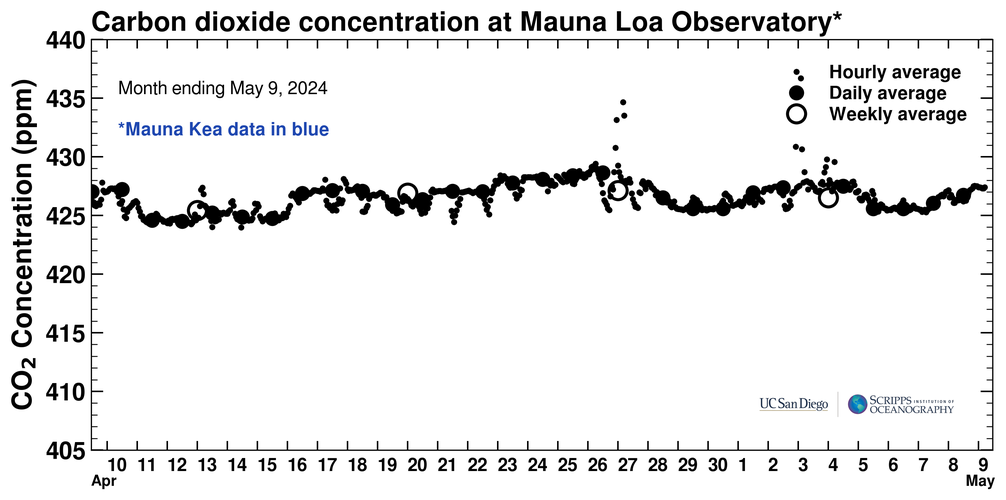
symbolset writes "Over the past month a number of individual observations of CO2 at the Mauna Loa Observatory have exceeded 400 parts per million. The daily average observation has crept above 399 ppm, and as annually the peak is typically in mid-May it seems likely the daily observation will break the 400 ppm milestone within a few days. This measure of potent greenhouse gas in the atmosphere should spark renewed discussion about the use of fossil fuels. For the past few decades the annual peak becomes the annual average two or three years later, and the annual minimum after two or three years more."
46 of 367 comments (clear)

  1. Yawn by DoofusOfDeath · · Score: 3, Insightful

    This measure of potent greenhouse gas in the atmosphere should spark renewed discussion about the use of fossil fuels.

    No it won't. It's not like politicians and the public have been just sitting on the sidelines, waiting util a value about 400 PPM was observed. I don't believe the public really doubts that atmospheric CO2 is increasing, and so a wonky measure of it is pretty irrelevant to public sentiment.

    1. Re: Yawn by cplusplus · · Score: 4, Insightful

      Graphs of natural phenomena are rarely linear. This is true for global temperature... this graph of average global temperatures, however, very clearly shows a trend. Picking small sections of data (portions of a graph) whilst ignoring the rest to try and make a point is scientifically dishonest at best (and wrong/completely inaccurate at worst).

      --
      "False hope is why we'll never run out of natural resources!" - Lewis Black
    2. Re: Yawn by tmosley · · Score: 3, Insightful

      I like how the chart at the end actually looks a lot more like a peaking temperature. They set up a strawman to make "skeptics" look ridiculous by having them "believe" that temperature was flat while it was rising. That ridiculous fake argument masks the fact that they are doing a linear extrapolation, and that that extrapolation is pulling away from the moving average. And we all know how linear extrapolation always works as a predictor, right? That's why the DOW is now at 72,000 and Pets.com is the powerhouse of the world economy. Also why my Dad has 11,300 wives.

      Of note is that that temperature chart looks a LOT like a log chart of planetary industrial output, which has leveled off in recent years. Almost as if the warming hasn't come from a persistent gas who's concentration continues to rise even as production falls, but by a transitory gas that is forced into higher concentrations by continuous industrial output, but which falls quickly with falling production and actually works as a significant greenhouse gas. You know, water vapor. The other product of combustion.

      But that doesn't mean that CO2 isn't a problem. It is a world-killing problem, but not because of some stupid idea like global warming. It is OCEAN ACIDIFICATION that will destroy us all, not balmy temperatures and poorly defined "increases in violent weather". Might want to stock up on canned tuna.

    3. Re: Yawn by I'm+New+Around+Here · · Score: 2

      So you're saying World War II stopped, and even reversed, global warming for decades? Great, now we know what he have to do to save the planet. Bomb it into submission again.

      --
      If you think I voted for Trump because of this post, you're wrong. I voted for Dr. Jill Stein of the Green Party. Again.
    4. Re: Yawn by haruchai · · Score: 3, Interesting

      From your linked PDF - "The agreement of the reconstruction of the temperature history using only the six strongest components of the spectrum, with M6, shows that the present climate dynamics is dominated by periodic processes. This does NOT rule out a warming by anthropogenic inuences such as an increase of
      atmospheric CO2
      (bolding and emphasis mine)

      All the records examined in this paper were in a time period where GHG levels were significantly lower than at present and the dominant climate forcings would have been natural ones such as insolation, and volcanic eruptions.

      Our use of fossil fuels have complicated the issue by adding significantly large amounts of both warming and cooling agents into the mix. But a net positive heat balance cannot simply be handwaved away into a "periodic oscillation". The heat has to go somewhere and wherever that may be, it will have an impact.
      Whether or not the impact is significant and long-term is a longer discussion.

      --
      Pain is merely failure leaving the body
    5. Re: Yawn by budgenator · · Score: 2, Interesting

      skepticalscience.com is completely unreliable source, they make non-trivial edits to posts after comments have began, they edit user comments and delete user comments without reference.

      --
      Apocalypse Cancelled, Sorry, No Ticket Refunds
    6. Re: Yawn by Snocone · · Score: 2, Insightful

      Nobody rational disputes that anthropogenic C02 will have a primary warming effect.

      In exactly the same fashion that nobody rational disputes that anthropogenic H20 will raise the ocean level when I spit into it.

      That the magnitude of this effect is concerning -- or even observable! -- any more in the first case than the second, that is unproven and looking less likely all the time as evidence accumulates that the solely positive feedbacks that IPCC-selected models assume are just not in accord with reality.

    7. Re:Yawn by Bengie · · Score: 2, Informative

      Just remind them of the thousands of record highs set in the past few years all around the world. For every small increase in average temps caused by global warming, larger extreme temperatures are seen throughout the year. Higher highs and lower lows but an overall average of warmer.

    8. Re: Yawn by Billly+Gates · · Score: 2

      Here is another source showing global warming slowing down and even reversing some cases!

      I am a former Alaskan. Tell that to the Alaskans where May first 60 degree days hit and leaves start appearing on the trees when it just hit 4 a night or two ago and the snow hasn't even melted yet?

      Before you say climate != weather, check this graph out? For 13 years straight it has persistently getting colder. The UK is getting colder every year as well. The climate of the world did get warmer starting in the 1970s but it is reversing now. It is not just Alaska or the UK.

      I think our calculations on CO2 are way off.

    9. Re: Yawn by dcherryholmes · · Score: 3, Insightful

      DAILY MAIL ALERT!

    10. Re: Yawn by chihowa · · Score: 4, Informative

      I'm not weighing in on this "debate", but the temperatures in the UK are artificially warm because of the ocean currents. Compare the UK to other regions of similar latitude to demonstrate this. If those ocean currents are disrupted by larger climate changes, expect to see the UK and most of western Europe get much colder overall, even though the global temperatures may be higher.

      Being coastal and bounded on the west by an ocean, I wouldn't be surprised if Alaska is in the same situation.

      --
      If you want a vision of the future, imagine a youtube comments section scrolling - forever.
    11. Re:Yawn by LordLimecat · · Score: 2

      THats partly because of idiots who last year said "See? Global warming" when we had abnormally warm weather.

      You make your bed, you lie in it.

    12. Re:Yawn by BasilBrush · · Score: 2, Interesting

      "Can someone offer a short and simple explanation for why abnormally cold weather doesn't mean "global warming is a myth"?"

      No.

      Then you probably shouldn't be entering into the discussion at all as you don't know the basics. Global warming refers to climate. "Abnormally cold weather" is weather. They are completely different things.

      Weather happens at a particular place at a particular time. Climate is an average of weather over a large geographical area over a long period of time. Typically 30 years.

      The two are as different as instantaneous speed of a car, and the average speed of a car over it's entire lifetime.

    13. Re:Yawn by meta-monkey · · Score: 2

      Yes.

      Warmer global temperatures have caused a massive loss in arctic ice. Warm water extends farther north this year than it ever has before. The high pressure stationary air masses that form over this water extend into the North Pacific and North Atlantic. In years past, the jet stream (the west to east moving flow of cold air around the poles) would have encountered colder, low pressure air over ice and moved on through. Instead it encounters the high pressure warm air in the north pacific, gets squeezed up around the air mass and all that cold polar air pushes far down into North America before it can squeeze back up around the warm air mass in the North Atlantic.

      It's funny, because I would get annoyed in years past when people would say, "it's hot! Must be global warming!" Or "it's cold! So much for global warming!" Or blame GW for specific storms like Katrina or Sandy, when those are just weather events, and not climate. But, this cold spring is the first time I think you can really say, "this is a changed climate due to global warming."

      Increased global average temperature -> loss of arctic ice -> warm air mass over water in the northern oceans -> cold polar jet stream air pushed further south -> cold springs in North America. And it'll happen every year, and that's climate, and that's a change.

      --
      We don't have a state-run media we have a media-run state.
    14. Re:Yawn by ultranova · · Score: 3, Insightful

      Atmospheric science is interesting and is a field worthy of further study. But we are nowhere near using it to make any sort of useful predictions, let alone as the basis for economic policy.

      And we never will. No amount of evidence can prove something you don't want to believe, especially if the cost of believing it comes right now while the cost of not believing it comes later. So as long as fossil fuels remain cost-effective, no amount of evidence can ever prove that they do harm - evidence only becomes sufficient after we've switched to something else.

      Add the tendency of people to think of arguments in terms of victory or defeat, and it makes one wonder if humanity is really suited for a technological civilization where decisions have farther reaching consequences than the pecking order of the pack. Hunter-gatherers can afford this level of self-delusional bullshit since they can just pick up and leave if they screw up bad enough, but we can't.

      --

      Forget magic. Any technology distinguishable from divine power is insufficiently advanced.

    15. Re: Yawn by Billly+Gates · · Score: 2

      That's within warming predictions. Local climate isn't global climate. Global warming may lead to local cooling. Your misunderstanding of the issues doesn't prove them wrong.

      Well it has changed since you left. Glacierazation is increasing as the peaks around Anchorage have not melted in 3 years as each summer is a record cold and raining one consistently since 2000.

      Alaska is considered the Canary in the coal mine. In the 1990s it warmed up in the interior first before the world. Now the permafrost line is reversing and tundra ponds in the west are increasing for the first time in 25 years as the permafrost is thinner in the summer than previous years. If Alaska stays colder longer (with Northern Canada, Europe, and Asia) the snow will reflect the heat back into space and cool it down further south. Eventually it will grow into an ice age. During the end of the last ice age surprising Alaska had many ice free peaks with Tundra vegetation and it warmed up first and spread around as the excess heat from the lack of snow melted the glaciers.

      The question is the cause related to fresh water melt freezing the sea and reflecting heat back into space? Or something else? This could be a natural response to warming as the cooler air from Alaska made its way to the lower 48 and created snow in May! Snow cover again cools things down considerable.

    16. Re:Yawn by khayman80 · · Score: 4, Informative

      ... Things have changed. "Anthropogenic Global Warming" (AGW) advocates repeatedly and consistently stated that a trend of 10 years or more proved their point... [Jane Q. Public, 2013-05-05]

      Presumably you're referring to "scientists." Also, I've repeatedly said:

      Since climate is an average over ~20 years ... climate is only meaningful when discussing averages over ~20 years. ... I've repeatedly stressed that we need ~20 years to average out weather noise. ... professional climatologists usually smooth data and model output using ~20 year averages. ... It's also important to remember that a ~20 year timespan is necessary to obtain statistically significant temperature trends...

      In fact, I've repeatedly told you that ~20 years are needed:

      As I've explained, climate is the global average over ~20 years. [Dumb Scientist to Jane Q. Public, 2010-02-16]

      This graph shows why scientists prefer trends calculated over at least ~20 years. [Dumb Scientist to Jane Q. Public, 2013-01-21]

      I've even gone into more detail, showing you a paper that says at least 17 years are required:

      ... at least 17 years are needed to establish a statistically significant trend of global surface temperatures. [Dumb Scientist to Jane Q. Public, 2012-12-05]

      Of course, you ignored me just like you previously ignored riverat1:

      And 10 years has what to do with climate trends? Not much. A recent paper by Santer et. al. calculated the signal (climate) to noise (weather/natural variation) ratio for climate trends. For 10 years the S/N ratio is less than 1. They found it takes 17 years to be sure the signal is greater than the noise. [riverat1 to Jane Q. Public, 2011-11-19]

      For global temperatures, Santer et al. 2011 shows that one needs to average over ~17 years of data to obtain statistically significant climate trends. Here's another explanation by Tamino. Also, the Skeptical Science trend calculator helps visualize statistical significance. [Dumb Scientist, 2012-08-15]

      Perhaps your ode to conspiracy theories distracted you, but I also linked to another method of calculating significance which is even more conservative:

      Also, Bart

    17. Re: Yawn by tbannist · · Score: 2

      lmost as if the warming hasn't come from a persistent gas who's concentration continues to rise even as production falls, but by a transitory gas that is forced into higher concentrations by continuous industrial output, but which falls quickly with falling production and actually works as a significant greenhouse gas. You know, water vapor. The other product of combustion.

      That's just amazingly stupid. Industrial production does not force water vapour into "higher concentrations" because there's a natural process called precipitation, or more commonly rain, that takes it out of the atmosphere after a few days. On the other hand, average water vapour content is actually tied to average global temperatures and thus is a global warming feedback mechanism. Which means, specifically, that it amplifies the warming effect of other greenhouse gases like carbon dioxide.

      It is OCEAN ACIDIFICATION that will destroy us all, not balmy temperatures and poorly defined "increases in violent weather".

      If you think anyone is claiming that "balmy temperatures" will "destroy us all", you're not paying enough attention. Ocean acidification is just one of a number of serious problems tied to the rise in global CO2 levels. Glacier depletion, decreased crop yields, heat stress, increased severe weather, and sea level rise are the major other threats. None of them will "destroy us all", that result is still most likely to be the outcome of a substantial nuclear exchange.

      --
      Fanatically anti-fanatical
    18. Re: Yawn by RockDoctor · · Score: 2

      On the other hand, average water vapour content is actually tied to average global temperatures and thus is a global warming feedback mechanism.

      Water vapour is the main greenhouse gas in the atmosphere. And with a lot of it laying around loose on the surface, it quite rapidly responds to changes of temperature - downwards as well as upwards - with a time constant of just a few years. The corresponding removal process for CO2 has a time constant up in the tens of thousands of years. As has been seen in the past. Without some form of artificial geoengineering, the present spike in CO2 is going to take on the order of 100,000 years to be taken away by natural processes.

      Glacier depletion, decreased crop yields, heat stress, increased severe weather, and sea level rise are the major other threats. None of them will "destroy us all", that result is still most likely to be the outcome of a substantial nuclear exchange.

      Why am I reminded of the "What did the Romans ever do for us?" sketch in 'Life of Brian'?

      --
      Birds are not dinosaur descendants;birds are dinosaurs, for all useful meanings of "birds", "are" and "dinosaurs"
    19. Re: Yawn by RockDoctor · · Score: 2

      Atmospheric carbon dioxide was up 0.001%.....

      You mean that [CO2] had increased from 0.0025% to 0.0035% ? (Actually, I think that you've slipped a decimal point - 1ppm = 0.0001%, so you're out by a factor of 10. Not that it's your significant mistake.)

      On the same basis of comparison, average global temperatures have increased from about 283K to 284.5K over the same interval, a relative increase of *0.005300353.

      "Apples and oranges", as my maths teacher used to say. If you're going to compare two things, make sure that they're comparable to start with. And that you perform the comparison calculations in comparable ways. Unless you want a reputation as a politician.

      --
      Birds are not dinosaur descendants;birds are dinosaurs, for all useful meanings of "birds", "are" and "dinosaurs"
  2. Out of Curiosity.... by Ferretman · · Score: 2

    There are groups (misguided in my opinion, but that's not relevant to the question) such as 350.org that want to restrict CO2 levels to 350ppm, feeling that that level is the "trigger" for global warming.

    It's not clear to me exactly how much time they propose it will take to get there though. On their web site are some generic words about installing solar panels and stopping fossil fuel subsidies, which I think anybody is generally for. But I don't see anything about how much time they expect this to take even if the world moved to their agenda.

    Anybody know?

    Ferret From the High, Snowy Mountains of Colorado

    --
    Sic gorgiamus allos subjectatos nunc
    1. Re:Out of Curiosity.... by Hentes · · Score: 4, Interesting

      You can't make predictions when a human factor is involved. If we were all controlled by a hivemind and made CO2 decrease our highest priority, stopping CO2 production could be done in 20 years (there's enough nuclear power to sustain our needs, and we have electric vehicles - technologically it's already possible). After that, the oceans would absorb the excess CO2 and bring it below 300ppm in about 300 years (according to a study I sadly can't find now). So absent some miracle like fusion reactors even in a best case scenario it would take at least 150 years to get below 350.

      But the most important thing is the human factor which depends on our decisions, and can make that time much much longer.

    2. Re:Out of Curiosity.... by budgenator · · Score: 3, Funny

      Yes but zombies give off methane as they ferment, which is worse than carbon dioxide!

      --
      Apocalypse Cancelled, Sorry, No Ticket Refunds
    3. Re:Out of Curiosity.... by drinkypoo · · Score: 3, Interesting

      I think it's one of the hypocracies of the AGW alarmists that every technology that can help us avoid their worst fears is roundly decried as worse than the global warming itself. The Three Gorges Dam in China was continuously railed against,

      as it would cause massive ecological damage, which has in fact been the case. It's even been fingered in heavy seismic activity which has occurred since.

      Logically though, anyone who thinks the world would be significantly better off with a lower population should take matters into their own hands and remove themselves from it.

      You really don't want people who think the world needs population reducation to take matters into their own hands.

      --
      "You're right," Fisheye says. "I should have set it on 'whip' or 'chop.'"
  3. Seems Odd To Me by Anonymous Coward · · Score: 2, Insightful

    Why would you take this measurement in such close proximity to one of the most active volcanoes on the planet?

    1. Re:Seems Odd To Me by Misagon · · Score: 4, Informative

      The Muana Loa observatory measures only at night, when air is descending from far up high. That air has come from across the Pacific Ocean, far from any specific CO2 sources.
      At night, the volcanic gasses are trapped in a thin layer near the ground by a temperature inversion. The observatory measures the air at several towers at different altitudes and also closer to the volcano so as to get a comparative reading.

      You can read more in this report.

      --
      "We mustn't be caught by surprise by our own advancing technology" -- Aldous Huxley
    2. Re:Seems Odd To Me by TapeCutter · · Score: 3, Informative

      Now THAT is something I'd never considered!

      But others have, it's an old canard, yes it's a factor for that site (the oldest continuous monitoring site), but nobody is relying on just that site, we are at ~400ppm global average across all sites. CO2 concentration varies by ~5ppm in sync with the northern seasons (deciduous trees are responsible) so there is some "wiggle room" in the numbers.

      --
      And did you exchange a walk on part in the war for a lead role in a cage? - Pink Floyd.
    3. Re:Seems Odd To Me by KGIII · · Score: 3, Insightful

      They have a problem with you asking questions likely because they view it as an assault on their religion. I am not a climate scientist and I leave the debate to them but, as an observer, it is amazing how many people have turned this into their belief system. It is amazing how many people have decided that they understand the science and are qualified to opine on it. It is amazing how many people have come to identify so strongly with a theory that they froth at the mouth even when someone poses a legitimate question. And, worse, it is amazing how many have managed to confuse the difference between political science and climate science.

      When I observe people responding it often includes something akin to, "You're not a climate scientist. There is a consensus so leave it to them. The data is infallible."

      Then they go on to opine on what the various countries need to do. I'm inclined to point out that, "They're not the political scientists, there's a consensus, leave it to them. The data is irrelevant in political science." (Politicians are pretty dumb, that is my opinion and I'm sticking with it.)

      Anyhow, I truly don't hold much of an opinion (one way or the other) concerning AGW though I see no reason why we shouldn't clean up our atmosphere. As such, an agnostic if you will, I don't tend to join in on the debate (though I do wonder, from time to time, about the validity of placing theoretical fixes on theoretical problems and using a lot of guesstimated and massaged data to reach conclusions) very often because I dislike the aggression when people are so passionate about their belief systems. I suppose I don't have anything to debate with either side actually, I simply don't know and am not a climate scientist. Just observing them, however, leaves a "sour taste in my mouth" type of feeling. It's as if some of them are rabid religious fanatics. One can't have a reasoned debate or change the opinions of people like that and that is a waste of time.

      From the other side, I'd also offer, you have people on the denialist's side who truly are religious and lay claims down such as it is just the Sun, the Earth will take care of itself (which is true in the long run but not in the manner that they're expecting I imagine), and things like that which don't do much more than muddy the waters further. They also seem to want to tie it into their political views as well and, really, science doesn't care what your political affiliations are - it just is. So, no, they're not really helping. Sometimes I see skeptics who appear to have valid reasons for their skepticism, I've seen reports of various underhanded deals, and have seen the responses and found them lacking but that may be because I'm not a climate scientist and I'm not understanding them. But I mostly see nuts in the denialist camp and that's not very helpful for the science either I suspect.

      Either way, I'll be dead and gone before it does much to change life around these parts. I don't know, I don't care to take the time to understand it either, and I have no plans on changing my life further (I'm pretty "green" by default) for this. It is sad to see science bastardized like this though, it is unfortunate that the people screaming the loudest (for either side of the debate) are given the most exposure. The lack of restraint by all involved has made me think that destruction of the human race may be the best thing after all.

      --
      "So long and thanks for all the fish."
    4. Re:Seems Odd To Me by SoftwareArtist · · Score: 5, Insightful

      Sometimes, trying to remain undecided just isn't an option. At least, not a morally acceptable one. In this case, whatever we do or don't do will have a profound impact on the lives of billions of people. So how do you respond? Well, there are a few options:

      1. "This is a really important issue, so I'm going to study the science involved. That'll take a lot of work, but this issue is so important I have a responsibility to do it."

      2. "I don't have time to study the science involved and really understand it. Therefore, I'll accept the judgement of the people who do study it."

      3. "I don't have the time or interest to study this issue and form an educated opinion, but I don't really want to accept anyone else's opinions either. Therefore I'll just use this as an opportunity to look down on people on both sides of the issue."

      I submit that what you are doing is basically #3. I also submit that in this case, that's a morally reprehensible way to respond.

      Also note my signature quote, which is remarkably appropriate to this topic.

      --
      "I'm too busy to research this and form an educated opinion, but I do have time to tell everyone my uninformed opinion."
    5. Re:Seems Odd To Me by Misagon · · Score: 2

      Sorry, the "only at night" was from another source.
      Here you go.

      --
      "We mustn't be caught by surprise by our own advancing technology" -- Aldous Huxley
    6. Re:Seems Odd To Me by Beryllium+Sphere(tm) · · Score: 3, Insightful

      OK, without studying the science, you can use other heuristics to guess at the credibility of the people involved.

      On one hand, you have people saying "We didn't know this for sure until late last century, here are our methodologies, here are several different lines of evidence and how similar their results are, here are our error bars".

      On the other hand, you have people saying
      o Global warming is not happening
      o The global warming that is not happening is being caused by natural sources.
      o The global warming that is not happening that is racing ahead because of unstoppable natural forces ended in 1997.
      o The global warming that ended in 1997 is still going on because of carbon dioxide from volcanos.
      o The carbon dioxide levels, which are going up because of volcanic activity, are not really going up.

      Then read a book like _The Climate Coverup_ and find out which side publishes arguments because they test well in focus groups.

    7. Re:Seems Odd To Me by kermidge · · Score: 2

      I'm not smart enough to make much headway against various arguments one way or another, hard enough trying to make a bit of sense from various condensed data; all I know for sure is that I find it freaky that amount of carbon dioxide in air has nigh doubled since I was a lad.

  4. Re:Levels were 16-18 times higher in the past by blackiner · · Score: 2

    And how about when they were 2000 ppm higher?

    http://en.wikipedia.org/wiki/Permian%E2%80%93Triassic_extinction_event

  5. Re: Hydrogen Sulfide by chrisale1452 · · Score: 5, Insightful

    Once again I am saddened by The depths to which the Slashdot community has fallen. This used to be a technology site. Technology that could not happen without extremely advanced science. And yet here you are, questioning global warming and the effect of human induced rises in CO2 levels. This stuff has been studied for going on 125 years. There is no doubt what has happened, what is happening, and what will happen. It's Grade School physics for goodness sakes. We should be the ones leading the charge to shift away from Fossil Fuels before great harm to our civilization becomes inevitable. But here we are, mired in the same ridiculously simplistic arguments about stuff that has been proven or disproven by science over and over. This isn't a matter of science being wrong, it is a matter of society not being allowed to trust a very small subset of scientists because they threaten a very profitable economic paradigm. Eventually, that will turn, I hope not before it is too late to avoid catastrophe.

  6. Re: Hydrogen Sulfide by Ironchew · · Score: 5, Insightful

    Once again I am saddened by The depths to which the Slashdot community has fallen. This used to be a technology site. Technology that could not happen without extremely advanced science.

    As long as I've been here, it's been a technophile site for advertisting consumer electronics.

    This isn't a matter of science being wrong, it is a matter of society not being allowed to trust a very small subset of scientists because they threaten a very profitable economic paradigm.

    You've hit the nail on the head. The Slashdot community as a whole touts the virtues of science, unless it's the kind of science that discovers the uncomfortable reality about capitalism and unlimited economic growth. Then they go apeshit and cover their ears as if it makes the evidence go away.

  7. Linear Growth? by Anonymous Coward · · Score: 3, Insightful

    Why does rate of increase seem constant. I mean, if it's influenced by human activity (of which I have no doubt), then shouldn't it track closely to the fluctuations in the global economy. Specifically, shouldn't there be a dip or flat corresponding to the Great Recession periods of '08/'09?

    1. Re:Linear Growth? by jfbriere · · Score: 2

      It isn't constant since the industrial revolution : Carbon_Dioxide_400kyr.

    2. Re:Linear Growth? by Hentes · · Score: 2, Informative

      There was a small dip in '09 in CO2 emissions but we have quickly recovered from it. Mind you, this is CO2 concentration, not production, so it's the log of the integral of production (that's why it's linear).

  8. Re:Past the point of no return by Troed · · Score: 2

    That "danger point" is completely reliant upon the value of the so-called "climate sensitivity" factor, our understanding of which changes each year as we increase our knowledge of the climate system.

    http://en.wikipedia.org/wiki/Climate_sensitivity

    There have been numerous studies lately (post IPCC AR4) pointing to a low climate sensitivity factor, which would change the value of "the danger point" upwards from 350 ppm as well (450 ppm IIRC, but that's from memory based on the below mean).

    http://www.cato.org/sites/cato.org/files/wp-content/uploads/gsr_042513_fig1.jpg

    (Please see image content, not domain name, for actual references)

  9. From 3 to 4 parts per 10,000 by jmichaelg · · Score: 2, Interesting

    Bringing the numbers closer to human-scale, a 300 parts per million is the same as 3 parts per 10,000. Similarly 400 is 4 parts per 10,000. So basically, we've gone from 3 molecules per 10,000 to 4 molecules of CO2 per 10,000 molecules of air.

    In the same period, plankton levels have declined over 1% per year since the late 1970's. John Martin at MBARI postulated that the decline was due to a decline of dissolved iron in the oceans. He's quoted as saying "Give me a tanker full of iron and I'll give you an ice age." A series of experiments, IRONEX and SOFEX demonstrated that he was right - adding iron caused the plankton to bloom. The SOFEX bloom lasted longer than the 45 days allotted to collect plankton samples. IRONEX demonstrated that the predators could find the bloom and feed on it.

    You want to reduce CO2 levels? Stop hunter-gatherer style fishing and start farming the oceans. Of course, then the problems will be keeping the earth warm enough to avoid another ice age and preventing fish rustlers from making off with your harvest.

  10. Single Data Point by betterunixthanunix · · Score: 2

    One cold year says nothing about the trend in the Earth's climate.

    --
    Palm trees and 8
  11. Re: Hydrogen Sulfide by cbarcus · · Score: 2

    Actually, radiative forcing (necessary for the basic assessment of the contribution of the various greenhouse gases to warming) is not 'grade school level physics'. The key problem that any plan to address this warming must deal with is how to address the problem economically. As it turns out, the political compromise to try and build a renewable economy on intermittent low power density sources is entirely misplaced, and it is distracting us from real potential solutions based on nuclear fission/fusion.

    http://nextbigfuture.com/2013/04/terrestrial-energy-will-make-integral.html

  12. Re:Past the point of no return by riverat1 · · Score: 2

    ... that significant ice has accumulated on Antarctica since human civilization has bloomed. It's up to 3 miles of ice there in some places ...

    Kind of a non sequitur there. The 3 miles of ice started accumulating around 34 million years ago, long before human civilization existed.

  13. Oh no it hasn't by Vainglorious+Coward · · Score: 2

    Observed Atmospheric CO2 Hits 400 Parts Per Million

    That's not true, the observations are wrong. And anyway it's not important. And even if was, we're not responsible. Peddling these myths is exactly what I'd expect from leftist, reality-based terrorists

    --
    My next sig will be ready soon, but subscribers can beat the rush