 Slashdot Mirror
How Did My Stratosphere Ever Get Shipped?
I've been using either a Samsung Stratosphere or a Samsung Stratosphere 2 from September 2012 to the present. Where to begin?
-
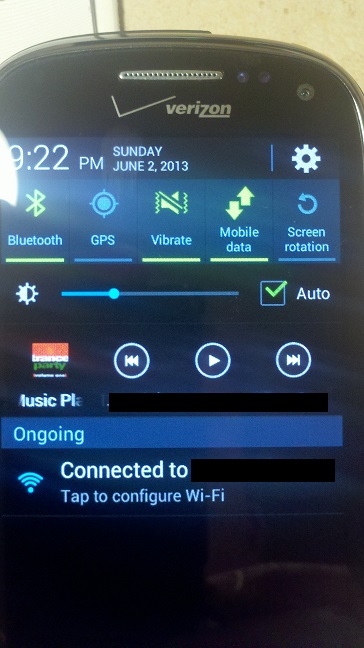
If you open the calendar application on the Stratosphere 2, it usually highlights tomorrow's date as "Today," and lists tomorrow's calendar entries as your list of things to do "Today." Here is a picture of my phone's screen taken on June 2, with the calendar app displaying "Today, Mon, Jun 3 2013" — despite the phone knowing the correct time is 9:22 PM on June 2.
Strangely, in the morning the calendar app would display the correct day as "Today," but would switch to the wrong day some time in the afternoon, and eventually I decided that the calendar app was probably using Coordinated Universal Time to decide what "Today" was, which is 9 hours ahead of Pacific Standard Time.
-
You'll notice that these images are not screen captures, but photos taken with another phone. This is because some time between the Stratosphere 1 and 2, the screen capture function broke — every support site says you're supposed to be able to take a screen cap on a Stratosphere by pressing the Home and Power buttons at the same time, and that works on the 1, but not on the 2.
-
If someone else sends a text to multiple recipients including you, the Stratosphere gives you no indication that it's a group text, and there's no way for you to see the other recipients or reply to the whole group. (I had a lot of awkward "What, you were asking everybody, not just me?" moments before I realized what was going on.) Other users have been complaining about this for months, and it apparently affects more Android phones than just the Stratosphere.
-
The built-in camera refuses to take a picture if the battery is low — it just says "Warning: low battery" and exits. Yes, I know they think they're doing it for my own good since the camera is a battery hog, but a few times I've wanted to take a picture where it was well worth using up a half a percent of my remaining battery life or however much it would have taken, but the phone wouldn't let me. That should be the user's decision, dammit.
-
When I was in Canada last week, if I tried sending a text message longer than 160 characters, the phone would tell me that the message sent, but it would actually fail silently and never get delivered. I'm not sure whether to blame Verizon, Android, or Samsung for this one (or just, you know), but in the end someone has to take responsibility for the product, and the phone telling you that a message was sent when it actually got lost, is a complete fail. If it doesn't work, fine, give me an error message, but never tell the user a message got sent successfully if it didn't.
-
During a phone call, the on-screen keypad doesn't work unless the phone is on speakerphone. If the speakerphone is off, the screen goes dark after about 1 second of inactivity, making it impossible to enter an account number or anything else. I can avoid this bug by turning on a speakerphone (which is how I know it's a software bug, not a problem with the touchscreen), but this is a pain if I'm in a public place and don't want to annoy everyone around me who would have to listen to all the voice prompts. (The phone's software seems to be following a rule like: "If the speakerphone is not on, then when the phone moves away from the user's face, assume the user is not actively using the phone and let the screen go dark" — where the bug is that it doesn't make an exception and keep the screen on if the user is actively pressing keys on the keypad.)

At first, these and many, many other bugs produce a state of mind that transcends annoyance to reach a kind of genuine curiosity, where you're asking "How did this happen?" not rhetorically, but because you actually want to know. But eventually the surprise wears off, and you're just left with bugs that are disproportionately aggravating because they obviously would have been caught during even the most basic UI testing. They're aggravating to me not because of how much they get in the way (you eventually get used to them), but because the existence of those bugs conveys a certain lazy attitude towards finding and fixing bugs at all.
I realize this is not a logical reaction. The aggravation you feel towards a bug should depend on how much the bug actually interferes with the user experience, not on how easily the manufacturer should have found it. Rationally speaking, the biggest problem with the phone right now (and the reason I'm having to mail to back to the manufacturer for a replacement) is that the charging port spontaneously broke, so that unless the micro USB charger is plugged in exactly right, the phone can't charge (even if you get it right and form a connection successfully, the connection breaks if you move the phone half an inch). Needless to say, that's exasperating — but it's hard for me to get mad at Samsung over that, because it's not an easy defect to catch at the manufacturing stage. On the other hand, if the calendar app displays the wrong day, I would say that someone should be fired over that except that probably nobody was assigned to do that testing in the first place.
I also posted questions about each of these problems on AndroidForums.com and AndroidCentral.com (those links show all questions recently posted from my username on each site), which have so far received hundreds of "views" but no replies. I mention this because some people think that if you do run into problems like these, all you have to do is post a question and The Community will help you out with a workaround. Nope.
Also, lest you think you can do away with these bugs by downloading third-party replacements for all of these apps, I spent part of an afternoon downloading different texting apps to see if any of them would fix even part of the problems I had with the built-in one. None of them worked much better, although several of them displayed pop-up ads over every third incoming text message, and most of them did not play nicely with each other, giving me no way to disable them so that their notifications would double and triple up on top of each other for every received text. So I gave up. Even if I thought I might eventually find a better app for texting, I didn't have time to test multiple replacements for every built-in default app that didn't work.
Farhad Manjoo has a column up at Slate arguing that the reason many Android phones suck is that they're laden down with adware attempting to extract more personal information and money from the user. I'm sure that's part of the problem, but I can't see how the manufacturer is making any money off of the bugs I ran into; they were just being lazy.
The problem, I think, is that phone manufacturers know that phone reviewers (and users, when they're choosing between models in the store) will focus on easily quanitifiable attributes, such as size, weight, battery life, and the number of megapixels in the camera. The number of aggravating bugs in the user interface is not something that is easy to compare across phones (and in any case would not be printed on the box). Thus market forces simply don't favor the development of a hassle-free interface, because in most cases the phone manufacturers wouldn't be rewarded for it.
And — I don't consider this too much of a stretch — this is where it connects with larger issues for me, because I've been arguing for years that the free market will usually fail to fix certain types of problems, often in the context of threats to free speech and civil liberties, especially if the user lacks information they need to compare multiple options. A major argument in favor of Net Neutrality is that the typical user wouldn't realize it if their ISP were throttling access to certain sites; they would just think that the remote site was responding slowly. Since that information would be hidden from the user, "the marketplace" won't solve the problem on its own. Similarly, every time I say that my Circumventor mailing list keeps getting blocked as "spam" by Yahoo, Hotmail, Gmail, or AOL (despite being 100% verified-opt-in, natch), someone tells me that if the free market is blocking my emails as unwanted, it must be because the users don't want them. That the free market might make a mistake (in this case, because users don't have full information about what is getting blocked as spam), doesn't occur to them. I think the belief in the infallibility of the free market, is one of the most widespread fallacies of our era — people who would never make the mistake of confusing correlation with causation, have no problem thinking that if a product or service gets blocked by a third-party intermediary, it must be because the end user didn't want it.
And so when I'm staring at my Stratosphere's calendar telling me that tomorrow is actually today, it brings out my aggravation not just towards Samsung, Google, and Verizon, but towards all the people I've heard over the years claiming that the marketplace will automatically reward good products and punish bad ones. If there weren't so many people who believed that, maybe we could have collectively put more effort into rating phones according to their usability, knowing that the "invisible hand" of the marketplace was not likely to solve those problems on its own, and maybe these bugs would have gotten fixed. Instead, the "marketplace" focuses disproportionately on attributes like dimensions, weight, and processor speed that are easily quantifiable.
So perhaps the solution — seriously — would be for some third-party review company to rate each new phone on the Stupid S#!% Index. They test the phone under normal usage, and each time they run into an idiotic bug like the calendar application not knowing what day it is, they file it under Stupid S#!%, and after some fixed period of phone usage they count up all the problems and rate the phone under the Stupid S#!% Index. For greater precision, you could compile multiple scores from different users for each phone and take the average. Now you have a quantifiable rating that can be used to compare one phone to another, and could incentivize manufacturers to do more testing on their phones in order to get a better Stupid S#!% Index score.
The message that Apple keeps pushing about the iPhone, after all, is essentially that it would get a good Stupid S#!% Index rating. In his keynote address at the 2011 Apple Worldwide Developers Conference, Steve Jobs repeated the words "It just works" like a mantra — unlike, presumably, everyone else's stuff. iPhones don't score well on price, openness, or compatibility with other companies' products (I always have to tell people that my car charger is not an iPhone charger, it's a literally-every-other-smartphone-in-the-entire-world charger) — but all of that scarcely matters to some people as long as It Just Works.
Well, I couldn't tell you. I can't test an iPhone under normal usage because I'm too addicted to the Stratosphere's slide-out keyboard, which enables me to type much faster than a touchscreen but which only comes on a few Android and Windows phones, and not on any version of the iPhone. Maybe I'll try one more time to make the switch to a touchscreen while my Stratosphere is in the shop.
Yes, these most First-World of First World Problems — especially the bugs specific to the Stratosphere — only apply to a small fraction of the population. But it should be a lesson for anyone who thinks the "free market" would prevent this sort of thing from happening.
Meanwhile, every time I hear an ad talking about how "thin" some new phone is going to be, I just want to say to the phone the same thing that I want to tell all the anorexic girls in nightclubs: You're already thin enough. So stop worrying about being thin, and just try to work on not being so f@#$ing stupid.
The correct way is to hold it over a trashcan and unclasp your hand.
The cow says "Moo." The dog says "Woof." The Timothy says "Thanks, valued customer. We appreciate your input."
Next you'll tell me that sometimes budgets get cut while demands increase.
this is where it connects with larger issues for me, because I've been arguing for years that the free market will usually fail to fix certain types of problems
Sorry, but that is WAY too much of a stretch.
The free market has fixed this problem - there were bad glitchy phone UI's in the past, and eventually the iPhone arrived exactly because all phones had these "lazy" errors all over the place. The iPhone originally was built to be a device where the functions it supported as a smartphone were really thoroughly tested and refined.
Now of course we have Blackberry 10, and Windows Phone too - each of which offer very carefully tested environments in which to use a phone.
Market forces are not about fixing one model of a phone, they are about a phone eventually arriving that solves a problem competitors have not addressed. Your problem is that you are looking for stability in a system whose primary purpose is not stability - Android came about in part to address the issue of phones being more locked down than some people like.
"There is more worth loving than we have strength to love." - Brian Jay Stanley
1) No one, not even the most "hard core" fiscal conservatives / libertarians, claim the free market is "infallable." The free market is individual human beings making individual economic decisions without coercive interference from others. Human beings are fallable, thus the free market is "fallable."
2) 3rd party reviews = free market. What is not free market is when government creates oversight organizations / watchdogs through taxation and uses them to enforce laws and regulations. Examples are the FCC, FDA etc.
3) As imperfect as it may be, at least when a company releases a major catastrophe of a buggy product they get penalized with support and replacement costs, bad PR and a market that will think long and hard before buying another product from that company.
4) There is nothing stopping anyone from implementing your suggestion for creating better cellphone reviews. That's the beauty of the free market. The fact that no one has done it (as far as we know) does not hint to the free market's imperfections, it means there is a business opportunity waiting to make someone some money.
If you want a keyboard that badly try the Blackberry Q10. Its not terrible.
I've been using either a Samsung Stratosphere (S1) or a Samsung Stratosphere 2 (S2) from September 2012 to the present.
The v2 wasn't yet available in September 2012...
So there are several options:
Bennet then complains market forces don't fix some things... indeed they do NOT. They do NOT fix stupid customers buying crap they hate with good money.
If I piss in your face and you hand me 50 bucks, then next day give me 50 bucks to piss in your face again... market forces tell me to piss in your face.
Does he even know what market forces are? Does he even grasp the concept of voting with your money?
Frankly his long list of complaints has to many "user is an idiot" elements so, having googled a few reviews, I am left to conclude the phone isn't perfect but the majority of his issues are imagined or over dramatized.
Similarly, every time I say that my Circumventor mailing list keeps getting blocked as "spam" by Yahoo, Hotmail, Gmail, or AOL (despite being 100% verified-opt-in, natch), someone tells me that if the free market is blocking my emails as unwanted, it must be because the users don't want them. That the free market might make a mistake (in this case, because users don't have full information about what is getting blocked as spam), doesn't occur to them. I think the belief in the infallibility of the free market, is one of the most widespread fallacies of our era — people who would never make the mistake of confusing correlation with causation, have no problem thinking that if a product or service gets blocked by a third-party intermediary, it must be because the end user didn't want it.
AH... it alls becomes so clear now... this guy is a spammer and can't grasp that the market does INDEED work. I do NOT want his spam, I want Google to filter my email and if I didn't want that, I wouldn't use gmail.
The market works, it just sucks when it doesn't work FOR you but against you. But that doesn't mean the market doesn't work, it just means the market doesn't like you. He doesn't want the market to fix things for everyone, he wants the market to fix things for HIM alone so HE can spam freely.
Well fuck him AND his crappy phone he bought a year after it had been reviewed as a crappy phone.
Buyer beware.
MMO Quests are like orgasms:
You may solo them, I prefer them in a group.
If you have an Apple developer account, have a look at the WWDC session video about dates. Handling dates is difficult. The simple difficulty is about the fact that you have absolute time and calendars - if we talk to each other on the phone, the absolute time is the same for both of us, but our watches may show totally different times if one is in the USA and the other in Australia; that's what the "calendar" is there fore. But not only the hour might be different, but also the day, depending what calendar you use. And that's just the easy things.
It's running a newer version of Android.
All the new android phones take a screenshot by placing the "blade" of your hand on the side of the screen and sliding it across the screen.
Calendar issue, Not sure, but I'd wager there is a setting like you said using the wrong timezone. there are 300 calendar apps. I use google's and have never had an issue.
Group texts are NOT BUILT INTO SMS. It's kind of a kludge and iMessage from apple makes it worse because group texts in iMessage are not even SMS. They use data and the apple servers, so you get all sorts of weirdness there.
When you were in Canada, using a foreign service, it maybe have been rogers, or whatever that blocked it as their roaming contract doesn't cover that. No telling why that failed. I wouldn't blame that on the phone.
Camera not working. there is a good chance that using the flash could kill it, also risking the battery going incredibly low and damaging it. This setting can be changed I believe without rooting, but definitely with rooting.
The display turning off IS a setting, also make sure when you go to type, you don't cover the light sensor on the front. It wants to turn the screen OFF when you put it to your head to talk to save battery and avoid your cheek pushing buttons by accident.
Overall score for your rant, Meh. Nice long rant, but you obviously didn't spend as much time googling as you did writing that.
I am 31337 or something.
Its because management shoved a shitty product out the door without letting the engineers finish their job.
You should be thankful it wasn't PC-based software from Samsung. What I got with my last Samsung phone was bad enough that it made me wish I was still using Sony's MagicGate.
If God forks the Universe every time you roll a die, he'd better have a damned good memory.
Almost everything you are describing is a productization issue. These types of issues exist, randomly, from phone to phone, because each phone is separately productized by the partner vendor. Generally, the productization, even between single letter/digit hardware versions from the same vendor, end up being handled by different teams, so there is typically not a lot of consistency here. There are vendors who are exceptions, but they are rather rare. Samsung is not one of those vendors.
Int the free market, your phone problems are fixed by you buying a new phone. Maybe the new phone will work, maybe it won't. If not,you are free to continuing to buy phones until you find one that works. Then the bad phone maker are free to go out of business.
That is the ugly dark side of libertarianism. Your car explodes because of a defective gas tank? Acter enough people know about this, the car sales slow, and the manufacturer might go out of business.
You'll still be dead.
We need to strike a balance between over-regulation and the completely impractical wild west approach that might have worked in the early 1800's. I
The shepherds did so well protecting the flock that the sheep no longer believed that wolves existed.
Yet you used a completely new product from before the release, if I understand correctly from the release date of the Stratosphere 2 (Nov 2012).
For both video games and phones and indeed any complicated piece of hardware one must wait. This is a hard learned lesson for me as well. I played Skyrim without bugs... six months after it was released. I've skipped other games and phones entirely. Markets are not instant feedback devices that make every product perfect, they are feedback devices that tell us which products are best.
There are some problems that markets can't fix... monopoly, regulatory capture, etc... Buying complicated technology without waiting for early adopters to pay the break-in price is another one of them.
For some reason, PM's (especially those at larger companies) think that developers create code that works. Frequently -- at best there is a "let the customer find it, well fix it on the next revision" attitude, however more frequently there is a "just bury the problem all together". Another one is -- hire QA form China (I've seen this fail time and time again). They (the PM's) think these actions will save money -- and it never does. Lost customers, lost business relations, lost faith in company, products that just don't work.
A recent example in Slashdot : Twitter - is hiring. Look at the number of job openings for QA -- just THREE, and all of those are developer based (technically SDET's). Number of "testers" is zero. Number of testers should be 3 or 4 developers to 1 QA (max). Any ratio with a testing staff less than this and you (your company/product) are asking for trouble. Twitter has an 85 to 3 ratio (Yes, they might have 20 testers sitting around waiting for work from development that will be hired, but I don't think so). Think about those numbers for a minute. How many companies have a "Quality, that doesn't even make it on our radar" attitude? Surprisingly, most of them. Frequently these same company's actually resent meaningful testing.
Sorry, the problem with the declaration The free market has fixed this problem is that it only fixed it AFTER I spent my $500 on a really crappy phone...
The free market fixed crappy phones long before you bought yours. There were phones that existed that addressed your problem before you made your purchase.
Your problem is that you were not using the information the market gives you to make choices based on the criteria important to you.
But you won't make that mistake again, right? Thus the market works over time exactly as it should. A free market does not fix a SPECIFIC problem. It fixes problems over time due to people's natural behavior in not wanting to be shafted, and companies seeing an opening in markets where consumers are being shafted...
"There is more worth loving than we have strength to love." - Brian Jay Stanley
The irony is that the solution he proposes, "would be for some third-party review company to rate each new phone on the Stupid S#!% Index." In other words, he's proposing a market based solution that already exists. One thinks first, of course, of Consumer Reports, but there are countless publication which review products as a business. It looks rather like he didn't even bother checking reviews.
No, quite the contrary, it's a very logical reaction. I find consistently that the care a company takes in the little things reflects the care a company takes in the big things. A company whose software has really obvious and easily caught bugs almost certainly did not do a great job at designing the hardware either, hence your broken charge port (which should always be the single most robust component of a phone, because it is the most heavily abused).
Case in point, I recently shipped back a Canon 28-135 lens (two copies) because of severe lens creep. I tend to assume that if the tolerances on such a user-visible component are that sloppy, the tolerances on other components that are less visible are probably equally sloppy, and such sloppy tolerances are likely to result in severely diminished life expectancy.
Helpful tip: You can buy cases for iPhones that include slide-out keyboards. You do have to charge the keyboards separately, but IMO that's a small price to pay for a phone that knows today isn't tomorrow. :-D
Check out my sci-fi/humor trilogy at PatriotsBooks.
Like evolutionary forces, the free market ensures the survival of the fit (good enough to keep going), not the fittest as so many people have erroneously come to believe. Unless a product is bad enough to sink a company, the company will stumble on with the same folks making the next generation of products. Bad management almost assures that even if the company halves in size as the result of a string of bad products they will not actually fix their internal company problems, as management can hardly tell a good employee from a terrible one (heck they look on the mirror daily and fail to immediately quit for the good of the company...).
So the free market will never drive companies to perfection, only weed out the weakest serial non-performers at best. Even then, those weeded out are weeded out based on profit, not product excellence (see: Firefly). At worst bad companies will have other large operations that will let them subsidize terrible behaviors for decades in their badly run groups (see: Microsoft).
A lot of this boils down to the engineers often having neither a clue there is a problem, nor the power to do anything about it when they have a clue. A group of good engineers can be powerless in the face of an awful product roadmap managed by a pointy haired buffoon. See Putt's Law for many more details.
The answer is really easy. You do not have a flagship product. You have a product meant to fit a hole in the low end of the market. Why pour large sums of money into polishing a turd? If you want a better experience but don't want to spend much money, go get a legacy Galaxy S{n} or equivalent flagship line from another vendor.
Two of my imaginary friends reproduced once
As with all large systems used by a society, the free market is incapable of solving problems, and is easily corrupted if most of the people in it are too stupid to make good choices for themselves. The thing that's great about a free market is that it works as long as enough people are smart enough to promote their own interests, it has no prerequisite for "moral" behavior because the individuals police each other's bad behavior. But the whole thing breaks down is most individuals are too stupid to do that.
If you start a Stupid Crap website, I'll visit it. Every time a friend or acquaintance asks me what they think about the phone they're thinking of buying, I'll direct them there. Every time someone comes to me and says, "Look at my sweet new Statosphere 3!" I'll say, "I don't know, man. I was looking at StupidPhoneBugCrap.com and how do you like your calendar?" and then I will encourage them to take the phone back. That's the free market at work. Now if I can beat you to the punch and create such a website, I'll make the money and you won't. Thanks for the idea, dummy!
I cried real tears when Li Mu Bai died.