 Slashdot Mirror
Education Chief Should Know About PLATO and the History of Online CS Education
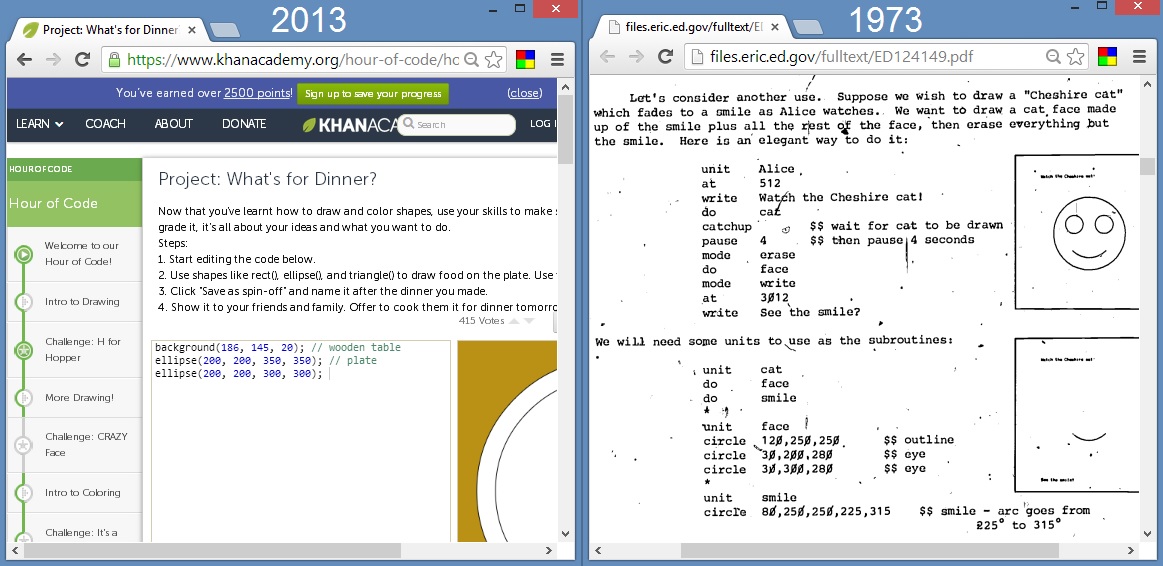
theodp writes Writing in Vanity Fair, U.S. Secretary of Education Arne Duncan marvels that his kids can learn to code online at their own pace thanks to "free" lessons from Khan Academy, which Duncan credits for "changing the way my kids learn" (Duncan calls out his kids' grade school for not offering coding). The 50-year-old Duncan, who complained last December that he "didn't have the opportunity to learn computer skills" while growing up attending the Univ. of Chicago Lab Schools and Yale, may be surprised to learn that the University of Illinois was teaching kids how to program online in the '70s with its PLATO system, and it didn't look all that different from what Khan Academy came up with for his kids 40 years later (Roger Ebert remarked in his 2011 TED Talk that seeing Khan Academy gave him a flashback to the PLATO system he reported on in the '60s). So, does it matter if the nation's education chief — who presides over a budget that includes $69 billion in discretionary spending — is clueless about The Hidden History of Ed-Tech? Some think so. "We can't move forward," Hack Education's Audrey Watters writes, "til we reconcile where we've been before." So, if Duncan doesn't want to shell out $200 to read a 40-year-old academic paper on the subject (that's a different problem!) to bring himself up to speed, he presumably can check out the free offerings at Ed.gov. A 1975 paper on Interactive Systems for Education, for instance, notes that 650 students were learning programming on PLATO during the Spring '75 semester, not bad considering that Khan Academy is boasting that it "helped over 2000 girls learn to code" in 2014 (after luring their teachers with funding from a $1,000,000 Google Award). Even young techies might be impressed by the extent of PLATO's circa-1975 online CS offerings, from lessons on data structures and numerical analysis to compilers, including BASIC, PL/I, SNOBOL, APL, and even good-old COBOL.
I learned to program on PLATO. It was an AMAZING system. In addition to supporting a variety of development environments, their system used a proprietary language called TUTOR. A good bit of networking technology today is derivative of this amazing system. I wasn't rich, although I noted a lot of kids who had access to PLATO tended to be children of CEOs and such. My parents worked at a college that had a grant to have the terminals available. The games on the system were also amazing.
As a programmer, PLATO was a great example of the "cloud"-type systems that will eventually become standard.. what Google is doing and Adobe is now proposing was done in the 70s at Plato, with centrally-hosted apps that routinely are updated automatically. As developers we could put in requests for program features and see them reflected in newer versions of the API. 512x512 resolution, touch sensitive screens, multi-player, real-time games between people all over the world..... in the 70s.
By the way, the original PLATO system has been ported and is running over TCP/IP. If you're willing to donate to the project, they have been known to grant access to people wanting to experience what it was like. See: http://www.cyber1.org/
By the way if anyone has the archive of the PLATO game 0drygulch.. PLEASE contact them... we've been dying to find that code and put it online.
The Plato system was not a niche system. It was a complete automated learning system with content in all areas, reading , writing ,math, history. They were the first to have the curriculum adapt to the students progress and allow, theoretically at least, a student to follow a course of study independently.
They did not close their doors until 2006.
Anyone involved in the educational software market knew and respected Plato.
When Fascism comes to America, it will call itself Anti-Fascism, and tell you to give up your guns.
He just doesn't know about some niche system from 40 years ago.
PLATO was many things, but not "niche".
I'm the same age as the SecEd, didn't go to "prestige" schools like he did, and still had access to systems running PLATO.
I took online courses on PLATO and wrote simple games for it. The hardware was laughable by today's standards - plasma screens that glowed orange text (and lines!) from a dark blue background with touch input provided on about a 1/2" grid coupled with hideously clunky keyboards having their own special function keys - but it was reasonably reliable and allowed some of the first really large scale research on CHI.
Not that anyone other than researchers actually gave a crap about that last part.
But the system was fun to write programs for. It had a pretty OK language for the day, called TUTOR, that contained necessary primitives to make it Turing complete along with others to let you write onto the screen in a variety of ways. Again, pretty primitive by today's standards, but enough to teach programming with - they were debugging the interpreter (I think Fortran) and I played with it once. Pretty advanced for the time with breakpoints being highlighted.
And of course this is back in the late 1970's. Before the PC was a gleam in IBM's eye. The whole thing ran as on a huge CDC 6600 running a custom OS (as many were, in those days). Odd instruction set by an even odder designer you may have heard of - guy named Seymour Cray. Quirkier than hell with 60-bit words, 18-bit address space, and 6-bit bytes (yes, we spoke octal). But that was back in the day when minicomputers were eating the lunch of the mainframe boys. CDC, whom the University of Illinois partnered with to productize the system, couldn't muster the resources or talent to market this system while swirling down the toilet.
And, like so many things in computing, we see progress, good ideas thwarted by, well, nothing but the fact that people are short-sighted and, if something doesn't make a buck for someone, we drop it on the floor. So it goes...
That is all.
I think the point of the story is that Duncan has never shown any curiosity once he got out of college. His degree is in Sociology and not Education so I think there are some valid questions as to his qualifications. I think it's rather telling that he doesn't even know what's been done in the past in the field in which he's employed. You have to wonder just that the heck he does all day. He's never done anything in education other than be an administrator. And he's never been much good at doing that. Chicago's pubic schools were a mess when he started running them and they were a mess when he left. Actual educators can't stand the guy.
BTW, PLATO was hardly a "niche" system and it was certainly never considered "irrelevant" by anyone who knows what the heck they're talking about. I first encountered it while on a two week high school trip (JETS) to UofI but didn't have as much time to access it as I would have liked. There were PLATO terminals in many colleges back in the '70s; I know there was at least a couple of them where I did my undergraduate work. The PLATO terminals were heavily used and getting time on them required signing up for a time slot well in advance. It's may be "cool" nowadays to consider the PLATO system "niche" but people need to remember that the world of computing and computer-aided education didn't begin with the Internet. PLATO was in use while Duncan was going to college at Harvard; maybe they just didn't have a terminal in the Sociology Department.
CUR ALLOC 20195.....5804M
On June 3, 2010, the Computer History Museum hosted a 6-session conference on the PLATO learning system. Session 1 was entitled "A Culture of Innovation: What Don Bitzer Wrought." https://www.youtube.com/watch?... Session 2 was entitled "Innovations in Hardware: Mission-based Developments Led Other Places." https://www.youtube.com/watch?... Session 3 was entitled "PLATO Software: Driven by a Clear, Compelling Challenge." https://www.youtube.com/watch?... Session 4 was entitled "Online Education & Courseware: Lessons Learned, Insights Gleaned." https://www.youtube.com/watch?... Session 5 was entitled "PLATO Games: An Early, Robust Community of Multiplayer, Online Games." https://www.youtube.com/watch?... Session 6 was entitled "An Early Online Community: People Plus Computing Grows Communities." https://www.youtube.com/watch?...